Dr Jeremy Pritchard
Human Evolution: an
overview
o Hominoid: Great apes and humans
o Hominid: Closer to us than gorillas and chimps
o Humans did not evolve from Apes
o You are descended from your mother and father
o You are related to your aunt and cousin
Dad Mum Aunt Uncle
You Cuz
Common
ancestor
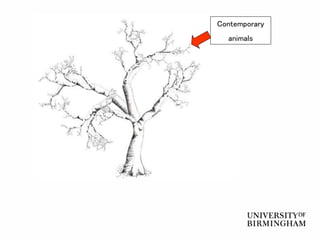
Contemporary
animals
Contemporary
animals
Fossils
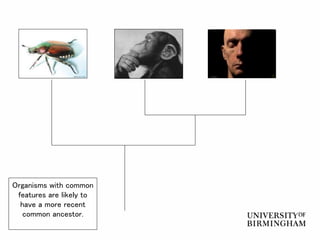
Organisms with common
features are likely to
have a more recent
common ancestor.
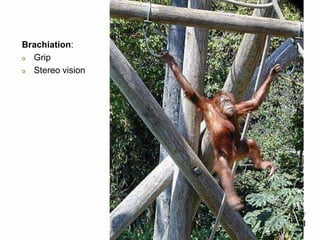
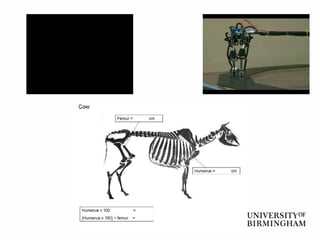
Locomotion
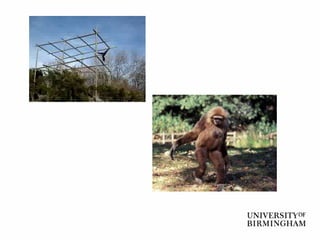
Brachiation:
o Grip
o Stereo vision
Humerus
Femur
1. Chimpanzee 2. Australopithecus africanus 3. Homo erectus 4. Homo sapiens
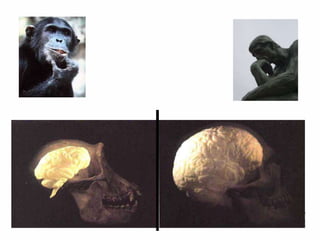
Brain size
Primate Characteristics/Trends
o Brains larger than other animals
Log body weight (g)
Log brain weight (g)
• Brains larger than other animals
Brains larger than other animals in relation to body size
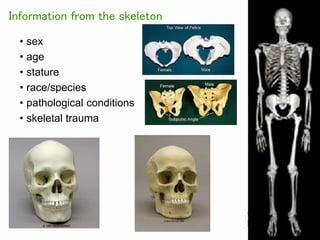
• sex
• age
• stature
• race/species
• pathological conditions
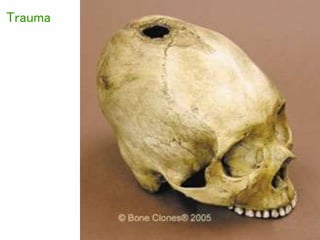
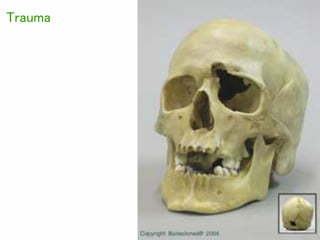
• skeletal trauma
Information from the skeleton
Trauma
Trauma
Trauma
Trauma
Proconsul
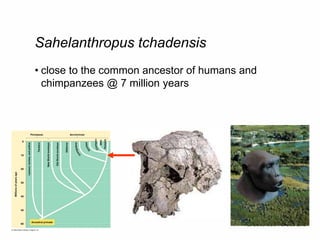
Sahelanthropus tchadensis
• close to the common ancestor of humans and
chimpanzees @ 7 million years
Australopithecus afarensis
Lucy, discovered in Ethiopia in 1974.
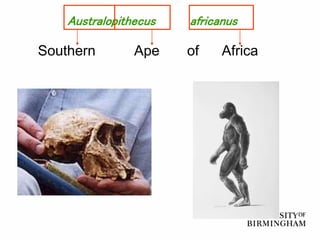
Australopithecus africanus
Southern Ape of Africa
Don’t run before you can walk
Homo habilis (ca. 2.5-1.6 mya)
Homo erectus (1.6 mya-300 kya)
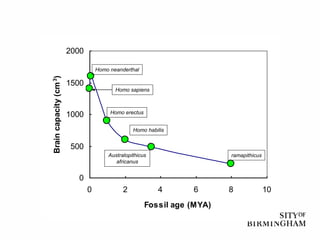
0
500
1000
1500
2000
0 2 4 6 8 10
Fossil age (MYA)
Brain
capacity
(cm
3
)
Homo neanderthal
Homo erectus
Homo sapiens
ramapithicus
Australopithicus
africanus
Homo habilis
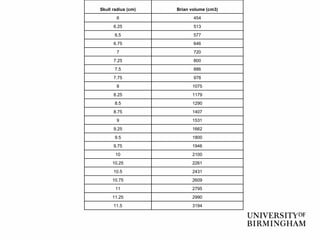
Skull radius (cm) Brian volume (cm3)
6 454
6.25 513
6.5 577
6.75 646
7 720
7.25 800
7.5 886
7.75 978
8 1075
8.25 1179
8.5 1290
8.75 1407
9 1531
9.25 1662
9.5 1800
9.75 1946
10 2100
10.25 2261
10.5 2431
10.75 2609
11 2795
11.25 2990
11.5 3194
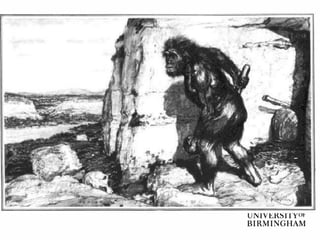
Neanderthals (ca. 100-32 kya)
o Restricted to Europe, eastern Middle East
during Ice Age
o Evolved to be cold-adapted:
– Short and stocky
– Large nose (for warming air)
– Barrel chest (for warming air)
– Long, low, thick skull but with
large Brain
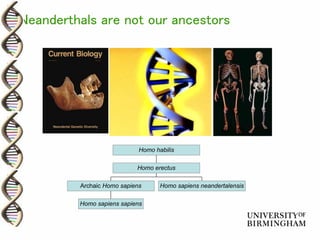
Neanderthals are not our ancestors
Homo sapiens sapiens
Archaic Homo sapiens Homo sapiens neandertalensis
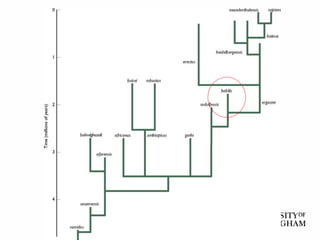
Homo erectus
Homo habilis
Krings et al 1997 Neandertal DNA Sequences and the Origin of Modern Humans
NOT our ancestors….
Are we still evolving?
Microevolution: change in gene frequency - YES
Macro evolution : formation of species - NO
Are we still evolving?
• Some parts of Africa have seen an increase in the
frequency of a gene called CCR5-32
• Protects against infection with HIV-1.
• May have been selected for during bubonic plague
25,000 genes 25, 000 genes
Human Evolution - Chimps are our closest relative
HumanEvolutionLecture.ppt

HumanEvolutionLecture.ppt

Editor's Notes

  • #27 Jaw = 5 year old child, deciduous teeth erupted, permanent teeth waiting to erupt
  • #29 Cut marks on skull – iron age – situated near origin of jaw muscles. – deliberate defleshing or injury in battle?
  • #30 Cut marks on skull – iron age – situated near origin of jaw muscles. – deliberate defleshing or injury in battle?
  • #31 Cut marks on skull – iron age – situated near origin of jaw muscles. – deliberate defleshing or injury in battle?
  • #32 Cut marks on skull – iron age – situated near origin of jaw muscles. – deliberate defleshing or injury in battle?
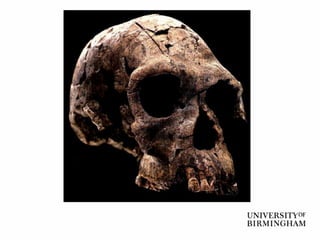
  • #42 H. habilis, "handy man", was so called because of evidence of tools found with its remains. Habilis existed between 2.4 and 1.5 million years ago. It is very similar to australopithecines in many ways. The face is still primitive, but it projects less than in A. africanus. The back teeth are smaller, but still considerably larger than in modern humans. The average brain size, at 650 cc, is considerably larger than in australopithecines. Brain size varies between 500 and 800 cc, overlapping the australopithecines at the low end and H. erectus at the high end. The brain shape is also more humanlike. The bulge of Broca's area, essential for speech, is visible in one habilis brain cast, and indicates it was possibly capable of rudimentary speech. Habilis is thought to have been about 127 cm (5'0") tall, and about 45 kg (100 lb) in weight, although females may have been smaller. Habilis has been a controversial species. Originally, some scientists did not accept its validity, believing that all habilis specimens should be assigned to either the australopithecines or Homo erectus. H. habilis is now fully accepted as a species, but it is widely thought that the 'habilis' specimens have too wide a range of variation for a single species, and that some of the specimens should be placed in one or more other species. One suggested species which is accepted by many scientists is Homo rudolfensis, which would contain fossils such as ER 1470.
  • #54 Distributions of Pairwise Sequence Differences among Humans, the Neandertal, and ChimpanzeesX axis, the number of sequence differences; Y axis, the percent of pairwise comparisons