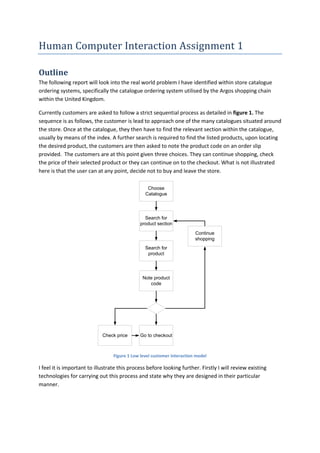
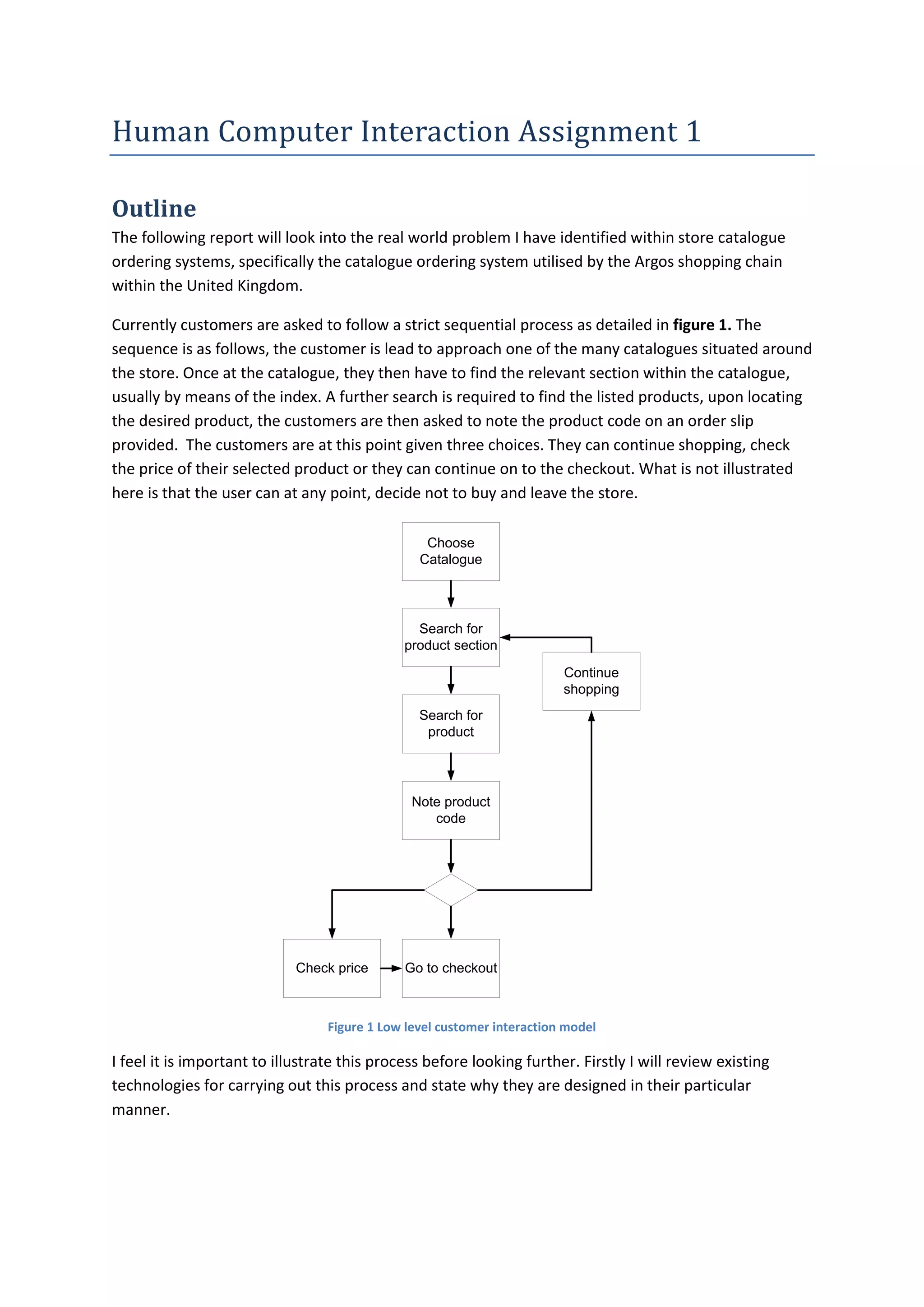
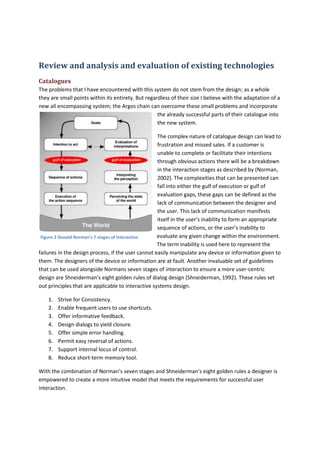
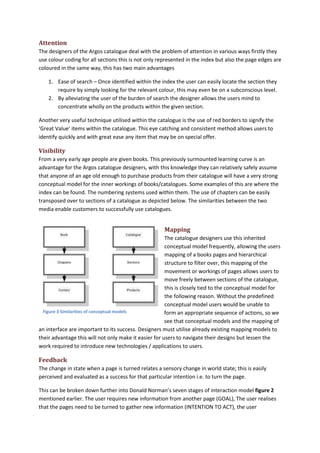
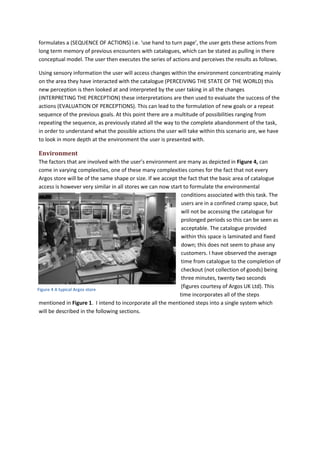
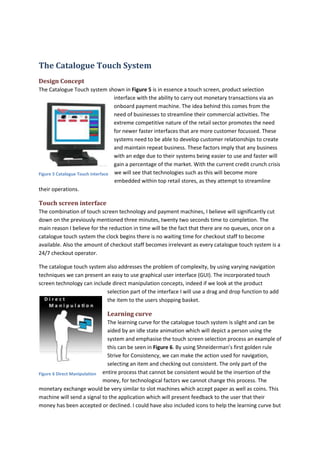
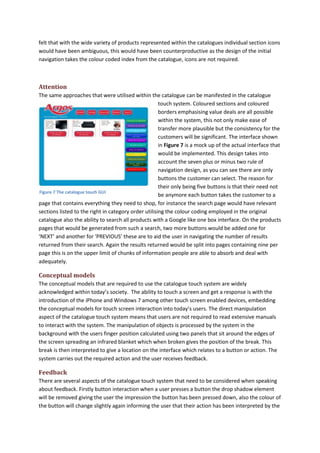
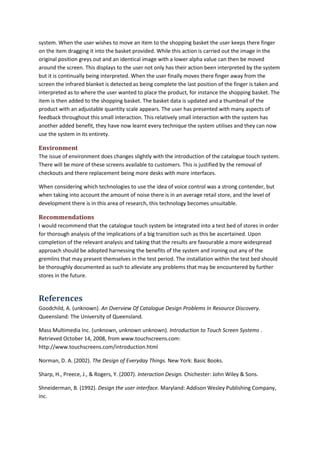
Human Computer Interaction Assignment 1<br />Outline<br />The following report will look into the real world problem I have identified within store catalogue ordering systems, specifically the catalogue ordering system utilised by the Argos shopping chain within the United Kingdom.   <br />Currently customers are asked to follow a strict sequential process as detailed in figure 1. The sequence is as follows, the customer is lead to approach one of the many catalogues situated around the store. Once at the catalogue, they then have to find the relevant section within the catalogue, usually by means of the index. A further search is required to find the listed products, upon locating the desired product, the customers are then asked to note the product code on an order slip provided.  The customers are at this point given three choices. They can continue shopping, check the price of their selected product or they can continue on to the checkout. What is not illustrated here is that the user can at any point, decide not to buy and leave the store.<br />Figure 1 Low level customer interaction model<br />I feel it is important to illustrate this process before looking further. Firstly I will review existing technologies for carrying out this process and state why they are designed in their particular manner.<br />Review and analysis and evaluation of existing technologies<br />Catalogues<br />20320617220The problems that I have encountered with this system do not stem from the design; as a whole they are small points within its entirety. But regardless of their size I believe with the adaptation of a new all encompassing system; the Argos chain can overcome these small problems and incorporate the already successful parts of their catalogue into the new system.<br />Figure 2 Donald Norman's 7 stages of interactionThe complex nature of catalogue design can lead to frustration and missed sales. If a customer is unable to complete or facilitate their intentions through obvious actions there will be a breakdown in the interaction stages as described by (Norman, 2002). The complexities that can be presented can fall into either the gulf of execution or gulf of evaluation gaps, these gaps can be defined as the lack of communication between the designer and the user. This lack of communication manifests itself in the user’s inability to form an appropriate sequence of actions, or the user’s inability to evaluate any given change within the environment. The term inability is used here to represent the failures in the design process, if the user cannot easily manipulate any device or information given to them. The designers of the device or information are at fault. Another invaluable set of guidelines that can be used alongside Normans seven stages of interaction to ensure a more user-centric design are Shneiderman’s eight golden rules of dialog design (Shneiderman, 1992). These rules set out principles that are applicable to interactive systems design.<br />Strive for Consistency.
Enable frequent users to use shortcuts.
Offer informative feedback.
Design dialogs to yield closure.
Offer simple error handling.
Permit easy reversal of actions.
Support internal locus of control.
Reduce short-term memory tool.With the combination of Norman’s seven stages and Shneiderman’s eight golden rules a designer is empowered to create a more intuitive model that meets the requirements for successful user interaction.<br />Attention<br />The designers of the Argos catalogue deal with the problem of attention in various ways firstly they use colour coding for all sections this is not only represented in the index but also the page edges are coloured in the same way, this has two main advantages <br />Ease of search – Once identified within the index the user can easily locate the section they require by simply looking for the relevant colour, this may even be on a subconscious level.

human-computer-interaction-assignment-1 - Pixsdesign

  • 1.
    Human Computer InteractionAssignment 1<br />Outline<br />The following report will look into the real world problem I have identified within store catalogue ordering systems, specifically the catalogue ordering system utilised by the Argos shopping chain within the United Kingdom. <br />Currently customers are asked to follow a strict sequential process as detailed in figure 1. The sequence is as follows, the customer is lead to approach one of the many catalogues situated around the store. Once at the catalogue, they then have to find the relevant section within the catalogue, usually by means of the index. A further search is required to find the listed products, upon locating the desired product, the customers are then asked to note the product code on an order slip provided. The customers are at this point given three choices. They can continue shopping, check the price of their selected product or they can continue on to the checkout. What is not illustrated here is that the user can at any point, decide not to buy and leave the store.<br />Figure 1 Low level customer interaction model<br />I feel it is important to illustrate this process before looking further. Firstly I will review existing technologies for carrying out this process and state why they are designed in their particular manner.<br />Review and analysis and evaluation of existing technologies<br />Catalogues<br />20320617220The problems that I have encountered with this system do not stem from the design; as a whole they are small points within its entirety. But regardless of their size I believe with the adaptation of a new all encompassing system; the Argos chain can overcome these small problems and incorporate the already successful parts of their catalogue into the new system.<br />Figure 2 Donald Norman's 7 stages of interactionThe complex nature of catalogue design can lead to frustration and missed sales. If a customer is unable to complete or facilitate their intentions through obvious actions there will be a breakdown in the interaction stages as described by (Norman, 2002). The complexities that can be presented can fall into either the gulf of execution or gulf of evaluation gaps, these gaps can be defined as the lack of communication between the designer and the user. This lack of communication manifests itself in the user’s inability to form an appropriate sequence of actions, or the user’s inability to evaluate any given change within the environment. The term inability is used here to represent the failures in the design process, if the user cannot easily manipulate any device or information given to them. The designers of the device or information are at fault. Another invaluable set of guidelines that can be used alongside Normans seven stages of interaction to ensure a more user-centric design are Shneiderman’s eight golden rules of dialog design (Shneiderman, 1992). These rules set out principles that are applicable to interactive systems design.<br />Strive for Consistency.
  • 2.
    Enable frequent usersto use shortcuts.
  • 3.
  • 4.
    Design dialogs toyield closure.
  • 5.
  • 6.
  • 7.
  • 8.
    Reduce short-term memorytool.With the combination of Norman’s seven stages and Shneiderman’s eight golden rules a designer is empowered to create a more intuitive model that meets the requirements for successful user interaction.<br />Attention<br />The designers of the Argos catalogue deal with the problem of attention in various ways firstly they use colour coding for all sections this is not only represented in the index but also the page edges are coloured in the same way, this has two main advantages <br />Ease of search – Once identified within the index the user can easily locate the section they require by simply looking for the relevant colour, this may even be on a subconscious level.