

PRESENTERS: MR. KARIM VIRANI & MS. HINA TEJANI
Traditional Pay System
ď‚—The traditional pay system compensates an
employee on the basis of either a fixed hourly rate or
an annual salary.
ď‚—Under this system, pays are
dependent on factors including
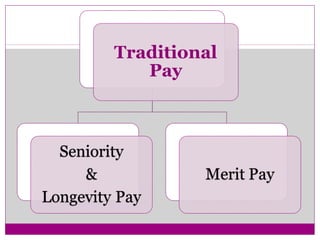
seniority and performance.
Merit Pay
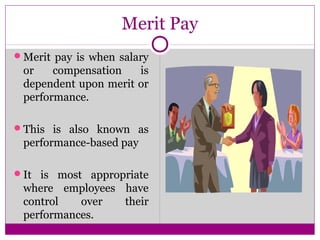
ď‚—Merit pay is when salary
or compensation is
dependent upon merit or
performance.
ď‚—This is also known as
performance-based pay
ď‚—It is most appropriate
where employees have
control over their
performances.
Elements of Merit Pay
ď‚—Objective performance indicators
ď‚—Subjective performance indicators
ď‚—Production Quotas or Quality Standards
ď‚—Funds
ď‚—Cost of Living or Inflation
ď‚—Commitments from top management
Objective Performance Indicators
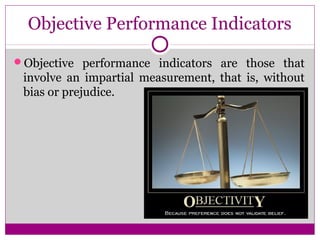
ď‚—Objective performance indicators are those that
involve an impartial measurement, that is, without
bias or prejudice.
Subjective Performance Indicators
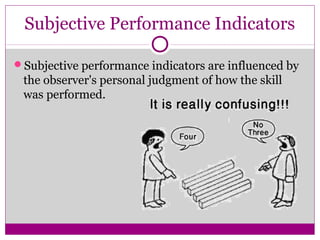
ď‚—Subjective performance indicators are influenced by
the observer's personal judgment of how the skill
was performed.
Production Quotas or Quality Standards
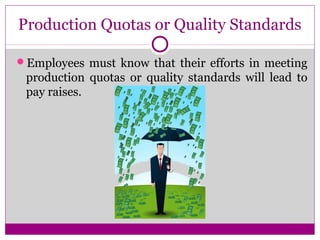
ď‚—Employees must know that their efforts in meeting
production quotas or quality standards will lead to
pay raises.
Funds
ď‚—Companies that use merit programs must ensure
that the funds needed to fulfill these promises to
compensate employees are available.
Cost of Living or Inflation
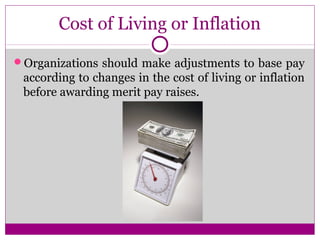
ď‚—Organizations should make adjustments to base pay
according to changes in the cost of living or inflation
before awarding merit pay raises.
Commitments from Top Management
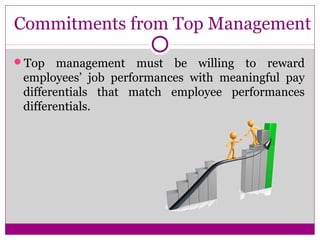
ď‚—Top management must be willing to reward
employees’ job performances with meaningful pay
differentials that match employee performances
differentials.
Just-Meaningful Pay Increase
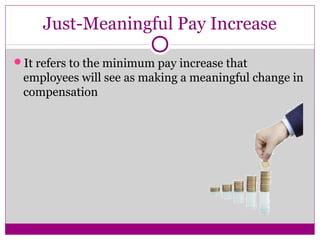
ď‚—It refers to the minimum pay increase that
employees will see as making a meaningful change in
compensation
Effective Merit Pay Program
Performance appraisal
A method by which the job performance of an
employee is documented and evaluated. Performance
appraisals are a part of career development and consist
of regular reviews of employee performance within
organizations.
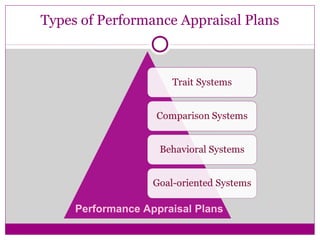
Types of Performance Appraisal Plans
Performance Appraisal Plans
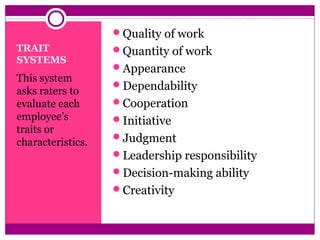
TRAIT
SYSTEMS
This system
asks raters to
evaluate each
employee’s
traits or
characteristics.
ď‚—Quality of work
ď‚—Quantity of work
ď‚—Appearance
ď‚—Dependability
ď‚—Cooperation
ď‚—Initiative
ď‚—Judgment
ď‚—Leadership responsibility
ď‚—Decision-making ability
ď‚—Creativity
Limitations of Trait System
Highly subjective on supervisor’s perspective
ď‚—Rate individual on subjective personality factors
rather than on objective job performance data.
ď‚—Focus attention on employees rather that on job
performance
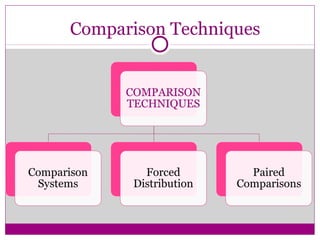
Comparison Techniques
Comparison Systems
This system evaluate a given employee’s
performance against that of other employees.
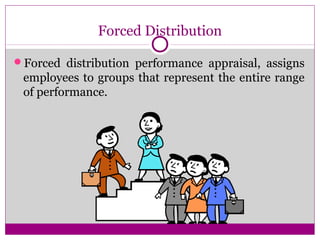
Forced Distribution
ď‚—Forced distribution performance appraisal, assigns
employees to groups that represent the entire range
of performance.
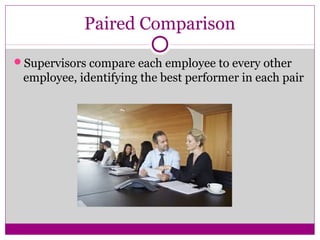
Paired Comparison
ď‚—Supervisors compare each employee to every other
employee, identifying the best performer in each pair
Behavioral Systems
ď‚—This system rates employees on the extent to which
they display successful job performance behaviors.
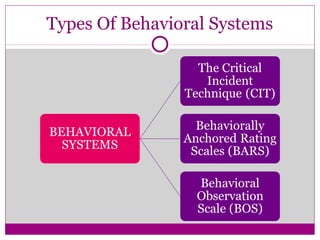
Types Of Behavioral Systems
The Critical Incident Technique (CIT)
ď‚—CIT requires job incumbents and their supervisors to
identify performance incidents (on-the-job behaviors
and behavioral outcomes) that distinguish successful
performances from unsuccessful ones.
Behaviorally Anchored Rating Scales (BARS)
ď‚—It is based on Critical Incident Technique in which
the incident would be written as “the incumbent is
expected to complete the task in a timely fashion.
Behavioral Observation Scale (BOS)
ď‚—A specific kind of behavioral system, displays
illustrations of positive incidents of job
performances for various job dimensions.
Goal-oriented Systems
Management by Objective (MBO)
Supervisors and employees determine objectives for
employees to meet during a rating period and
employees appraise how well they have achieved their
objectives
Performance Appraisal Process
Non Discriminatory Performance Appraisal
Practices
These are key to effective merit pay systems because
they accurately measure job performance
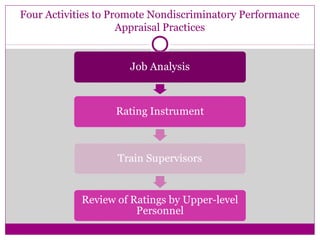
Four Activities to Promote Nondiscriminatory Performance
Appraisal Practices
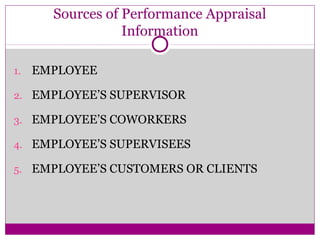
Sources of Performance Appraisal
Information
1. EMPLOYEE
2. EMPLOYEE’S SUPERVISOR
3. EMPLOYEE’S COWORKERS
4. EMPLOYEE’S SUPERVISEES
5. EMPLOYEE’S CUSTOMERS OR CLIENTS
Errors in the Performance Appraisal Process
ď‚—BIAS ERRORS
ď‚—CONTRAST ERRORS
ď‚—ERRORS OF CENTRAL TENDENCY
ď‚—ERRORS OF LENIENCY OR STRICTNESS
Bias Errors
ď‚—It happens when the rater evaluates the employee
based on a personal negative or positive opinion of
the employee rather than on the employee’s actual
performance
 First Impression effect
 Positive Halo effect or Negative Halo effect
 Similar-to-me-effect
Contrast Errors
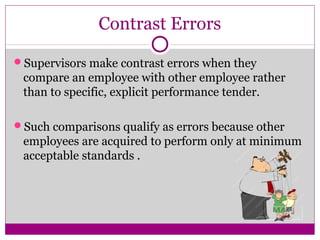
ď‚—Supervisors make contrast errors when they
compare an employee with other employee rather
than to specific, explicit performance tender.
ď‚—Such comparisons qualify as errors because other
employees are acquired to perform only at minimum
acceptable standards .
Errors of Central Tendency
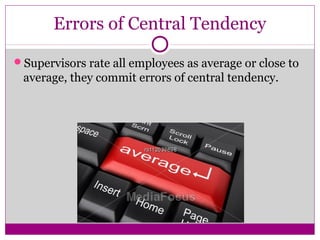
ď‚—Supervisors rate all employees as average or close to
average, they commit errors of central tendency.
Errors of Leniency or Strictness
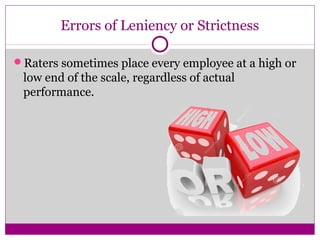
ď‚—Raters sometimes place every employee at a high or
low end of the scale, regardless of actual
performance.
Strengthening the Pay-for-Performance Link
ď‚—Linking performance appraisals to business goals
ď‚—Analyze jobs
ď‚—Communicate
ď‚—Establish effective appraisals
ď‚—Empower employees
ď‚—Differentiate among performers
Possible Limitations of Merit Pay Programs
ď‚—Failure to differentiate among performers
ď‚—Poor performance measures
Supervisor’s biased ratings of employee job
performance
ď‚—Lack of open communication between management
and employees
ď‚—Undesirable social structures
ď‚—Factors other than merit
ď‚—Undesirable competition
ď‚—Little motivational value
Merit Pay - Karim Virani

Merit Pay - Karim Virani

  • 1.
    PRESENTERS: MR. KARIMVIRANI & MS. HINA TEJANI
  • 2.
    Traditional Pay System ď‚—Thetraditional pay system compensates an employee on the basis of either a fixed hourly rate or an annual salary. ď‚—Under this system, pays are dependent on factors including seniority and performance.
  • 5.
    Merit Pay ď‚—Merit payis when salary or compensation is dependent upon merit or performance. ď‚—This is also known as performance-based pay ď‚—It is most appropriate where employees have control over their performances.
  • 6.
    Elements of MeritPay ď‚—Objective performance indicators ď‚—Subjective performance indicators ď‚—Production Quotas or Quality Standards ď‚—Funds ď‚—Cost of Living or Inflation ď‚—Commitments from top management
  • 7.
    Objective Performance Indicators ď‚—Objectiveperformance indicators are those that involve an impartial measurement, that is, without bias or prejudice.
  • 8.
    Subjective Performance Indicators ď‚—Subjectiveperformance indicators are influenced by the observer's personal judgment of how the skill was performed.
  • 9.
    Production Quotas orQuality Standards ď‚—Employees must know that their efforts in meeting production quotas or quality standards will lead to pay raises.
  • 10.
    Funds ď‚—Companies that usemerit programs must ensure that the funds needed to fulfill these promises to compensate employees are available.
  • 11.
    Cost of Livingor Inflation ď‚—Organizations should make adjustments to base pay according to changes in the cost of living or inflation before awarding merit pay raises.
  • 12.
    Commitments from TopManagement Top management must be willing to reward employees’ job performances with meaningful pay differentials that match employee performances differentials.
  • 13.
    Just-Meaningful Pay Increase ď‚—Itrefers to the minimum pay increase that employees will see as making a meaningful change in compensation
  • 14.
    Effective Merit PayProgram Performance appraisal A method by which the job performance of an employee is documented and evaluated. Performance appraisals are a part of career development and consist of regular reviews of employee performance within organizations.
  • 15.
    Types of PerformanceAppraisal Plans Performance Appraisal Plans
  • 16.
    TRAIT SYSTEMS This system asks ratersto evaluate each employee’s traits or characteristics. Quality of work Quantity of work Appearance Dependability Cooperation Initiative Judgment Leadership responsibility Decision-making ability Creativity
  • 17.
    Limitations of TraitSystem Highly subjective on supervisor’s perspective Rate individual on subjective personality factors rather than on objective job performance data. Focus attention on employees rather that on job performance
  • 18.
  • 19.
    Comparison Systems This systemevaluate a given employee’s performance against that of other employees.
  • 20.
    Forced Distribution ď‚—Forced distributionperformance appraisal, assigns employees to groups that represent the entire range of performance.
  • 21.
    Paired Comparison ď‚—Supervisors compareeach employee to every other employee, identifying the best performer in each pair
  • 22.
    Behavioral Systems ď‚—This systemrates employees on the extent to which they display successful job performance behaviors.
  • 23.
  • 24.
    The Critical IncidentTechnique (CIT) ď‚—CIT requires job incumbents and their supervisors to identify performance incidents (on-the-job behaviors and behavioral outcomes) that distinguish successful performances from unsuccessful ones.
  • 25.
    Behaviorally Anchored RatingScales (BARS) It is based on Critical Incident Technique in which the incident would be written as “the incumbent is expected to complete the task in a timely fashion.
  • 26.
    Behavioral Observation Scale(BOS) ď‚—A specific kind of behavioral system, displays illustrations of positive incidents of job performances for various job dimensions.
  • 27.
    Goal-oriented Systems Management byObjective (MBO) Supervisors and employees determine objectives for employees to meet during a rating period and employees appraise how well they have achieved their objectives
  • 28.
    Performance Appraisal Process NonDiscriminatory Performance Appraisal Practices These are key to effective merit pay systems because they accurately measure job performance
  • 29.
    Four Activities toPromote Nondiscriminatory Performance Appraisal Practices
  • 30.
    Sources of PerformanceAppraisal Information 1. EMPLOYEE 2. EMPLOYEE’S SUPERVISOR 3. EMPLOYEE’S COWORKERS 4. EMPLOYEE’S SUPERVISEES 5. EMPLOYEE’S CUSTOMERS OR CLIENTS
  • 31.
    Errors in thePerformance Appraisal Process ď‚—BIAS ERRORS ď‚—CONTRAST ERRORS ď‚—ERRORS OF CENTRAL TENDENCY ď‚—ERRORS OF LENIENCY OR STRICTNESS
  • 32.
    Bias Errors It happenswhen the rater evaluates the employee based on a personal negative or positive opinion of the employee rather than on the employee’s actual performance  First Impression effect  Positive Halo effect or Negative Halo effect  Similar-to-me-effect
  • 33.
    Contrast Errors ď‚—Supervisors makecontrast errors when they compare an employee with other employee rather than to specific, explicit performance tender. ď‚—Such comparisons qualify as errors because other employees are acquired to perform only at minimum acceptable standards .
  • 34.
    Errors of CentralTendency ď‚—Supervisors rate all employees as average or close to average, they commit errors of central tendency.
  • 35.
    Errors of Leniencyor Strictness ď‚—Raters sometimes place every employee at a high or low end of the scale, regardless of actual performance.
  • 36.
    Strengthening the Pay-for-PerformanceLink ď‚—Linking performance appraisals to business goals ď‚—Analyze jobs ď‚—Communicate ď‚—Establish effective appraisals ď‚—Empower employees ď‚—Differentiate among performers
  • 37.
    Possible Limitations ofMerit Pay Programs Failure to differentiate among performers Poor performance measures Supervisor’s biased ratings of employee job performance Lack of open communication between management and employees Undesirable social structures Factors other than merit Undesirable competition Little motivational value

Editor's Notes

  • #6 Merit increases reward excellent effort or results, motivate future performance, and help employers retain valued employees. Merit increases are usuasally expressed as a percentage of hourly wages for nonexempt employees and as a percentage of annual salaries for exempt employees.
  • #7 Supervisors give merit increases to employees based on subjective appraisal of employees’ performance. They periodically review individual employee performance to evaluate how well each worker is accomplishing assigned duties relative to established standards and goals.
  • #8 Objective performance measures include timing measures such as stopwatches or electronic timing devices, or distance measures such as measuring tapes to determine the winner of an event. In these situations the performance appraisal is not subject to personal opinion or interpretation of results and it is a clear objective measure.
  • #9 These measures are often criticised and scrutinised as they are open to interpretation and opinion. Subjective measures often refer to the quality and style of performance such as scoring of dance and gymnastics. While a numerical score may be used it is open to interpretation of the judge not a clear cut measure.
  • #10 Job requirements must be realistic, and employees must have the skills and abilities to meet job goals. Employees must perceive a strong relationship between attaining performance standards and receiving pay increases.
  • #11 Organizations must make sure that adequate funding is in place.
  • #12 Merit pay should always reward employee performance rather than represent adjustments for inflation. Compensation professionals attempt to minimize negative inflationary effects by making permanent increases to base pay known as cost-of-living adjustments.
  • #20 EMPLOYEES ARE RANKED FROM THE BEST PERFORMER TO THE POOREST PERFORMER. SUPERVISORS RANK EACH EMPLOYEE AND ESTABLISH A PERFORMANCE HIERARCHY SUCH THAT THE EMPLOYEE WITH THE BEST PERFORMANCE RECEIVES THE HIGHEST RANKING.
  • #21 FOR EXAMPLE: THREE CATEGORIES THAT MIGHT BE USED ARE BEST PERFORMERS, MODERATE PERFORMERS AND POOR PERFORMERS. MANY COMPANIES USE THIS APPROACH TO MINIMIZE THE TENDENCY FOR SUPERVISORS TO RATE MOST EMPLOYEES AS EXCELLENT PERFORMERS.
  • #23 THIS SYSTEM PROVIDES RESULTS THAT ARE RELATIVELY FREE OF RATER ERRORS AND BIASES WHEN CORRECTLY DEVELOPED AND APPLIED.