AN D R E A VAL L E J O
E N G L I S H T E AC H I N G P R AC T I C U M
F I R S T T E R M
AC T I V I T Y 1 . 4
HUMAN LEARNING
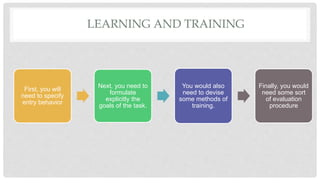
LEARNING AND TRAINING
First, you will
need to specify
entry behavior
Next, you need to
formulate
explicitly the
goals of the task.
You would also
need to devise
some methods of
training.
Finally, you would
need some sort
of evaluation
procedure
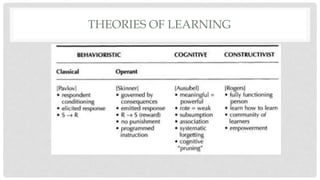
THEORIES OF LEARNING
PAVLOV’S CLASSICAL BEHAVIORISM
The learning process
consisted of the
formation of associations
between stimuli and
reflexive responses.
The human behavior should
be studied objectively,
rejecting mentalis tic notions
of innateness and instinct.
Skinner’s operant conditioning
Operant behavior is
behavior in which one
operates on the
environment; within this
model the importance of
stimuli is de-emphasized
Operants are classes of
responses. Crying, sitting
down, walking, and batting
a baseball are operants
Skinner was extremely
methodical and empirical in
his theory of learning, to the
point of being preoccupied
with scientific controls.
Attempted to account for
most of human learning and
behavior.
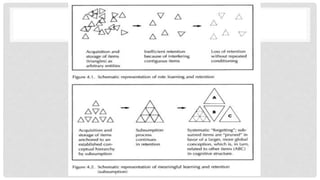
AUSUBEL’S MEANINGFUL LEARNING THEORY
The learning
takes place in
human
organism
through a
meaningful
process of
relating new
events or items
to already
existing cognitive
concepts or
propositions.
It is the best
understood by
contrasting rote
learning and
meaningful
learning.
ROGERS’S HUMANISTIC PSYCHOLOGY
principles of behavior is
the ability of human
beings to adapt and to
grow in the direction that
enhances their existence.
The goal of education is
the facilitation of change
and learning
The learners understand
themselves and
communicate this self to
others freely and
nondefensively.
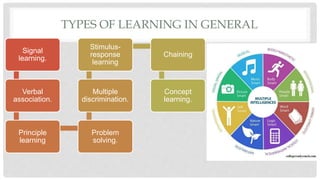
TYPES OF LEARNING IN GENERAL
Signal
learning.
Verbal
association.
Principle
learning
Problem
solving.
Multiple
discrimination.
Stimulus-
response
learning
Chaining
Concept
learning.
TYPES OF LEARNING IN SECOND LANGUAGE
• the total language process
• human beings make a general response of some kind to languageSignal learning
• evident in the acquisition of the sound system of a foreign language
• learner makes closer and closer approximations to native like pronunciationStimulus
• evident in the acquisition of phonological sequences and syntactic patterns
• we should not be misled into believing that verbal chains are necessarily linear.
Chaining
• necessary particularly in SLL
• for example, a Word has to take on several meanings, or rule in the native language is
reshaped to fit a SL context
Multiple discriminations
• the notion that language and cognition are inextricably interrelated
• rules of syntax, rules of conversation- are linguistic concepts that have to be acquiredConcept learning
• the extension of concepts learning to the formation of a linguistic system
• rules are not isolated in role memory, but conjoined and subsumed in a total systemPrinciple learning
• clearly evident in SL learning as the learner is continually faced with sets of events that are
truly problems to be solved
• Solutions to the problems involve the creative interaction of all eight types of learning as the
learner sights and weighs previous information and knowledge in order to correctly determine
the meaning of a word, the interpretation of an utterance
Problem solving
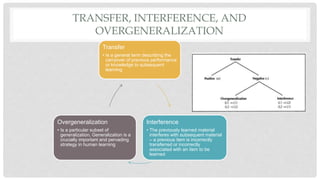
TRANSFER, INTERFERENCE, AND
OVERGENERALIZATION
Transfer
• Is a general term describing the
carryover of previous performance
or knowledge to subsequent
learning
Interference
• The previously learned material
interferes with subsequent material
– a previous item is incorrectly
transferred or incorrectly
associated with an item to be
learned
Overgeneralization
• Is a particular subset of
generalization. Generalization is a
crucially important and pervading
strategy in human learning
One stores a number of
specific instances and induces
a general law or rule or
conclusion that governs or
subsumes the specific
instances
Inductive
reasoning
Is a movement from a
generalization to
specific instances:
specific subsumed facts
are inferred or deduced
from a general principle.
Deductive
reasoning
APTITUDE
Number of
characteristics of
successful language
learners
Research shows some
people are able to learn
faster and more
efficiently
Risk-taking behavior,
memory efficiency,
intelligent guessing,
ambiguity tolerance
Teachers should to be
optimistic, monitor styles
and strategies carefully
to chose appropriate
ones
Aptitude tests
Used to predict
successful language
learners
Modern Language
Aptitude Test
Pimsleur Language
Aptitude Battery
Was later proven that
only reflected only
general intelligence/
academic ability
INTELLIGENCE
• It is defined and measured in terms of linguistic and logical-mathematical
abilities.
• There are seven types of intelligences: linguistic, logical-mathematical,
spatial, musical, bodily-kinesthetic, interpersonal and intrapersonal
intelligence

Human learning

  • 1.
    AN D RE A VAL L E J O E N G L I S H T E AC H I N G P R AC T I C U M F I R S T T E R M AC T I V I T Y 1 . 4 HUMAN LEARNING
  • 2.
    LEARNING AND TRAINING First,you will need to specify entry behavior Next, you need to formulate explicitly the goals of the task. You would also need to devise some methods of training. Finally, you would need some sort of evaluation procedure
  • 3.
  • 4.
    PAVLOV’S CLASSICAL BEHAVIORISM Thelearning process consisted of the formation of associations between stimuli and reflexive responses. The human behavior should be studied objectively, rejecting mentalis tic notions of innateness and instinct.
  • 5.
    Skinner’s operant conditioning Operantbehavior is behavior in which one operates on the environment; within this model the importance of stimuli is de-emphasized Operants are classes of responses. Crying, sitting down, walking, and batting a baseball are operants Skinner was extremely methodical and empirical in his theory of learning, to the point of being preoccupied with scientific controls. Attempted to account for most of human learning and behavior.
  • 6.
    AUSUBEL’S MEANINGFUL LEARNINGTHEORY The learning takes place in human organism through a meaningful process of relating new events or items to already existing cognitive concepts or propositions. It is the best understood by contrasting rote learning and meaningful learning.
  • 8.
    ROGERS’S HUMANISTIC PSYCHOLOGY principlesof behavior is the ability of human beings to adapt and to grow in the direction that enhances their existence. The goal of education is the facilitation of change and learning The learners understand themselves and communicate this self to others freely and nondefensively.
  • 9.
    TYPES OF LEARNINGIN GENERAL Signal learning. Verbal association. Principle learning Problem solving. Multiple discrimination. Stimulus- response learning Chaining Concept learning.
  • 10.
    TYPES OF LEARNINGIN SECOND LANGUAGE • the total language process • human beings make a general response of some kind to languageSignal learning • evident in the acquisition of the sound system of a foreign language • learner makes closer and closer approximations to native like pronunciationStimulus • evident in the acquisition of phonological sequences and syntactic patterns • we should not be misled into believing that verbal chains are necessarily linear. Chaining • necessary particularly in SLL • for example, a Word has to take on several meanings, or rule in the native language is reshaped to fit a SL context Multiple discriminations • the notion that language and cognition are inextricably interrelated • rules of syntax, rules of conversation- are linguistic concepts that have to be acquiredConcept learning • the extension of concepts learning to the formation of a linguistic system • rules are not isolated in role memory, but conjoined and subsumed in a total systemPrinciple learning • clearly evident in SL learning as the learner is continually faced with sets of events that are truly problems to be solved • Solutions to the problems involve the creative interaction of all eight types of learning as the learner sights and weighs previous information and knowledge in order to correctly determine the meaning of a word, the interpretation of an utterance Problem solving
  • 11.
    TRANSFER, INTERFERENCE, AND OVERGENERALIZATION Transfer •Is a general term describing the carryover of previous performance or knowledge to subsequent learning Interference • The previously learned material interferes with subsequent material – a previous item is incorrectly transferred or incorrectly associated with an item to be learned Overgeneralization • Is a particular subset of generalization. Generalization is a crucially important and pervading strategy in human learning
  • 12.
    One stores anumber of specific instances and induces a general law or rule or conclusion that governs or subsumes the specific instances Inductive reasoning
  • 13.
    Is a movementfrom a generalization to specific instances: specific subsumed facts are inferred or deduced from a general principle. Deductive reasoning
  • 14.
    APTITUDE Number of characteristics of successfullanguage learners Research shows some people are able to learn faster and more efficiently Risk-taking behavior, memory efficiency, intelligent guessing, ambiguity tolerance Teachers should to be optimistic, monitor styles and strategies carefully to chose appropriate ones Aptitude tests Used to predict successful language learners Modern Language Aptitude Test Pimsleur Language Aptitude Battery Was later proven that only reflected only general intelligence/ academic ability
  • 15.
    INTELLIGENCE • It isdefined and measured in terms of linguistic and logical-mathematical abilities. • There are seven types of intelligences: linguistic, logical-mathematical, spatial, musical, bodily-kinesthetic, interpersonal and intrapersonal intelligence