Language Acquisition
Second Term
Activity 2.4
Andrea Vallejo
Learner acquires L2 knowledge
What does the L2 learner come to
know?
• The L2 system is never exactly like the
learner´s L1, however nor is it ever exactly the
same as of its native speakers.
• Components of L2- SPECIFIC KNOWLEDGE:
Vocabulary, Morphology, Phonology, Syntax,
Discourse
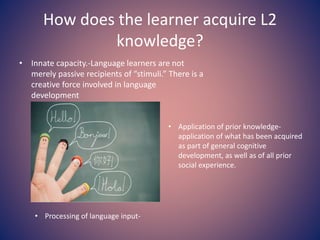
How does the learner acquire L2
knowledge?
• Innate capacity.-Language learners are not
merely passive recipients of “stimuli.” There is a
creative force involved in language
development
• Application of prior knowledge-
application of what has been acquired
as part of general cognitive
development, as well as of all prior
social experience.
• Processing of language input-
How does the learner acquire L2
knowledge?
• Interaction-Benefits come from collaborative
expression, modified input, feedback (including
correction), and negotiation of meaning.
•Restructuring of the L2 knowledge
system- reorganization takes place from
time to time during the process of SLA,
presumably as perceived L2
input cannot be accommodated within the
learners’ existing system
of knowledge.
• Automatization.- Automatization is an
incremental achievement upon which efficient
and effective engagement in all language activities
ultimately
depends.
Why are some learners more
successful than others?
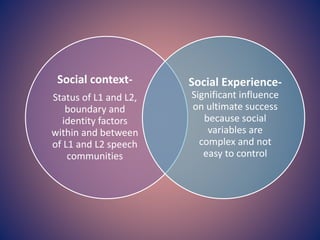
Social context-
Status of L1 and L2,
boundary and
identity factors
within and between
of L1 and L2 speech
communities
Social Experience-
Significant influence
on ultimate success
because social
variables are
complex and not
easy to control
Relationship
of L1 and L2
Not all L2 are the same
to learn for all L1s
L1 knowledge
important of
all L2 initial
state
Genetic,
Typological,
Historical
relationships
yield differential
possibilities
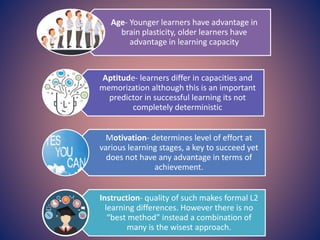
Age- Younger learners have advantage in
brain plasticity, older learners have
advantage in learning capacity
Aptitude- learners differ in capacities and
memorization although this is an important
predictor in successful learning its not
completely deterministic
Motivation- determines level of effort at
various learning stages, a key to succeed yet
does not have any advantage in terms of
achievement.
Instruction- quality of such makes formal L2
learning differences. However there is no
“best method” instead a combination of
many is the wisest approach.

G.2 language acquisition.vallejo.andrea.act2.3

  • 1.
    Language Acquisition Second Term Activity2.4 Andrea Vallejo Learner acquires L2 knowledge
  • 2.
    What does theL2 learner come to know? • The L2 system is never exactly like the learner´s L1, however nor is it ever exactly the same as of its native speakers. • Components of L2- SPECIFIC KNOWLEDGE: Vocabulary, Morphology, Phonology, Syntax, Discourse
  • 3.
    How does thelearner acquire L2 knowledge? • Innate capacity.-Language learners are not merely passive recipients of “stimuli.” There is a creative force involved in language development • Application of prior knowledge- application of what has been acquired as part of general cognitive development, as well as of all prior social experience. • Processing of language input-
  • 4.
    How does thelearner acquire L2 knowledge? • Interaction-Benefits come from collaborative expression, modified input, feedback (including correction), and negotiation of meaning. •Restructuring of the L2 knowledge system- reorganization takes place from time to time during the process of SLA, presumably as perceived L2 input cannot be accommodated within the learners’ existing system of knowledge. • Automatization.- Automatization is an incremental achievement upon which efficient and effective engagement in all language activities ultimately depends.
  • 5.
    Why are somelearners more successful than others?
  • 6.
    Social context- Status ofL1 and L2, boundary and identity factors within and between of L1 and L2 speech communities Social Experience- Significant influence on ultimate success because social variables are complex and not easy to control
  • 7.
    Relationship of L1 andL2 Not all L2 are the same to learn for all L1s L1 knowledge important of all L2 initial state Genetic, Typological, Historical relationships yield differential possibilities
  • 8.
    Age- Younger learnershave advantage in brain plasticity, older learners have advantage in learning capacity Aptitude- learners differ in capacities and memorization although this is an important predictor in successful learning its not completely deterministic Motivation- determines level of effort at various learning stages, a key to succeed yet does not have any advantage in terms of achievement. Instruction- quality of such makes formal L2 learning differences. However there is no “best method” instead a combination of many is the wisest approach.