HUMAN ERROR- AN INEVITABLE CAUSE
BEHIND DATA BREACHES
CONTENTS
• Definition
• Types of Human Error:
 Skill-Based
 Decision-Based
• Examples of Human Error:
 Phishing
 Weak Passwords
 Misdelivery
• Thing with Feathers : Remote browser isolation
• Conclusion
DEFINITION
 Human error can be described as that something has
been done that was “not intended by the actor; not
desired by a set of rules or an external observer; or that
led the task or system outside its acceptable limits”.
TYPES OF HUMAN ERROR
Skill-based errors:
 Skill-based human error consists of slips and lapses:
small mistakes that occur when performing familiar tasks
and activities.
Decision-based errors:
 Decision-based errors are when a user makes a faulty
decision often called as Violation.
EXAMPLES OF HUMAN ERROR
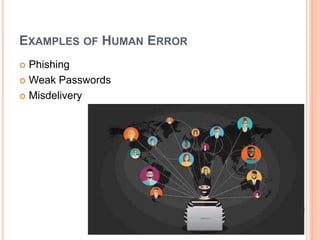
 Phishing
 Weak Passwords
 Misdelivery
PHISHING
 A phishing attack is a scam that aims to ‘fish’ information from
the receiver by posing as a legitimate email.
 Prevention:
 Fake domain: (@micrusoft.com instead of @microsoft.com)
 Check the link address: ‘https://’ instead of ‘http://’ (there is an
‘s’ before the colon).
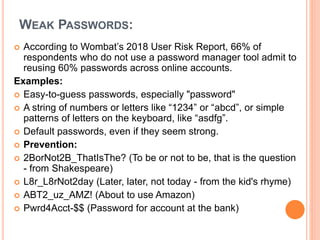
WEAK PASSWORDS:
 According to Wombat’s 2018 User Risk Report, 66% of
respondents who do not use a password manager tool admit to
reusing 60% passwords across online accounts.
Examples:
 Easy-to-guess passwords, especially "password"
 A string of numbers or letters like “1234” or “abcd”, or simple
patterns of letters on the keyboard, like “asdfg”.
 Default passwords, even if they seem strong.
 Prevention:
 2BorNot2B_ThatIsThe? (To be or not to be, that is the question
- from Shakespeare)
 L8r_L8rNot2day (Later, later, not today - from the kid's rhyme)
 ABT2_uz_AMZ! (About to use Amazon)
 Pwrd4Acct-$$ (Password for account at the bank)
MIS-DELIVERY:
 Mis-delivery - sending something to a wrong recipient is a
common threat to corporate data security.
 Mis-delivery was the fifth most common cause of all cyber
security breaches.
 Example:
 The 56 Dean Street clinic in London sent out a newsletter
in 2015 that mistakenly revealed the recipients' email
addresses to one another.
 This is a classic example of a skill-based error, as the
employee knew the correct course of action, but simply
didn’t take enough care to ensure that they were doing
what they intended to.
THING WITH FEATHERS : REMOTE BROWSER
ISOLATION
 In short, remote browsing isolation is a method by
which you can enjoy a seamless malware-free version
of the internet.
 It isolates the web-based malware from reaching your
computer, thus securing the integrity of a network.
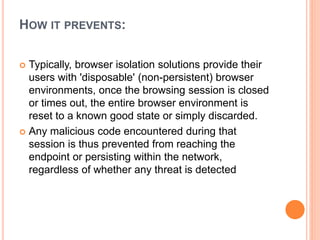
HOW IT PREVENTS:
 Typically, browser isolation solutions provide their
users with 'disposable' (non-persistent) browser
environments, once the browsing session is closed
or times out, the entire browser environment is
reset to a known good state or simply discarded.
 Any malicious code encountered during that
session is thus prevented from reaching the
endpoint or persisting within the network,
regardless of whether any threat is detected
HOW IS IT DIFFERENT FROM OTHER ISOLATION
TECHNIQUES?
 Remote browsing isolation enables users easy web
access on any kind of computing device and
operating system, which is a limitation for other
isolation techniques.
 In addition, the ease with which it can be deployed
amongst the variety of devices is another reason for
its usage.
 Also, it’s cost effective and can be scaled quickly and
cheaply.
CONCLUSION
 Remote browser isolation represents the next
generation of cyber defense, making it more difficult
for networks to be compromised due to human
error.
Human Error- Data breaches/Cyber Security

Human Error- Data breaches/Cyber Security

  • 1.
    HUMAN ERROR- ANINEVITABLE CAUSE BEHIND DATA BREACHES
  • 2.
    CONTENTS • Definition • Typesof Human Error:  Skill-Based  Decision-Based • Examples of Human Error:  Phishing  Weak Passwords  Misdelivery • Thing with Feathers : Remote browser isolation • Conclusion
  • 3.
    DEFINITION  Human errorcan be described as that something has been done that was “not intended by the actor; not desired by a set of rules or an external observer; or that led the task or system outside its acceptable limits”.
  • 4.
    TYPES OF HUMANERROR Skill-based errors:  Skill-based human error consists of slips and lapses: small mistakes that occur when performing familiar tasks and activities. Decision-based errors:  Decision-based errors are when a user makes a faulty decision often called as Violation.
  • 5.
    EXAMPLES OF HUMANERROR  Phishing  Weak Passwords  Misdelivery
  • 6.
    PHISHING  A phishingattack is a scam that aims to ‘fish’ information from the receiver by posing as a legitimate email.  Prevention:  Fake domain: (@micrusoft.com instead of @microsoft.com)  Check the link address: ‘https://’ instead of ‘http://’ (there is an ‘s’ before the colon).
  • 7.
    WEAK PASSWORDS:  Accordingto Wombat’s 2018 User Risk Report, 66% of respondents who do not use a password manager tool admit to reusing 60% passwords across online accounts. Examples:  Easy-to-guess passwords, especially "password"  A string of numbers or letters like “1234” or “abcd”, or simple patterns of letters on the keyboard, like “asdfg”.  Default passwords, even if they seem strong.  Prevention:  2BorNot2B_ThatIsThe? (To be or not to be, that is the question - from Shakespeare)  L8r_L8rNot2day (Later, later, not today - from the kid's rhyme)  ABT2_uz_AMZ! (About to use Amazon)  Pwrd4Acct-$$ (Password for account at the bank)
  • 8.
    MIS-DELIVERY:  Mis-delivery -sending something to a wrong recipient is a common threat to corporate data security.  Mis-delivery was the fifth most common cause of all cyber security breaches.  Example:  The 56 Dean Street clinic in London sent out a newsletter in 2015 that mistakenly revealed the recipients' email addresses to one another.  This is a classic example of a skill-based error, as the employee knew the correct course of action, but simply didn’t take enough care to ensure that they were doing what they intended to.
  • 9.
    THING WITH FEATHERS: REMOTE BROWSER ISOLATION  In short, remote browsing isolation is a method by which you can enjoy a seamless malware-free version of the internet.  It isolates the web-based malware from reaching your computer, thus securing the integrity of a network.
  • 10.
    HOW IT PREVENTS: Typically, browser isolation solutions provide their users with 'disposable' (non-persistent) browser environments, once the browsing session is closed or times out, the entire browser environment is reset to a known good state or simply discarded.  Any malicious code encountered during that session is thus prevented from reaching the endpoint or persisting within the network, regardless of whether any threat is detected
  • 11.
    HOW IS ITDIFFERENT FROM OTHER ISOLATION TECHNIQUES?  Remote browsing isolation enables users easy web access on any kind of computing device and operating system, which is a limitation for other isolation techniques.  In addition, the ease with which it can be deployed amongst the variety of devices is another reason for its usage.  Also, it’s cost effective and can be scaled quickly and cheaply.
  • 12.
    CONCLUSION  Remote browserisolation represents the next generation of cyber defense, making it more difficult for networks to be compromised due to human error.