THE DIGESTIVE SYSTEM
AND ITS INTERACTION
WITH OTHER ORGANS OF
THE BODY
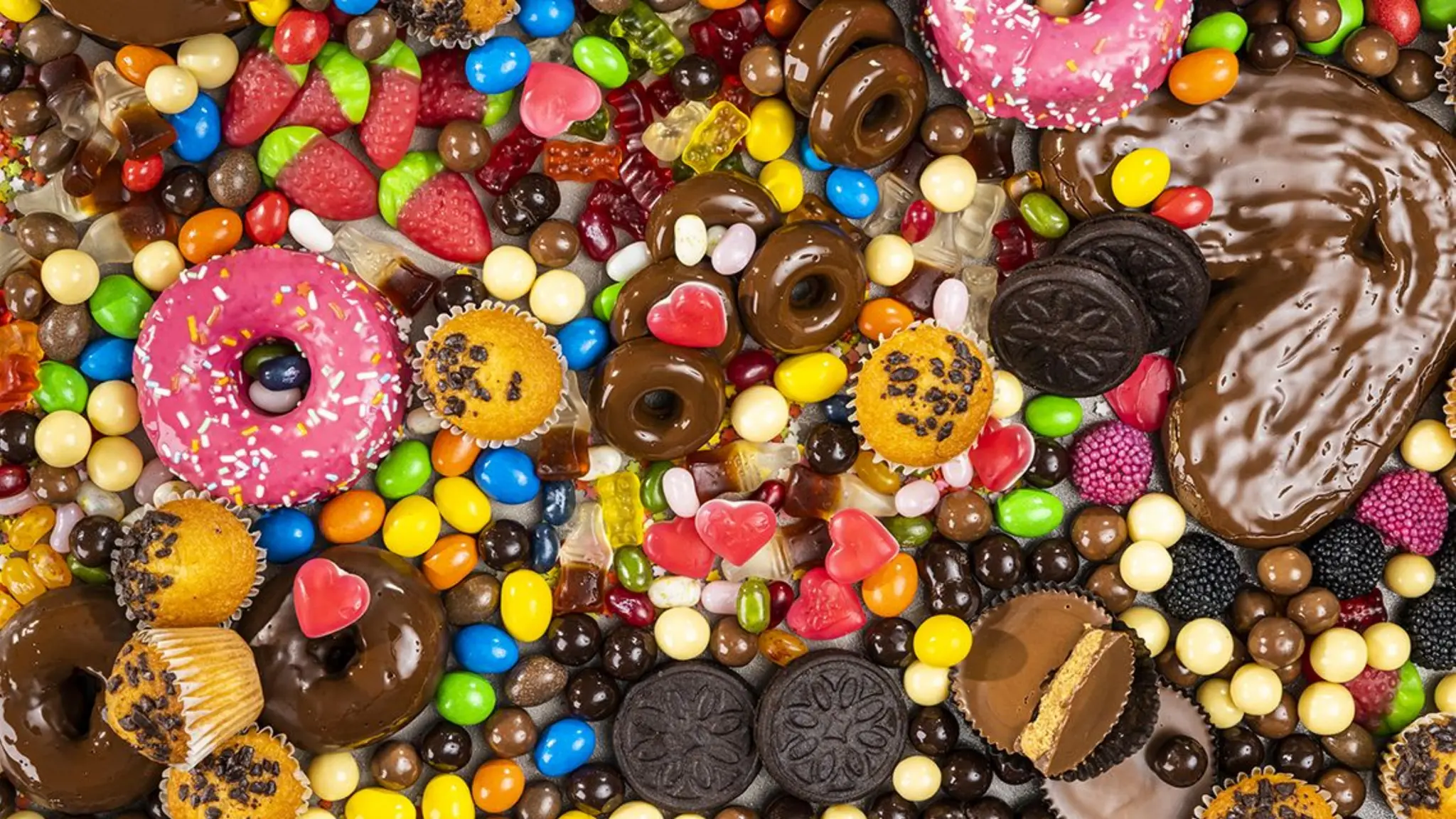
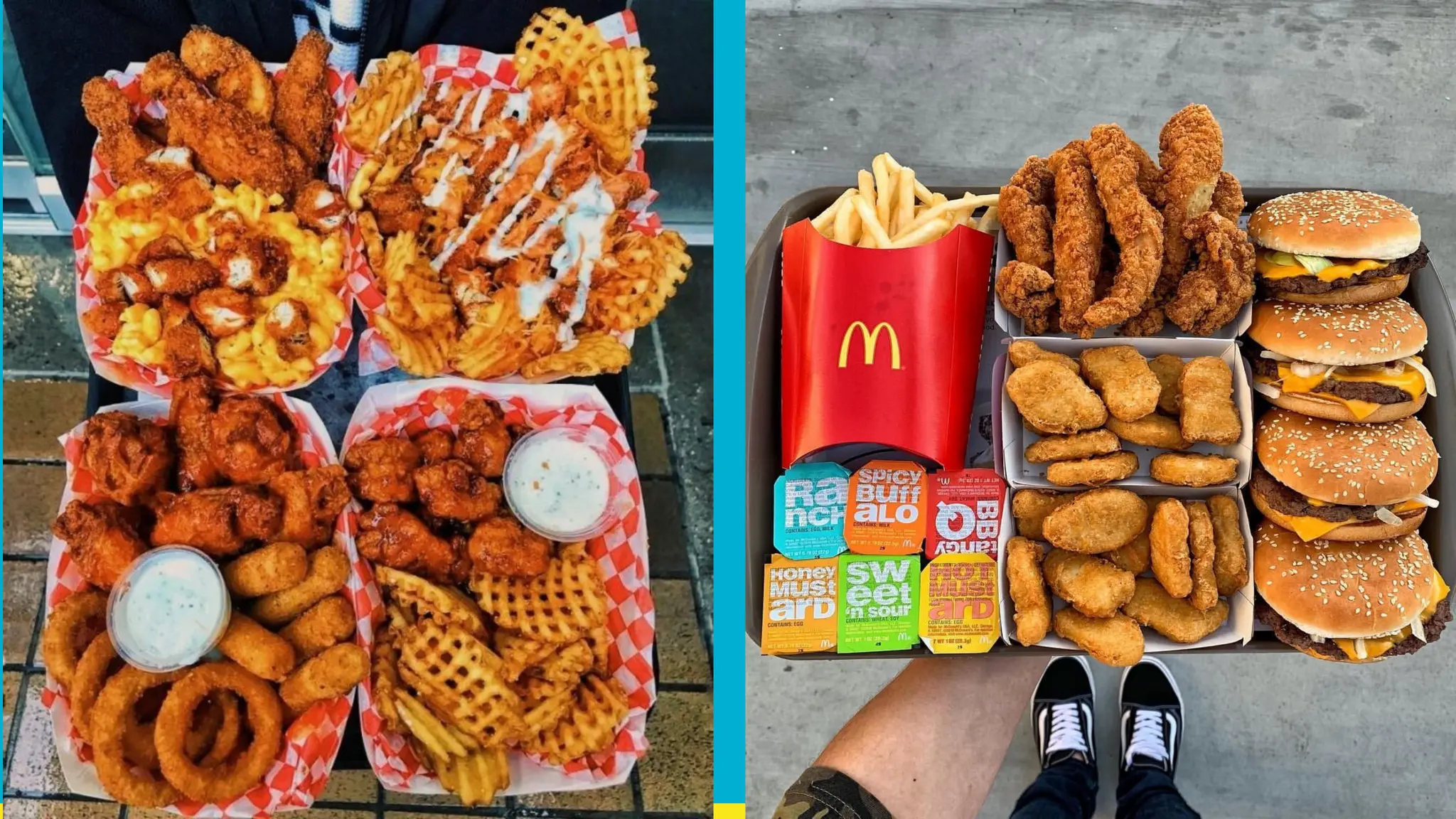
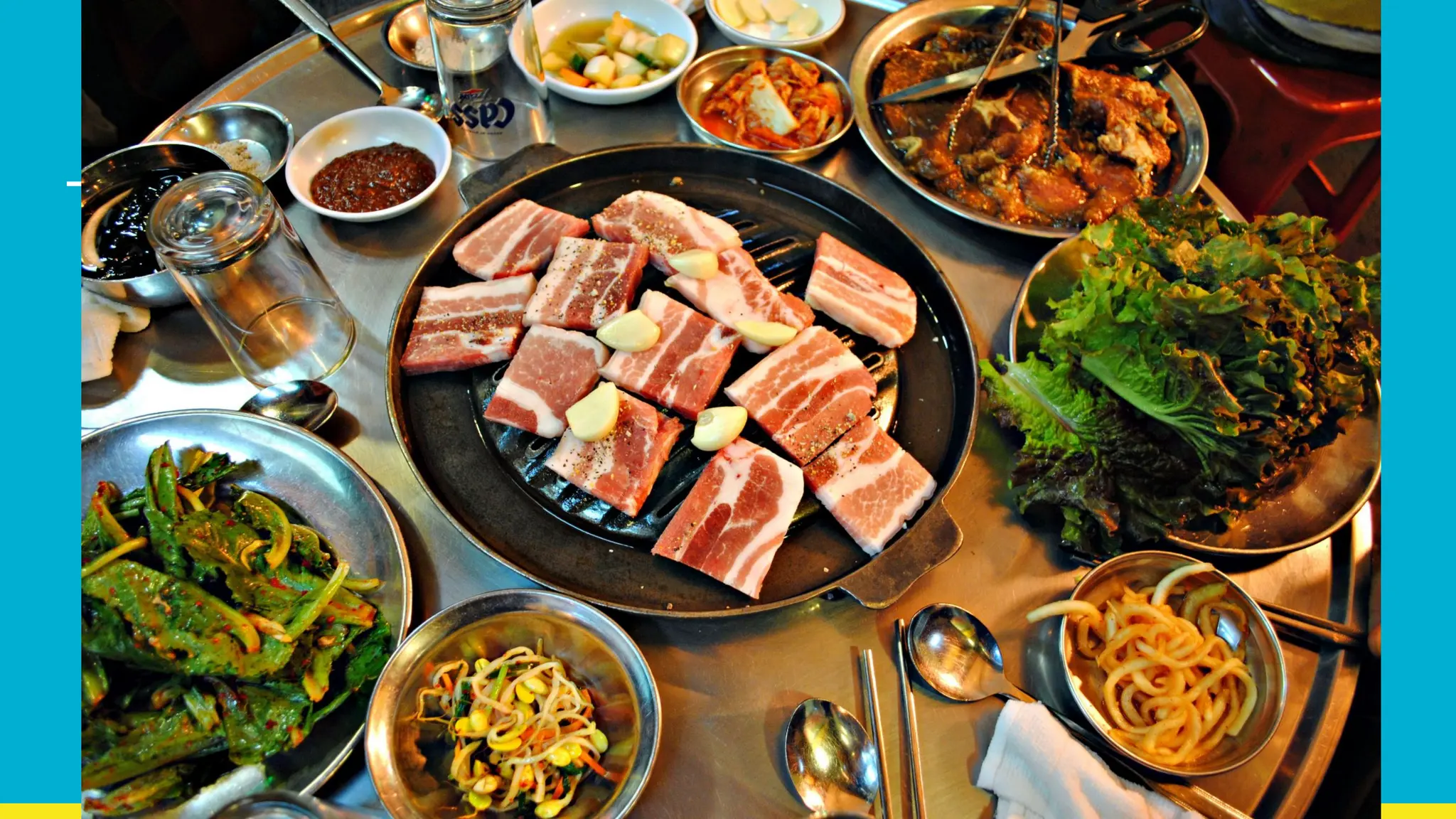
What is your favorite food?
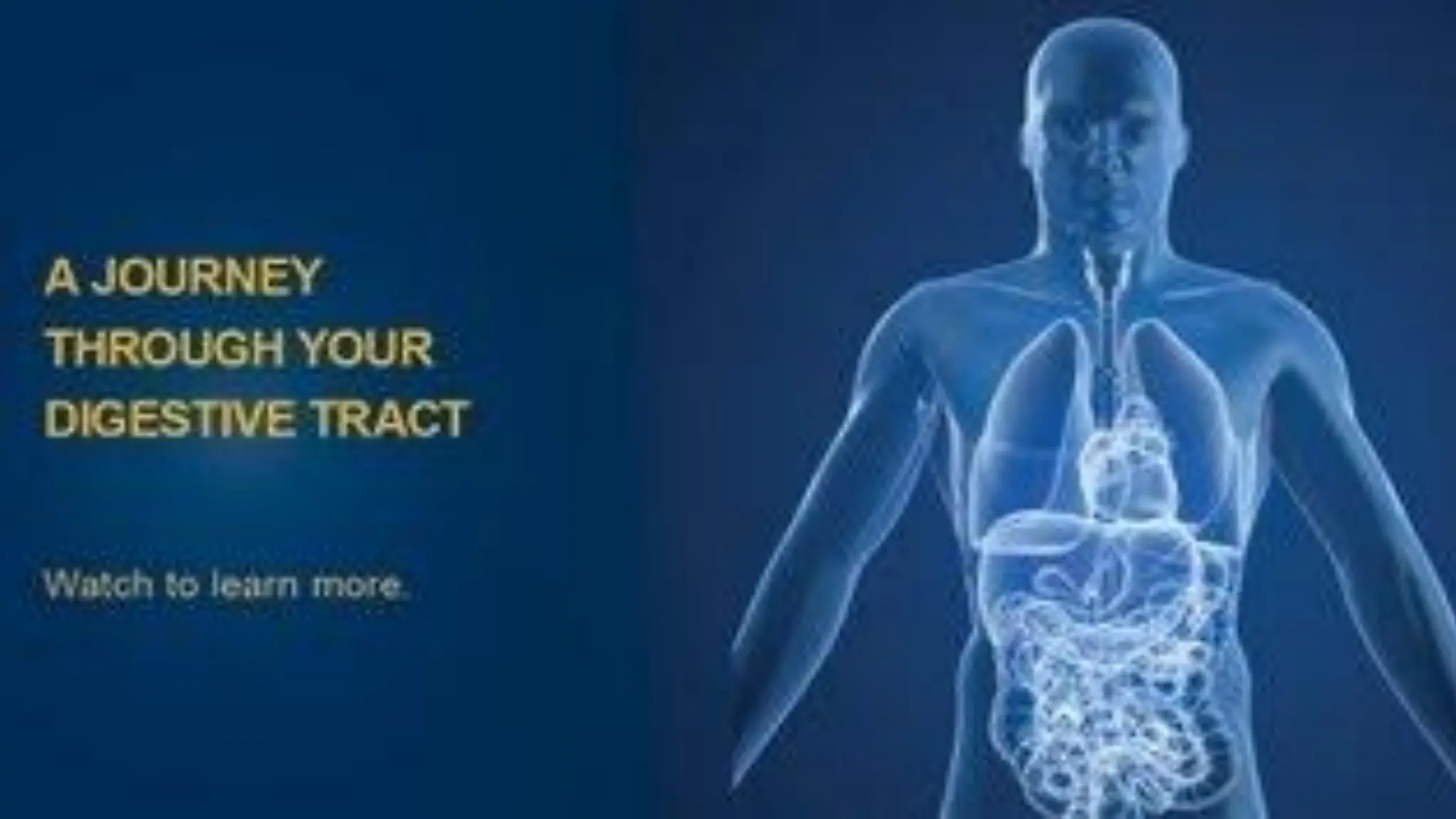
THE DIGESTIVE TRACT
- As you may recall from your previous Biology classes, the
digestive system contains a set of organs that function
simultaneously to break food down into nutrients, convert
them into energy for the human body, and eliminate the
excess products. It consists gastrointestinal tract and
digestive tract which is a sequence of tubular, muscular
digestive organs beginning from the mouth and extending
down to the anus.
MOUTH (Oral Cavity)
- Digestive process begins when you take food into your mouth
- It is also called oral cavity
- It is composed of teeth, tongue, gums, and salivary glands
- MASTICATION is the process of chewing. The teeth physically break the food
down into the smaller bits to make digestion in the inner organs easier.
- SALIVARY GLANDS produce saliva. It softens the food through moisture and
assists the teeth during mastication.
- Saliva enables the chemical break down of the starch in food by producing the
enzyme called amylase. (maltose, maltotriose and dextrins) which give the food
a sweet taste.
- The tongue rolls the food into a slimy, slippery ball-shaped mass of food called
bolus.
- The tongue pushes the bolus further towards the pharynx.
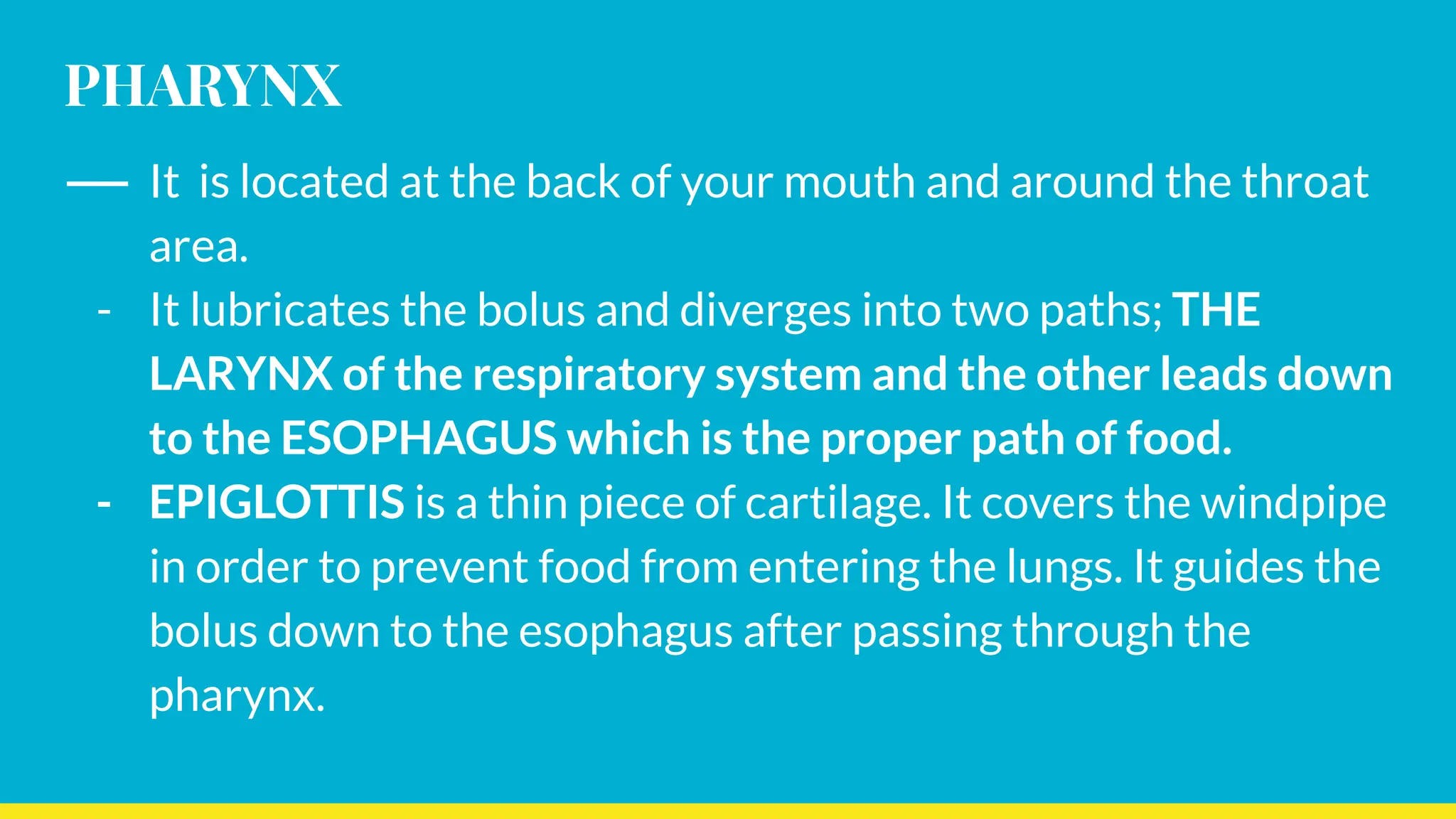
PHARYNX
- It is located at the back of your mouth and around the throat
area.
- It lubricates the bolus and diverges into two paths; THE
LARYNX of the respiratory system and the other leads down
to the ESOPHAGUS which is the proper path of food.
- EPIGLOTTIS is a thin piece of cartilage. It covers the windpipe
in order to prevent food from entering the lungs. It guides the
bolus down to the esophagus after passing through the
pharynx.
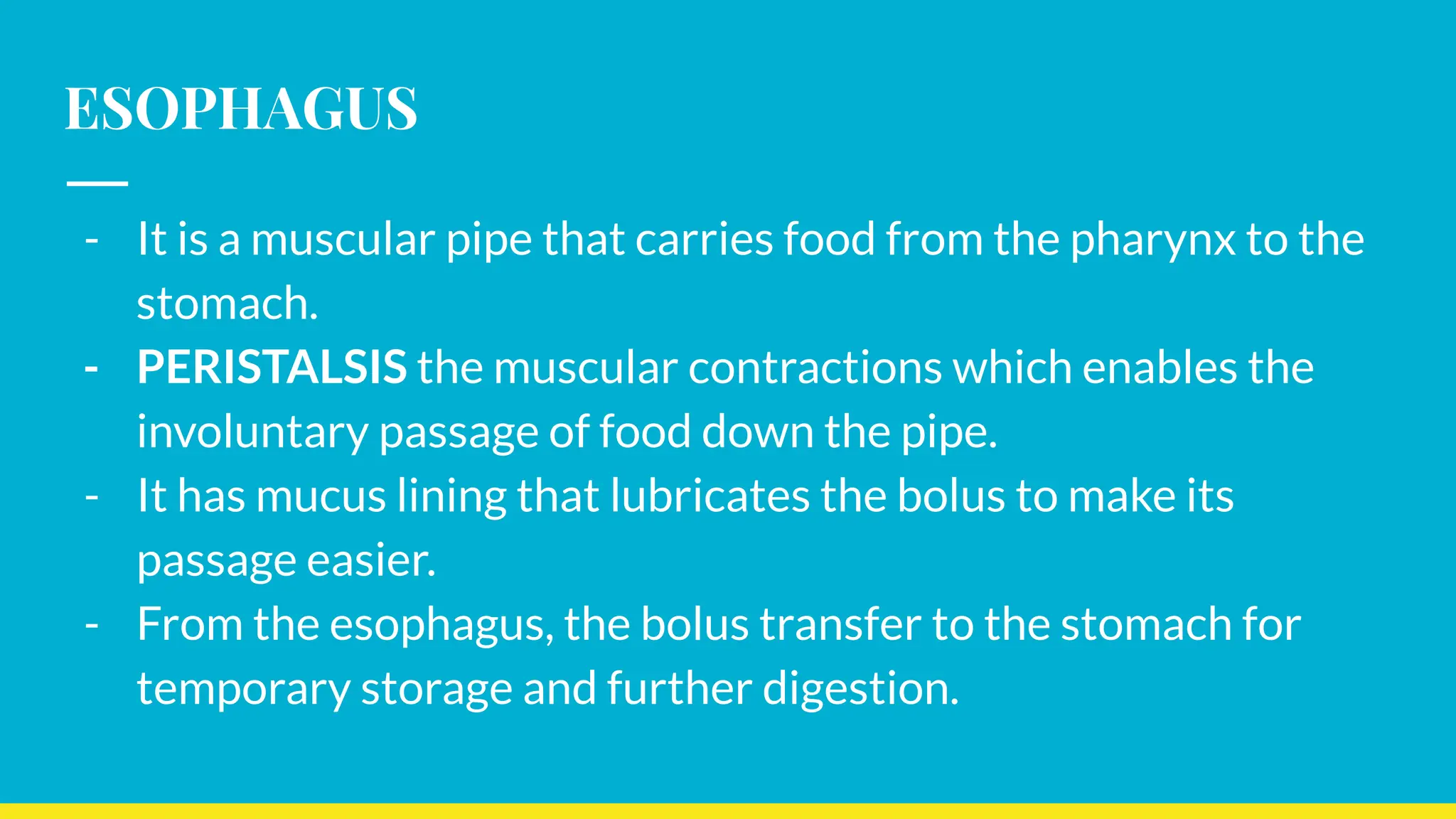
ESOPHAGUS
- It is a muscular pipe that carries food from the pharynx to the
stomach.
- PERISTALSIS the muscular contractions which enables the
involuntary passage of food down the pipe.
- It has mucus lining that lubricates the bolus to make its
passage easier.
- From the esophagus, the bolus transfer to the stomach for
temporary storage and further digestion.
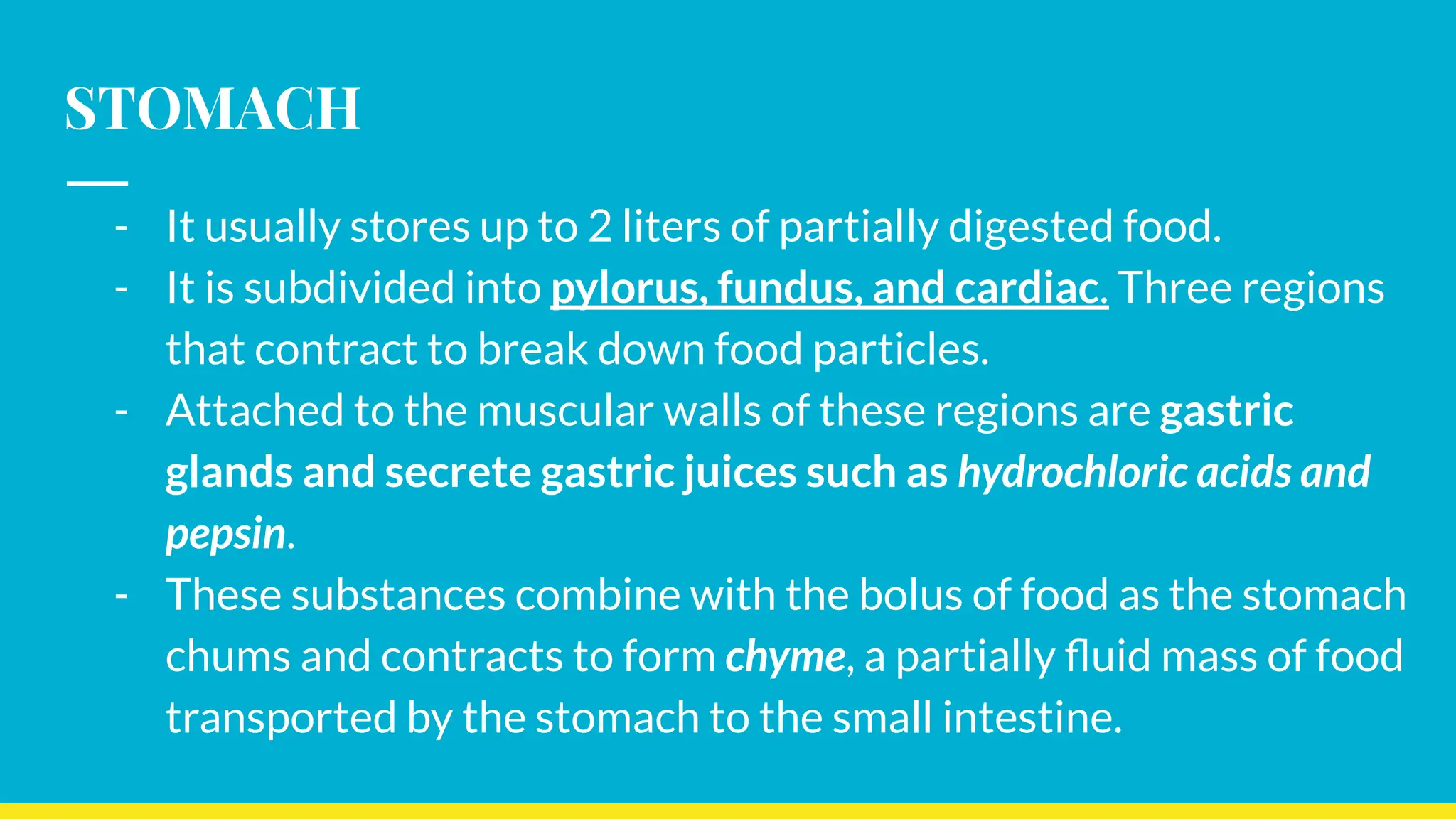
STOMACH
- It usually stores up to 2 liters of partially digested food.
- It is subdivided into pylorus, fundus, and cardiac. Three regions
that contract to break down food particles.
- Attached to the muscular walls of these regions are gastric
glands and secrete gastric juices such as hydrochloric acids and
pepsin.
- These substances combine with the bolus of food as the stomach
chums and contracts to form chyme, a partially fluid mass of food
transported by the stomach to the small intestine.
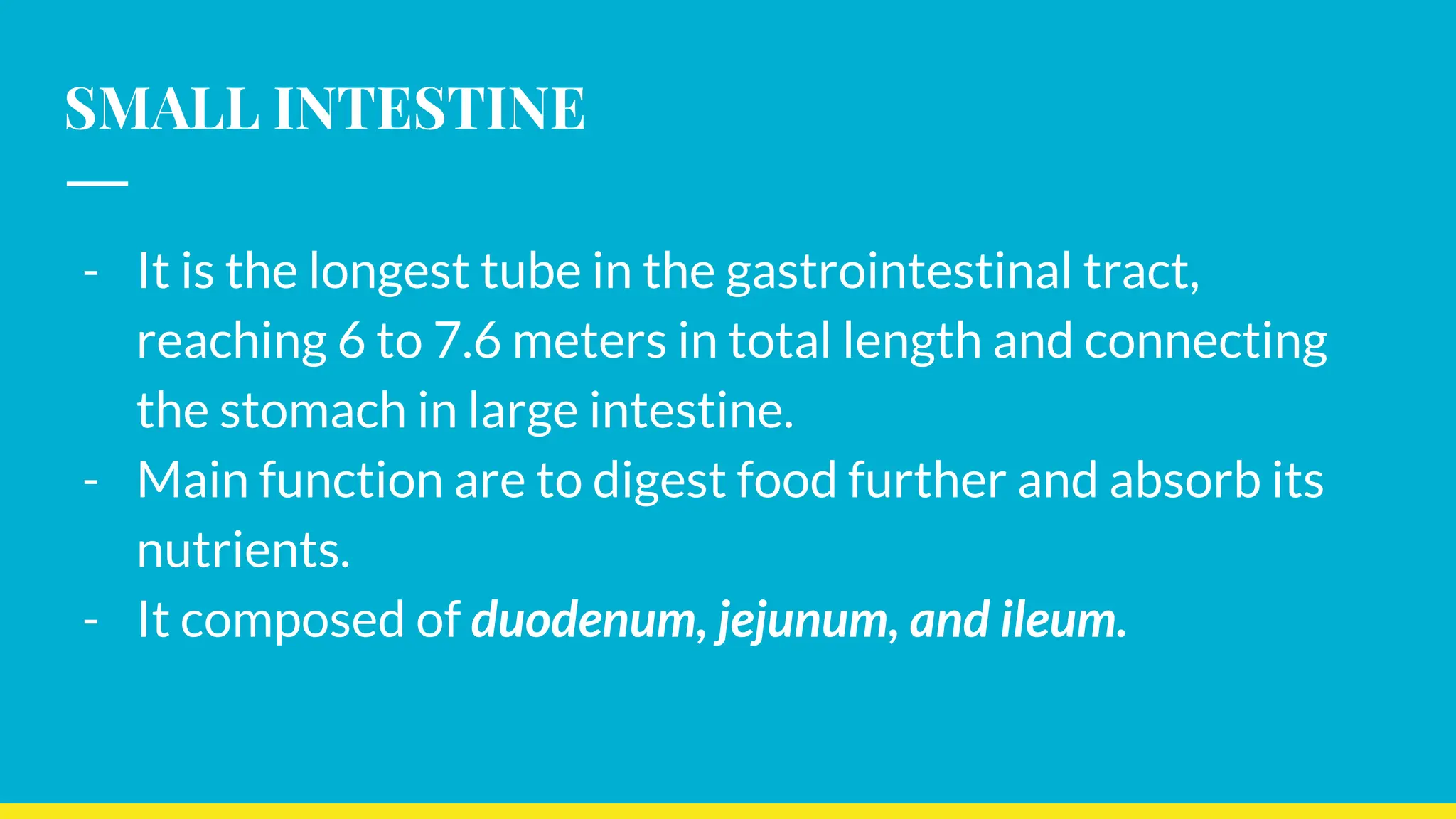
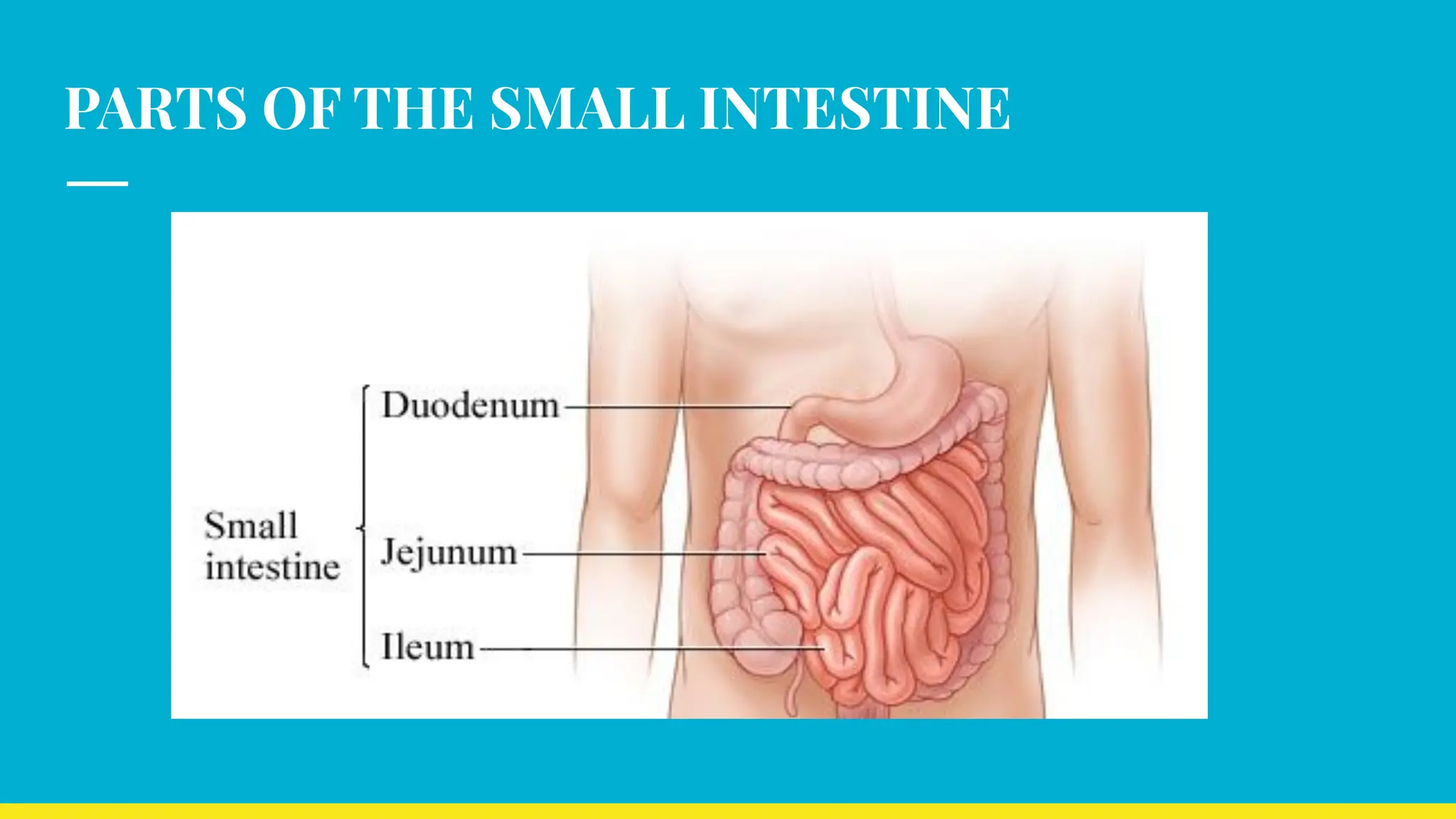
SMALL INTESTINE
- It is the longest tube in the gastrointestinal tract,
reaching 6 to 7.6 meters in total length and connecting
the stomach in large intestine.
- Main function are to digest food further and absorb its
nutrients.
- It composed of duodenum, jejunum, and ileum.
PARTS OF THE SMALL INTESTINE
DUODENUM
- It is connected to the stomach where chyme is broken down by the enzymes,
amylase, protease and lipase and converted into molecules that the body can
absorb.
JEJUNUM AND ILEUM
- Once broken down, the molecules travel towards the jejunum and the ileum
where nutrient absorption takes place.
- The lining of jejunum’s walls consists of finger-shaped folds called villi which
enlarge the surface area of the intestines to increase the absorption of
nutrients from the food molecules.
- Once the nutrients are absorbed and delivered to the other parts of the body,
the remaining particles of food are transmitted to the large intestine.
THE ACCESSORY ORGANS
a. LIVER
- It is extremely important digestive organ with many key roles.
- Largest organ in the digestive system
- Takes part in converting food into energy and producing bile , an
alkaline fluid consisting of water, electrolytes, and other nutrient
molecules that are vital for the digestion of lipid such as oils and
fats.
- Helps also in the production of blood proteins and the
purification of poisonous content from the blood.
b. Gallbladder
- It is a small organ located beneath the liver where the bile is
produced.
- Bile passes through the bile ducts and moves into the
gallbladder where it is temporarily stored.
- Once ready, it is transported from the gallbladder to the small
intestine where digestion and absorption of nutrients take
place.
c. Pancreas
- It makes the necessary enzymes that aid digestion of
food.
- Lipase, amylase, and protease are the enzymes
secreted into the small intestine to digest chemically
the lipids, carbohydrates, and proteins respectively.
LARGE INTESTINE
- Large intestine includes cecum, the appendix, the colon, and the rectum.
- CECUM a pouch at the lower right side of the large intestine which mixes the
food particles with bacteria and absorbs salts and electrolytes from the liquids.
- APPENDIX hanging below the cecum, which does not necessarily serve a
significant function in the digestive process but has a tendency to undergo
inflammation and cause appendicitis.
- COLON. Food particles ascend the colon from cecum. It is in here that water
and other essential nutrients remaining in the food mass may be reabsorbed
into your body.
- RECTUM is the final part of the large intestine. After the food particles have
been digested and the nutrients have been absorbed, their remnants are
converted into feces and stored temporarily in the rectum.
ANUS
- It is the end of gastrointestinal tract.
- This is the canal where the feces (waste)
that have been stored in the rectum are
released during defecation.
HOW THE DIGESTIVE SYSTEM WORKS
WITH OTHER ORGAN SYSTEM
- Multicellular organisms are composed of organ systems
that have specific functions. Every tiny cell works
together all the time, unable to survive and operate
independent and of each other. Working together
requires organization, coordination, and control. This is
how the digestive system operates with fellow organ
systems.
How the Digestive System works with Circulatory
System?
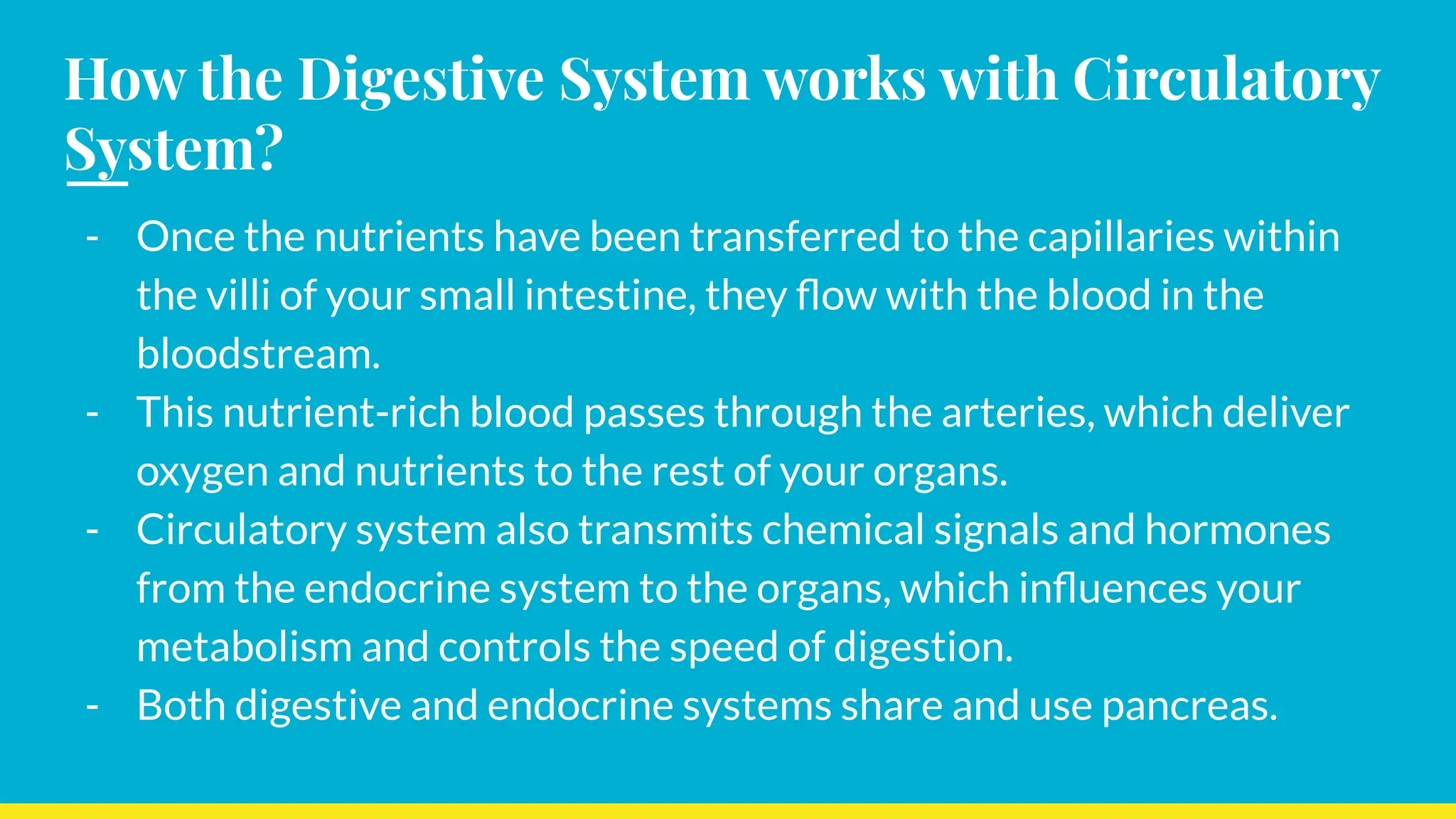
- Once the nutrients have been transferred to the capillaries within
the villi of your small intestine, they flow with the blood in the
bloodstream.
- This nutrient-rich blood passes through the arteries, which deliver
oxygen and nutrients to the rest of your organs.
- Circulatory system also transmits chemical signals and hormones
from the endocrine system to the organs, which influences your
metabolism and controls the speed of digestion.
- Both digestive and endocrine systems share and use pancreas.
How the Digestive System works with Excretory
System?
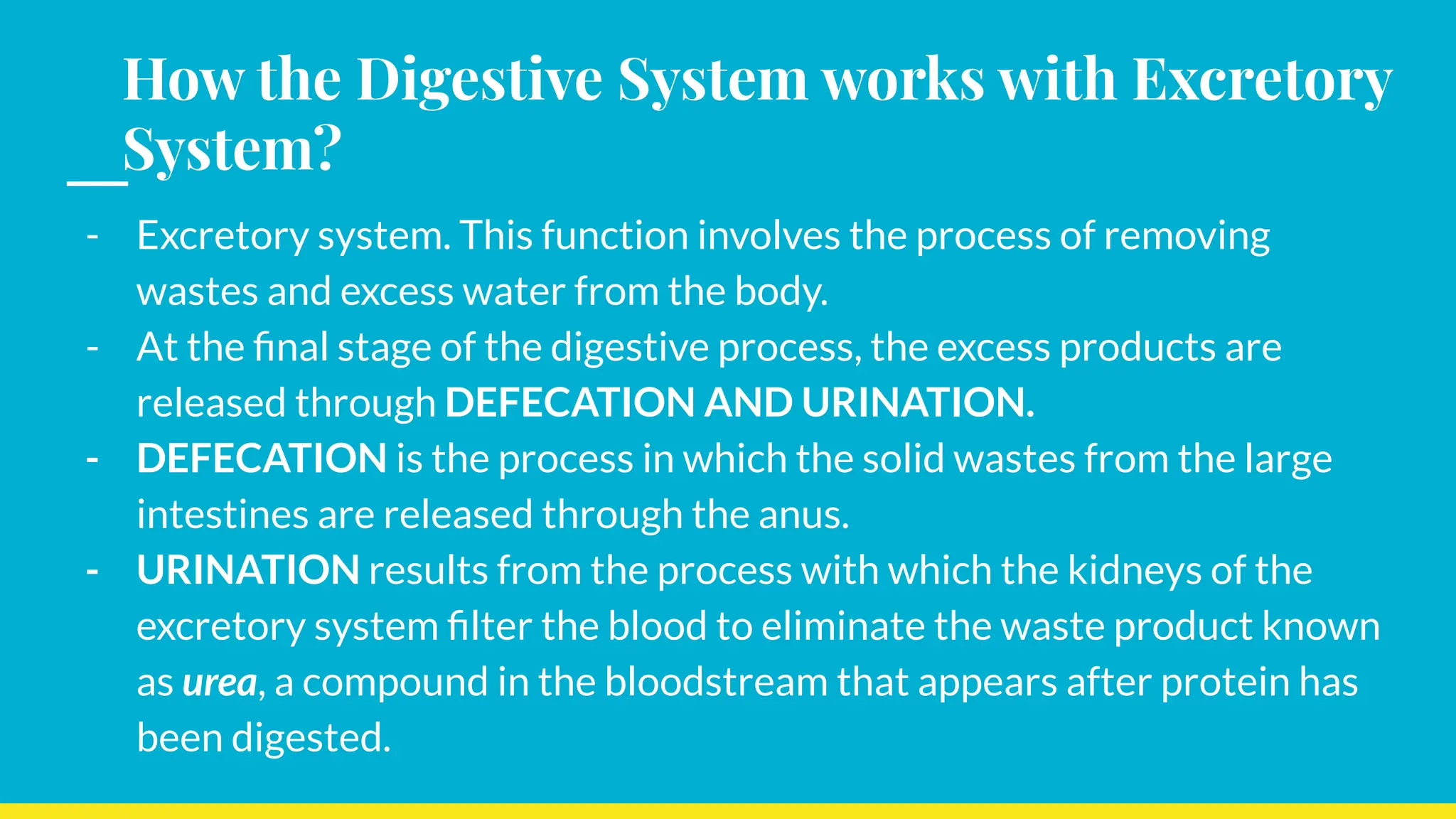
- Excretory system. This function involves the process of removing
wastes and excess water from the body.
- At the final stage of the digestive process, the excess products are
released through DEFECATION AND URINATION.
- DEFECATION is the process in which the solid wastes from the large
intestines are released through the anus.
- URINATION results from the process with which the kidneys of the
excretory system filter the blood to eliminate the waste product known
as urea, a compound in the bloodstream that appears after protein has
been digested.
How the Digestive System works with Respiratory
System?
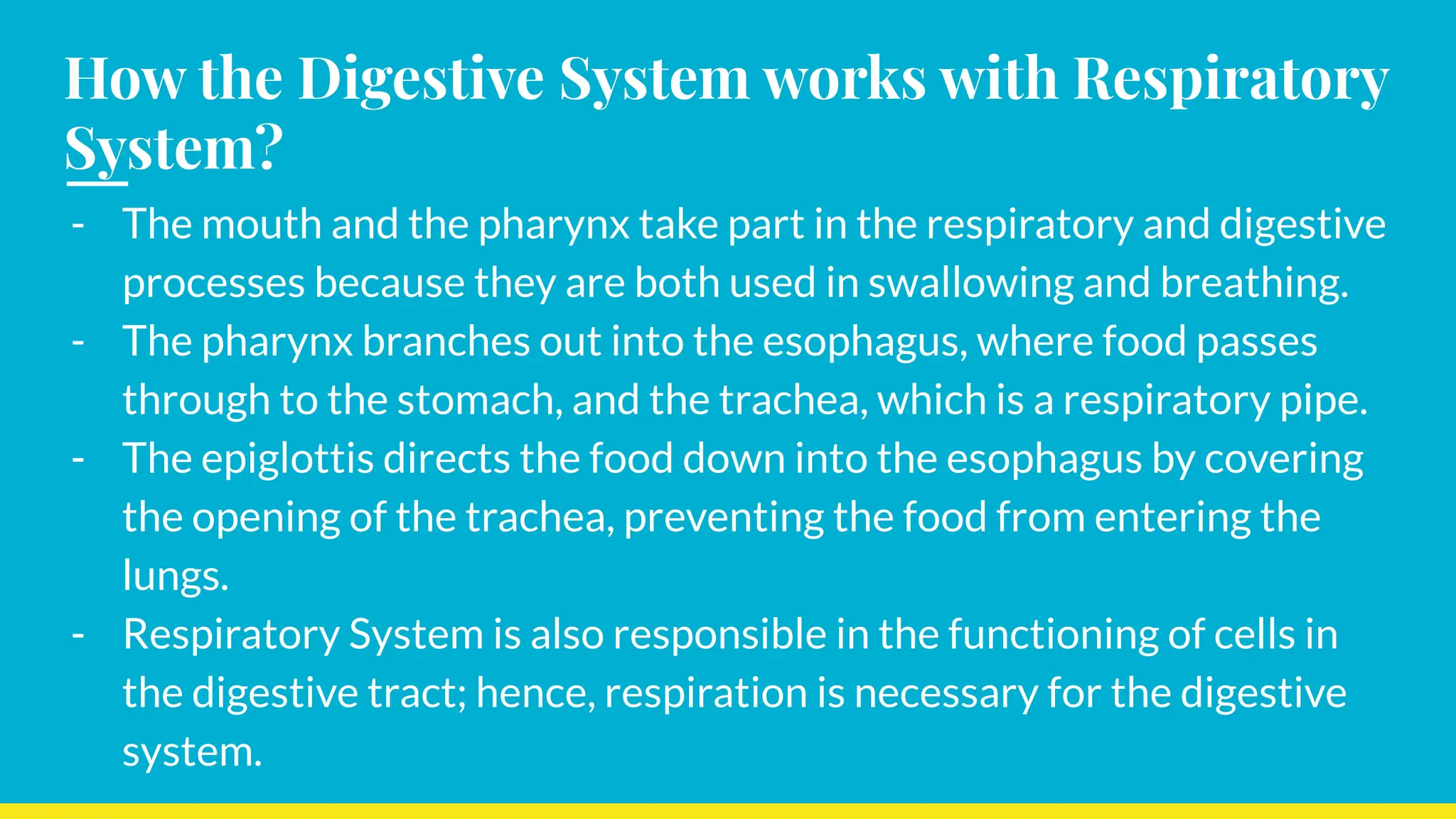
- The mouth and the pharynx take part in the respiratory and digestive
processes because they are both used in swallowing and breathing.
- The pharynx branches out into the esophagus, where food passes
through to the stomach, and the trachea, which is a respiratory pipe.
- The epiglottis directs the food down into the esophagus by covering
the opening of the trachea, preventing the food from entering the
lungs.
- Respiratory System is also responsible in the functioning of cells in
the digestive tract; hence, respiration is necessary for the digestive
system.

THE DIGESTIVE SYSTEM AND ITS INTERACTION WITH OTHER ORGANS OF THE BODY.pdf

  • 1.
    THE DIGESTIVE SYSTEM ANDITS INTERACTION WITH OTHER ORGANS OF THE BODY
  • 3.
    What is yourfavorite food?
  • 9.
    THE DIGESTIVE TRACT -As you may recall from your previous Biology classes, the digestive system contains a set of organs that function simultaneously to break food down into nutrients, convert them into energy for the human body, and eliminate the excess products. It consists gastrointestinal tract and digestive tract which is a sequence of tubular, muscular digestive organs beginning from the mouth and extending down to the anus.
  • 10.
    MOUTH (Oral Cavity) -Digestive process begins when you take food into your mouth - It is also called oral cavity - It is composed of teeth, tongue, gums, and salivary glands - MASTICATION is the process of chewing. The teeth physically break the food down into the smaller bits to make digestion in the inner organs easier. - SALIVARY GLANDS produce saliva. It softens the food through moisture and assists the teeth during mastication. - Saliva enables the chemical break down of the starch in food by producing the enzyme called amylase. (maltose, maltotriose and dextrins) which give the food a sweet taste. - The tongue rolls the food into a slimy, slippery ball-shaped mass of food called bolus. - The tongue pushes the bolus further towards the pharynx.
  • 11.
    PHARYNX - It islocated at the back of your mouth and around the throat area. - It lubricates the bolus and diverges into two paths; THE LARYNX of the respiratory system and the other leads down to the ESOPHAGUS which is the proper path of food. - EPIGLOTTIS is a thin piece of cartilage. It covers the windpipe in order to prevent food from entering the lungs. It guides the bolus down to the esophagus after passing through the pharynx.
  • 12.
    ESOPHAGUS - It isa muscular pipe that carries food from the pharynx to the stomach. - PERISTALSIS the muscular contractions which enables the involuntary passage of food down the pipe. - It has mucus lining that lubricates the bolus to make its passage easier. - From the esophagus, the bolus transfer to the stomach for temporary storage and further digestion.
  • 13.
    STOMACH - It usuallystores up to 2 liters of partially digested food. - It is subdivided into pylorus, fundus, and cardiac. Three regions that contract to break down food particles. - Attached to the muscular walls of these regions are gastric glands and secrete gastric juices such as hydrochloric acids and pepsin. - These substances combine with the bolus of food as the stomach chums and contracts to form chyme, a partially fluid mass of food transported by the stomach to the small intestine.
  • 14.
    SMALL INTESTINE - Itis the longest tube in the gastrointestinal tract, reaching 6 to 7.6 meters in total length and connecting the stomach in large intestine. - Main function are to digest food further and absorb its nutrients. - It composed of duodenum, jejunum, and ileum.
  • 15.
    PARTS OF THESMALL INTESTINE
  • 16.
    DUODENUM - It isconnected to the stomach where chyme is broken down by the enzymes, amylase, protease and lipase and converted into molecules that the body can absorb. JEJUNUM AND ILEUM - Once broken down, the molecules travel towards the jejunum and the ileum where nutrient absorption takes place. - The lining of jejunum’s walls consists of finger-shaped folds called villi which enlarge the surface area of the intestines to increase the absorption of nutrients from the food molecules. - Once the nutrients are absorbed and delivered to the other parts of the body, the remaining particles of food are transmitted to the large intestine.
  • 17.
    THE ACCESSORY ORGANS a.LIVER - It is extremely important digestive organ with many key roles. - Largest organ in the digestive system - Takes part in converting food into energy and producing bile , an alkaline fluid consisting of water, electrolytes, and other nutrient molecules that are vital for the digestion of lipid such as oils and fats. - Helps also in the production of blood proteins and the purification of poisonous content from the blood.
  • 18.
    b. Gallbladder - Itis a small organ located beneath the liver where the bile is produced. - Bile passes through the bile ducts and moves into the gallbladder where it is temporarily stored. - Once ready, it is transported from the gallbladder to the small intestine where digestion and absorption of nutrients take place.
  • 19.
    c. Pancreas - Itmakes the necessary enzymes that aid digestion of food. - Lipase, amylase, and protease are the enzymes secreted into the small intestine to digest chemically the lipids, carbohydrates, and proteins respectively.
  • 20.
    LARGE INTESTINE - Largeintestine includes cecum, the appendix, the colon, and the rectum. - CECUM a pouch at the lower right side of the large intestine which mixes the food particles with bacteria and absorbs salts and electrolytes from the liquids. - APPENDIX hanging below the cecum, which does not necessarily serve a significant function in the digestive process but has a tendency to undergo inflammation and cause appendicitis. - COLON. Food particles ascend the colon from cecum. It is in here that water and other essential nutrients remaining in the food mass may be reabsorbed into your body. - RECTUM is the final part of the large intestine. After the food particles have been digested and the nutrients have been absorbed, their remnants are converted into feces and stored temporarily in the rectum.
  • 21.
    ANUS - It isthe end of gastrointestinal tract. - This is the canal where the feces (waste) that have been stored in the rectum are released during defecation.
  • 22.
    HOW THE DIGESTIVESYSTEM WORKS WITH OTHER ORGAN SYSTEM - Multicellular organisms are composed of organ systems that have specific functions. Every tiny cell works together all the time, unable to survive and operate independent and of each other. Working together requires organization, coordination, and control. This is how the digestive system operates with fellow organ systems.
  • 23.
    How the DigestiveSystem works with Circulatory System? - Once the nutrients have been transferred to the capillaries within the villi of your small intestine, they flow with the blood in the bloodstream. - This nutrient-rich blood passes through the arteries, which deliver oxygen and nutrients to the rest of your organs. - Circulatory system also transmits chemical signals and hormones from the endocrine system to the organs, which influences your metabolism and controls the speed of digestion. - Both digestive and endocrine systems share and use pancreas.
  • 24.
    How the DigestiveSystem works with Excretory System? - Excretory system. This function involves the process of removing wastes and excess water from the body. - At the final stage of the digestive process, the excess products are released through DEFECATION AND URINATION. - DEFECATION is the process in which the solid wastes from the large intestines are released through the anus. - URINATION results from the process with which the kidneys of the excretory system filter the blood to eliminate the waste product known as urea, a compound in the bloodstream that appears after protein has been digested.
  • 25.
    How the DigestiveSystem works with Respiratory System? - The mouth and the pharynx take part in the respiratory and digestive processes because they are both used in swallowing and breathing. - The pharynx branches out into the esophagus, where food passes through to the stomach, and the trachea, which is a respiratory pipe. - The epiglottis directs the food down into the esophagus by covering the opening of the trachea, preventing the food from entering the lungs. - Respiratory System is also responsible in the functioning of cells in the digestive tract; hence, respiration is necessary for the digestive system.