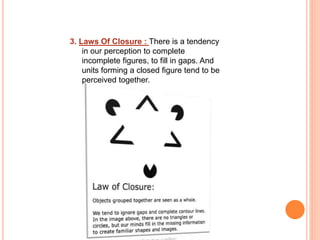
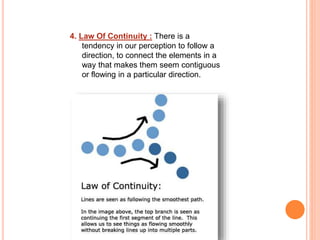
This document summarizes key concepts related to perceptual organization and interpretation. It discusses four laws of perceptual organization: similarity, proximity, closure, and continuity. It then explains that perception involves interpreting stimuli based on an individual's past experiences, needs, wishes, and interests. Interpretations can be impacted by factors like selective perception, contrast effects, stereotyping, inference, and distortion. Common perceptual errors are also outlined, such as the halo effect, primacy effect, recency effect, and false consensus effect.