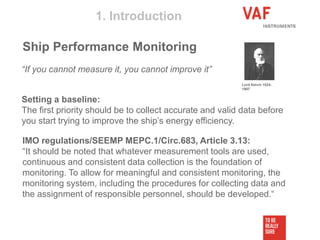
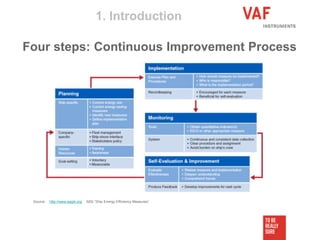
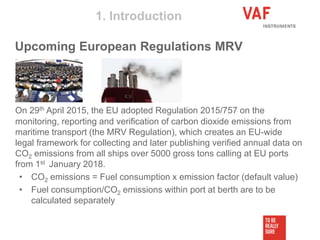
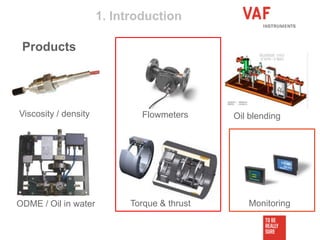
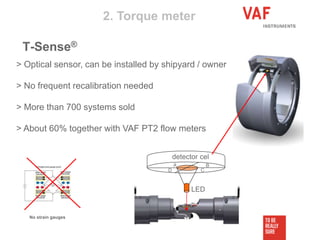
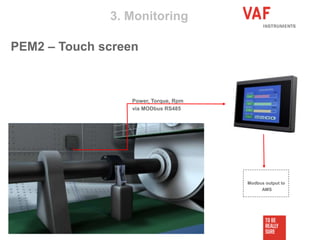
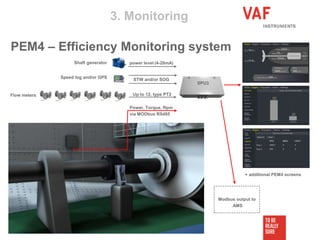
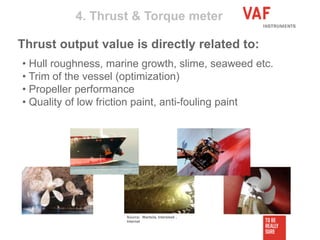
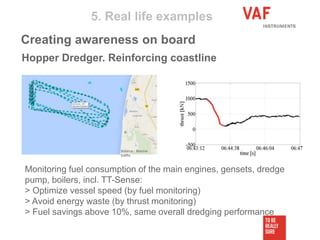
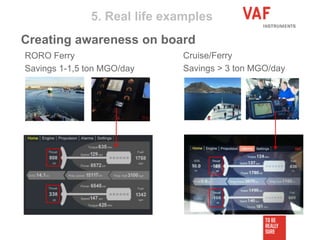
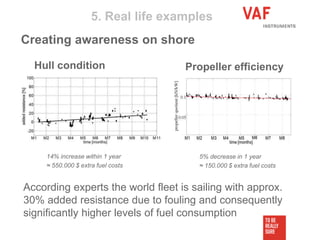
The document discusses ship performance monitoring and evaluating the business case. It notes that continuous data collection is key to meaningful monitoring. The first priority should be collecting accurate baseline data before trying to improve efficiency. The document then discusses upcoming EU regulations on monitoring and reporting carbon emissions from ships. It presents products for monitoring including torque meters and thrust and torque meters that can measure engine torque and propeller thrust. Real-life examples show how monitoring fuel consumption and thrust can optimize vessel speed, avoid waste, and yield fuel savings of over 10% for dredgers and 3 tons per day for cruise/ferry ships. Monitoring hull condition and propeller efficiency is important as fouling can increase resistance and fuel costs by 30%.

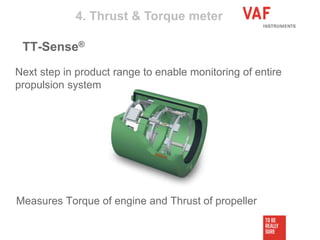
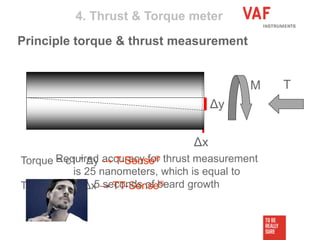
![TT-Sense measures torque and propeller thrust
Resistance = T(1-t), t=thrust deduction factor
Resistance [kN]Thrust [kN]
4. Thrust & Torque meter](https://image.slidesharecdn.com/hullandpropellerefficiencymeasurement2015-151207143148-lva1-app6892/85/Hull-and-propeller-efficiency-measurement-2015-12-320.jpg)



![IRZ artificial lift solutions [version 1.2 july 2016]](https://cdn.slidesharecdn.com/ss_thumbnails/irzartificialliftsolutionsversion1-160720102154-thumbnail.jpg?width=640&height=640&fit=bounds)


![IRZ artificial lift solutions [version 1.4 july 2016]](https://cdn.slidesharecdn.com/ss_thumbnails/irzartificialliftsolutionsversion1-160914111003-thumbnail.jpg?width=640&height=640&fit=bounds)


