HTTP AND SECURITY
AGENDA
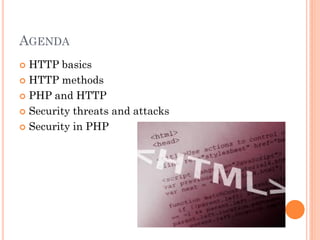
HTTP basics
 HTTP methods
 PHP and HTTP
 Security threats and attacks
 Security in PHP

HTTP
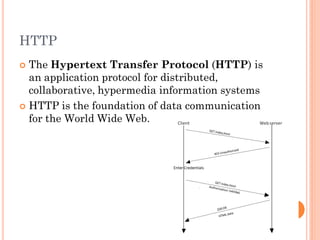
The Hypertext Transfer Protocol (HTTP) is
an application protocol for distributed,
collaborative, hypermedia information systems
 HTTP is the foundation of data communication
for the World Wide Web.

HTTP
HTTP functions as a request-response protocol in
the client-server computing model
 The response contains completion status
information about the request and may also
contain requested content in its message body
 HTTP is an application layer protocol (mostly
TCP, but can use UDP)

HTTP SESSIONS
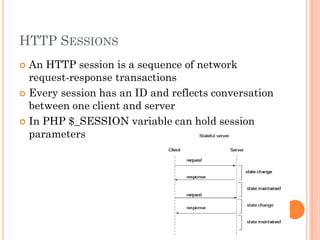
An HTTP session is a sequence of network
request-response transactions
 Every session has an ID and reflects conversation
between one client and server
 In PHP $_SESSION variable can hold session
parameters

HTTP METHODS













GET - Requests a representation of the specified resource
HEAD - likeGET request, but without the response body
POST - Requests that the server accept the entity enclosed
in the request as a new subordinate of the web resource
identified by the URI
PUT - Requests that the enclosed entity be stored under
the supplied URI
DELETE - Deletes the specified resource.
TRACE - Echoes back the received request so that a client
can see what changes or additions have been made by
intermediate servers.
OPTIONS - Returns the HTTP methods that the server
supports for the specified URL
CONNECT - Converts the request connection to a
transparent TCP/IP tunnel
PATCH - Is used to apply partial modifications to a
resource
HTTP GET
/test/demo_form.php?name1=value1&name2=val
ue2
 GET requests can be cached
 GET requests remain in the browser history
 GET requests can be bookmarked
 GET requests should never be used when dealing
with sensitive data
 GET requests have length restrictions (2048)
 GET requests should be used only to retrieve
data

HTTP POST
POST /test/demo_form.asp HTTP/1.1
 Host: w3schools.com
 name1=value1&name2=value2


POST requests are never cached
 POST requests do not remain in the browser
history
 POST requests cannot be bookmarked
 POST requests have no restrictions on data
length

PHP METHODS FOR POST AND GET
GET - $_GET variable
 POST - $_POST variable
 $_REQUEST for both + $_COOKIE


if (isset($_GET['user']) && isset($_GET['gen']))
{
 $user = $_GET['user'];
 $gen = $_GET['gen'];
 echo 'User: '. $user. ' - gender: '. $gen;
}

AND WORDPRESS
Wordpress core does not use sessions
 Wordpress core uses only cookies
 However plugins can use sessions

SECURITY INTRODUCTION
Weakest part of site is entry point
 Write your code secure!
 Don’t be victim of laziness and get hacked (or put
users in risk)
 It’s easier to protect then to heal

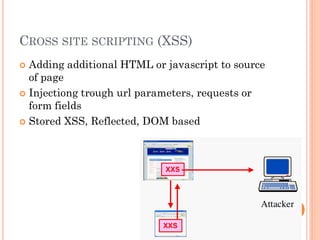
CROSS SITE SCRIPTING (XSS)
Adding additional HTML or javascript to source
of page
 Injectiong trough url parameters, requests or
form fields
 Stored XSS, Reflected, DOM based

XSS PROTECTION
Stripping tags
 Transform characters like <,>,/,’,” etc to html
entities
 Php functions:






string strip_tags ( string $str [, string
$allowable_tags ] )
string htmlentities ( string $string)
string htmlspecialchars( string $string)
SQL INJECTION
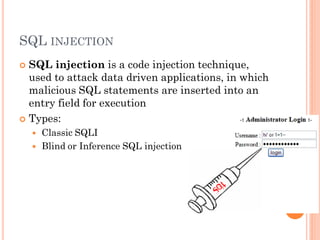
SQL injection is a code injection technique,
used to attack data driven applications, in which
malicious SQL statements are inserted into an
entry field for execution
 Types:





Classic SQLI
Blind or Inference SQL injection
SQL INJECTION EXAMPLE
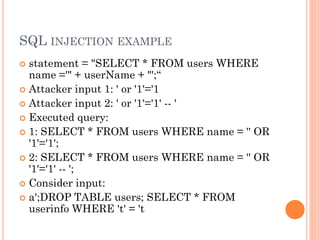
statement = "SELECT * FROM users WHERE
name ='" + userName + "';“
 Attacker input 1: ' or '1'='1
 Attacker input 2: ' or '1'='1' -- '
 Executed query:
 1: SELECT * FROM users WHERE name = '' OR
'1'='1';
 2: SELECT * FROM users WHERE name = '' OR
'1'='1' -- ';
 Consider input:
 a';DROP TABLE users; SELECT * FROM
userinfo WHERE 't' = 't

SQL INJECTION PROTECTION
Filter user input
 Way 1:












$stmt = $dbConnection->prepare('SELECT * FROM employees WHERE
name = ?');
$stmt->bind_param('s', $name);
$stmt->execute();
$result = $stmt->get_result();
while ($row = $result->fetch_assoc())
{ // do something with $row }

Way2:
$unsafe_variable = $_POST["user-input"] ;
 $safe_variable = mysql_real_escape_string($unsafe_variable);
 mysql_query("INSERT INTO table (column) VALUES ('" .
$safe_variable . "')");

SQL INJECTION WORDPRESS PROTECTION
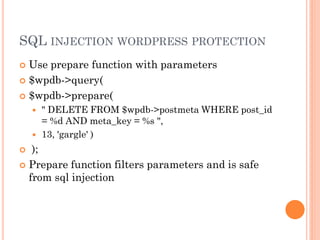
Use prepare function with parameters
 $wpdb->query(
 $wpdb->prepare(





" DELETE FROM $wpdb->postmeta WHERE post_id
= %d AND meta_key = %s ",
13, 'gargle' )

);
 Prepare function filters parameters and is safe
from sql injection

SENSITIVE DATA EXPOSURE
All data that are stored should be stored hased or
encrypted
 Try to protect also transport layer (best using ssl)

CROSS SITE REQUEST FORGERY (CSRF)
Cross-site request forgery, also known as a
one-click attack or session riding and
abbreviated as CSRF, is a type of malicious
exploit of a website whereby unauthorized
commands are transmitted from a user that the
website trusts.
 Attacker creates page that request some action
that only authorized user can execute
 Attacker sends link of the page to the victim
 Victim clicks on link and execute command as
authorized user

PROTECTION AGAINST CSRF
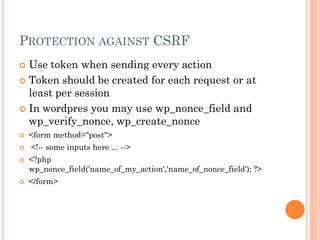
Use token when sending every action
 Token should be created for each request or at
least per session
 In wordpres you may use wp_nonce_field and
wp_verify_nonce, wp_create_nonce





<form method="post">
<!-- some inputs here ... -->



<?php
wp_nonce_field('name_of_my_action','name_of_nonce_field'); ?>



</form>
INSECURE DIRECT OBJECT REFERENCES
Http and security

Http and security

  • 1.
  • 2.
    AGENDA HTTP basics  HTTPmethods  PHP and HTTP  Security threats and attacks  Security in PHP 
  • 3.
    HTTP The Hypertext TransferProtocol (HTTP) is an application protocol for distributed, collaborative, hypermedia information systems  HTTP is the foundation of data communication for the World Wide Web. 
  • 4.
    HTTP HTTP functions asa request-response protocol in the client-server computing model  The response contains completion status information about the request and may also contain requested content in its message body  HTTP is an application layer protocol (mostly TCP, but can use UDP) 
  • 5.
    HTTP SESSIONS An HTTPsession is a sequence of network request-response transactions  Every session has an ID and reflects conversation between one client and server  In PHP $_SESSION variable can hold session parameters 
  • 6.
    HTTP METHODS          GET -Requests a representation of the specified resource HEAD - likeGET request, but without the response body POST - Requests that the server accept the entity enclosed in the request as a new subordinate of the web resource identified by the URI PUT - Requests that the enclosed entity be stored under the supplied URI DELETE - Deletes the specified resource. TRACE - Echoes back the received request so that a client can see what changes or additions have been made by intermediate servers. OPTIONS - Returns the HTTP methods that the server supports for the specified URL CONNECT - Converts the request connection to a transparent TCP/IP tunnel PATCH - Is used to apply partial modifications to a resource
  • 7.
    HTTP GET /test/demo_form.php?name1=value1&name2=val ue2  GETrequests can be cached  GET requests remain in the browser history  GET requests can be bookmarked  GET requests should never be used when dealing with sensitive data  GET requests have length restrictions (2048)  GET requests should be used only to retrieve data 
  • 8.
    HTTP POST POST /test/demo_form.aspHTTP/1.1  Host: w3schools.com  name1=value1&name2=value2  POST requests are never cached  POST requests do not remain in the browser history  POST requests cannot be bookmarked  POST requests have no restrictions on data length 
  • 9.
    PHP METHODS FORPOST AND GET GET - $_GET variable  POST - $_POST variable  $_REQUEST for both + $_COOKIE  if (isset($_GET['user']) && isset($_GET['gen'])) {  $user = $_GET['user'];  $gen = $_GET['gen'];  echo 'User: '. $user. ' - gender: '. $gen; } 
  • 10.
    AND WORDPRESS Wordpress coredoes not use sessions  Wordpress core uses only cookies  However plugins can use sessions 
  • 11.
    SECURITY INTRODUCTION Weakest partof site is entry point  Write your code secure!  Don’t be victim of laziness and get hacked (or put users in risk)  It’s easier to protect then to heal 
  • 12.
    CROSS SITE SCRIPTING(XSS) Adding additional HTML or javascript to source of page  Injectiong trough url parameters, requests or form fields  Stored XSS, Reflected, DOM based 
  • 13.
    XSS PROTECTION Stripping tags Transform characters like <,>,/,’,” etc to html entities  Php functions:     string strip_tags ( string $str [, string $allowable_tags ] ) string htmlentities ( string $string) string htmlspecialchars( string $string)
  • 14.
    SQL INJECTION SQL injectionis a code injection technique, used to attack data driven applications, in which malicious SQL statements are inserted into an entry field for execution  Types:    Classic SQLI Blind or Inference SQL injection
  • 15.
    SQL INJECTION EXAMPLE statement= "SELECT * FROM users WHERE name ='" + userName + "';“  Attacker input 1: ' or '1'='1  Attacker input 2: ' or '1'='1' -- '  Executed query:  1: SELECT * FROM users WHERE name = '' OR '1'='1';  2: SELECT * FROM users WHERE name = '' OR '1'='1' -- ';  Consider input:  a';DROP TABLE users; SELECT * FROM userinfo WHERE 't' = 't 
  • 16.
    SQL INJECTION PROTECTION Filteruser input  Way 1:         $stmt = $dbConnection->prepare('SELECT * FROM employees WHERE name = ?'); $stmt->bind_param('s', $name); $stmt->execute(); $result = $stmt->get_result(); while ($row = $result->fetch_assoc()) { // do something with $row } Way2: $unsafe_variable = $_POST["user-input"] ;  $safe_variable = mysql_real_escape_string($unsafe_variable);  mysql_query("INSERT INTO table (column) VALUES ('" . $safe_variable . "')"); 
  • 17.
    SQL INJECTION WORDPRESSPROTECTION Use prepare function with parameters  $wpdb->query(  $wpdb->prepare(    " DELETE FROM $wpdb->postmeta WHERE post_id = %d AND meta_key = %s ", 13, 'gargle' ) );  Prepare function filters parameters and is safe from sql injection 
  • 18.
    SENSITIVE DATA EXPOSURE Alldata that are stored should be stored hased or encrypted  Try to protect also transport layer (best using ssl) 
  • 19.
    CROSS SITE REQUESTFORGERY (CSRF) Cross-site request forgery, also known as a one-click attack or session riding and abbreviated as CSRF, is a type of malicious exploit of a website whereby unauthorized commands are transmitted from a user that the website trusts.  Attacker creates page that request some action that only authorized user can execute  Attacker sends link of the page to the victim  Victim clicks on link and execute command as authorized user 
  • 20.
    PROTECTION AGAINST CSRF Usetoken when sending every action  Token should be created for each request or at least per session  In wordpres you may use wp_nonce_field and wp_verify_nonce, wp_create_nonce    <form method="post"> <!-- some inputs here ... -->  <?php wp_nonce_field('name_of_my_action','name_of_nonce_field'); ?>  </form>
  • 21.