NEONATE AND INFANTILE
HYPERTENSION
Dr.ELHAM EMAMI
PEDIATRIC NEPHROLOGIST
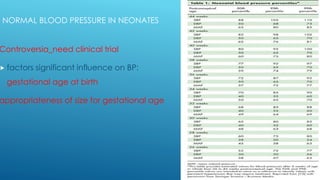
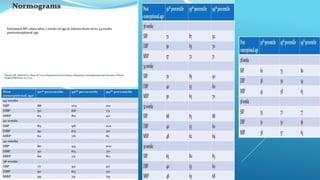
NORMAL BLOOD PRESSURE IN NEONATES
Controversia_need clinical trial
 factors significant influence on BP:
gestational age at birth
appropriateness of size for gestational age
DEFINITION and incidence :
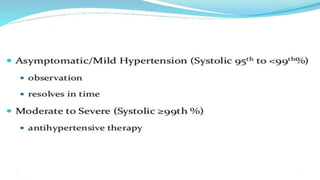
Neonatal hypertension : systolic blood pressure of at least
the 95th percentile incidence :1.3 % - 2 % in nicu
multiple BP measurements are needed( 3 separate
occasions)
 Dress Giri and Roth have disclosed no financial relationships relevant to this article.
This commentary does not contain a discussion of an unapproved/investigative use
of a commercial product/device.
Severe htn (defined by systolic BP >99th percentile):
end organ damage: vascular injury, left ventricular hypertrophy, encephalopathy, and
hypertensive retinopathy
complications from, linked to hypertension beyond infancy
diagnose and aggressively manage severe or persistent hypertension
ROUTINE EVALUATION OF BP IS NOT RECOMMENDED IN ALL
NEONATES (AAP)
 routinely screening in the absence of symptoms does not usually apply
 do not recommend routine screening, which should begin annually only at 3 years of
age.
recent AAP guidelines (Pediatrics. 2017;140[3]:e20171904
Hypertension was considerably more common in infants with:
bronchopulmonary dysplasia
patent ductus arteriosus
and intraventricular hemorrhage
with indwelling umbilical arterial catheters
Antenatal steroids
ETIOLOGIES:
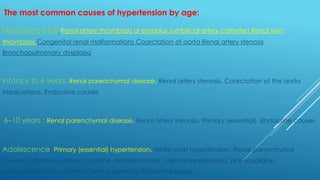
The most common causes of hypertension by age:
Newborn:### Renal artery thrombosis or embolus (umbilical artery catheter) Renal vein
thrombosis Congenital renal malformations Coarctation of aorta Renal artery stenosis
Bronchopulmonary dysplasia
Infancy to 6 years: Renal parenchymal disease، Renal artery stenosis، Coarctation of the aorta
Medications، Endocrine causes
6–10 years : Renal parenchymal disease، Renal artery stenosis، Primary (essential) ،Endocrine causes
Adolescence: Primary (essential) hypertension، White coat hypertension، Renal parenchymal
disease Substance abuse (cocaine, amphetamines, methamphetamines, phencyclidine,
methylphenidate, caffeine) Teen pregnancy Endocrine cause
Drug in etiology:

 dexamethasone and other corticosteroids used to treat chronic pulmonary
diseases
 catecholamines (dopamine, adrenaline)
 xanthines (caffeine and theophylline)
 curare-mimetics (pancuronium)
 mydriatic eye drops (phenylephrine)
VOGT M, KUHN A, BAUMGARTNER D, BAUMGARTNER C, BUSCH R, KOSTOLNY M, HESS J. IMPAIRED ELASTIC PROPERTIES OF
THE ASCENDING AORTA IN NEWBORNS BEFORE AND EARLY AFTER SUCCESSFUL COARCTATION REPAIR—PROOF OF A
SYSTEMIC VASCULAR DISEASE OF THE PRESTENOTIC ARTERIES? CIRCULATION 2005; 111: 3269–3273.
POLSON JW, MCCALLION N, WAKI H, THORNE G, TOOLEY MA, PATON JFR, WOLF AR. EVIDENCE FOR CARDIOVASCULAR
AUTONOMIC DYSFUNCTION IN NEONATES WITH COARCTATION OF THE AORTA. CIRCULATION 2006; 113: 2844–2850
Hypertension and coarctation of the aorta :
increased aortic stiffnes
alteration in autonomic cardiac balance
maladaptive response to mechanisms responsible for longer term blood pressure
control
Endothelial dysfunction
MAXIMUM AORTIC THICKNESS WAS SIGNIFICANTLY HIGHER STIFFNESS INDEX
CONCLUSION: THE AORTIC WALL THICKNESS AND VASOMOTOR FUNCTION ARE SIGNIFICANTLY
ALTERED IN PRETERM INFANTS WITH SEVERE BPD..
Systemic arterial stiffness in infants with bronchopulmonary
dysplasia: potential cause of systemic hypertension:
Damien Kenny1, Jaimie W Polson2, Robin P Martin1, Julian FR Paton3 and Andrew R Wolf 4 Patients with
coarctation of the aorta develop early onset hypertension in spite of early effective repair. (2011) 34, 543–
547; doi:10.1038/hr.2011.22; published online 17 March 2011
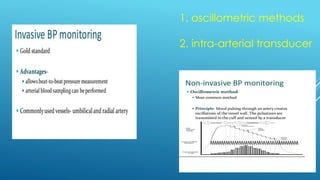
1. oscillometric methods
2. intra-arterial transducer
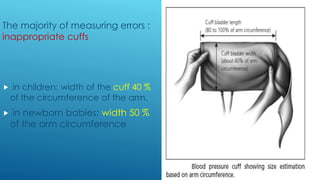
The majority of measuring errors :
inappropriate cuffs
 in children: width of the cuff 40 %
of the circumference of the arm.
 in newborn babies: width 50 %
of the arm circumference
Oscillometric devices : proper cuff size
a cuff too small gives falsely high BP reading
 measurement in the right upper arm
 infant in the supine position
 minimizing infant activity
 ****at least 1.5 hours after feeding
medical intervention
DIAGNOSIS:
Plasma renin activity is very high in newborns
little data normal values for infants
particularly for preterm
typically quite high in infancy
particularly in premature
renal artery stenosis and thromboembolism are high renin states, peripheral plasma renin activity may not
be elevated in such infants
methylxanthines, caffeine, and aminophylline
these limitations
 angiography gold standard renal artery stenosis
fibrodysplasia
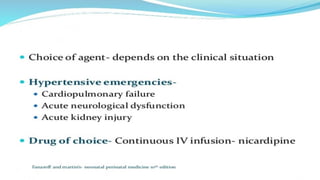
TREATMENTs
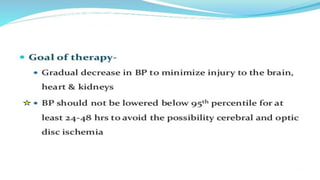
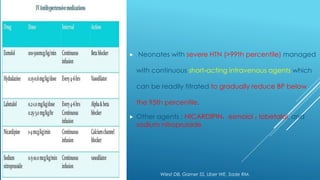
 Neonates with severe HTN (>99th percentile) managed
with continuous short-acting intravenous agents which
can be readily titrated to gradually reduce BP below
the 95th percentile.
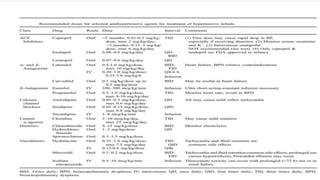
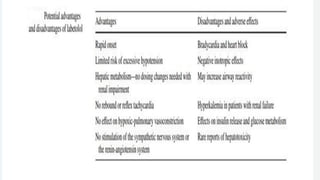
 Other agents : NICARDIPIN، esmolol ، labetalol, and
sodium nitroprusside
Wiest DB, Garner SS, Uber WE, Sade RM.
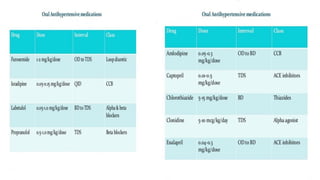
CALCIUM CHANNEL BLOCKER:
• THE SHORT-ACTING ISRADIPINE (DOSAGE OF 0.05–
0.1 MG/KG/ DOSE EVERY 6–8 H) PARTICULARLY IN
BRONCHOPULMONARY DYSPLASIA OR STEROID
INDUCED HTN
• AMLODIPINE LONGER DURATION OF ACTION
DELAYED ONSET OF ACTION
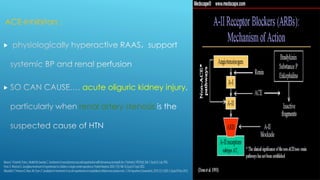
ACE-inhibitors :
not to use ACE-inhibitors in preterm neonate :
1. negative effects of the development of the kidney.
2. the reaction unpredictable
3. risk of profound hypotension with possible renal failure and severe
neurological consequences
captopril dosage in neonates are much lower than those used in full-term
babies
ACE-inhibitors :

 acute oliguric kidney injury
renal artery stenosis
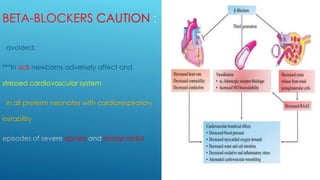
BETA-BLOCKERS CAUTION
avoided:
***in sick newborns adversely affect and
stressed cardiovascular system
in all preterm neonates with cardiorespiratory
instability
apnea bradycardia
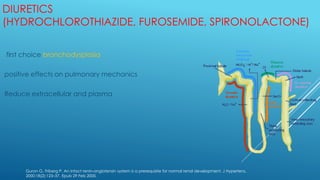
DIURETICS
(HYDROCHLOROTHIAZIDE, FUROSEMIDE, SPIRONOLACTONE)
first choice bronchodysplasia
positive effects on pulmonary mechanics
Reduce extracellular and plasma
Guron G, Friberg P. An intact renin-angiotensin system is a prerequisite for normal renal development. J Hypertens.
2000;18(2):123–37. Epub 29 Feb 2000.
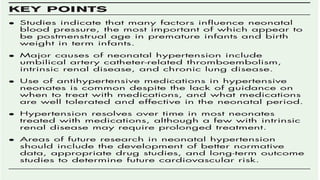
 Many causes of HTN that begin in the newborn period resolve spontaneously by 1 year
of age. Thus, “step-down” care should be anticipated. Also, most infants tend to
outgrow their medication dosages due to rapid body growth during infancy.
conditions can be treated surgically:
1. coarctation of the aorta
2. some neoplasias
3. urologic diseases
Thanks for your attention

HTN in heonates and infants

  • 1.
    NEONATE AND INFANTILE HYPERTENSION Dr.ELHAMEMAMI PEDIATRIC NEPHROLOGIST
  • 2.
    NORMAL BLOOD PRESSUREIN NEONATES Controversia_need clinical trial  factors significant influence on BP: gestational age at birth appropriateness of size for gestational age
  • 4.
    DEFINITION and incidence: Neonatal hypertension : systolic blood pressure of at least the 95th percentile incidence :1.3 % - 2 % in nicu multiple BP measurements are needed( 3 separate occasions)  Dress Giri and Roth have disclosed no financial relationships relevant to this article. This commentary does not contain a discussion of an unapproved/investigative use of a commercial product/device.
  • 5.
    Severe htn (definedby systolic BP >99th percentile): end organ damage: vascular injury, left ventricular hypertrophy, encephalopathy, and hypertensive retinopathy complications from, linked to hypertension beyond infancy diagnose and aggressively manage severe or persistent hypertension
  • 6.
    ROUTINE EVALUATION OFBP IS NOT RECOMMENDED IN ALL NEONATES (AAP)  routinely screening in the absence of symptoms does not usually apply  do not recommend routine screening, which should begin annually only at 3 years of age. recent AAP guidelines (Pediatrics. 2017;140[3]:e20171904 Hypertension was considerably more common in infants with: bronchopulmonary dysplasia patent ductus arteriosus and intraventricular hemorrhage with indwelling umbilical arterial catheters Antenatal steroids
  • 9.
  • 10.
    The most commoncauses of hypertension by age: Newborn:### Renal artery thrombosis or embolus (umbilical artery catheter) Renal vein thrombosis Congenital renal malformations Coarctation of aorta Renal artery stenosis Bronchopulmonary dysplasia Infancy to 6 years: Renal parenchymal disease، Renal artery stenosis، Coarctation of the aorta Medications، Endocrine causes 6–10 years : Renal parenchymal disease، Renal artery stenosis، Primary (essential) ،Endocrine causes Adolescence: Primary (essential) hypertension، White coat hypertension، Renal parenchymal disease Substance abuse (cocaine, amphetamines, methamphetamines, phencyclidine, methylphenidate, caffeine) Teen pregnancy Endocrine cause
  • 13.
    Drug in etiology:  dexamethasone and other corticosteroids used to treat chronic pulmonary diseases  catecholamines (dopamine, adrenaline)  xanthines (caffeine and theophylline)  curare-mimetics (pancuronium)  mydriatic eye drops (phenylephrine)
  • 14.
    VOGT M, KUHNA, BAUMGARTNER D, BAUMGARTNER C, BUSCH R, KOSTOLNY M, HESS J. IMPAIRED ELASTIC PROPERTIES OF THE ASCENDING AORTA IN NEWBORNS BEFORE AND EARLY AFTER SUCCESSFUL COARCTATION REPAIR—PROOF OF A SYSTEMIC VASCULAR DISEASE OF THE PRESTENOTIC ARTERIES? CIRCULATION 2005; 111: 3269–3273. POLSON JW, MCCALLION N, WAKI H, THORNE G, TOOLEY MA, PATON JFR, WOLF AR. EVIDENCE FOR CARDIOVASCULAR AUTONOMIC DYSFUNCTION IN NEONATES WITH COARCTATION OF THE AORTA. CIRCULATION 2006; 113: 2844–2850 Hypertension and coarctation of the aorta : increased aortic stiffnes alteration in autonomic cardiac balance maladaptive response to mechanisms responsible for longer term blood pressure control Endothelial dysfunction
  • 15.
    MAXIMUM AORTIC THICKNESSWAS SIGNIFICANTLY HIGHER STIFFNESS INDEX CONCLUSION: THE AORTIC WALL THICKNESS AND VASOMOTOR FUNCTION ARE SIGNIFICANTLY ALTERED IN PRETERM INFANTS WITH SEVERE BPD.. Systemic arterial stiffness in infants with bronchopulmonary dysplasia: potential cause of systemic hypertension: Damien Kenny1, Jaimie W Polson2, Robin P Martin1, Julian FR Paton3 and Andrew R Wolf 4 Patients with coarctation of the aorta develop early onset hypertension in spite of early effective repair. (2011) 34, 543– 547; doi:10.1038/hr.2011.22; published online 17 March 2011
  • 17.
    1. oscillometric methods 2.intra-arterial transducer
  • 19.
    The majority ofmeasuring errors : inappropriate cuffs  in children: width of the cuff 40 % of the circumference of the arm.  in newborn babies: width 50 % of the arm circumference
  • 20.
    Oscillometric devices :proper cuff size a cuff too small gives falsely high BP reading  measurement in the right upper arm  infant in the supine position  minimizing infant activity  ****at least 1.5 hours after feeding medical intervention
  • 21.
  • 28.
    Plasma renin activityis very high in newborns little data normal values for infants particularly for preterm typically quite high in infancy particularly in premature renal artery stenosis and thromboembolism are high renin states, peripheral plasma renin activity may not be elevated in such infants methylxanthines, caffeine, and aminophylline these limitations
  • 29.
     angiography goldstandard renal artery stenosis fibrodysplasia
  • 30.
  • 36.
     Neonates withsevere HTN (>99th percentile) managed with continuous short-acting intravenous agents which can be readily titrated to gradually reduce BP below the 95th percentile.  Other agents : NICARDIPIN، esmolol ، labetalol, and sodium nitroprusside Wiest DB, Garner SS, Uber WE, Sade RM.
  • 38.
    CALCIUM CHANNEL BLOCKER: •THE SHORT-ACTING ISRADIPINE (DOSAGE OF 0.05– 0.1 MG/KG/ DOSE EVERY 6–8 H) PARTICULARLY IN BRONCHOPULMONARY DYSPLASIA OR STEROID INDUCED HTN • AMLODIPINE LONGER DURATION OF ACTION DELAYED ONSET OF ACTION
  • 39.
    ACE-inhibitors : not touse ACE-inhibitors in preterm neonate : 1. negative effects of the development of the kidney. 2. the reaction unpredictable 3. risk of profound hypotension with possible renal failure and severe neurological consequences captopril dosage in neonates are much lower than those used in full-term babies
  • 40.
    ACE-inhibitors :   acuteoliguric kidney injury renal artery stenosis
  • 42.
    BETA-BLOCKERS CAUTION avoided: ***in sicknewborns adversely affect and stressed cardiovascular system in all preterm neonates with cardiorespiratory instability apnea bradycardia
  • 43.
    DIURETICS (HYDROCHLOROTHIAZIDE, FUROSEMIDE, SPIRONOLACTONE) firstchoice bronchodysplasia positive effects on pulmonary mechanics Reduce extracellular and plasma Guron G, Friberg P. An intact renin-angiotensin system is a prerequisite for normal renal development. J Hypertens. 2000;18(2):123–37. Epub 29 Feb 2000.
  • 44.
     Many causesof HTN that begin in the newborn period resolve spontaneously by 1 year of age. Thus, “step-down” care should be anticipated. Also, most infants tend to outgrow their medication dosages due to rapid body growth during infancy. conditions can be treated surgically: 1. coarctation of the aorta 2. some neoplasias 3. urologic diseases
  • 48.