Module – 5 HUMAN RESOURCE ANALYTICS
Dr Nagarajan
Professor
Rajarajeswari College of Engineering
Bengaluru
Defining Metrics
“A System or a standard of Metrics”
“Simply put, Metrics are a way to quantify, measure, and track
key performance indicators”
In HR, Metrics are used to measure and track the performance
of the company’s largest investment.
Defining Metrics
Some questions need to be asked
- Why do we track metrics?
- Why are they important?
- What metrics do we track?
- What do we do with the information we track?
Defining HR Metrics
Human Resource (HR) metrics are measurements used to determine
the value and effectiveness of HR initiatives, typically including such
areas as turnover, training, return on human capital, costs of labor,
and expenses per employee.
Human Resources’ role in Metrics and Analytics
- Shift in focus from administrative to strategic
- Focus on revenue, Growth, Market share, Productivity.
- HR has direct impact on data driven decisions
- Data is the key
The connection between the organizational strategy and HR
In some way that an organization has a specific strategy, so
must HR.
To demonstrate HR’s value to the organization, metrics must
tie to what is most important to the C-Suite
In other words, HR metrics must tie directly or indirectly to the
organizational strategy
How HR can bring value to the organization through metrics
Understand WHY you are measuring
- Don’t measure just for the sake of measurement
- What do you hope to discover, improve, increase/decrease with
metrics
- Have an action plan once metrics are attained
Understand WHAT you are measuring
- Metrics must relate to business
- Metrics must be important to the leader
- Metrics should be easy to gather, analyse and disseminate
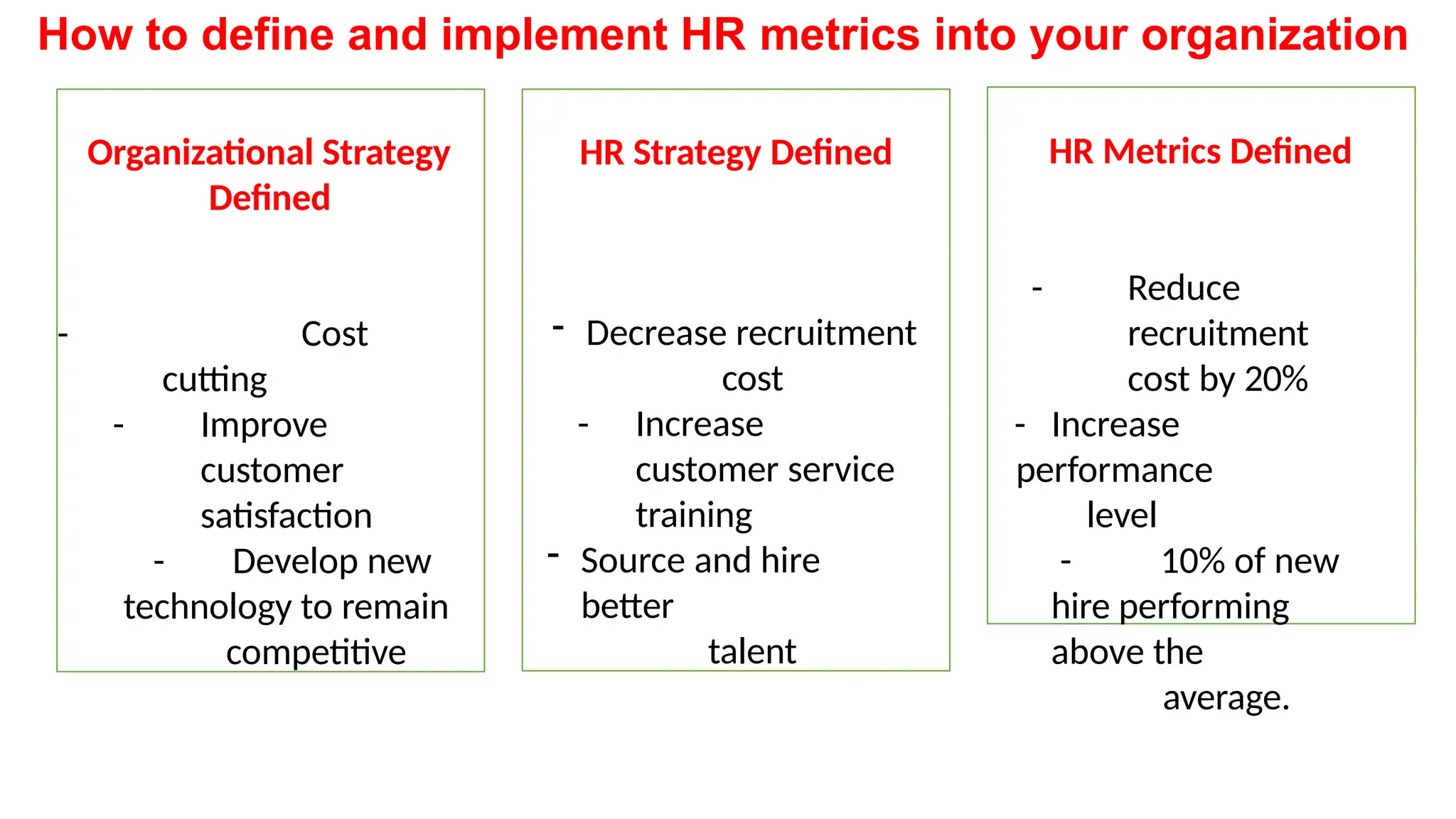
How to define and implement HR metrics into your organization
Organizational Strategy
Defined
- Cost
cutting
- Improve
customer
satisfaction
- Develop new
technology to remain
competitive
HR Strategy Defined
- Decrease recruitment
cost
- Increase
customer service
training
- Source and hire
better
talent
HR Metrics Defined
- Reduce
recruitment
cost by 20%
- Increase
performance
level
- 10% of new
hire performing
above the
average.
Key Points To Remember
- Matric should give the whole picture, includingthe cost, quality, quantity,
time, cost and effectiveness
- Focus on key area where change is necessary
- Develop a benchmark to use for evaluating progress towards goals
- Set goals and establish metrics for measuring progress
- If possible, compare with Competitors
- Use the language of your leaders
- Hard metrics(real data) are better than soft metrics
- HR Metrics are directly related to important business issues
- Easy to understand and data should be readily available
- Don’t keep metrics as secret
- Use metrics to identify trends and head off problems on the horizon
- Don’t be afraid of metrics and measuring data
Demographics
As you create the measurement plan, consider which
demographics have are a reasonable connection to the
investment, as well as the type of demographic data that is
available.
Demographics
Two Categories:
- Individual – Individuals personality traits, such as age,
gender, education level, ethnicity and so on.
- Organizational – derived fromsome unit the
individual is part of – Region, division and work unit and so
on
These data come from different sources and are linked back to
individual.
Organizational demographics are more fluid than the individual
•Operations
Data sources and requirements
• Compensation
• Customer service
• Human resources information systems (HRIS)
• Learning management systems (LMS)
• Social media and non-traditional learning systems
• Engagement
• Surveys
• Performance management systems
• Interviews and estimation by experts
• Public data from outside the organization
Types of Data
Operational Data:
- Tracks the business processes
- Sales commission, revenue, Call centre information, defects,
safety incidents,
- This has a advantage as it is closest to the cash flow and likely to be well
organised and closely tracked
- It doesn’t have privacy issue as it is with HR Data
- The results with the analysis of this data has got instant credibility because
the metrics align with those tracked by executives.
Types of Data
Customer service data:
- Addresses the important business processes – in particularly where there is
a high ratio of customers facing employees i.e. “Surface Area”
- It can be measured in many ways
- Reported satisfaction
- Business Results
Types of Data
Human Resource Information System:
- Primarily they provide demographic information – education, tenure,
job title and other details
- It includes compensation data
- Provides master list of participants in the measurement of project
- Most likely source for mapping data that ties different data set together
Types of Data
Learning Management System.
- Contains information about training, which is a common focus of
human capital investment measurement.
- Training received and date on which the training received
- Online training virtually always contain ways of tracking this information
- Traditional classroom method has an issue of tracking – Logbook
of classroom booking and simple spreadsheet maintains the same is ideal
Types of Data
Social media and informal learning system.
Organizations use social media in different fashion
- Promoting and sharing information about the company with the outsider
- Recording the public sentiment about the company and its Products and
Services
- Use social media internally providing a forum for employee to
browse and post useful content.
- Mind set of social media is still a challenge as it requires
relinquishing central control and allowing free, unstructured exchange of
information.
- If we collect the information about who has collected the information, it is
possible to directly measure impact on individual.
- External social media may be difficult to or impossible platform on which to
Types of Data
Engagement Survey.
- Effective instrument for gauging sentiment by employees and are
gaining the popularity
- Includes gauging the employees satisfaction with their managers or
with their careers
- Because of its confidentiality these surveys are very difficult to map
to a particular individual or to a “Manager”
- Here the involvement of third party will make better sense
- Confidentiality is the important issue and all employees should not
worry their information?’’ and the further
about “Who is might
read consequences
- There are issues with the
surveys
Types of Data
Psychological Testing:
- These show promise in predicting the performance on job metrics,
both individual sense and “fit” towards the team.
- The role of “Psychological and social capital” in creating and maintaining a
dynamic, productive workplace is an area of growing importance.
- Research
resilience
suggest
are
that the concepts such as “Self efficacy,
hope and important
constructs in understanding employee
performance.
-
Types of Data
Performance Management System:
- Internal rating and planning systems designed to evaluate employees
or teams or to plan for future development for those employees.
- 360 Degree evaluation system
- KPI
- These can results in proposing someone for training programmes
- Relationship between the KPI’s and Performance system can be tested
Types of Data
Expert estimation:
- This is one way of collecting data from many things
- Information such as estimation of cost of security breach, the likely wood
of success for particular projects, or the amount of revenue a new
project could generate
- This method is commonly applied to costs and risks
Types of Data
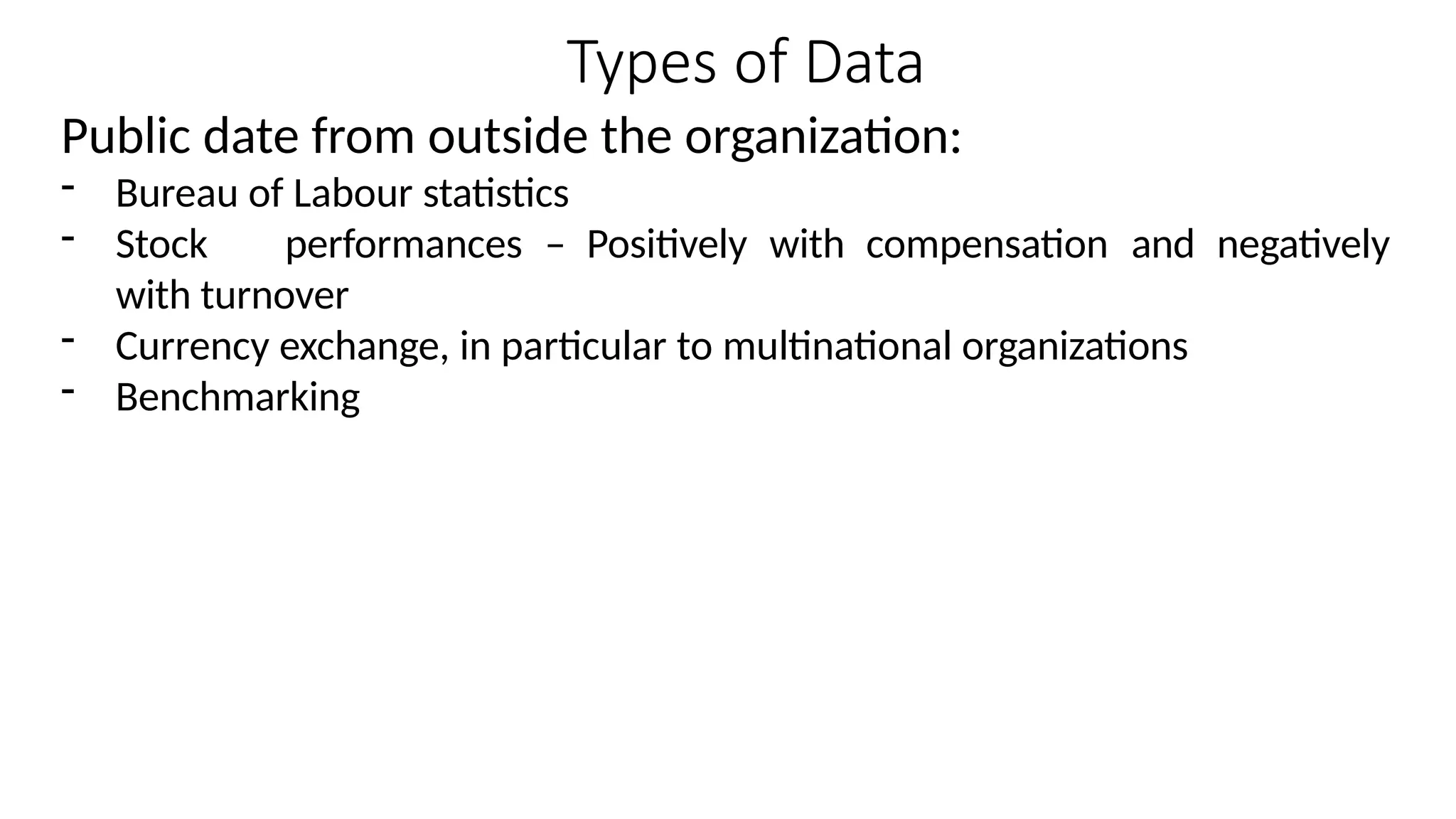
Public date from outside the organization:
- Bureau of Labour statistics
- Stock performances – Positively with compensation and negatively
with turnover
- Currency exchange, in particular to multinational organizations
- Benchmarking
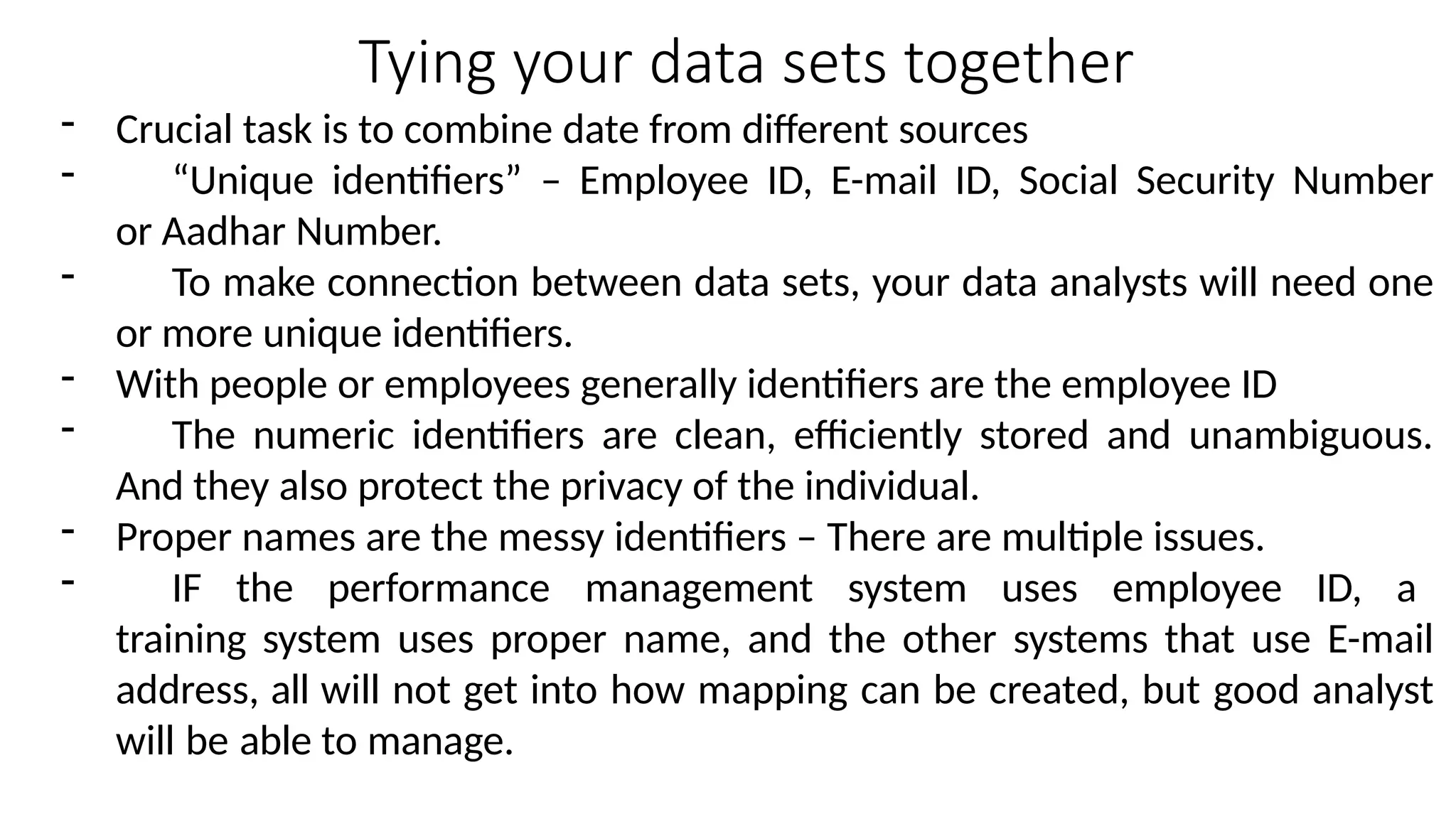
Tying your data sets together
- Crucial task is to combine date from different sources
- “Unique identifiers” – Employee ID, E-mail ID, Social Security Number
or Aadhar Number.
- To make connection between data sets, your data analysts will need one
or more unique identifiers.
- With people or employees generally identifiers are the employee ID
- The numeric identifiers are clean, efficiently stored and unambiguous.
And they also protect the privacy of the individual.
- Proper names are the messy identifiers – There are multiple issues.
- IF the performance management system uses employee ID, a
training system uses proper name, and the other systems that use E-mail
address, all will not get into how mapping can be created, but good analyst
will be able to manage.
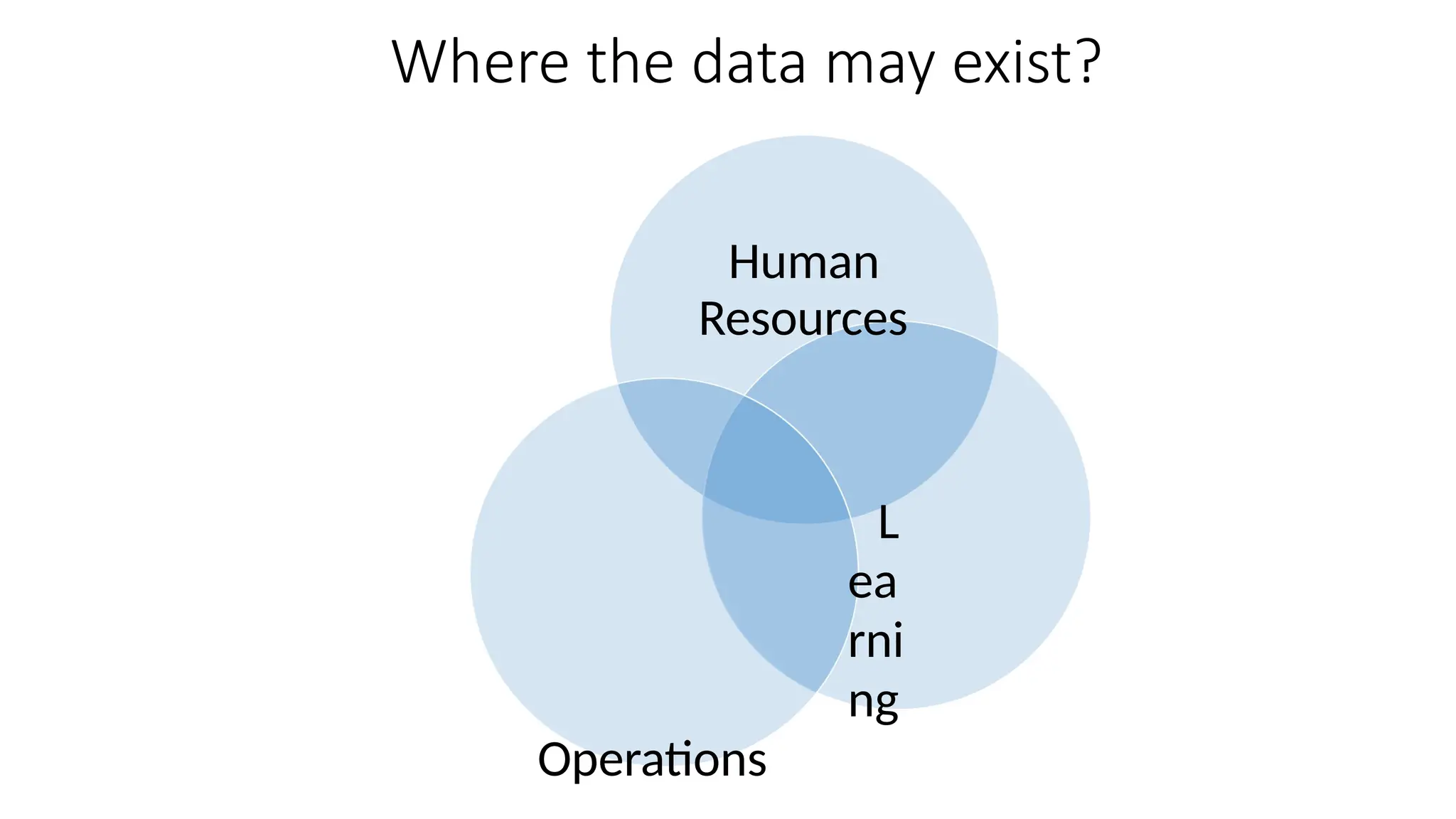
Where the data may exist?
Human
Resources
L
ea
rni
ng
Operations
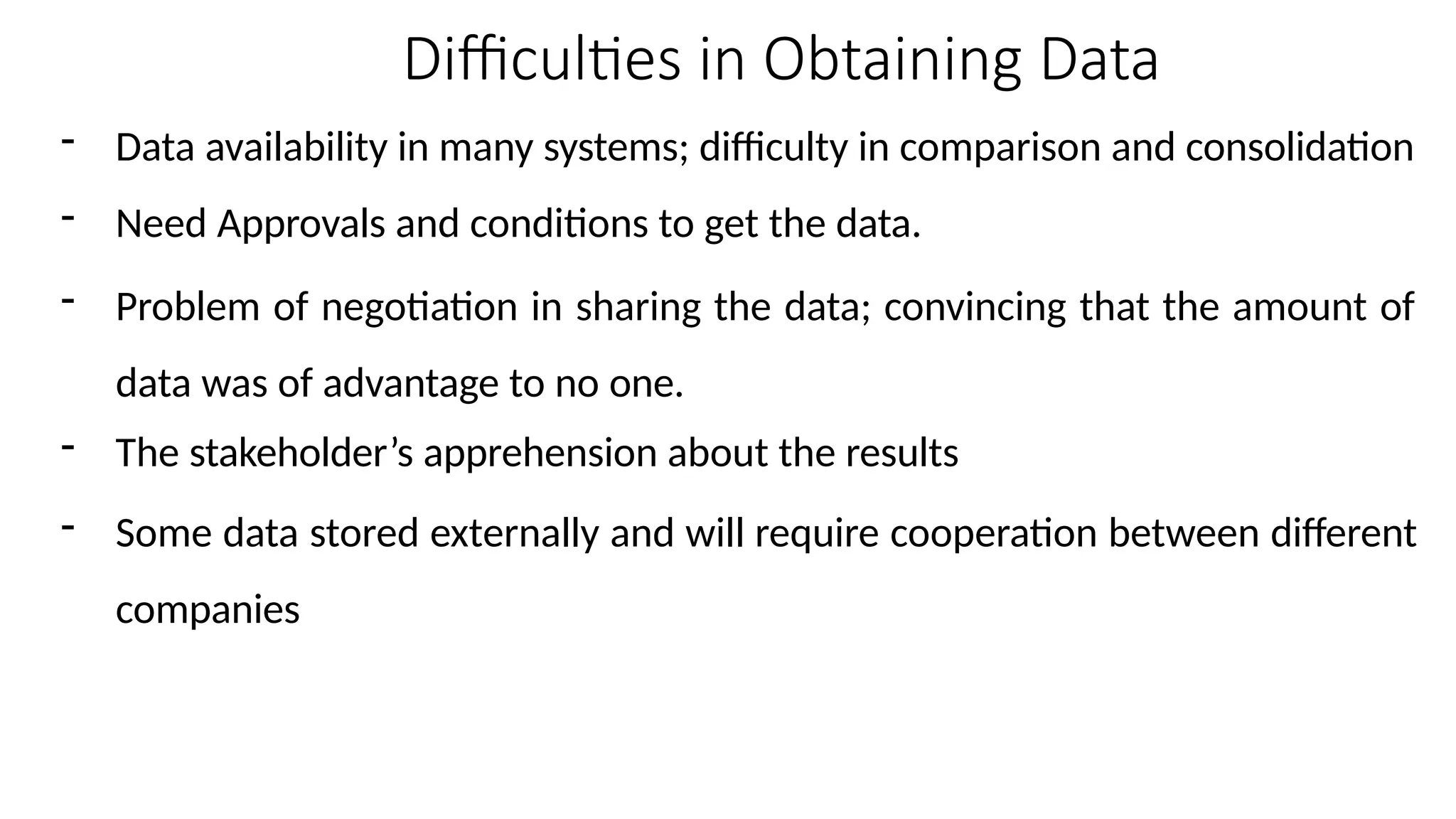
Difficulties in Obtaining Data
- Data availability in many systems; difficulty in comparison and consolidation
- Need Approvals and conditions to get the data.
- Problem of negotiation in sharing the data; convincing that the amount of
data was of advantage to no one.
- The stakeholder’s apprehension about the results
- Some data stored externally and will require cooperation between different
companies
Difficulties in Obtaining Data Conti….
- Systems have different criteria for including and excluding employees,
such as terminated employees, summer interns, contract and temporary
workers and more
- Some systems may use a convention for identifying employees that does
not exist elsewhere
- Employees may have slightly different identifiers in different systems.
- Not all employees belong in all data sets.
- Identifiers may change over time
Ethics of Measurement and Evaluation
- Sensitive information – Confidentiality – Using employee ID can
safeguard – “hashing” of identifiers, unique and reproducible but
does not give information to prying eyes. Secure and encrypted channels
to safeguard the information.
- Justification to some decision – by knowledge and techniques, which
may affect their life.
- Presence of wisdom and kindness in your process – HR analytics
should provide toolkit to make tough decision
Ethics of Measurement and Evaluation
- Seeking the help of the stakeholders and compliance officers
regarding understanding on “What data are off limits for making decision?”
Example- Pharmaceutical companies giving continuous education on the
treatment.
- Considering the race, gender and age, as they are very critical in making
the sensitive decision
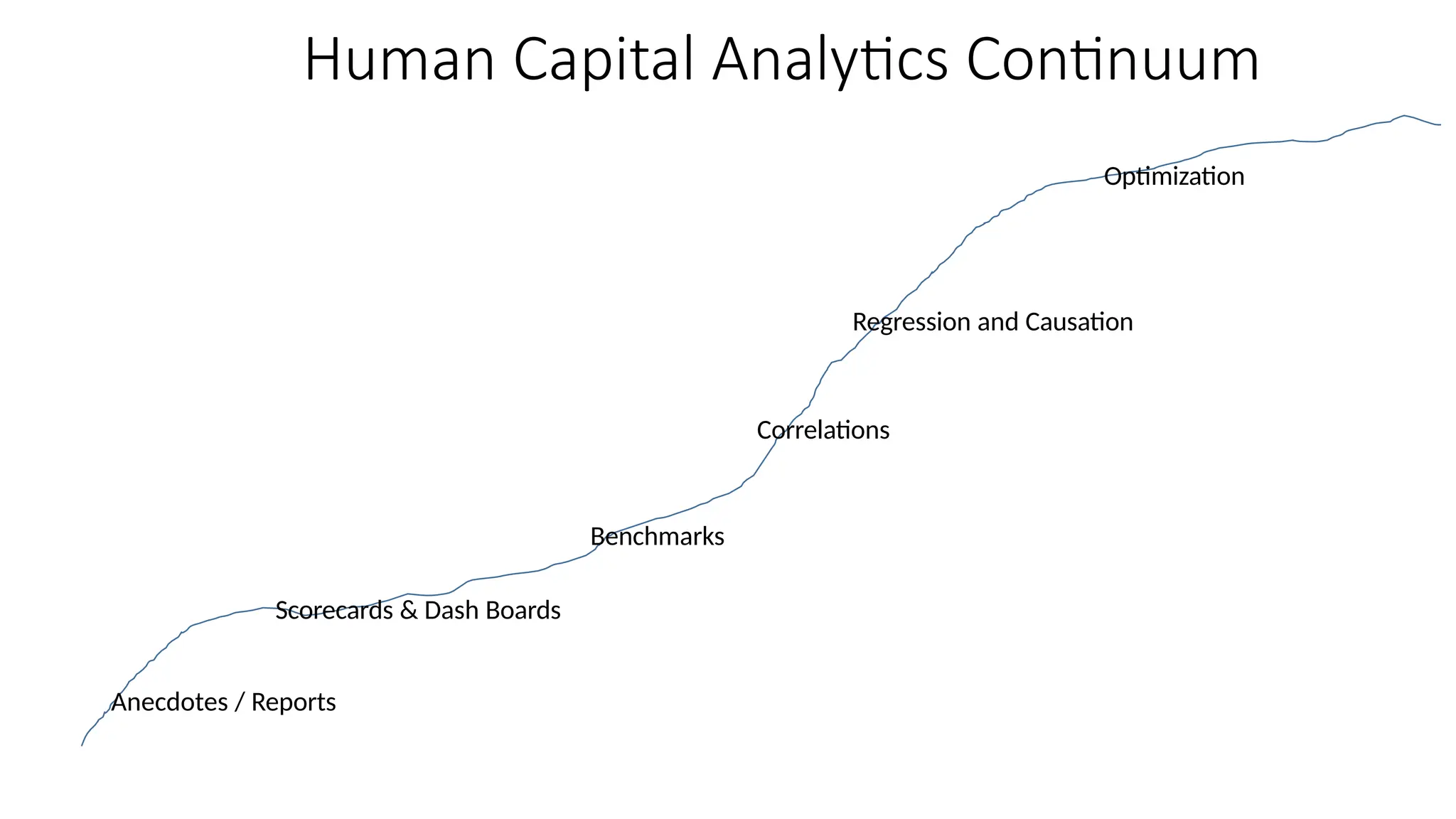
Human Capital Analytics Continuum
Regression and Causation
Correlations
Benchmarks
Scorecards & Dash Boards
Anecdotes / Reports
Optimization
Thank You

HRA 5TH MODULE Defining metrics and Demographics.pptx

  • 1.
    Module – 5HUMAN RESOURCE ANALYTICS Dr Nagarajan Professor Rajarajeswari College of Engineering Bengaluru
  • 2.
    Defining Metrics “A Systemor a standard of Metrics” “Simply put, Metrics are a way to quantify, measure, and track key performance indicators” In HR, Metrics are used to measure and track the performance of the company’s largest investment.
  • 3.
    Defining Metrics Some questionsneed to be asked - Why do we track metrics? - Why are they important? - What metrics do we track? - What do we do with the information we track?
  • 4.
    Defining HR Metrics HumanResource (HR) metrics are measurements used to determine the value and effectiveness of HR initiatives, typically including such areas as turnover, training, return on human capital, costs of labor, and expenses per employee.
  • 5.
    Human Resources’ rolein Metrics and Analytics - Shift in focus from administrative to strategic - Focus on revenue, Growth, Market share, Productivity. - HR has direct impact on data driven decisions - Data is the key
  • 6.
    The connection betweenthe organizational strategy and HR In some way that an organization has a specific strategy, so must HR. To demonstrate HR’s value to the organization, metrics must tie to what is most important to the C-Suite In other words, HR metrics must tie directly or indirectly to the organizational strategy
  • 7.
    How HR canbring value to the organization through metrics Understand WHY you are measuring - Don’t measure just for the sake of measurement - What do you hope to discover, improve, increase/decrease with metrics - Have an action plan once metrics are attained Understand WHAT you are measuring - Metrics must relate to business - Metrics must be important to the leader - Metrics should be easy to gather, analyse and disseminate
  • 8.
    How to defineand implement HR metrics into your organization Organizational Strategy Defined - Cost cutting - Improve customer satisfaction - Develop new technology to remain competitive HR Strategy Defined - Decrease recruitment cost - Increase customer service training - Source and hire better talent HR Metrics Defined - Reduce recruitment cost by 20% - Increase performance level - 10% of new hire performing above the average.
  • 9.
    Key Points ToRemember - Matric should give the whole picture, includingthe cost, quality, quantity, time, cost and effectiveness - Focus on key area where change is necessary - Develop a benchmark to use for evaluating progress towards goals - Set goals and establish metrics for measuring progress - If possible, compare with Competitors - Use the language of your leaders - Hard metrics(real data) are better than soft metrics - HR Metrics are directly related to important business issues - Easy to understand and data should be readily available - Don’t keep metrics as secret - Use metrics to identify trends and head off problems on the horizon - Don’t be afraid of metrics and measuring data
  • 10.
    Demographics As you createthe measurement plan, consider which demographics have are a reasonable connection to the investment, as well as the type of demographic data that is available.
  • 11.
    Demographics Two Categories: - Individual– Individuals personality traits, such as age, gender, education level, ethnicity and so on. - Organizational – derived fromsome unit the individual is part of – Region, division and work unit and so on These data come from different sources and are linked back to individual. Organizational demographics are more fluid than the individual
  • 12.
    •Operations Data sources andrequirements • Compensation • Customer service • Human resources information systems (HRIS) • Learning management systems (LMS) • Social media and non-traditional learning systems • Engagement • Surveys • Performance management systems • Interviews and estimation by experts • Public data from outside the organization
  • 13.
    Types of Data OperationalData: - Tracks the business processes - Sales commission, revenue, Call centre information, defects, safety incidents, - This has a advantage as it is closest to the cash flow and likely to be well organised and closely tracked - It doesn’t have privacy issue as it is with HR Data - The results with the analysis of this data has got instant credibility because the metrics align with those tracked by executives.
  • 14.
    Types of Data Customerservice data: - Addresses the important business processes – in particularly where there is a high ratio of customers facing employees i.e. “Surface Area” - It can be measured in many ways - Reported satisfaction - Business Results
  • 15.
    Types of Data HumanResource Information System: - Primarily they provide demographic information – education, tenure, job title and other details - It includes compensation data - Provides master list of participants in the measurement of project - Most likely source for mapping data that ties different data set together
  • 16.
    Types of Data LearningManagement System. - Contains information about training, which is a common focus of human capital investment measurement. - Training received and date on which the training received - Online training virtually always contain ways of tracking this information - Traditional classroom method has an issue of tracking – Logbook of classroom booking and simple spreadsheet maintains the same is ideal
  • 17.
    Types of Data Socialmedia and informal learning system. Organizations use social media in different fashion - Promoting and sharing information about the company with the outsider - Recording the public sentiment about the company and its Products and Services - Use social media internally providing a forum for employee to browse and post useful content. - Mind set of social media is still a challenge as it requires relinquishing central control and allowing free, unstructured exchange of information. - If we collect the information about who has collected the information, it is possible to directly measure impact on individual. - External social media may be difficult to or impossible platform on which to
  • 18.
    Types of Data EngagementSurvey. - Effective instrument for gauging sentiment by employees and are gaining the popularity - Includes gauging the employees satisfaction with their managers or with their careers - Because of its confidentiality these surveys are very difficult to map to a particular individual or to a “Manager” - Here the involvement of third party will make better sense - Confidentiality is the important issue and all employees should not worry their information?’’ and the further about “Who is might read consequences - There are issues with the surveys
  • 19.
    Types of Data PsychologicalTesting: - These show promise in predicting the performance on job metrics, both individual sense and “fit” towards the team. - The role of “Psychological and social capital” in creating and maintaining a dynamic, productive workplace is an area of growing importance. - Research resilience suggest are that the concepts such as “Self efficacy, hope and important constructs in understanding employee performance. -
  • 20.
    Types of Data PerformanceManagement System: - Internal rating and planning systems designed to evaluate employees or teams or to plan for future development for those employees. - 360 Degree evaluation system - KPI - These can results in proposing someone for training programmes - Relationship between the KPI’s and Performance system can be tested
  • 21.
    Types of Data Expertestimation: - This is one way of collecting data from many things - Information such as estimation of cost of security breach, the likely wood of success for particular projects, or the amount of revenue a new project could generate - This method is commonly applied to costs and risks
  • 22.
    Types of Data Publicdate from outside the organization: - Bureau of Labour statistics - Stock performances – Positively with compensation and negatively with turnover - Currency exchange, in particular to multinational organizations - Benchmarking
  • 23.
    Tying your datasets together - Crucial task is to combine date from different sources - “Unique identifiers” – Employee ID, E-mail ID, Social Security Number or Aadhar Number. - To make connection between data sets, your data analysts will need one or more unique identifiers. - With people or employees generally identifiers are the employee ID - The numeric identifiers are clean, efficiently stored and unambiguous. And they also protect the privacy of the individual. - Proper names are the messy identifiers – There are multiple issues. - IF the performance management system uses employee ID, a training system uses proper name, and the other systems that use E-mail address, all will not get into how mapping can be created, but good analyst will be able to manage.
  • 24.
    Where the datamay exist? Human Resources L ea rni ng Operations
  • 25.
    Difficulties in ObtainingData - Data availability in many systems; difficulty in comparison and consolidation - Need Approvals and conditions to get the data. - Problem of negotiation in sharing the data; convincing that the amount of data was of advantage to no one. - The stakeholder’s apprehension about the results - Some data stored externally and will require cooperation between different companies
  • 26.
    Difficulties in ObtainingData Conti…. - Systems have different criteria for including and excluding employees, such as terminated employees, summer interns, contract and temporary workers and more - Some systems may use a convention for identifying employees that does not exist elsewhere - Employees may have slightly different identifiers in different systems. - Not all employees belong in all data sets. - Identifiers may change over time
  • 27.
    Ethics of Measurementand Evaluation - Sensitive information – Confidentiality – Using employee ID can safeguard – “hashing” of identifiers, unique and reproducible but does not give information to prying eyes. Secure and encrypted channels to safeguard the information. - Justification to some decision – by knowledge and techniques, which may affect their life. - Presence of wisdom and kindness in your process – HR analytics should provide toolkit to make tough decision
  • 28.
    Ethics of Measurementand Evaluation - Seeking the help of the stakeholders and compliance officers regarding understanding on “What data are off limits for making decision?” Example- Pharmaceutical companies giving continuous education on the treatment. - Considering the race, gender and age, as they are very critical in making the sensitive decision
  • 29.
    Human Capital AnalyticsContinuum Regression and Causation Correlations Benchmarks Scorecards & Dash Boards Anecdotes / Reports Optimization
  • 30.