• HR analyticsis the process of collecting and analyzing
Human Resource (HR) data to improve an organization’s
staff performance. The synonyms of HR analytics are
talent analytics, people analytics, or even workforce
analytics
• HR analytics gives firms data-backed insight into what's
working and what isn't so they can improve and plan
more successfully for the future.
Introduction
3.
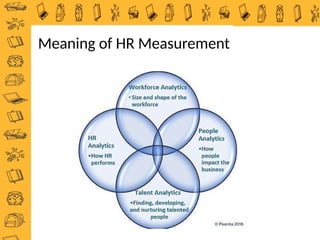
• Metrics aremeasures of quantitative assessment
frequently used for assessing, comparing and tracking
performance. HR Metrics are used to measure the
effectiveness of various HR responsibilities and initiatives
such as recruitment, retention, training, and labor costs.
Metrics are measures of quantitative assessment
frequently used for assessing, comparing and tracking
performance.
• Understanding the reporting needs of your executive
team, and then meeting those needs, can open the way
for you to become a more strategic force in your
organization. It isn’t frequency alone that matters when it
comes to HR metrics—it’s also about what you measure.
Meaning of HR Measurement
• Our brainsuse so-called cognitive biases to assist us to
deal with four major issues: information overload, a lack
of meaning, the need to act quickly, and recognizing what
needs to be retained for later. These shortcuts aren't free.
These methods also produce four major issues: we don't
see everything, we create illusions, our hasty decisions
might be significantly wrong, and our memories can
reinforce our mistake
Decision Making
• All theexternal market forces and internal organizational
factors are listed in terms of how they might affect the
organization’s human, structural, and relational capital.
Additionally, the interdependencies and interactions
across these three forms of capital are recognized and
accounted for. This is a critical, often ignored, point.
Scanning
11.
• Workforce planningis reconstituted as capability
development. The industrial-era, gap-analysis, and the
structure-focused model is replaced with an agile system
focused on building sustainable human capability rather
than filling positions; in fact, many of those older
positions will be restructured or eliminated.
Planning
12.
• Human resourcesservices are studied as processes with
inputs, throughputs, and outputs. Statistical analysis is
applied to uncover the most cost-effective combination of
inputs and throughputs to drive the desired outputs.
Predicting
• A three-point measurement system is designed to include
strategic, operational, and leading indicators. The causal
and correlational aspects of the three points are used to
tell a comprehensive story
Producing & predicting
14.
• More accuratedecision-making can be had thanks to a
data-driven approach, which reduces the need for
organizations to rely on intuition or guesswork in
decision-making.
• Strategies to improve retention can be developed thanks
to a deeper understanding of the reasons employees
leave or stay with an organization.
• Employee engagement can be improved by analyzing
data about employee behavior, such as how they work
with co-workers and customers, and determining how
processes and environment can be fine-tuned.
Advantages of HR Analytics
15.
• Recruitment andhiring can be better tailored to the
organization’s actual skillset needs by analyzing and
comparing the data of current employees and potential
candidates.
• Trends and patterns in HR data can lend themselves to
forecasting via predictive analytics, enabling organizations
to be proactive in maintaining a productive workforce.
Advantages of HR Analytics
16.
• Many HRdepartments lack the statistical and analytical
skillset to work with large datasets.
• Different management and reporting systems within the
organization can make it difficult to aggregate and
compare data.
• Access to quality data can be an issue for some
organizations that do not have up-to-date systems.
Organizations need access to good quality analysis and
reporting software that can utilize the data collected.
• Monitoring and collecting a greater amount of data with
new technologies (eg. cloud-based systems, wearable
devices), as well as basing predictions on data, can create
ethical issues
Disadvantages of HR Analytics
17.
• People -Understanding people means understanding HR
and the members of your organization so that you’re
asking good questions. Understanding fundamentals of
psychology, like how to motivate employees and teams,
comes in handy here. In HR, we need to understand why
people work, what they want from their careers, and why
they leave organizations.
Three Domains of HR Analyst
18.
• Business -Analytics will have limited impact if they aren’t
tied to challenges of importance to business leaders.
Analysts need to have a thorough understanding of the
business process and where the organization generates
its competitive advantage. It’s critical to understand the
issues business leaders care about and where the
business is in greatest need of help.
Three Domains of HR Analyst
19.
• Data -Understanding data is about two types of
expertise: data expertise and analytics expertise. Data
expertise involves working directly with data—data
extraction, cleaning, transformation, and management.
Analytics expertise involves data analysis, data
visualization, and validation. Although data fluency and
statistics, particularly more advanced statistics, are newer
skills for many HR professionals, you’ll see that much of
what is needed are things you're ready good at—
consulting, business acumen, and a deep understanding
of the people and people processes in your organization.
Three Domains of HR Analyst
20.
• Before aligningHR with the business goals, it is very
important to understand the process of HR analytics
Following are the steps of HR analytics
• Descriptive analytics.
• Predictive analytics. ...
• Prescriptive analytics. ...
• Diagnostic analytics
Process of HR Analytics
21.
• Descriptive analyticsis a statistical method that is used to
search and summarize historical data to identify patterns
or meaning, it's about describing the data and its
characteristics making some e meaning can be inferred
from it. pattern based on historic trends. Descriptive
analytics is all about understanding the pattern of the
data so that some meaning can be inferred from it.
Process of HR Analytics – Descriptive
Analysis
22.
• If acompany manager has data on the attrition level of
the employees of different departments over the last five
years and the past trends show that in L&D department
has the maximum rate of attrition. Interpret the key
results for Descriptive Statistics
• Step 1: Describe the size of your sample.
• Step 2: Describe the center of your data. Step 2: Describe
the center of your data.
• Step 3: Describe the spread of your data.
• Step 4: Evaluate the shape and spread of your data
distribution.
• Step 5: Comparison of different groups
Example
23.
• Predictive analyticsis a branch of advanced analytics that
makes predictions about future consequences using
historical data combined with statistical modeling, data
mining techniques.
• Though predictive analytics has been around for periods,
it's a technology whose time has come. Various
organizations are adopting predictive analytics to increase
their bottom line and competitive advantage.
Process of HR Analytics – Predictive
Analysis
24.
• In thecoming days how many employees will leave the
organization.
• How many customers will churn in near future?
• How many employees will get a promotion?
Example
25.
• Most contemporaryBI tools have built-in prescriptive
analytics for employers to make better decisions that are
not based on gut feelings. One of the more interesting
applications of prescriptive analytics is in oil and gas
management, where prices constantly fluctuate based on
ever-changing political, environmental, and demand
conditions.
• For recruiters, the ability to model employees retention
on a variety of factors allows them to make better
decisions about training, and performance appraisal.
Process of HR Analytics – Prescriptive
Analytics
26.
• Diagnostic analyticsis an approach that answers the
question, “Why did this happen?” Various incidents
occurred in the organization. Diagnostics analytics is an
approach that will give you an answer to the root cause
of those incidents so that precautionary measures can be
adopted in near future.
Process of HR Analytics – Diagnostic
analytics







![HR ANALYTICS[26].pptx](https://cdn.slidesharecdn.com/ss_thumbnails/hranalytics26-230506145358-4cc92c80-thumbnail.jpg?width=640&height=640&fit=bounds)


