Business Administration Expertise:
Strategic Management: Understanding how to develop and
execute long-term plans to achieve organizational goals. This
includes defining mission and vision, conducting SWOT analysis,
and formulating strategies.
Financial Management: Knowledge of financial principles and
practices, including budgeting, financial analysis, forecasting,
and investment decision-making. This expertise helps in
managing resources effectively and optimizing financial
performance.
Marketing Management: Understanding consumer behavior,
market research techniques, branding strategies, product
development, pricing strategies, and promotional tactics. This
expertise is crucial for creating and implementing effective
marketing campaigns.
Operations Management: Skills in optimizing processes, improving
efficiency, and managing resources to ensure smooth
operations. This includes supply chain management, inventory
control, quality management, and production planning.
Human Resource Management: Knowledge of HR principles and
practices, including recruitment, training, performance
evaluation, compensation management, and employee relations.
This expertise helps in building and managing effective teams.
Business Analytics: Ability to analyze data to derive insights and
support decision-making. This includes statistical analysis, data
visualization, predictive modeling, and business intelligence
tools.
Computer Applications Expertise:
Programming Languages: Proficiency in programming
languages such as Java, Python, C++, JavaScript,
etc., which are essential for software development
and system integration.
Database Management: Skills in designing,
implementing, and managing databases using
technologies like SQL, NoSQL, and relational
database management systems (RDBMS).
Software Development: Knowledge of software
development methodologies, such as Agile or
Waterfall, and experience in developing
applications, websites, or software products.
System Analysis and Design: Understanding business
requirements and translating them into technical
specifications for developing software solutions.
This includes creating system architectures, defining
functionalities, and designing user interfaces.
Networking and Security: Knowledge of computer
networks, protocols, and security measures to
ensure the integrity, confidentiality, and availability
of data and systems.
Web Development: Skills in creating dynamic and
interactive web applications using front-end and
back-end technologies like HTML, CSS, JavaScript,
and frameworks such as React, Angular, or Node.js.
1. Tech and Data Analytics: With the increasing importance of technology across industries, MBA graduates
were increasingly pursuing careers in tech companies, startups, or tech-related roles within traditional
industries. Data analytics, in particular, was a growing area of interest, with companies seeking professionals
who could interpret and leverage data to drive business decisions.
2. Entrepreneurship and Startups: Many MBA graduates were opting to launch their own ventures or join
startups. Entrepreneurial skills cultivated during MBA programs, coupled with a favorable ecosystem for
startups in various regions, encouraged more individuals to take the entrepreneurial path.
3. Social Impact and Sustainability: There was a rising interest among MBA students in careers that aligned
with social impact and sustainability goals. Many companies were integrating environmental, social, and
governance (ESG) considerations into their strategies, creating opportunities for MBAs to contribute to
sustainability initiatives.
4. Remote Work and Flexibility: The COVID-19 pandemic accelerated the acceptance of remote work
arrangements, providing MBA graduates with greater flexibility in choosing their work location and
schedule. This trend opened up opportunities for remote work and freelance consulting, allowing MBAs to
work with clients and companies globally.
5. Healthcare Management: The healthcare sector continued to offer promising career prospects for MBA
graduates, driven by factors such as an aging population, advancements in medical technology, and
evolving healthcare policies. Roles in healthcare consulting, pharmaceuticals, and hospital management
were in demand.
Ethical Hacker exp
ert
Ethical hackers are responsible to access a network or any computer system to disclose the security
susceptibilities on the behalf of its owner that a
Business Analyst
A Business analyst is responsible for those who are looking to start their setup and want to give a new idea in
market
Database Engineer
Most of the computer systems based companies do hiring for database manager, they hiring database
engineer to design and monitor complex databases in his company, The main role of these engineers to
provide data. With operation, rationality and relevancy
Trouble-shooters
Trouble-shooters are specialists who know both technologies of hardware and software – come handy to
those who need it. They resolve the issues which occurs they resolve and help in delivery of the project as
per the given time
App Developer
They are trained professional who develop the apps and responsible to designing, and building the app in
companies, they work to maintain and functioning properly of the mobile application for android, iOS,
windows, platforms, at this time app developer are most demanding professional and the company offered
them a handsome amount as well
Technical Writers
Online MCA student is good in technical and they full of the knowledge of computer a system, so who have
good writing skill can apply for technical writer where they have written about the description of product,
product specification, manual deign with the technical description
Manual Tester
These professionals are responsible for manual testing of software for faults. These expert are required to
play the role of an end-user who makes use of almost all the structures of the application to ensure behaving
exactly.
Lecturer They provide Lecture in an institute in government and private
Social Media
manager
Social media is answerable to look on social media performance and presence of any company over the
internet to make the popularity of a company in the virtual world.
Hardware Engineer
Hardware engineers are answerable to test the system including they do testing of all part of the computer, do
the production of all type hardware equipment in the computer system and also do installation, the functioning
of the internet.
6. Globalization and International Opportunities: As businesses expanded their operations
globally, there was a growing demand for MBA graduates with international experience and
cross-cultural competence. Multinational corporations sought professionals who could
navigate diverse markets and manage global teams effectively.
7. Soft Skills and Leadership Development: In addition to technical expertise, employers
increasingly valued soft skills such as communication, emotional intelligence, and
adaptability. MBA programs were placing greater emphasis on leadership development,
coaching, and experiential learning to prepare graduates for leadership roles.
8. Specialized MBA Programs: Traditional MBA programs were facing competition from
specialized master's degrees focusing on specific industries or functions, such as finance,
marketing, or supply chain management. Some students opted for these specialized
programs to gain deeper expertise in their area of interest.
9. Continued Learning and Lifelong Education: The dynamic nature of business and rapid
technological advancements necessitated a commitment to lifelong learning among MBA
graduates. Many professionals pursued continuous education through online courses,
certifications, or executive education programs to stay relevant in their careers.

Business Administration Expertise.pptx

  • 1.
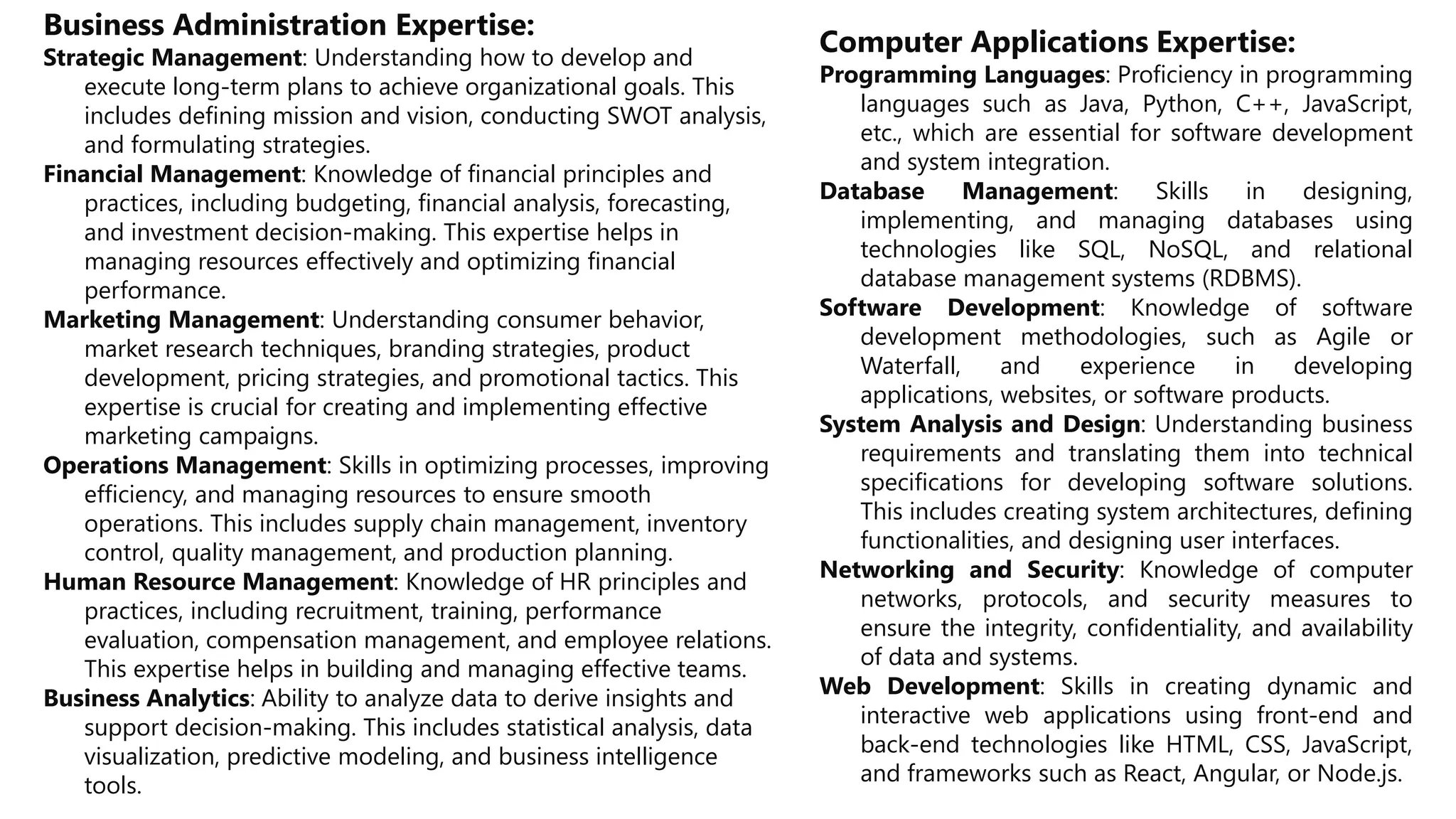
    Business Administration Expertise: StrategicManagement: Understanding how to develop and execute long-term plans to achieve organizational goals. This includes defining mission and vision, conducting SWOT analysis, and formulating strategies. Financial Management: Knowledge of financial principles and practices, including budgeting, financial analysis, forecasting, and investment decision-making. This expertise helps in managing resources effectively and optimizing financial performance. Marketing Management: Understanding consumer behavior, market research techniques, branding strategies, product development, pricing strategies, and promotional tactics. This expertise is crucial for creating and implementing effective marketing campaigns. Operations Management: Skills in optimizing processes, improving efficiency, and managing resources to ensure smooth operations. This includes supply chain management, inventory control, quality management, and production planning. Human Resource Management: Knowledge of HR principles and practices, including recruitment, training, performance evaluation, compensation management, and employee relations. This expertise helps in building and managing effective teams. Business Analytics: Ability to analyze data to derive insights and support decision-making. This includes statistical analysis, data visualization, predictive modeling, and business intelligence tools. Computer Applications Expertise: Programming Languages: Proficiency in programming languages such as Java, Python, C++, JavaScript, etc., which are essential for software development and system integration. Database Management: Skills in designing, implementing, and managing databases using technologies like SQL, NoSQL, and relational database management systems (RDBMS). Software Development: Knowledge of software development methodologies, such as Agile or Waterfall, and experience in developing applications, websites, or software products. System Analysis and Design: Understanding business requirements and translating them into technical specifications for developing software solutions. This includes creating system architectures, defining functionalities, and designing user interfaces. Networking and Security: Knowledge of computer networks, protocols, and security measures to ensure the integrity, confidentiality, and availability of data and systems. Web Development: Skills in creating dynamic and interactive web applications using front-end and back-end technologies like HTML, CSS, JavaScript, and frameworks such as React, Angular, or Node.js.
  • 2.
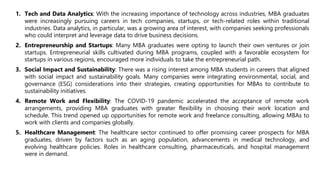
    1. Tech andData Analytics: With the increasing importance of technology across industries, MBA graduates were increasingly pursuing careers in tech companies, startups, or tech-related roles within traditional industries. Data analytics, in particular, was a growing area of interest, with companies seeking professionals who could interpret and leverage data to drive business decisions. 2. Entrepreneurship and Startups: Many MBA graduates were opting to launch their own ventures or join startups. Entrepreneurial skills cultivated during MBA programs, coupled with a favorable ecosystem for startups in various regions, encouraged more individuals to take the entrepreneurial path. 3. Social Impact and Sustainability: There was a rising interest among MBA students in careers that aligned with social impact and sustainability goals. Many companies were integrating environmental, social, and governance (ESG) considerations into their strategies, creating opportunities for MBAs to contribute to sustainability initiatives. 4. Remote Work and Flexibility: The COVID-19 pandemic accelerated the acceptance of remote work arrangements, providing MBA graduates with greater flexibility in choosing their work location and schedule. This trend opened up opportunities for remote work and freelance consulting, allowing MBAs to work with clients and companies globally. 5. Healthcare Management: The healthcare sector continued to offer promising career prospects for MBA graduates, driven by factors such as an aging population, advancements in medical technology, and evolving healthcare policies. Roles in healthcare consulting, pharmaceuticals, and hospital management were in demand.
  • 3.
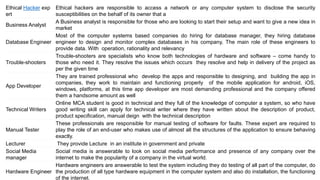
    Ethical Hacker exp ert Ethicalhackers are responsible to access a network or any computer system to disclose the security susceptibilities on the behalf of its owner that a Business Analyst A Business analyst is responsible for those who are looking to start their setup and want to give a new idea in market Database Engineer Most of the computer systems based companies do hiring for database manager, they hiring database engineer to design and monitor complex databases in his company, The main role of these engineers to provide data. With operation, rationality and relevancy Trouble-shooters Trouble-shooters are specialists who know both technologies of hardware and software – come handy to those who need it. They resolve the issues which occurs they resolve and help in delivery of the project as per the given time App Developer They are trained professional who develop the apps and responsible to designing, and building the app in companies, they work to maintain and functioning properly of the mobile application for android, iOS, windows, platforms, at this time app developer are most demanding professional and the company offered them a handsome amount as well Technical Writers Online MCA student is good in technical and they full of the knowledge of computer a system, so who have good writing skill can apply for technical writer where they have written about the description of product, product specification, manual deign with the technical description Manual Tester These professionals are responsible for manual testing of software for faults. These expert are required to play the role of an end-user who makes use of almost all the structures of the application to ensure behaving exactly. Lecturer They provide Lecture in an institute in government and private Social Media manager Social media is answerable to look on social media performance and presence of any company over the internet to make the popularity of a company in the virtual world. Hardware Engineer Hardware engineers are answerable to test the system including they do testing of all part of the computer, do the production of all type hardware equipment in the computer system and also do installation, the functioning of the internet.
  • 4.
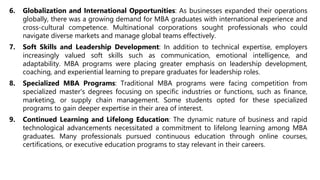
    6. Globalization andInternational Opportunities: As businesses expanded their operations globally, there was a growing demand for MBA graduates with international experience and cross-cultural competence. Multinational corporations sought professionals who could navigate diverse markets and manage global teams effectively. 7. Soft Skills and Leadership Development: In addition to technical expertise, employers increasingly valued soft skills such as communication, emotional intelligence, and adaptability. MBA programs were placing greater emphasis on leadership development, coaching, and experiential learning to prepare graduates for leadership roles. 8. Specialized MBA Programs: Traditional MBA programs were facing competition from specialized master's degrees focusing on specific industries or functions, such as finance, marketing, or supply chain management. Some students opted for these specialized programs to gain deeper expertise in their area of interest. 9. Continued Learning and Lifelong Education: The dynamic nature of business and rapid technological advancements necessitated a commitment to lifelong learning among MBA graduates. Many professionals pursued continuous education through online courses, certifications, or executive education programs to stay relevant in their careers.