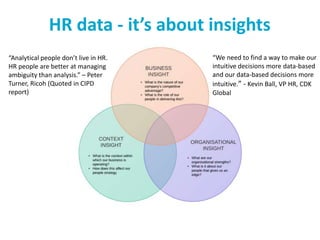
HR data - it’s about insights
“We need to find a way to make our
intuitive decisions more data-based
and our data-based decisions more
intuitive.” - Kevin Ball, VP HR, CDK
Global
“Analytical people don’t live in HR.
HR people are better at managing
ambiguity than analysis.” – Peter
Turner, Ricoh (Quoted in CIPD
report)
But “the people analytics revolution is gaining speed…in 2016 we see a major leap
forward in capabilities”
A lot more being said than done
From data to insights
• Data: Coded values collected from business processes, raw facts, eg
headcount and revenues (ambient data – stuff just lying around).
• Metrics: Measurement created by combining data, eg revenue per FTE.
• Analysis and information: Compared to what? Since when? Eg Has our
revenue per FTE gone up or down? How does that compare with our
competitors?
• Intelligence: What else do we know? Eg Do we have a lot of non-revenue
generating employees due to recent investment? How does this compare to
our competitors?
• Insight: Whole story, eg our revenue per FTE is still ahead of our
competitors, even after our increased research headcount.
3 levels of analytics
• Level 1 - basic analytics: The use of descriptive data to illustrate a particular
aspect of HR. This covers most of the standard reports from the HRIS, for
example, headcount, turnover, absence rates and age profiles.
• Level 2 - using multidimensional data: Combining different data sets, or
types of data to investigate relationships between them. This involves cross
referencing HR data with information from other systems, for example
looking at the relationship between absence and financial or sales
performance.
• Level 3 - predictive analysis: Using data to predict future trends or to
anticipate events and scenarios. For example, forecasting attrition rates or
modeling future remuneration costs. Some organisations claim to have used
HR analytics to identify probable leavers and predict future team
performance.
Data Metrics Information/Analysis Intelligence Insight
From data to insights
Number of
successful
calls
Number of
staff in each
location
Supervisor
development
scores
Training
investment
Successful
calls per
employee
Aggregate
scores by
location
Average
supervisor
rating
How do
locations
compare?
How has this
changed?
What is
difference
between
performance
of
supervisors?
Business
circumstances?
Seasonal
effects?
What else was
going on?
Where we
invested in
supervisor
development,
team
performance
improved
Quantitative Quantitative & qualitative
Is our supervisor development working?
Getting started
Focus on business priorities:
• To achieve our business goals, what information will we need over
the next 3 years?
• What is the CEO interested in?
• What stories do we want to be able to tell the exec team?
• How does the company make its money and how will these
measures help?
One version of the truth:
• Single point of data entry for all people data
• Integrate with other systems
• Clean your data
• Agree common coding with other functions
• HRIS becomes source for all people data on other systems
Getting started
Build your skills:
• Data and analytics team
• Critical thinking skills
• Ability to understand patterns in data - what it is telling us and what
it is not
• Consultancy skills - people who can understand the business, get HR
and can do data
Work with other functions:
• IT
• Finance
• Marketing
Just start!
• Download some data, mess about with it, see what you find
Poll – what do you measure?
1. Absence
2. Workforce costs
3. Employee turnover and retention
4. Workforce productivity
5. Cost of the HR function
6. Employee engagement
7. Remuneration relative to market
8. Metrics that link people management
to financial performance
9. None
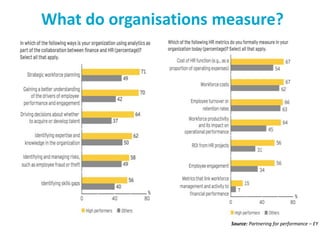
What do organisations measure?
Source: Partnering for performance – EY
Working with finance
“CFOs and CHROs at high-performing companies collaborate better and
differently”
Source: Partnering for performance – EY
Example metrics
Workforce profile:
• Heads and FTE
• Age and length of service
• Type, eg sales/operations/development/support
• Grade and span of control
Performance and productivity:
• Revenue per FTE
• Human Capital ROI
• Human Capital Value Added (HCVA)
• Absence
• Performance ratings relative to business performance
Reward:
• Total reward as % of revenue
• Compa ratios
• Percentage of employees paid above or below market rate
Talent:
• Capability gaps
• % new hires at mid-performance point by first review
• Succession risk - % of key roles with no clear successor
• Replacement impact (difference between reward of new hires and those who have left over same
period)
Compared to what?
Since when?
Source: NTPC
4 ways to show changing profile
Source: Institute for Government
Source: National Audit Office

Xpert HR webinar

  • 1.
    HR data -it’s about insights “We need to find a way to make our intuitive decisions more data-based and our data-based decisions more intuitive.” - Kevin Ball, VP HR, CDK Global “Analytical people don’t live in HR. HR people are better at managing ambiguity than analysis.” – Peter Turner, Ricoh (Quoted in CIPD report)
  • 2.
    But “the peopleanalytics revolution is gaining speed…in 2016 we see a major leap forward in capabilities” A lot more being said than done
  • 3.
    From data toinsights • Data: Coded values collected from business processes, raw facts, eg headcount and revenues (ambient data – stuff just lying around). • Metrics: Measurement created by combining data, eg revenue per FTE. • Analysis and information: Compared to what? Since when? Eg Has our revenue per FTE gone up or down? How does that compare with our competitors? • Intelligence: What else do we know? Eg Do we have a lot of non-revenue generating employees due to recent investment? How does this compare to our competitors? • Insight: Whole story, eg our revenue per FTE is still ahead of our competitors, even after our increased research headcount.
  • 4.
    3 levels ofanalytics • Level 1 - basic analytics: The use of descriptive data to illustrate a particular aspect of HR. This covers most of the standard reports from the HRIS, for example, headcount, turnover, absence rates and age profiles. • Level 2 - using multidimensional data: Combining different data sets, or types of data to investigate relationships between them. This involves cross referencing HR data with information from other systems, for example looking at the relationship between absence and financial or sales performance. • Level 3 - predictive analysis: Using data to predict future trends or to anticipate events and scenarios. For example, forecasting attrition rates or modeling future remuneration costs. Some organisations claim to have used HR analytics to identify probable leavers and predict future team performance.
  • 5.
    Data Metrics Information/AnalysisIntelligence Insight From data to insights Number of successful calls Number of staff in each location Supervisor development scores Training investment Successful calls per employee Aggregate scores by location Average supervisor rating How do locations compare? How has this changed? What is difference between performance of supervisors? Business circumstances? Seasonal effects? What else was going on? Where we invested in supervisor development, team performance improved Quantitative Quantitative & qualitative Is our supervisor development working?
  • 6.
    Getting started Focus onbusiness priorities: • To achieve our business goals, what information will we need over the next 3 years? • What is the CEO interested in? • What stories do we want to be able to tell the exec team? • How does the company make its money and how will these measures help? One version of the truth: • Single point of data entry for all people data • Integrate with other systems • Clean your data • Agree common coding with other functions • HRIS becomes source for all people data on other systems
  • 7.
    Getting started Build yourskills: • Data and analytics team • Critical thinking skills • Ability to understand patterns in data - what it is telling us and what it is not • Consultancy skills - people who can understand the business, get HR and can do data Work with other functions: • IT • Finance • Marketing Just start! • Download some data, mess about with it, see what you find
  • 8.
    Poll – whatdo you measure? 1. Absence 2. Workforce costs 3. Employee turnover and retention 4. Workforce productivity 5. Cost of the HR function 6. Employee engagement 7. Remuneration relative to market 8. Metrics that link people management to financial performance 9. None
  • 9.
    What do organisationsmeasure? Source: Partnering for performance – EY
  • 10.
    Working with finance “CFOsand CHROs at high-performing companies collaborate better and differently” Source: Partnering for performance – EY
  • 11.
    Example metrics Workforce profile: •Heads and FTE • Age and length of service • Type, eg sales/operations/development/support • Grade and span of control Performance and productivity: • Revenue per FTE • Human Capital ROI • Human Capital Value Added (HCVA) • Absence • Performance ratings relative to business performance Reward: • Total reward as % of revenue • Compa ratios • Percentage of employees paid above or below market rate Talent: • Capability gaps • % new hires at mid-performance point by first review • Succession risk - % of key roles with no clear successor • Replacement impact (difference between reward of new hires and those who have left over same period)
  • 12.
  • 13.
  • 14.
    4 ways toshow changing profile Source: Institute for Government Source: National Audit Office

Editor's Notes

  • #5 “The team didn’t start with fancy forecasting algorithms or advanced predictive tools. Instead, the team began by understanding the people problems that needed to be addressed and the organizational context.” – Google Re:work
  • #6 Does supervisor assessment match business performance? HR data from development centres and appraisal cross referenced with call handling data (Yes)   What’s the relationship between sales and training investment? Data from HR development system and sales system (Those that invested more sold more) Do we have “problem business units”? Calls to the HR service centre, absence data and data on project over-runs (Yes, there were problem areas)