Chapter Ten
Performance
Assessment and
Management
Copyright © Houghton Mifflin Company. All rights reserved. 10–2
Chapter Outline
• The Performance Assessment and Management
Process
• Strategic Importance of Performance Appraisal
• Functions of Performance Appraisal
• Criteria for a Good Assessment System
• Deciding What Types of Performance to Measure
• Methods of Appraising Performance
• Raters of Employee Performance
• Enhancing the Measurement of Employee
Performance
• Feedback of Results: The Performance Appraisal
Interview
Copyright © Houghton Mifflin Company. All rights reserved. 10–3
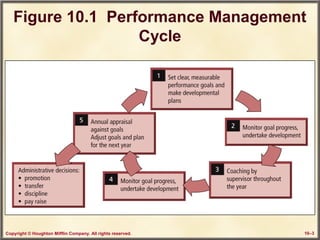
Figure 10.1 Performance Management
Cycle
Copyright © Houghton Mifflin Company. All rights reserved. 10–4
Strategic Importance of Performance
Assessment
• Consistency Between Organizational
Strategy and Job Behavior
• Consistency Between Organizational
Values and Job Behavior
Copyright © Houghton Mifflin Company. All rights reserved. 10–5
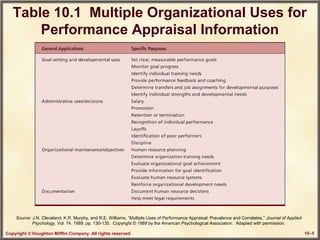
Table 10.1 Multiple Organizational Uses for
Performance Appraisal Information
Source: J.N. Cleveland, K.R. Murphy, and R.E. Williams, “Multiple Uses of Performance Appraisal: Prevalence and Correlates,” Journal of Applied
Psychology, Vol. 74. 1989, pp. 130-135. Copyright © 1989 by the American Psychological Association. Adapted with permission.
Copyright © Houghton Mifflin Company. All rights reserved. 10–6
Functions of Performance Assessment
• Performance Assessment as an
Employee Development Tool
– Goal Setting
– Reinforcing and Sustaining Performance
– Improving Performance
– Determining Career Progression Goals
– Determining Training Needs
Copyright © Houghton Mifflin Company. All rights reserved. 10–7
Functions of Performance Assessment
(cont’d)
• Performance Assessment as an
Administrative Tool
– Linking Rewards to Performance
– Evaluation of HRM Policies
and Programs
• Summary
Copyright © Houghton Mifflin Company. All rights reserved. 10–8
Criteria for a Good Appraisal System
• Validity
• Reliability
Copyright © Houghton Mifflin Company. All rights reserved. 10–9
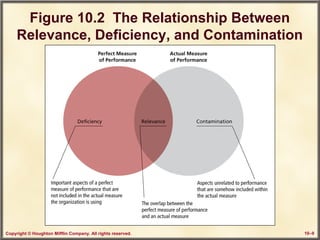
Figure 10.2 The Relationship Between
Relevance, Deficiency, and Contamination
Copyright © Houghton Mifflin Company. All rights reserved. 10–10
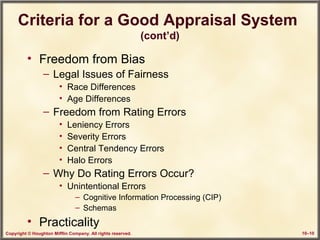
Criteria for a Good Appraisal System
(cont’d)
• Freedom from Bias
– Legal Issues of Fairness
• Race Differences
• Age Differences
– Freedom from Rating Errors
• Leniency Errors
• Severity Errors
• Central Tendency Errors
• Halo Errors
– Why Do Rating Errors Occur?
• Unintentional Errors
– Cognitive Information Processing (CIP)
– Schemas
• Practicality
Copyright © Houghton Mifflin Company. All rights reserved. 10–11
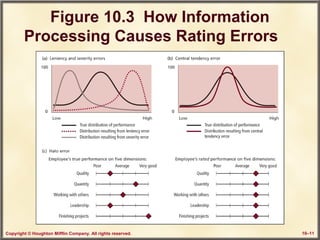
Figure 10.3 How Information
Processing Causes Rating Errors
Copyright © Houghton Mifflin Company. All rights reserved. 10–12
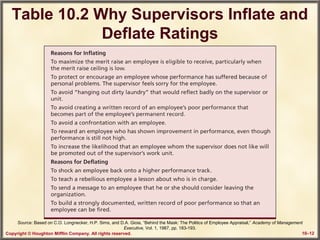
Table 10.2 Why Supervisors Inflate and
Deflate Ratings
Source: Based on C.O. Longnecker, H.P. Sims, and D.A. Gioia, “Behind the Mask: The Politics of Employee Appraisal,” Academy of Management
Executive, Vol. 1, 1987, pp. 183-193.
Copyright © Houghton Mifflin Company. All rights reserved. 10–13
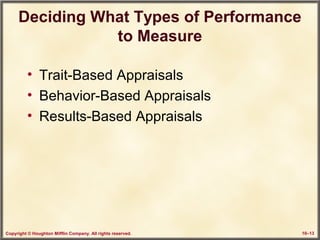
Deciding What Types of Performance
to Measure
• Trait-Based Appraisals
• Behavior-Based Appraisals
• Results-Based Appraisals
Copyright © Houghton Mifflin Company. All rights reserved. 10–14
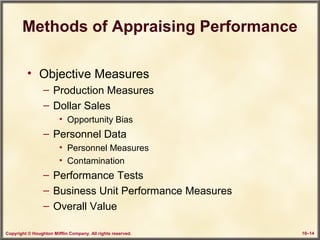
Methods of Appraising Performance
• Objective Measures
– Production Measures
– Dollar Sales
• Opportunity Bias
– Personnel Data
• Personnel Measures
• Contamination
– Performance Tests
– Business Unit Performance Measures
– Overall Value
Copyright © Houghton Mifflin Company. All rights reserved. 10–15
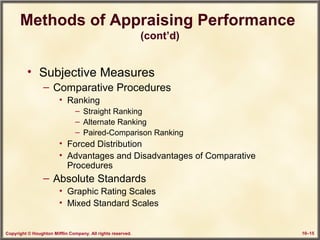
Methods of Appraising Performance
(cont’d)
• Subjective Measures
– Comparative Procedures
• Ranking
– Straight Ranking
– Alternate Ranking
– Paired-Comparison Ranking
• Forced Distribution
• Advantages and Disadvantages of Comparative
Procedures
– Absolute Standards
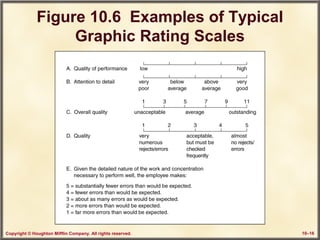
• Graphic Rating Scales
• Mixed Standard Scales
Copyright © Houghton Mifflin Company. All rights reserved. 10–16
Figure 10.6 Examples of Typical
Graphic Rating Scales
Copyright © Houghton Mifflin Company. All rights reserved. 10–17
Methods of Appraising Performance
(cont’d)
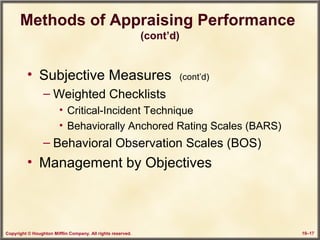
• Subjective Measures (cont’d)
– Weighted Checklists
• Critical-Incident Technique
• Behaviorally Anchored Rating Scales (BARS)
– Behavioral Observation Scales (BOS)
• Management by Objectives
Copyright © Houghton Mifflin Company. All rights reserved. 10–18
Raters of Employee Performance
• Self-Evaluation
• Peer Evaluation
• Subordinate Evaluation
• Customer Evaluation
• 360-Degree Assessment
• Self Managed Teams
Copyright © Houghton Mifflin Company. All rights reserved. 10–19
Enhancing the Measurement of
Employee Performance
• Training Evaluators
– Rater Error Training (RET)
– Frame-of-Reference (FOR) Training
– Information-Processing Approaches
• Observation Training
• Decision-Making Training
– Which Training Method is Best?
• Feedback to Evaluators
Copyright © Houghton Mifflin Company. All rights reserved. 10–20
Feedback of Results: The
Performance Appraisal Interview
• Types of Feedback Interviews
– Tell and Sell
– Tell and Listen
– Problem Solving
• Problems with the Appraisal Interview
– Disagreement and Defensiveness
– Multiple Purposes
– Impression Management in the Feedback Process
Copyright © Houghton Mifflin Company. All rights reserved. 10–21
Feedback of Results: The
Performance Appraisal Interview (cont’d)
• Improving the Performance Appraisal
Interview
– Feedback Specificity
– Subordinate Acceptance
– Setting Clear Goals
Copyright © Houghton Mifflin Company. All rights reserved. 10–22
Review
• The Performance Assessment and Management
Process
• Strategic Importance of Performance Assessment
• Functions of Performance Assessment
• Criteria for a Good Appraisal System
• Deciding What Types of Performance to Measure
• Methods of Appraising Performance
• Raters of Employee Performance
• Contemporary Assessment Challenges
• Enhancing the Measurement of Employee
Performance
• Feedback of Results: The Performance
Assessment Interview

Hra 310 chapter 10

  • 1.
  • 2.
    Copyright © HoughtonMifflin Company. All rights reserved. 10–2 Chapter Outline • The Performance Assessment and Management Process • Strategic Importance of Performance Appraisal • Functions of Performance Appraisal • Criteria for a Good Assessment System • Deciding What Types of Performance to Measure • Methods of Appraising Performance • Raters of Employee Performance • Enhancing the Measurement of Employee Performance • Feedback of Results: The Performance Appraisal Interview
  • 3.
    Copyright © HoughtonMifflin Company. All rights reserved. 10–3 Figure 10.1 Performance Management Cycle
  • 4.
    Copyright © HoughtonMifflin Company. All rights reserved. 10–4 Strategic Importance of Performance Assessment • Consistency Between Organizational Strategy and Job Behavior • Consistency Between Organizational Values and Job Behavior
  • 5.
    Copyright © HoughtonMifflin Company. All rights reserved. 10–5 Table 10.1 Multiple Organizational Uses for Performance Appraisal Information Source: J.N. Cleveland, K.R. Murphy, and R.E. Williams, “Multiple Uses of Performance Appraisal: Prevalence and Correlates,” Journal of Applied Psychology, Vol. 74. 1989, pp. 130-135. Copyright © 1989 by the American Psychological Association. Adapted with permission.
  • 6.
    Copyright © HoughtonMifflin Company. All rights reserved. 10–6 Functions of Performance Assessment • Performance Assessment as an Employee Development Tool – Goal Setting – Reinforcing and Sustaining Performance – Improving Performance – Determining Career Progression Goals – Determining Training Needs
  • 7.
    Copyright © HoughtonMifflin Company. All rights reserved. 10–7 Functions of Performance Assessment (cont’d) • Performance Assessment as an Administrative Tool – Linking Rewards to Performance – Evaluation of HRM Policies and Programs • Summary
  • 8.
    Copyright © HoughtonMifflin Company. All rights reserved. 10–8 Criteria for a Good Appraisal System • Validity • Reliability
  • 9.
    Copyright © HoughtonMifflin Company. All rights reserved. 10–9 Figure 10.2 The Relationship Between Relevance, Deficiency, and Contamination
  • 10.
    Copyright © HoughtonMifflin Company. All rights reserved. 10–10 Criteria for a Good Appraisal System (cont’d) • Freedom from Bias – Legal Issues of Fairness • Race Differences • Age Differences – Freedom from Rating Errors • Leniency Errors • Severity Errors • Central Tendency Errors • Halo Errors – Why Do Rating Errors Occur? • Unintentional Errors – Cognitive Information Processing (CIP) – Schemas • Practicality
  • 11.
    Copyright © HoughtonMifflin Company. All rights reserved. 10–11 Figure 10.3 How Information Processing Causes Rating Errors
  • 12.
    Copyright © HoughtonMifflin Company. All rights reserved. 10–12 Table 10.2 Why Supervisors Inflate and Deflate Ratings Source: Based on C.O. Longnecker, H.P. Sims, and D.A. Gioia, “Behind the Mask: The Politics of Employee Appraisal,” Academy of Management Executive, Vol. 1, 1987, pp. 183-193.
  • 13.
    Copyright © HoughtonMifflin Company. All rights reserved. 10–13 Deciding What Types of Performance to Measure • Trait-Based Appraisals • Behavior-Based Appraisals • Results-Based Appraisals
  • 14.
    Copyright © HoughtonMifflin Company. All rights reserved. 10–14 Methods of Appraising Performance • Objective Measures – Production Measures – Dollar Sales • Opportunity Bias – Personnel Data • Personnel Measures • Contamination – Performance Tests – Business Unit Performance Measures – Overall Value
  • 15.
    Copyright © HoughtonMifflin Company. All rights reserved. 10–15 Methods of Appraising Performance (cont’d) • Subjective Measures – Comparative Procedures • Ranking – Straight Ranking – Alternate Ranking – Paired-Comparison Ranking • Forced Distribution • Advantages and Disadvantages of Comparative Procedures – Absolute Standards • Graphic Rating Scales • Mixed Standard Scales
  • 16.
    Copyright © HoughtonMifflin Company. All rights reserved. 10–16 Figure 10.6 Examples of Typical Graphic Rating Scales
  • 17.
    Copyright © HoughtonMifflin Company. All rights reserved. 10–17 Methods of Appraising Performance (cont’d) • Subjective Measures (cont’d) – Weighted Checklists • Critical-Incident Technique • Behaviorally Anchored Rating Scales (BARS) – Behavioral Observation Scales (BOS) • Management by Objectives
  • 18.
    Copyright © HoughtonMifflin Company. All rights reserved. 10–18 Raters of Employee Performance • Self-Evaluation • Peer Evaluation • Subordinate Evaluation • Customer Evaluation • 360-Degree Assessment • Self Managed Teams
  • 19.
    Copyright © HoughtonMifflin Company. All rights reserved. 10–19 Enhancing the Measurement of Employee Performance • Training Evaluators – Rater Error Training (RET) – Frame-of-Reference (FOR) Training – Information-Processing Approaches • Observation Training • Decision-Making Training – Which Training Method is Best? • Feedback to Evaluators
  • 20.
    Copyright © HoughtonMifflin Company. All rights reserved. 10–20 Feedback of Results: The Performance Appraisal Interview • Types of Feedback Interviews – Tell and Sell – Tell and Listen – Problem Solving • Problems with the Appraisal Interview – Disagreement and Defensiveness – Multiple Purposes – Impression Management in the Feedback Process
  • 21.
    Copyright © HoughtonMifflin Company. All rights reserved. 10–21 Feedback of Results: The Performance Appraisal Interview (cont’d) • Improving the Performance Appraisal Interview – Feedback Specificity – Subordinate Acceptance – Setting Clear Goals
  • 22.
    Copyright © HoughtonMifflin Company. All rights reserved. 10–22 Review • The Performance Assessment and Management Process • Strategic Importance of Performance Assessment • Functions of Performance Assessment • Criteria for a Good Appraisal System • Deciding What Types of Performance to Measure • Methods of Appraising Performance • Raters of Employee Performance • Contemporary Assessment Challenges • Enhancing the Measurement of Employee Performance • Feedback of Results: The Performance Assessment Interview