Chapter Four
Job Analysis:
Concepts,
Procedures, and
Choices
Copyright © Houghton Mifflin Company. All rights reserved. 4–2
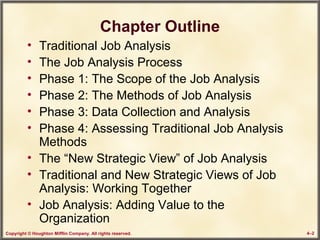
Chapter Outline
• Traditional Job Analysis
• The Job Analysis Process
• Phase 1: The Scope of the Job Analysis
• Phase 2: The Methods of Job Analysis
• Phase 3: Data Collection and Analysis
• Phase 4: Assessing Traditional Job Analysis
Methods
• The “New Strategic View” of Job Analysis
• Traditional and New Strategic Views of Job
Analysis: Working Together
• Job Analysis: Adding Value to the
Organization
Copyright © Houghton Mifflin Company. All rights reserved. 4–3
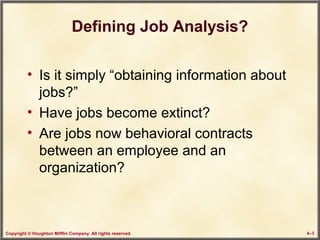
Defining Job Analysis?
• Is it simply “obtaining information about
jobs?”
• Have jobs become extinct?
• Are jobs now behavioral contracts
between an employee and an
organization?
Copyright © Houghton Mifflin Company. All rights reserved. 4–4
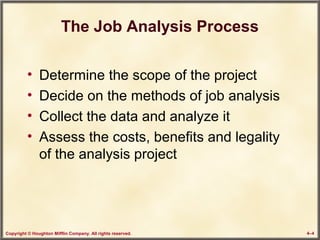
The Job Analysis Process
• Determine the scope of the project
• Decide on the methods of job analysis
• Collect the data and analyze it
• Assess the costs, benefits and legality
of the analysis project
Copyright © Houghton Mifflin Company. All rights reserved. 4–5
Phase 1: The Scope of the Job
Analysis
• How Will The Job Analysis Data Be
Used?
– Recruiting & selection
– Developing an appraising employees
– Determining compensation
– Job and organizational design
Copyright © Houghton Mifflin Company. All rights reserved. 4–6
Scope of Job Analysis (cont’d)
• Determining Which Jobs to Analyze
– Strategically important job
– Jobs that are difficult to learn
– Job that require frequent hiring
– Jobs where there are legal issues
– Jobs changed by new technology
Copyright © Houghton Mifflin Company. All rights reserved. 4–7
Phase 2: The Methods of Job Analysis
• Types of Job Data
– Work activities
– Human Abilities
– Occupational Information Network (O*NET)
– Qualitative data
– Quantitative data
Copyright © Houghton Mifflin Company. All rights reserved. 4–8
Phase 2: The Methods of Job Analysis
(cont’d)
• Sources of Job Data
– Non-Human Sources, such as…..
• Existing descriptions
• Films of employees working
• Blueprints
• Equipment maintenance records
– Subject Matter Experts (SMEs)
• Job incumbents
• Supervisors
• Job analysts
• Trainers
Copyright © Houghton Mifflin Company. All rights reserved. 4–9
Phase 2: The Methods of Job Analysis
• Job Analysis Procedures
– Narrative Job Descriptions
– Engineering Approaches
• Micromotion Studies
Copyright © Houghton Mifflin Company. All rights reserved. 4–10
Methods of Job Analysis (cont’d)
• Structured Job Analysis Procedures
• Critical Incidents Technique (CIT)
• Department of Labor O*NET
• Functional Job Analysis (FJA)
• Position Analysis Questionnaire
(PAQ)
• Task Inventory Procedure
• Ability Requirements Scales
• Personality-Related Procedures
Copyright © Houghton Mifflin Company. All rights reserved. 4–11
Methods of Job Analysis (cont’d)
• Structured Procedures (cont’d)
– Managerial Job Analysis Procedures
• Management Position Description
Questionnaire (MPDQ)
• Supervisory Task Description Questionnaire
(STDQ)
• Professional and Managerial
Position Questionnaire (PMPQ)
– Cognitive Task Analysis
Copyright © Houghton Mifflin Company. All rights reserved. 4–12
Phase 3: Data Collection and Analysis
• Collecting Job Data
– Getting the Organization Ready
– Sources of Bias
– Job Analysis Interviews
• Analyzing Job Data
• Reporting and
Rechecking Job Data
Copyright © Houghton Mifflin Company. All rights reserved. 4–13
Phase 4: Assessing Job Analysis
Methods
• Purposes served
• Versatility
• Standardization level
• User acceptance
• Training required
• Sample size needed
Copyright © Houghton Mifflin Company. All rights reserved. 4–14
Assessing Job Analysis Methods (cont’d)
• Off-the-shelf
• Reliability
• Legality
• Time to complete
• Cost
• Examine validity of the “job descriptive
inference”
Copyright © Houghton Mifflin Company. All rights reserved. 4–15
The New Strategic View of Job
Analysis
• Job Analysis Methods Should Be:
– Future-oriented
– Linked to key strategic issues
– More generic in their approach
Copyright © Houghton Mifflin Company. All rights reserved. 4–16
The New Strategic View (cont’d)
• Competency Modelling
– Task competencies
– Results competencies
– Outcome competencies
– Knowledge, skill, and attitude
competencies
– Superior performer differentiators
– Attribute bundles
Copyright © Houghton Mifflin Company. All rights reserved. 4–17
Job Analysis Adding Value?
• Dollar costs versus dollar benefits
• Non-dollar costs versus non-dollar
benefits
• Dollar and non-dollar costs/benefits
difficult to assess
• Critical issue is does job analysis help
employees perform better
Copyright © Houghton Mifflin Company. All rights reserved. 4–18
Review
• Traditional Job Analysis
• The Job Analysis Process
• Phase 1: The Scope of the Job Analysis
• Phase 2: The Methods of Job Analysis
• Phase 3: Data Collection and Analysis
• Phase 4: Assessing Traditional Job Analysis
Methods
• The New Strategic View of Job Analysis
• Traditional and New Strategic Views of Job
Analysis: Working Together
• Job Analysis: Adding Value to the
Organization

Hra 310 chapter 4

  • 1.
  • 2.
    Copyright © HoughtonMifflin Company. All rights reserved. 4–2 Chapter Outline • Traditional Job Analysis • The Job Analysis Process • Phase 1: The Scope of the Job Analysis • Phase 2: The Methods of Job Analysis • Phase 3: Data Collection and Analysis • Phase 4: Assessing Traditional Job Analysis Methods • The “New Strategic View” of Job Analysis • Traditional and New Strategic Views of Job Analysis: Working Together • Job Analysis: Adding Value to the Organization
  • 3.
    Copyright © HoughtonMifflin Company. All rights reserved. 4–3 Defining Job Analysis? • Is it simply “obtaining information about jobs?” • Have jobs become extinct? • Are jobs now behavioral contracts between an employee and an organization?
  • 4.
    Copyright © HoughtonMifflin Company. All rights reserved. 4–4 The Job Analysis Process • Determine the scope of the project • Decide on the methods of job analysis • Collect the data and analyze it • Assess the costs, benefits and legality of the analysis project
  • 5.
    Copyright © HoughtonMifflin Company. All rights reserved. 4–5 Phase 1: The Scope of the Job Analysis • How Will The Job Analysis Data Be Used? – Recruiting & selection – Developing an appraising employees – Determining compensation – Job and organizational design
  • 6.
    Copyright © HoughtonMifflin Company. All rights reserved. 4–6 Scope of Job Analysis (cont’d) • Determining Which Jobs to Analyze – Strategically important job – Jobs that are difficult to learn – Job that require frequent hiring – Jobs where there are legal issues – Jobs changed by new technology
  • 7.
    Copyright © HoughtonMifflin Company. All rights reserved. 4–7 Phase 2: The Methods of Job Analysis • Types of Job Data – Work activities – Human Abilities – Occupational Information Network (O*NET) – Qualitative data – Quantitative data
  • 8.
    Copyright © HoughtonMifflin Company. All rights reserved. 4–8 Phase 2: The Methods of Job Analysis (cont’d) • Sources of Job Data – Non-Human Sources, such as….. • Existing descriptions • Films of employees working • Blueprints • Equipment maintenance records – Subject Matter Experts (SMEs) • Job incumbents • Supervisors • Job analysts • Trainers
  • 9.
    Copyright © HoughtonMifflin Company. All rights reserved. 4–9 Phase 2: The Methods of Job Analysis • Job Analysis Procedures – Narrative Job Descriptions – Engineering Approaches • Micromotion Studies
  • 10.
    Copyright © HoughtonMifflin Company. All rights reserved. 4–10 Methods of Job Analysis (cont’d) • Structured Job Analysis Procedures • Critical Incidents Technique (CIT) • Department of Labor O*NET • Functional Job Analysis (FJA) • Position Analysis Questionnaire (PAQ) • Task Inventory Procedure • Ability Requirements Scales • Personality-Related Procedures
  • 11.
    Copyright © HoughtonMifflin Company. All rights reserved. 4–11 Methods of Job Analysis (cont’d) • Structured Procedures (cont’d) – Managerial Job Analysis Procedures • Management Position Description Questionnaire (MPDQ) • Supervisory Task Description Questionnaire (STDQ) • Professional and Managerial Position Questionnaire (PMPQ) – Cognitive Task Analysis
  • 12.
    Copyright © HoughtonMifflin Company. All rights reserved. 4–12 Phase 3: Data Collection and Analysis • Collecting Job Data – Getting the Organization Ready – Sources of Bias – Job Analysis Interviews • Analyzing Job Data • Reporting and Rechecking Job Data
  • 13.
    Copyright © HoughtonMifflin Company. All rights reserved. 4–13 Phase 4: Assessing Job Analysis Methods • Purposes served • Versatility • Standardization level • User acceptance • Training required • Sample size needed
  • 14.
    Copyright © HoughtonMifflin Company. All rights reserved. 4–14 Assessing Job Analysis Methods (cont’d) • Off-the-shelf • Reliability • Legality • Time to complete • Cost • Examine validity of the “job descriptive inference”
  • 15.
    Copyright © HoughtonMifflin Company. All rights reserved. 4–15 The New Strategic View of Job Analysis • Job Analysis Methods Should Be: – Future-oriented – Linked to key strategic issues – More generic in their approach
  • 16.
    Copyright © HoughtonMifflin Company. All rights reserved. 4–16 The New Strategic View (cont’d) • Competency Modelling – Task competencies – Results competencies – Outcome competencies – Knowledge, skill, and attitude competencies – Superior performer differentiators – Attribute bundles
  • 17.
    Copyright © HoughtonMifflin Company. All rights reserved. 4–17 Job Analysis Adding Value? • Dollar costs versus dollar benefits • Non-dollar costs versus non-dollar benefits • Dollar and non-dollar costs/benefits difficult to assess • Critical issue is does job analysis help employees perform better
  • 18.
    Copyright © HoughtonMifflin Company. All rights reserved. 4–18 Review • Traditional Job Analysis • The Job Analysis Process • Phase 1: The Scope of the Job Analysis • Phase 2: The Methods of Job Analysis • Phase 3: Data Collection and Analysis • Phase 4: Assessing Traditional Job Analysis Methods • The New Strategic View of Job Analysis • Traditional and New Strategic Views of Job Analysis: Working Together • Job Analysis: Adding Value to the Organization