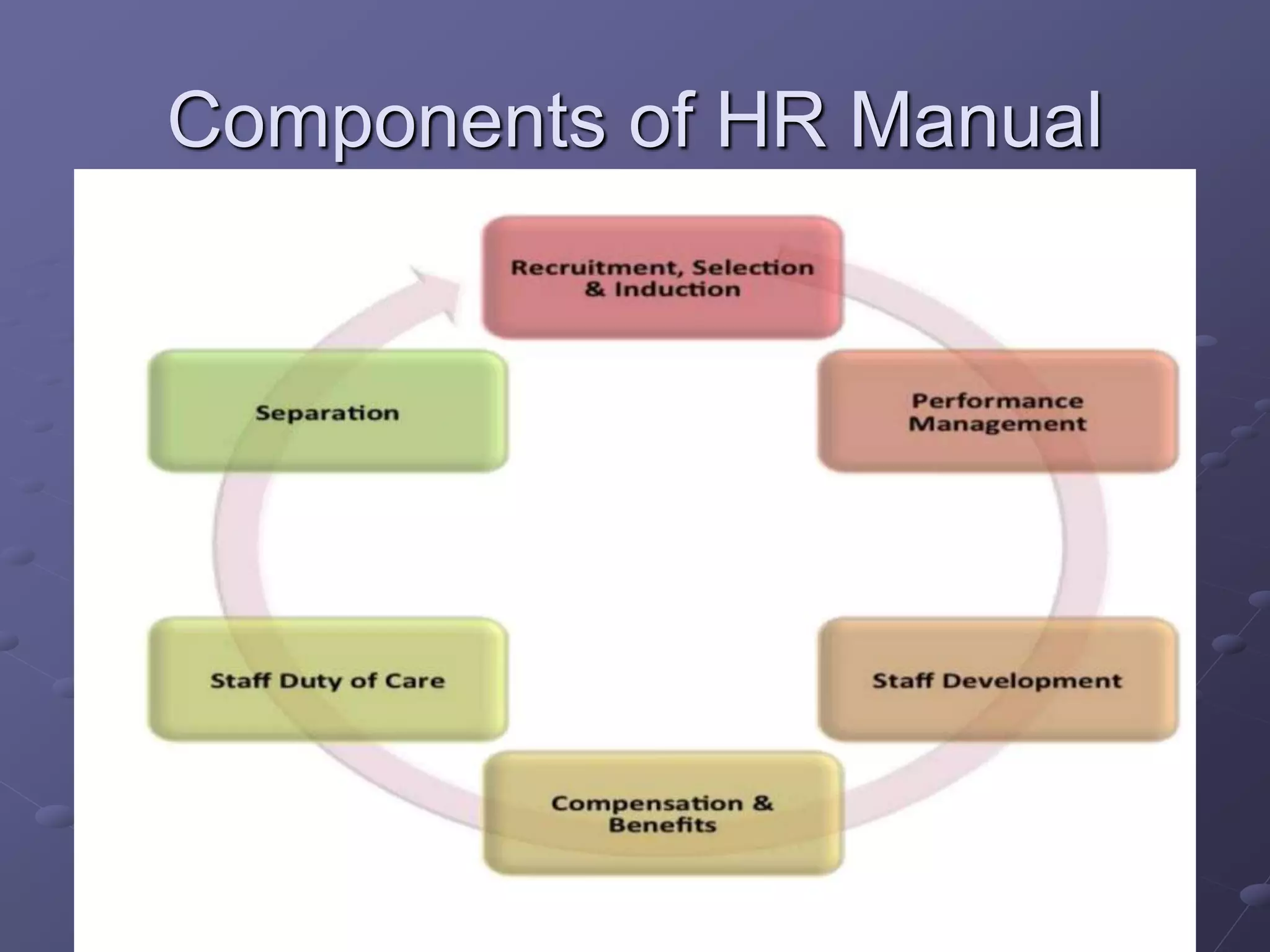
HR Manual:- Components
and service condition
Presented by:- Shreya verma
Roll no. 34
M.S.W 4th sem.
Introduction
HR manual was designed to support HR
manager who are setting up anew HR
function within a program, both at head
office or in field operations .
It provides a framework of principles,
policies, procedures, guideline, tool and
templates to serve as a practical guide for
HR management in field original and head
offices.
Importance of HR Manual
Past experience in local or field operations confirms the
importance of setting up a good foundation
of HR systems, policies and procedures early on,
especially when an operation is working in its
emergency stages. Ensuring this will provide all staff
members with the adequate HR support and
guidance to enable them to deliver the required services
to the most vulnerable people.
Users of this manual should select and adapt the
information provided according to the needs and
requirements in their particular organisation, and to the
legal framework of the country of opration
Components of HR Manual
Recruitment, Selection and
Induction
Achieve a standard approach in best/good practice adopted by all
parties (line managers, HR representative, community members,
partner organisations etc.) involved throughout the recruitment and
selection process.
Provide means of and foundations for attracting, developing and
retaining staff of the quality, and in the numbers required to meet the
organisation’s objectives.
Create and maintain a professional image and positive branding as
an employer, both internally and externally, and in line with its values
and mandate.
Encourage growth, promotions and transfers from within to provide
the opportunity for all staff with the required skills, knowledge and
experience to be considered for career progression.
Process
Performance Management
Performance management is also called talent
management in some contexts. You may decide
to
use the terms interchangeably, although in its
true sense, performance management forms
only a
part of talent management, and not the entirety
of the concept.
Performance management is a systematic
process of:
process
Staff Development
Organisations recognise that the success
of their programmes, whether they are
community-based
development or emergency response and
recovery, largely depend upon the skills,
qualities,
experience and motivation of their staff.
Staff development cycle
Compensation and Benefits
Compensation and benefits systems within an
organisation are designed to motivate staff to perform
well in their roles, feel recognised as well as reap the
benefits of strong performance. It is essential for an
organisation to have a fair and transparent system for all
staff.
Compensation (or pay/salary) forms only a part of a
wider ‘Total Reward System’. The table below describes
the various elements within total reward. A part of these
are financial rewards or extrinsic rewards, which are
observable, while, simultaneously, there are some
rewards which are more intrinsic and non-financial in
nature. We will talk a bit more about these various
elements below.
Continue
Staff Duty of Care
A very important aspect of the role of a HR
manager is ensuring organisational duty of
care towards
all staff members. This is especially true
when working in the field and during
emergencies, as there
is a variety of security, health and safety
risks associated with aid work.
Health, Safety and Security
Health and safety management is hence a
core operational area for HR managers,in
close collaboration with the security team.
It should be embedded well into the
culture of the organisation. Besides
ensuring compliance with health and
safety laws, it also enables national and
international staff to feel supported in their
work, thus enhancing their perform
Separation
Separation is the natural final stage in the
employee life cycle. A member of staff can
reach this step due to multiple reasons,
mentioned in the table below.
Whatever the reasons for separation,
some HR processes form the core of this
activity. In addition to these core activities,
further activities may be necessary as
well.
HR manual

HR manual

  • 1.
    HR Manual:- Components andservice condition Presented by:- Shreya verma Roll no. 34 M.S.W 4th sem.
  • 2.
    Introduction HR manual wasdesigned to support HR manager who are setting up anew HR function within a program, both at head office or in field operations . It provides a framework of principles, policies, procedures, guideline, tool and templates to serve as a practical guide for HR management in field original and head offices.
  • 3.
    Importance of HRManual Past experience in local or field operations confirms the importance of setting up a good foundation of HR systems, policies and procedures early on, especially when an operation is working in its emergency stages. Ensuring this will provide all staff members with the adequate HR support and guidance to enable them to deliver the required services to the most vulnerable people. Users of this manual should select and adapt the information provided according to the needs and requirements in their particular organisation, and to the legal framework of the country of opration
  • 4.
  • 5.
    Recruitment, Selection and Induction Achievea standard approach in best/good practice adopted by all parties (line managers, HR representative, community members, partner organisations etc.) involved throughout the recruitment and selection process. Provide means of and foundations for attracting, developing and retaining staff of the quality, and in the numbers required to meet the organisation’s objectives. Create and maintain a professional image and positive branding as an employer, both internally and externally, and in line with its values and mandate. Encourage growth, promotions and transfers from within to provide the opportunity for all staff with the required skills, knowledge and experience to be considered for career progression.
  • 6.
  • 7.
    Performance Management Performance managementis also called talent management in some contexts. You may decide to use the terms interchangeably, although in its true sense, performance management forms only a part of talent management, and not the entirety of the concept. Performance management is a systematic process of:
  • 8.
  • 9.
    Staff Development Organisations recognisethat the success of their programmes, whether they are community-based development or emergency response and recovery, largely depend upon the skills, qualities, experience and motivation of their staff.
  • 10.
  • 11.
    Compensation and Benefits Compensationand benefits systems within an organisation are designed to motivate staff to perform well in their roles, feel recognised as well as reap the benefits of strong performance. It is essential for an organisation to have a fair and transparent system for all staff. Compensation (or pay/salary) forms only a part of a wider ‘Total Reward System’. The table below describes the various elements within total reward. A part of these are financial rewards or extrinsic rewards, which are observable, while, simultaneously, there are some rewards which are more intrinsic and non-financial in nature. We will talk a bit more about these various elements below.
  • 12.
  • 13.
    Staff Duty ofCare A very important aspect of the role of a HR manager is ensuring organisational duty of care towards all staff members. This is especially true when working in the field and during emergencies, as there is a variety of security, health and safety risks associated with aid work.
  • 14.
    Health, Safety andSecurity Health and safety management is hence a core operational area for HR managers,in close collaboration with the security team. It should be embedded well into the culture of the organisation. Besides ensuring compliance with health and safety laws, it also enables national and international staff to feel supported in their work, thus enhancing their perform
  • 16.
    Separation Separation is thenatural final stage in the employee life cycle. A member of staff can reach this step due to multiple reasons, mentioned in the table below. Whatever the reasons for separation, some HR processes form the core of this activity. In addition to these core activities, further activities may be necessary as well.