Aftab Ahmed, Research Scholar.
pk.linkedin.com/in/aftabch
1
Older Peoples (OPs) and Human
Rights
Prepared By: Aftab Ahmed
pk.linkedin.com/in/aftabch
https://independent.academia.edu/Aftabchaudhry
Older Peoples (OPs) and Human
Rights
3
Aftab Ahmed, Research Scholar.
pk.linkedin.com/in/aftabch
Older Peoples (OPs) and Human Rights
• Over the past several decades a massive change has taken
place in a key demographic area of the planet’s human
population: age. The oldest old are the most rapidly
expanding segment of the elderly population. Currently,
the oldest old make up 11 percent of the 60+ age group
and will grow to 19 percent by 2050.
• More recently middle age has become recognized as a
distinctive phase and, increasingly, there is a trend to
differentiate between the `young' elderly (those aged
between 65 and 74 years) and the `old' elderly (those aged
over 75 years). There is also the distinction between the
`third age' (those aged 50–74) and the `fourth age' (Laslett,
1989).
4
Aftab Ahmed, Research Scholar.
pk.linkedin.com/in/aftabch
World Aging Scenario
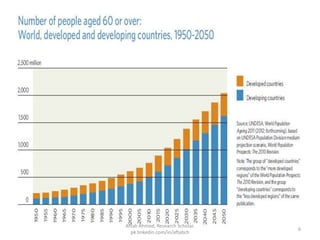
• Population ageing is happening in all regions and
in countries at various levels of development.
• It is progressing fastest in developing countries,
including in those that also have a large
population of young people.
• Of the current 15 countries with more than 10
million older persons, seven of these are
developing countries.
5
Aftab Ahmed, Research Scholar.
pk.linkedin.com/in/aftabch
6
Aftab Ahmed, Research Scholar.
pk.linkedin.com/in/aftabch
A Fact:-
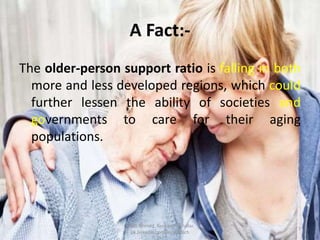
The older-person support ratio is falling in both
more and less developed regions, which could
further lessen the ability of societies and
governments to care for their aging
populations.
7
Aftab Ahmed, Research Scholar.
pk.linkedin.com/in/aftabch
Rights of Elders’
The rights of aged persons can be broken down into three
main categories: protection, participation and image.
• Protection refers to securing the physical,
psychological and emotional safety of elderly persons
with regard to their unique vulnerability to abuse and
ill treatment.
• Participation refers to the need to establish a greater
and more active role for older persons in society.
• Image refers to the need to define a more positive, less
degrading and discriminatory idea of who elderly
persons are and what they are capable of doing.
8
Aftab Ahmed, Research Scholar.
pk.linkedin.com/in/aftabch
Universal Declaration of Human Rights
Universal Declaration of Human Rights (1948) (article 3, 22, 25, 27):-
The Universal Declaration asserts that everyone has the
• Right to life, liberty and security of person.
• everyone is entitled to social security
• Realization of any economic, social and cultural rights
that are essential to that individual’s dignity and
personality development.
• Everyone should have the opportunity to participate in
cultural activities in their community and share in the
benefits of the arts and sciences.
9
Aftab Ahmed, Research Scholar.
pk.linkedin.com/in/aftabch
Universal Declaration of Human Rights
• Everyone is entitled to a standard of living
adequate for one’s health and well-being
including food, clothing, housing and medical
care as well as any needed social services
provided by the governments of nation-states.
• Most important to elderly persons, in the event
of unemployment, sickness, disability,
widowhood or old age, one has the right to
security due to circumstances beyond one’s
control.
10
Aftab Ahmed, Research Scholar.
pk.linkedin.com/in/aftabch
Rights of Elders
1. Right to Life
2. Right to Liberty
3. Right to security
4. Right to healthcare
5. Right to an adequate standard of living
6. Right to non-discrimination
7. Right to participation
8. Right to be free from torture or cruel, inhuman
or degrading treatment
11
Aftab Ahmed, Research Scholar.
pk.linkedin.com/in/aftabch
Right to Life, Liberty & Security
The right to life: The right to life is the supreme right of the human
being (UN Human Rights Committee (UNHRC), 1982). It is basic to
all human rights and without it all other rights are without meaning.
The right to liberty
The right to liberty protects the physical liberty of the person through
a cluster of interrelated rights.
The right to security
The right to security is closely associated with the right to liberty.
However, it is also relevant in a variety of other contexts in which
the State is required to keep its citizens safe, ranging from the
threat of terrorism to domestic violence.
12
Aftab Ahmed, Research Scholar.
pk.linkedin.com/in/aftabch
Right to health and care
The right to health and care
“The right to health means that governments must generate
conditions in which everyone can be as healthy as possible.
Such conditions range from ensuring availability of health
services, healthy and safe working conditions, adequate
housing and nutritious food. The right to health does not
mean the right to be healthy” (WHO).
The human right to health means that everyone has the right
to the highest attainable standard of physical and mental
health, which includes access to all medical services,
sanitation, adequate food, decent housing, healthy working
conditions, and a clean environment (NESRI).
13
Aftab Ahmed, Research Scholar.
pk.linkedin.com/in/aftabch
Right to Non-discrimination & Participation
The Right to non-discrimination Elderly people
should not be thought of as useless to society
simply because some of them may need more
care than the average person.
The Right to participation is sometimes threatened
due to prevailing negative images societies hold
of the aged. The aged are often not given the
same opportunities as others to be productive
members of society.
14
Aftab Ahmed, Research Scholar.
pk.linkedin.com/in/aftabch
Right to be free from torture or cruel, inhuman
or degrading treatment
UN-Article 15 - Freedom from torture or cruel, inhuman or degrading
treatment or punishment
1. No one shall be subjected to torture or to cruel, inhuman or
degrading treatment or punishment. In particular, no one shall be
subjected without his or her free consent to medical or scientific
experimentation.
2. States Parties shall take all effective legislative, administrative,
judicial or other measures to prevent persons with disabilities, on
an equal basis with others, from being subjected to torture or cruel,
inhuman or degrading treatment or punishment.
15
Aftab Ahmed, Research Scholar.
pk.linkedin.com/in/aftabch
International and Regional Instruments
for Protection and Promotion
1. Charter of the United Nations (1945) (article 55)
2. Universal Declaration of Human Rights (1948) (article 3,
22, 25, 27)
3. Convention Relating to the Status of Refugees (1951)
(article 24)
4. International Covenant on Economic, Social and Cultural
Rights (1966) (article 9, 11, 12)
5. Declaration on the Rights of Disabled Persons (1975)
(article 5, 9, 10, 12)
6. ILO Recommendation No. 162 concerning Older Workers
(1980) (section II, paragraph 5(g))
7. Declaration on the Elimination of Violence Against
Women (1993)
16
Aftab Ahmed, Research Scholar.
pk.linkedin.com/in/aftabch
Conti…
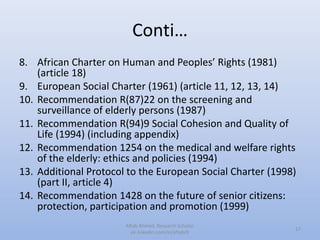
8. African Charter on Human and Peoples’ Rights (1981)
(article 18)
9. European Social Charter (1961) (article 11, 12, 13, 14)
10. Recommendation R(87)22 on the screening and
surveillance of elderly persons (1987)
11. Recommendation R(94)9 Social Cohesion and Quality of
Life (1994) (including appendix)
12. Recommendation 1254 on the medical and welfare rights
of the elderly: ethics and policies (1994)
13. Additional Protocol to the European Social Charter (1998)
(part II, article 4)
14. Recommendation 1428 on the future of senior citizens:
protection, participation and promotion (1999)
17
Aftab Ahmed, Research Scholar.
pk.linkedin.com/in/aftabch
Conti…
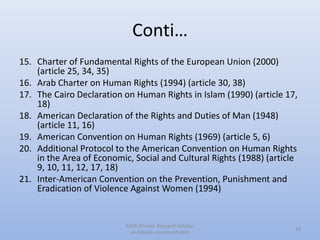
15. Charter of Fundamental Rights of the European Union (2000)
(article 25, 34, 35)
16. Arab Charter on Human Rights (1994) (article 30, 38)
17. The Cairo Declaration on Human Rights in Islam (1990) (article 17,
18)
18. American Declaration of the Rights and Duties of Man (1948)
(article 11, 16)
19. American Convention on Human Rights (1969) (article 5, 6)
20. Additional Protocol to the American Convention on Human Rights
in the Area of Economic, Social and Cultural Rights (1988) (article
9, 10, 11, 12, 17, 18)
21. Inter-American Convention on the Prevention, Punishment and
Eradication of Violence Against Women (1994)
18
Aftab Ahmed, Research Scholar.
pk.linkedin.com/in/aftabch
Remarks
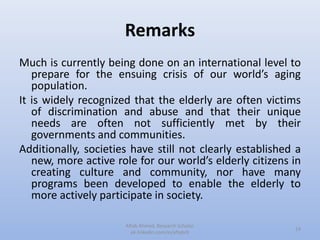
Much is currently being done on an international level to
prepare for the ensuing crisis of our world’s aging
population.
It is widely recognized that the elderly are often victims
of discrimination and abuse and that their unique
needs are often not sufficiently met by their
governments and communities.
Additionally, societies have still not clearly established a
new, more active role for our world’s elderly citizens in
creating culture and community, nor have many
programs been developed to enable the elderly to
more actively participate in society.
19
Aftab Ahmed, Research Scholar.
pk.linkedin.com/in/aftabch
20
Aftab Ahmed, Research Scholar.
pk.linkedin.com/in/aftabch
Thanks
Aftab Ahmed, Research Scholar.
pk.linkedin.com/in/aftabch
21

Older People and Human Rights

  • 1.
    Aftab Ahmed, ResearchScholar. pk.linkedin.com/in/aftabch 1
  • 2.
    Older Peoples (OPs)and Human Rights Prepared By: Aftab Ahmed pk.linkedin.com/in/aftabch https://independent.academia.edu/Aftabchaudhry
  • 3.
    Older Peoples (OPs)and Human Rights 3 Aftab Ahmed, Research Scholar. pk.linkedin.com/in/aftabch
  • 4.
    Older Peoples (OPs)and Human Rights • Over the past several decades a massive change has taken place in a key demographic area of the planet’s human population: age. The oldest old are the most rapidly expanding segment of the elderly population. Currently, the oldest old make up 11 percent of the 60+ age group and will grow to 19 percent by 2050. • More recently middle age has become recognized as a distinctive phase and, increasingly, there is a trend to differentiate between the `young' elderly (those aged between 65 and 74 years) and the `old' elderly (those aged over 75 years). There is also the distinction between the `third age' (those aged 50–74) and the `fourth age' (Laslett, 1989). 4 Aftab Ahmed, Research Scholar. pk.linkedin.com/in/aftabch
  • 5.
    World Aging Scenario •Population ageing is happening in all regions and in countries at various levels of development. • It is progressing fastest in developing countries, including in those that also have a large population of young people. • Of the current 15 countries with more than 10 million older persons, seven of these are developing countries. 5 Aftab Ahmed, Research Scholar. pk.linkedin.com/in/aftabch
  • 6.
    6 Aftab Ahmed, ResearchScholar. pk.linkedin.com/in/aftabch
  • 7.
    A Fact:- The older-personsupport ratio is falling in both more and less developed regions, which could further lessen the ability of societies and governments to care for their aging populations. 7 Aftab Ahmed, Research Scholar. pk.linkedin.com/in/aftabch
  • 8.
    Rights of Elders’ Therights of aged persons can be broken down into three main categories: protection, participation and image. • Protection refers to securing the physical, psychological and emotional safety of elderly persons with regard to their unique vulnerability to abuse and ill treatment. • Participation refers to the need to establish a greater and more active role for older persons in society. • Image refers to the need to define a more positive, less degrading and discriminatory idea of who elderly persons are and what they are capable of doing. 8 Aftab Ahmed, Research Scholar. pk.linkedin.com/in/aftabch
  • 9.
    Universal Declaration ofHuman Rights Universal Declaration of Human Rights (1948) (article 3, 22, 25, 27):- The Universal Declaration asserts that everyone has the • Right to life, liberty and security of person. • everyone is entitled to social security • Realization of any economic, social and cultural rights that are essential to that individual’s dignity and personality development. • Everyone should have the opportunity to participate in cultural activities in their community and share in the benefits of the arts and sciences. 9 Aftab Ahmed, Research Scholar. pk.linkedin.com/in/aftabch
  • 10.
    Universal Declaration ofHuman Rights • Everyone is entitled to a standard of living adequate for one’s health and well-being including food, clothing, housing and medical care as well as any needed social services provided by the governments of nation-states. • Most important to elderly persons, in the event of unemployment, sickness, disability, widowhood or old age, one has the right to security due to circumstances beyond one’s control. 10 Aftab Ahmed, Research Scholar. pk.linkedin.com/in/aftabch
  • 11.
    Rights of Elders 1.Right to Life 2. Right to Liberty 3. Right to security 4. Right to healthcare 5. Right to an adequate standard of living 6. Right to non-discrimination 7. Right to participation 8. Right to be free from torture or cruel, inhuman or degrading treatment 11 Aftab Ahmed, Research Scholar. pk.linkedin.com/in/aftabch
  • 12.
    Right to Life,Liberty & Security The right to life: The right to life is the supreme right of the human being (UN Human Rights Committee (UNHRC), 1982). It is basic to all human rights and without it all other rights are without meaning. The right to liberty The right to liberty protects the physical liberty of the person through a cluster of interrelated rights. The right to security The right to security is closely associated with the right to liberty. However, it is also relevant in a variety of other contexts in which the State is required to keep its citizens safe, ranging from the threat of terrorism to domestic violence. 12 Aftab Ahmed, Research Scholar. pk.linkedin.com/in/aftabch
  • 13.
    Right to healthand care The right to health and care “The right to health means that governments must generate conditions in which everyone can be as healthy as possible. Such conditions range from ensuring availability of health services, healthy and safe working conditions, adequate housing and nutritious food. The right to health does not mean the right to be healthy” (WHO). The human right to health means that everyone has the right to the highest attainable standard of physical and mental health, which includes access to all medical services, sanitation, adequate food, decent housing, healthy working conditions, and a clean environment (NESRI). 13 Aftab Ahmed, Research Scholar. pk.linkedin.com/in/aftabch
  • 14.
    Right to Non-discrimination& Participation The Right to non-discrimination Elderly people should not be thought of as useless to society simply because some of them may need more care than the average person. The Right to participation is sometimes threatened due to prevailing negative images societies hold of the aged. The aged are often not given the same opportunities as others to be productive members of society. 14 Aftab Ahmed, Research Scholar. pk.linkedin.com/in/aftabch
  • 15.
    Right to befree from torture or cruel, inhuman or degrading treatment UN-Article 15 - Freedom from torture or cruel, inhuman or degrading treatment or punishment 1. No one shall be subjected to torture or to cruel, inhuman or degrading treatment or punishment. In particular, no one shall be subjected without his or her free consent to medical or scientific experimentation. 2. States Parties shall take all effective legislative, administrative, judicial or other measures to prevent persons with disabilities, on an equal basis with others, from being subjected to torture or cruel, inhuman or degrading treatment or punishment. 15 Aftab Ahmed, Research Scholar. pk.linkedin.com/in/aftabch
  • 16.
    International and RegionalInstruments for Protection and Promotion 1. Charter of the United Nations (1945) (article 55) 2. Universal Declaration of Human Rights (1948) (article 3, 22, 25, 27) 3. Convention Relating to the Status of Refugees (1951) (article 24) 4. International Covenant on Economic, Social and Cultural Rights (1966) (article 9, 11, 12) 5. Declaration on the Rights of Disabled Persons (1975) (article 5, 9, 10, 12) 6. ILO Recommendation No. 162 concerning Older Workers (1980) (section II, paragraph 5(g)) 7. Declaration on the Elimination of Violence Against Women (1993) 16 Aftab Ahmed, Research Scholar. pk.linkedin.com/in/aftabch
  • 17.
    Conti… 8. African Charteron Human and Peoples’ Rights (1981) (article 18) 9. European Social Charter (1961) (article 11, 12, 13, 14) 10. Recommendation R(87)22 on the screening and surveillance of elderly persons (1987) 11. Recommendation R(94)9 Social Cohesion and Quality of Life (1994) (including appendix) 12. Recommendation 1254 on the medical and welfare rights of the elderly: ethics and policies (1994) 13. Additional Protocol to the European Social Charter (1998) (part II, article 4) 14. Recommendation 1428 on the future of senior citizens: protection, participation and promotion (1999) 17 Aftab Ahmed, Research Scholar. pk.linkedin.com/in/aftabch
  • 18.
    Conti… 15. Charter ofFundamental Rights of the European Union (2000) (article 25, 34, 35) 16. Arab Charter on Human Rights (1994) (article 30, 38) 17. The Cairo Declaration on Human Rights in Islam (1990) (article 17, 18) 18. American Declaration of the Rights and Duties of Man (1948) (article 11, 16) 19. American Convention on Human Rights (1969) (article 5, 6) 20. Additional Protocol to the American Convention on Human Rights in the Area of Economic, Social and Cultural Rights (1988) (article 9, 10, 11, 12, 17, 18) 21. Inter-American Convention on the Prevention, Punishment and Eradication of Violence Against Women (1994) 18 Aftab Ahmed, Research Scholar. pk.linkedin.com/in/aftabch
  • 19.
    Remarks Much is currentlybeing done on an international level to prepare for the ensuing crisis of our world’s aging population. It is widely recognized that the elderly are often victims of discrimination and abuse and that their unique needs are often not sufficiently met by their governments and communities. Additionally, societies have still not clearly established a new, more active role for our world’s elderly citizens in creating culture and community, nor have many programs been developed to enable the elderly to more actively participate in society. 19 Aftab Ahmed, Research Scholar. pk.linkedin.com/in/aftabch
  • 20.
    20 Aftab Ahmed, ResearchScholar. pk.linkedin.com/in/aftabch
  • 21.
    Thanks Aftab Ahmed, ResearchScholar. pk.linkedin.com/in/aftabch 21