Human Rights ethical,socio-political and legal
foundations
HRBR Lecture 2
Samentha Goethals
Hector Candray
2.
Quiz 1 –Recap
• ‘Human rights refer to a higher order right’, this means that…
a/ companies should only comply with national law regardless of its compatibility with human rights
b/ companies must aim for the highest standards even if national law is lower or conflict with human rights
• What is the relationship between human rights and the sustainable development goals (SDGs)?
a/ human rights precede and underpin the SDGs
b/ the SDGs precede and underpin human rights
c/ they have nothing in common
• Common corporate human rights violations from basic labour rights to modern slavery result from…
a/ companies’ business models and organization of labour
b/ weak and/or not enforced labour regulations
c/ both
3.
Outline
Key questions coveredin lecture:
• What are human rights, philosophical,
ethical, legal and political dimensions?
• What are international human rights
standards?
• What are international labour standards?
• How is the international human rights
system set up and what are the
challenges for BHR?
Key BHR concepts:
⮚ Ethical/moral imperatives
⮚ Socio-political and justice claims
⮚ Legal rules and obligations
⮚ States duties to protect, respect and
realise
⮚ ICCPR, ICESCR, ILO Fundamental
Declarations
4.
Human rights: whatfor?
Prevent encroachments by the powerful actors that organize and
govern society upon the conditions that help human beings flourish
and realise their potential (Aristotle) and capabilities (Sen 2004)
Basis of the social contract between free and equal human beings who
grant each other certain rights and accept certain obligations in
return for the security of a shared community (i.e. the state)
(Enlightenment to today)
The moral character of human rights provides the basis for society; it
predates the laws and institutions that protect them in practice and
help individuals and groups express, claim and realise such rights
5.
4 Core elementsof human rights
Universal and unconditional = we are all equal in our moral worth as human beings, we
are born with human rights, they are not a reward or dependent on a responsibility
Equal and non-discriminatory = human beings hold human rights equally and to the same
extent, we all have them and they apply everywhere
Indivisible = human rights are often interdependent, the improvement of one right
facilitate advancement in the others, the deprivation of one right adversely affect the
others e.g. freedom of speech and right to collectively bargain; right to a decent
livelihood and right to equal remuneration.
Inalienable = although they can be denied or infringed upon, they cannot be taken away or
traded in
6.
Universal: not relativenor absolute
Absolutist view hold that there is only one correct view of human
rights, valid for everyone > ethical ethnocentrism runs counter to
the very idea of human rights
Relativist view emphasises cultural diversity and plurality and
denies any absolute moral norm or the existence and desirability of
any universally justifiable norms or principle > ultimately leads to a
‘general ban on moral reasoning
Universal view acknowledges and respects cultural variety and
individual uniqueness by accepting our fundamental moral equality.
What is universal in human rights is not a list of norms but the
underlying principle of our equal moral worth which justifies a
basic sense of conduct towards other people and cultures. It is
opened to participation by persons across national boundaries to
critically assess our conduct and behaviour by all affected by it
Need to distinguish between the underlying
ethical idea or concept and the real
manifestation and institutionalisation of human
rights
Are human rights traditionally Western? Let’s
pause and reconsider the violent and colonial
histories of Western nations and the
contemporary backsliding of many governments
towards authoritarianism and societies against
fundamental rights… clearly a work in progress
that’s far from being completed!
7.
Should managers andbusiness
operating in foreign contexts adhere
blindly to local laws and customs?
Should they refuse the practices
they deem problematic with
reference to universal ethical
principles and values?
Case p.37 e-textbook: In what way did IKEA and
Starbucks decisions place sensitivity to
discriminatory local customs and norms before
women rights? How could they have acted in line
with women rights and with their own values of
diversity and inclusivity?
Human rights’ toolbox for managerial/marketing
dilemmas over issues of diversity and inclusivity
8.
Human rights asethical concerns (philosophically
expansive view / founded in natural law)
• Human rights have in common an ethical concern for just treatment, built on
empathy or altruism in human behavior and concepts of justice in
philosophy.
• Their ethical basis is defined using concepts such as human flourishing,
dignity, duties to family and society, natural rights, individual freedom, and
social justice against exploitation based on sex, religion, political views, age,
ethnicity, class or caste, etc.
• Derived from concepts such as natural law, social contract, justice as
fairness, consequentialism and other theories of justice.
• A right is conceived as an inalienable and absolute entitlement of
individuals, either by virtue of being human or because they are members of
a political community (citizens)
• They are universal because we as human beings are all entitled to them due
to our common ‘humanness’
9.
Human rights associal claims (pragmatic,
non-foundationalist view)
‘Human rights tends to come mostly from those who are concerned with
changing the world rather than interpreting it… The colossal appeal of
the idea of human rights [has provided comfort to those suffering]
intense oppression or great misery, without having to wait for the
theoretical air to clear.’
They are dynamic social forms and constructs, use to challenge power
relations, inequalities, injustices
They are not pre-political possessions nor self-evidently inscribed in
nature but are ultimately political in character
They are one among several key transnational normative discourses
defined and redefined as they are put in practice
They evolve as they are claimed and revendicated from below by social
movements towards self-realization, dignity and emancipation or
asserted from above by political authorities
10.
Human Rights aslegal claims (restrictive,
founded in legal rules)
• For “Legal positivists” human rights result from a formal legal and political
norm-creating process = an authoritative formulation of the rules, declaration,
law, treaty (national or international) by which a society is governed.
• They must be legislated, legally recognized, and codified before they can be
taken seriously as part of the law of nations
• They are not absolute nor inalienable, can vary over time and be subject to
derogations or limitations designed to optimize respect for human rights
• ‘‘Human rights’’ refers to the body of international law that emerged in the
wake of the 1948 Universal Declaration of Human Rights and follow-on
instruments.
• They attain a higher degree of universality based on the participation of
virtually every nation in the norm-creating process, a process that is law-based
but that reflects compromise and historical shifts (e.g recent abolition of
slavery, torture, discrimination on the basis of race or gender)
11.
3 interrelated discoursesof human rights
Human
rights as
ethical
concerns
Human
rights as
social
reality
Human
rights as
legal rights
positive law
tradition
Human
rights as
social/politi
cal claims
Public reasoning drawing on ethical
arguments and social mobilization based
on advocacy agendas influence legal
norms, processes and institutions
> all three modes of discourse contribute
to human rights becoming part of social
reality
Marks,
2016
12.
Quiz 2 –key points so far
• Which one is NOT a defining element of human rights? a/ equal
b/ voluntary
c/ universal
d/ indivisible
e/ inalienable
• To state that human rights are universal means that
a/ they are a set list of norms that all states adhere to
b/ they are Western
c/ they derive from our equal moral worth as human beings
• Non-foundationalist accounts of human rights start from the assumption that
a/ human rights emerge through political and social claims and struggles for justice
b/ human rights are rooted in and derive from essential and defining features of human beings
“Generations” of humanrights
Dignity
1st
pillar, UDHR
art 1 and 2
Liberty
2nd
pillar, UDHR
art 3-19
Equality
3rd
pillar, UDHR
art 20-26
Solidarity
4th
pillar, UDHR
art 27-28
The sequence of the articles corresponds to the historical appearance of successive generations and
visions of universal rights.
Basic humanistic,
universal, natural rights,
principle shared across
humanity
Cross cultural and cross
religion
First generation of civil
liberties and other liberal
rights fought for during
the Enlightenment
Second generation of
rights, i.e. those related
to political, social and
economic equity and
championed during the
industrial revolution
Third generation of rights
associated with
communal and national
solidarity, advocated
through 19th
C
throughout the 20th
C
postcolonial era
15.
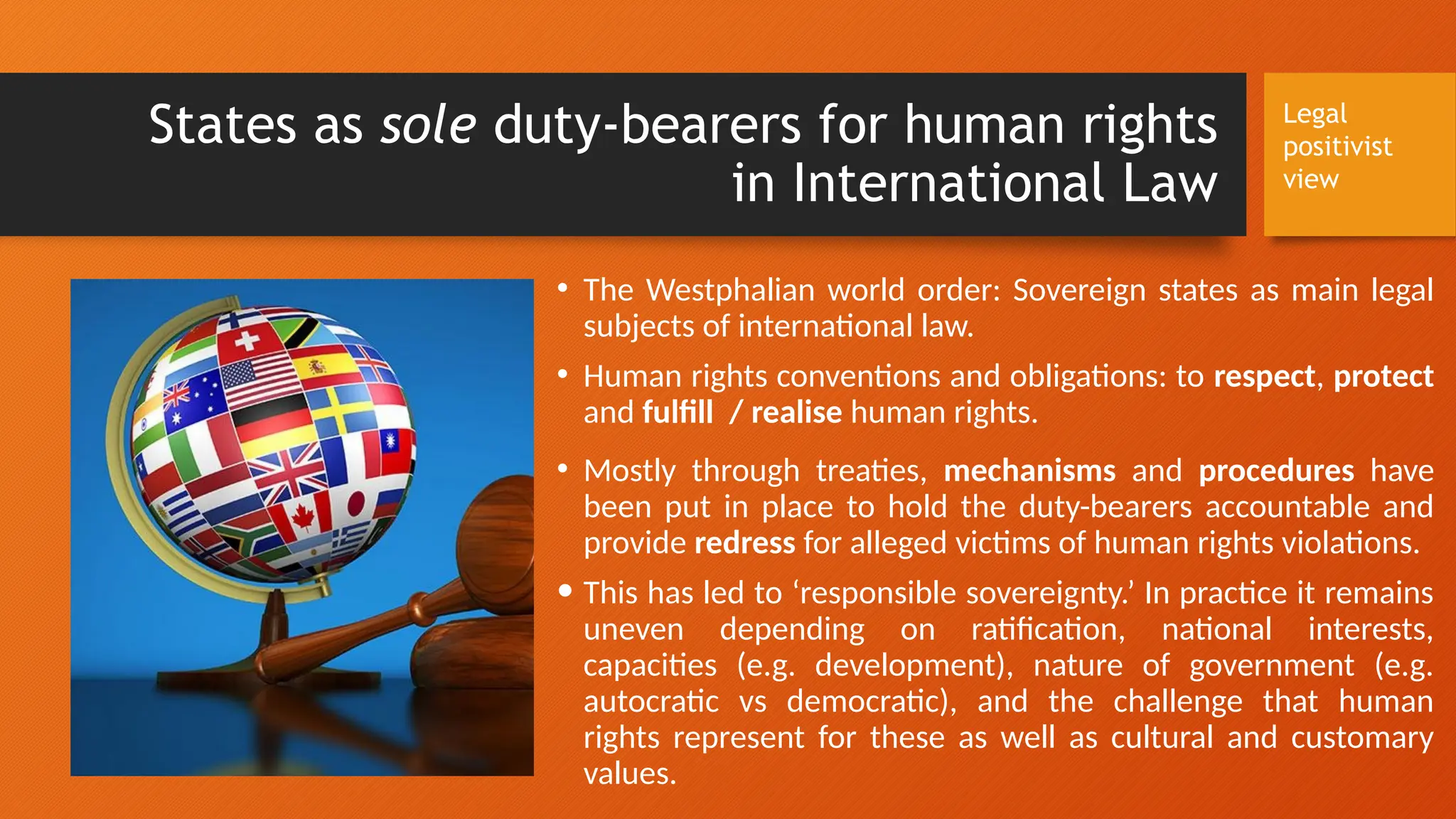
States as soleduty-bearers for human rights
in International Law
• The Westphalian world order: Sovereign states as main legal
subjects of international law.
• Human rights conventions and obligations: to respect, protect
and fulfill / realise human rights.
• Mostly through treaties, mechanisms and procedures have
been put in place to hold the duty-bearers accountable and
provide redress for alleged victims of human rights violations.
• This has led to ‘responsible sovereignty.’ In practice it remains
uneven depending on ratification, national interests,
capacities (e.g. development), nature of government (e.g.
autocratic vs democratic), and the challenge that human
rights represent for these as well as cultural and customary
values.
Legal
positivist
view
16.
• “International Billof Human
Rights” is the most reliable
source of the core content of
international human rights.
It enumerates approximately
fifty normative propositions
on which additional human
rights documents have built
…
• International Labour
Organization Conventions
Human Rights
instruments
17.
Civil and politicalrights (CPR) – justiciable…?
1. Right to life
2. Freedom from
torture
3. Freedom from
slavery
4. Freedom from
arbitrary
arrest/detention
5. Right to
humane
treatment in
detention
6. Freedom of
movement and
residence
7. Prohibition of
expulsion of
aliens
8. Freedom of
thought,
conscience, and
religious belief
9. Freedom of
expression
10. Right to
privacy
11. Non-
imprisonment
for debt
12. Fair trial
(sub-divided into
16 enumerated
rights)
CPR are to be implemented by states
immediately, may be enforced through
judicial remedies, and are relatively cost-
free since they merely require the state to
leave people alone (so-called “negative
rights”)
Yet many CPR are not achieved merely
passively but require a considerable
investment of time and resources (for
example, to train law enforcement officials
or establish an independent judiciary).
18.
CPR continued
13. Rightto
personhood under
the law
14. Equality before
the law
15. Freedom of
assembly
16. Freedom of
association
17. Right to marry
and found a family
18. Rights of
children
19. Right to
practice a religion
20. Prohibition of
war propaganda
and hate speech
constituting
incitement
21. Right to hold
office
22. Right to vote in
free elections
23. Right to be
elected to office
24. Equal access to
public service
The Kiobel vs Shell case has
gone through many trials in the
US and the Netherlands since
1995 because of the
impossibility of a fair trial in
Nigeria. The case was accepted
by a Dutch court in 2017 and is
still on-going
Social media firms have
the responsibility to
monitor and eliminate
hate speech and
misinformation interfering
with free elections
19.
Economic, Social andCultural
Rights (ESCR) – progressive…?
1. Right to gain a living by work freely chosen and
accepted
2. Right to just and favorable work conditions
3. Right to form and join trade unions
4. Right to strike
5. Right to social security
6. Right to assistance to the family, mothers, and children
7. Right to adequate standard of living (including food,
clothing, and housing)
8. Right to the highest attainable standard of physical and
mental health
20.
ESCR continued
9. Rightto
education towards
the full
development of
human personality
10. Free and
compulsory primary
education
11. Availability of
other levels of
education
12. Participation in
cultural life
13. Protection of
moral and material
rights of creators
and transmitters of
culture
14. Right to enjoy
the benefits of
scientific progress
21.
“WHEREAS the Leagueof Nations has for its object the establishment of universal
peace, and such a peace can be established only if it is based upon social justice;
AND WHEREAS conditions of labour exist involving such injustice, hardship, and
privation to large numbers of people as to produce unrest so great that the peace
and harmony of the world are imperilled; and an improvement of those conditions
is urgently required: as, for example, by the regulation of the hours of work,
including the establishment of a maximum working day and week, the regulation
of the labour supply, the prevention of unemployment, the provision of an
adequate living wage, the protection of the worker against sickness, disease and
injury arising out of his employment, the protection of children, young persons
and women, provision for old age and injury, protection of the interests of workers
when employed in countries other than their own recognition of the principle of
freedom of association, the organisation of vocational and technical education and
other measures…”
22.
International Labour Organization
●The ILO was created in 1919; it pre-dates the
United Nations. To date, it belongs to the UN as a
specialized agency.
● ILO aims to promote decent work for all workers,
regardless of where they work.
● Labour standards are human rights.
● The ILO has a “tripartite” framework, working
with States, Employers (Companies), and Workers:
• 5ed 2017 (1977) Tripartite Declaration of Principles
concerning Multinational Enterprises and Social Policy;
1998 ILO Declaration on Fundamental Principles and
Rights at WorK; & “Core” Conventions…
23.
‘Core’ Labour Standards
Freedomof
Association
Freedom of Association and
Protection of the Right to
Organise Convention, 1948 (No.
87) & Right to Organise and
Collective Bargaining
Convention, 1949 (No. 98)
Equality and Non-
discrimination
Equal Remuneration Convention,
1951 (No. 100) & Discrimination
(Employment and Occupation)
Convention, 1958 (No. 111)
Child Labour
Minimum Age Convention, 1973
(No. 138) & Worst Forms of
Child Labour Convention, 1999
(No. 182)
Forced labour
Forced Labour Convention,
1930 (No. 29) & Abolition of
Forced Labour Convention,
1957 (No. 105)
Occupational health and safety
Occupational Safety and Health Convention, 1981 (No. 155) &
Promotional Framework for Occupational Safety and Health
Convention, 2006 (No. 187)
24.
UN Mechanisms tohold
States accountable for
human rights violations
• Expert monitoring bodies have been
established to examine the reports of
governments on how they fulfil their
human rights obligations
• Under most human rights treaties,
complaints can be brought by
aggrieved individuals against the state
at the international level
• Special procedures and rapporteurs on
thematic issues
• It is hard to test the actual impact of
these treaties. The translation of the
principles is subtle and takes effect
over time. (Clapham 2015)
25.
Regional Mechanisms
and Procedures…
Thereare “main” human rights
conventions in each region,
further developed by
specialized conventions (much
like the “universal” UN Human
Rights System)
Each regional system has
institutions and procedures
(e.g., an Ombudsman,
Commission and/or Court)
which hear individual
complaints against States.
Quiz 3 –to wrap up
• The International Bill of Human Rights…
• a) Is the Constitution of the United Nations, includes a list of basic rights for everyone
• b) Was created to resemble the Bill of Rights of the United Kingdom (1689) and United States of America (1791)
• c) Is composed by the Universal Declaration of Human Rights and two international covenants
• If a State regulates companies and other private actors to respect human rights within its jurisdiction, the State
is trying to comply with its obligation to:
• a) Respect
• b) Protect
• c) Realize or Fulfil
• d) None of the above
• Is the oldest regional human rights system:
• a) Inter-American System
• b) European System
• c) Asian System
• d) African System
28.
Conclusions
• What arehuman rights, philosophical, ethical, legal and political
dimensions?
• What are international human rights standards?
• What are international labour standards?
• How is the international human rights system set up and what are the
challenges for BHR?


![Human rights as social claims (pragmatic,
non-foundationalist view)
‘Human rights tends to come mostly from those who are concerned with
changing the world rather than interpreting it… The colossal appeal of
the idea of human rights [has provided comfort to those suffering]
intense oppression or great misery, without having to wait for the
theoretical air to clear.’
They are dynamic social forms and constructs, use to challenge power
relations, inequalities, injustices
They are not pre-political possessions nor self-evidently inscribed in
nature but are ultimately political in character
They are one among several key transnational normative discourses
defined and redefined as they are put in practice
They evolve as they are claimed and revendicated from below by social
movements towards self-realization, dignity and emancipation or
asserted from above by political authorities](https://image.slidesharecdn.com/hrbrlect2031022-250429090758-33bdfad5/75/HRBR-lect-2-031022-Human-Rights-pptx-9-2048.jpg)