WALFARE OF AGED
INTRODUCTION 
 Aging is the terminal stage of 
one’s life ,which is accompanied 
with decreasing energy and body 
resources and with infirmities 
due to the decaying and waking 
of one’s bodily organs, such 
infirmities of the aging process 
have always been present 
among the older people.
Meaning of Aged 
 The bouncing between middle age and oldage cannot be defined 
exactly because it shifts according to context and to society. 
peoples can be considered old because of certain changes in 
their activities or social roles. 
 The aged in India was considered to be of 55 years the age of 
superannuating when the employees retired from service 
 Subsequently it was raised 58 years but according to prof. W.L. 
Wahi, former Director ,postgraduate institute of research and 
medical sciences, chandigarh ,with the medical service having 
gone up, there is a demand that the govt should raise the 
mandatory retirement age from 58 to 60 years”
Historical situation of Aged person 
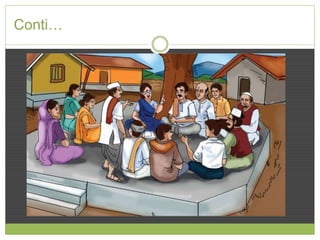
 Once the aged commanded great respect due to the 
traditional norms and values of Indian society.. 
 Historically the aged were taken care properly by their 
family member.. 
 They were the heads of the households and played a 
dominant role in decision making.. 
 In the rural societies they were the patriarchs and 
executive head of the household, they were also control the 
budget of the family…. 
 Aged people were consulted not only in the family matters 
by the members of the family but also in village affairs by 
the community…
Conti…
How its become a social issue 
The industrialization, urbanization and nuclearization 
of family have rendered the aged as social problem. 
The aged are treated as a problem because they are 
not productive and earning member of family. 
The fast growing economy and standard of life, the 
family is not able to meet the needs of their children, 
Therefore the aged being neglected in the family.
Present situation of aged person 
 The institution of joint family has started disintegrating rapid change in 
social values… 
 Social structure and economy resulting from industrialization and 
urbanization the tradition is change… 
 The attitude of younger is now become more individualistic and 
unquestioned regard for authority and respect to the elder is vanishing. 
 On the other hand, the elderly people find it difficult to adjust with their 
own sons and daughter because of the generation gap and their rare 
perception. 
 The result of such situations yield the feelings in the new generation 
that elders are become a torture and develop their opinion that they are 
“unwanted”.
WALFARE OF AGED 
 Old age is considered as a social problem and many 
national and international organization working for 
the welfare of aged…. 
 Even state and central government has taken steps 
to provide some facilities to the aged, who are above 
60+….. 
 There are many programs being organized by 
different agencies to give awareness towards the 
situation of aged in society.
Problems of aged 
Economic and Financial Problem 
Health and medical care 
Familial and Emotional problem 
Housing Problem
Senior Citizens in India: Constitutional Benefits and Facilities 
Article 41 of Indian Constitution deals with the 
State’s role in providing social security to the 
aged. According to this article, "the State shall, 
within the limits of its economic capacity and 
development, make effective provision for 
securing the right to work, to education and to 
public assistance in case of unemployment, 
OLD AGE, sickness and disablement and in 
other cases of undeserved want":
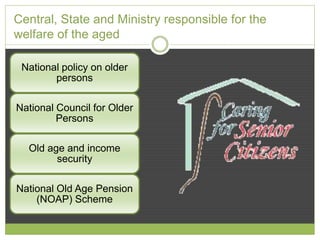
Central, State and Ministry responsible for the 
welfare of the aged 
National policy on older 
persons 
National Council for Older 
Persons 
Old age and income 
security 
National Old Age Pension 
(NOAP) Scheme
National Council for Older Persons 
A National Council for Older Persons (NCOP) has been constituted 
by the Ministry of Social Justice and Empowerment to 
operationalise the National Policy on Older Persons. The basic 
objectives of the NCOP are to… 
 Advice the Government on policies and programmes for older 
persons…. 
 Provide feedback to the Government on the implementation of the 
National Policy on Older Persons as well as on specific programme 
initiatives for older persons…. 
 Provide lobby for concessions, rebates and discounts for older 
persons both with the Government as well as with the corporate 
sector ….
Conti… 
• Represent the collective opinion of older persons to the 
Government 
 Suggest steps to make old age productive and interesting… 
 Suggest measures to enhance the quality of inter-generational 
relationships… 
 Undertake any other work or activity in the best interest of older 
persons.
National policy on older persons 
 The Government of India announced a National Policy on Older 
Persons in January, 1999. This policy provides a broad framework for 
inter- sectoral collaboration and cooperation. 
 The policy has identified a number of areas of intervention -- financial 
security, healthcare and nutrition, shelter, education, welfare, protection 
of life and property etc. for the wellbeing of older persons in the country. 
 While recognizing the need for promoting productive ageing, the policy 
also emphasizes the importance of family in providing vital non formal 
social security for older persons. 
 To facilitate implementation of the policy, the participation of Panchayati 
Raj Institutions, State Governments and different Departments of the 
Government of India is envisaged with coordinating responsibility 
resting with the Ministry of Social Justice & Empowerment.
Old age social and income security 
 The Ministry has also launched a project called "Old Age 
Social and Income Security (OASIS)". 
 The first report of the Committee and the existing income 
security instruments available to older persons have been 
comprehensively examined. 
 The recommendations of the Committee are being examined 
by the Ministry of Finance for further action. 
 Meanwhile, Phase II of the project is looking at the pension 
and gratuity schemes of the central government and old age 
pension provided under National Social Assistance 
Programme (NSAP).
National Old Age Pension (NOAP) Scheme 
o Under National Old Age Pension Scheme, Central Assistance is 
available on fulfillment of the following criteria 
1> The age of the applicant (male or female) should be 65 years 
or more. 
2>The applicant must be a destitute in the sense that he/she has 
no regular means of subsistence from his/her own source of 
income or through financial support from family members or 
other sources. 
o The amount of old age pension is Rs 75 per month. 
o This scheme is implemented in the State and Union Territories 
through Panchayats and Municipalities
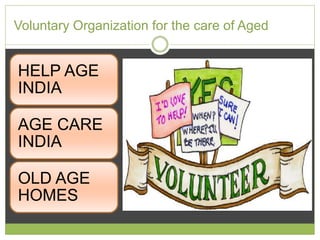
Voluntary Organization for the care of Aged 
HELP AGE 
INDIA 
AGE CARE 
INDIA 
OLD AGE 
HOMES
HELP AGE INDIA 
 Help age India was established in 1978 on the 
pattern of help the aged society of England. It is 
working nation wide for the cause and care of the 
aged people. It is creating awareness among the 
young generation about the needs and importance of 
aged in the society. It also conducts various events, 
competitions, debates for the aged. Help age India 
also provide training for those voluntary organization, 
who are engaged in old care program.
AGE CARE INDIA 
 Age care is a secular organization which is registered as a 
charitable trust. 
 Its India’s leading health care company which believes in 
giving support to the old age people, physically challenged 
person and families. It effectively makes you independent 
by providing their excellent service at your door step. 
 Age Care India brings a timely checkup facility to your 
doorstep to solve all the health related problems. This 
company effectively saves your families from trauma and 
financial distress as well.
OLD AGE HOMES 
 The central/state government, municipal bodies, voluntary 
organization and senior citizen welfare association have 
set-up homes for the aged… 
 Old age homes provides them residential facilities and all 
other needs like entertainment, Physical and mental activity 
instructor and place. 
 Old age homes provide all the convenience and comfort to 
combat their loneliness and to contact and interaction with 
other people.. 
 There are 300 something Old age homes in 
India, which are mostly in urban areas.
Other policies, facilities, allowances & benefits 
 Annapurna 
 Pension and family pension 
 Income Tax Rebate (Section 88B of Finance Act, 1992) 
 Insurance schemes 
 Deduction in respect of medical treatment 
 Banking 
 Travel 
 Magazines for the elderly
Remedies could be taken 
 Reasonable amount o old-age pension to be suitably steepen. 
 Concession in the medical treatment cost in government 
hospitals and dispensaries and provision of special wards of 2 
bed. 
 Housing facilities in the form of homes and arrangement of home 
care. 
 Recreation facilities to relief them of the burden of loneliness etc. 
 To extend them usual courtesy as a mark of respect and regard 
for them which will go a long way in making them feel they are 
honourable and much care foe senior citizen.
Conclusion 
 One of the biggest social problem is faced how to care 
for elders when those elders are no longer able to live 
independently. Welfare figure out numerous different 
strategies for handling eldercare needs. As part of the 
process of finding eldercare solutions, they must 
consider many different factors, including finding ways to 
assess elders' needs, locating care resources that can 
address these needs, and managing financial and legal 
considerations associated with transitioning elders into 
care arrangements. After locating appropriate care, they 
must help support their elders and themselves through 
the stressful process of transitioning into care.
Travel facilities
THANK YOU 
SAVE AND 
FACILITATED 
OLDERS AND 
SAVE OUR MORAL 
VALUES

Walfare of aged

  • 1.
  • 2.
    INTRODUCTION  Agingis the terminal stage of one’s life ,which is accompanied with decreasing energy and body resources and with infirmities due to the decaying and waking of one’s bodily organs, such infirmities of the aging process have always been present among the older people.
  • 3.
    Meaning of Aged  The bouncing between middle age and oldage cannot be defined exactly because it shifts according to context and to society. peoples can be considered old because of certain changes in their activities or social roles.  The aged in India was considered to be of 55 years the age of superannuating when the employees retired from service  Subsequently it was raised 58 years but according to prof. W.L. Wahi, former Director ,postgraduate institute of research and medical sciences, chandigarh ,with the medical service having gone up, there is a demand that the govt should raise the mandatory retirement age from 58 to 60 years”
  • 4.
    Historical situation ofAged person  Once the aged commanded great respect due to the traditional norms and values of Indian society..  Historically the aged were taken care properly by their family member..  They were the heads of the households and played a dominant role in decision making..  In the rural societies they were the patriarchs and executive head of the household, they were also control the budget of the family….  Aged people were consulted not only in the family matters by the members of the family but also in village affairs by the community…
  • 5.
  • 6.
    How its becomea social issue The industrialization, urbanization and nuclearization of family have rendered the aged as social problem. The aged are treated as a problem because they are not productive and earning member of family. The fast growing economy and standard of life, the family is not able to meet the needs of their children, Therefore the aged being neglected in the family.
  • 7.
    Present situation ofaged person  The institution of joint family has started disintegrating rapid change in social values…  Social structure and economy resulting from industrialization and urbanization the tradition is change…  The attitude of younger is now become more individualistic and unquestioned regard for authority and respect to the elder is vanishing.  On the other hand, the elderly people find it difficult to adjust with their own sons and daughter because of the generation gap and their rare perception.  The result of such situations yield the feelings in the new generation that elders are become a torture and develop their opinion that they are “unwanted”.
  • 8.
    WALFARE OF AGED  Old age is considered as a social problem and many national and international organization working for the welfare of aged….  Even state and central government has taken steps to provide some facilities to the aged, who are above 60+…..  There are many programs being organized by different agencies to give awareness towards the situation of aged in society.
  • 9.
    Problems of aged Economic and Financial Problem Health and medical care Familial and Emotional problem Housing Problem
  • 10.
    Senior Citizens inIndia: Constitutional Benefits and Facilities Article 41 of Indian Constitution deals with the State’s role in providing social security to the aged. According to this article, "the State shall, within the limits of its economic capacity and development, make effective provision for securing the right to work, to education and to public assistance in case of unemployment, OLD AGE, sickness and disablement and in other cases of undeserved want":
  • 11.
    Central, State andMinistry responsible for the welfare of the aged National policy on older persons National Council for Older Persons Old age and income security National Old Age Pension (NOAP) Scheme
  • 12.
    National Council forOlder Persons A National Council for Older Persons (NCOP) has been constituted by the Ministry of Social Justice and Empowerment to operationalise the National Policy on Older Persons. The basic objectives of the NCOP are to…  Advice the Government on policies and programmes for older persons….  Provide feedback to the Government on the implementation of the National Policy on Older Persons as well as on specific programme initiatives for older persons….  Provide lobby for concessions, rebates and discounts for older persons both with the Government as well as with the corporate sector ….
  • 13.
    Conti… • Representthe collective opinion of older persons to the Government  Suggest steps to make old age productive and interesting…  Suggest measures to enhance the quality of inter-generational relationships…  Undertake any other work or activity in the best interest of older persons.
  • 14.
    National policy onolder persons  The Government of India announced a National Policy on Older Persons in January, 1999. This policy provides a broad framework for inter- sectoral collaboration and cooperation.  The policy has identified a number of areas of intervention -- financial security, healthcare and nutrition, shelter, education, welfare, protection of life and property etc. for the wellbeing of older persons in the country.  While recognizing the need for promoting productive ageing, the policy also emphasizes the importance of family in providing vital non formal social security for older persons.  To facilitate implementation of the policy, the participation of Panchayati Raj Institutions, State Governments and different Departments of the Government of India is envisaged with coordinating responsibility resting with the Ministry of Social Justice & Empowerment.
  • 15.
    Old age socialand income security  The Ministry has also launched a project called "Old Age Social and Income Security (OASIS)".  The first report of the Committee and the existing income security instruments available to older persons have been comprehensively examined.  The recommendations of the Committee are being examined by the Ministry of Finance for further action.  Meanwhile, Phase II of the project is looking at the pension and gratuity schemes of the central government and old age pension provided under National Social Assistance Programme (NSAP).
  • 16.
    National Old AgePension (NOAP) Scheme o Under National Old Age Pension Scheme, Central Assistance is available on fulfillment of the following criteria 1> The age of the applicant (male or female) should be 65 years or more. 2>The applicant must be a destitute in the sense that he/she has no regular means of subsistence from his/her own source of income or through financial support from family members or other sources. o The amount of old age pension is Rs 75 per month. o This scheme is implemented in the State and Union Territories through Panchayats and Municipalities
  • 17.
    Voluntary Organization forthe care of Aged HELP AGE INDIA AGE CARE INDIA OLD AGE HOMES
  • 18.
    HELP AGE INDIA  Help age India was established in 1978 on the pattern of help the aged society of England. It is working nation wide for the cause and care of the aged people. It is creating awareness among the young generation about the needs and importance of aged in the society. It also conducts various events, competitions, debates for the aged. Help age India also provide training for those voluntary organization, who are engaged in old care program.
  • 19.
    AGE CARE INDIA  Age care is a secular organization which is registered as a charitable trust.  Its India’s leading health care company which believes in giving support to the old age people, physically challenged person and families. It effectively makes you independent by providing their excellent service at your door step.  Age Care India brings a timely checkup facility to your doorstep to solve all the health related problems. This company effectively saves your families from trauma and financial distress as well.
  • 20.
    OLD AGE HOMES  The central/state government, municipal bodies, voluntary organization and senior citizen welfare association have set-up homes for the aged…  Old age homes provides them residential facilities and all other needs like entertainment, Physical and mental activity instructor and place.  Old age homes provide all the convenience and comfort to combat their loneliness and to contact and interaction with other people..  There are 300 something Old age homes in India, which are mostly in urban areas.
  • 21.
    Other policies, facilities,allowances & benefits  Annapurna  Pension and family pension  Income Tax Rebate (Section 88B of Finance Act, 1992)  Insurance schemes  Deduction in respect of medical treatment  Banking  Travel  Magazines for the elderly
  • 22.
    Remedies could betaken  Reasonable amount o old-age pension to be suitably steepen.  Concession in the medical treatment cost in government hospitals and dispensaries and provision of special wards of 2 bed.  Housing facilities in the form of homes and arrangement of home care.  Recreation facilities to relief them of the burden of loneliness etc.  To extend them usual courtesy as a mark of respect and regard for them which will go a long way in making them feel they are honourable and much care foe senior citizen.
  • 23.
    Conclusion  Oneof the biggest social problem is faced how to care for elders when those elders are no longer able to live independently. Welfare figure out numerous different strategies for handling eldercare needs. As part of the process of finding eldercare solutions, they must consider many different factors, including finding ways to assess elders' needs, locating care resources that can address these needs, and managing financial and legal considerations associated with transitioning elders into care arrangements. After locating appropriate care, they must help support their elders and themselves through the stressful process of transitioning into care.
  • 24.
  • 25.
    THANK YOU SAVEAND FACILITATED OLDERS AND SAVE OUR MORAL VALUES