The Human Rights of Vulnerable
People
What are “Human Rights?”
Kathryn Mecrow
Why are Human Rights important?
“Human Rights have come to
provide a powerful basis for
an ethical critique of
international politics and
policy. Understanding the
history of human rights and
their critiques is essential to
theorizing modern human
rights.” (Langlois)
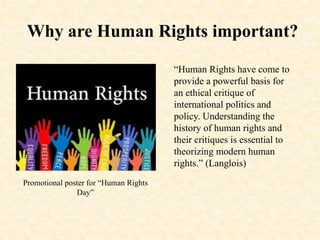
Promotional poster for “Human Rights
Day”
The Charter of the United Nations (1945)
WE THE PEOPLES OF THE UNITED
NATIONS DETERMINED
• to save succeeding generations from the
scourge of war, which twice in our
lifetime has brought untold sorrow to
mankind, and
• to reaffirm faith in fundamental human
rights, in the dignity and worth of the
human person, in the equal rights of
men and women and of nations large
and small, and
• to establish conditions under which
justice and respect for the obligations
arising from treaties and other sources
of international law can be maintained,
and
• to promote social progress and better
standards of life in larger freedom.
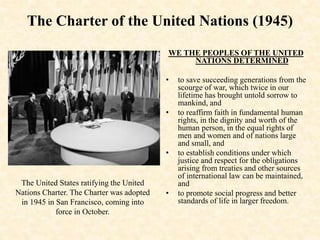
The United States ratifying the United
Nations Charter. The Charter was adopted
in 1945 in San Francisco, coming into
force in October.
The Nuremburg Trials
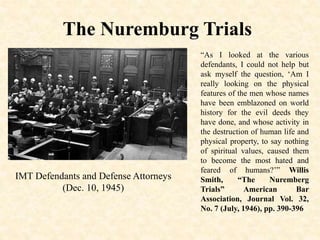
IMT Defendants and Defense Attorneys
(Dec. 10, 1945)
“As I looked at the various
defendants, I could not help but
ask myself the question, ‘Am I
really looking on the physical
features of the men whose names
have been emblazoned on world
history for the evil deeds they
have done, and whose activity in
the destruction of human life and
physical property, to say nothing
of spiritual values, caused them
to become the most hated and
feared of humans?’” Willis
Smith, “The Nuremberg
Trials” American Bar
Association, Journal Vol. 32,
No. 7 (July, 1946), pp. 390-396
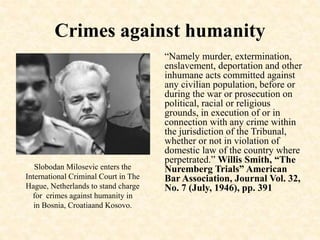
Crimes against humanity
“Namely murder, extermination,
enslavement, deportation and other
inhumane acts committed against
any civilian population, before or
during the war or prosecution on
political, racial or religious
grounds, in execution of or in
connection with any crime within
the jurisdiction of the Tribunal,
whether or not in violation of
domestic law of the country where
perpetrated.” Willis Smith, “The
Nuremberg Trials” American
Bar Association, Journal Vol. 32,
No. 7 (July, 1946), pp. 391
Slobodan Milosevic enters the
International Criminal Court in The
Hague, Netherlands to stand charge
for crimes against humanity in
in Bosnia, Croatiaand Kosovo.
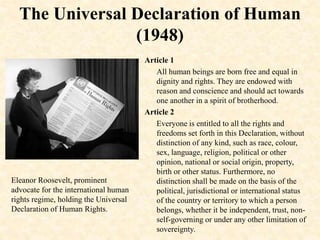
The Universal Declaration of Human
(1948)
Article 1
All human beings are born free and equal in
dignity and rights. They are endowed with
reason and conscience and should act towards
one another in a spirit of brotherhood.
Article 2
Everyone is entitled to all the rights and
freedoms set forth in this Declaration, without
distinction of any kind, such as race, colour,
sex, language, religion, political or other
opinion, national or social origin, property,
birth or other status. Furthermore, no
distinction shall be made on the basis of the
political, jurisdictional or international status
of the country or territory to which a person
belongs, whether it be independent, trust, non-
self-governing or under any other limitation of
sovereignty.
Eleanor Roosevelt, prominent
advocate for the international human
rights regime, holding the Universal
Declaration of Human Rights.
The Normative Base of Human
Rights
“In the same way that believers in natural law and rights claimed that
these ideas were self-evident, so too, for many believers in human
rights, the universal rights they articulate are held to be universal,
values of the common human sense.” Anthony J. Langlois, 16
“What we conceive of as “Modern Human Rights” therefore
originally came from the ideas of natural laws and natural rights.
The universality of these rights derived from their proponents
belief that human sociability should be articulated (at least in part)
by the use of rights language, and that these particular rights
should be moral norms by which human behavior should be judged
and evaluated.” (Anthony Langlois, 16)
Limitations of “Early” Modern
Human Rights
“No comprehensive system for protecting human rights was
enshrined in the Charter. Rather, the goal of securing respect
for human rights was specified with States pledging to
encourage the promotion and observance of rights within
their territories. There was no definition or articulation of
‘human rights’ although reference was made to the concept
of equality and the notion of the dignity and worth of the
human persons.” Rhonda K Smith, 27
“Scattered, terse, even cryptic” Steiner, Alston and
Goodman, 135
What are “Human Rights”?
• “Human Rights are, literally, the rights one has simply
because one is a human being… Human rights are
equal rights; one either is or is not a human being, and
therefore has the same human rights as everyone else
(or not at all).” (Jack Donnelly, 10)
• (1) Each and every (born) human being has inherent
dignity. (2) Certain things cannot be done to a human
being and certain things must be done for a human
being because the claim of inherent human dignity has
normative implications for society. Perry (2000)
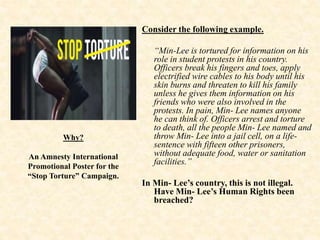
Consider the following example.
“Min-Lee is tortured for information on his
role in student protests in his country.
Officers break his fingers and toes, apply
electrified wire cables to his body until his
skin burns and threaten to kill his family
unless he gives them information on his
friends who were also involved in the
protests. In pain, Min- Lee names anyone
he can think of. Officers arrest and torture
to death, all the people Min- Lee named and
throw Min- Lee into a jail cell, on a life-
sentence with fifteen other prisoners,
without adequate food, water or sanitation
facilities.”
In Min- Lee’s country, this is not illegal.
Have Min- Lee’s Human Rights been
breached?
Why?
An Amnesty International
Promotional Poster for the
“Stop Torture” Campaign.
Legal Positivism
“Political forces have mooted the principal
philosophical objections, bridging the chasm
between natural and positive law by converting
natural human rights into positive legal rights.”
(Henkin 1978)
“One might argue that the difficult task of
philosophical justification has been superseded
by the creation of the international human rights
regime.” (Langlois 17)
“The danger is this reduces rights to their legal
status only, which means that when rights do not
exist we do not have them.” Jack Donnelly
(1989)
Interests Theory Approach
“Autonomy , the self- directed or self- authored life is considered to be the human ideal .
Autonomy and choice are fundamental ingredients in any valuable life.” (Raz 1986)
“A prudential argument from fundamental interests attempts to show that it would be
reasonable to accept and comply with human rights, in circumstances where most others
are likely to do so, because these norms are part of the best means for protecting one's
fundamental interests against actions and omissions that endanger them.” Nickel
(1987:84)
Human rights have instrumental value for securing the necessary conditions of human
well-being. The “basic forms of human good” are life and development, knowledge,
recreation, aesthetic expression, sociability and friendship, practical reasonableness, the
capacity for intelligent and reasonable thought processes and finally, religion, or the
capacity for spiritual experience. Finnis (1980)
Conceptual Necessity
• Shue (1980): “Moral Rights” and “Basic Rights.”
• Moral Rights: 1) Rational basis for a justified demand. 2) Actual enjoyment of a
substance that is 3) Socially guaranteed against standard threats. (13)
• “Everyone’s minimum reasonable demands upon the rest of humanity.” (19)
• “One of the chief purposes of morality in general, and certainly conceptions of rights,
and of basic rights above all, is indeed to provide some minimal protection against
utter helplessness to those too weak to protect themselves. Basic rights are a shield
for the defenseless against at lease some of the more devastation and common of
life’s threats…” (18)
• Basic Rights: “Enjoyment of them is essential to the enjoyment of other moral
rights.” Conceptual Necessity: “made essential by the very concept of a right.” (31)
• Everyone has a right to something, some other things are necessary for enjoying the
first right, therefore everyone has right to other things as well.
Will Theory Approach
Alan Gewirth (1978, 1982): People have the capacity
for rationally purposive agency. Human rights are
necessary to achieving this as they advance freedom
and well-being which are the two necessary
conditions.
Individual cannot simply will their own enjoyment of
these prerequisites for rational agency without due
concern for others. “Principle of generic consistency.”
Absolute right to life is possessed separately and
equally by all of us.
A “right is absolute when it cannot be overridden in
any circumstances, so that it can never be justifiably
infringed and it must be fulfilled without any
exceptions.” (1982:92).
Will Theory Approach
James Griffin (2008): People have a unique value
of agency and autonomy. Human rights protect
people's ability to form and pursue conceptions of
a worthwhile life, i.e. “autonomy,” “normative
agency,” and “personhood.”
“Practicalities” shape the exercise of human rights.
“Indeterminacy of sense” makes human rights
vulnerable to expanding and poorly defined new
rights which are not effective.
Linking human rights to the single value of
normative agency and practicalities is the most
effective manner to pursue human rights.
Capabilities
• Basic “capabilities” : “Goes without saying a just and fair society would seek to
minimally ensure for all its citizens. These capabilities include the freedom to be
well nourished, to live long and disease-free lives, to move around, to be
educated, to enjoy self- respect, to enjoy self-respect in society, to participate in
public life and others.” (Sen 1980)
• “Freedom” and “Functions” “Being” and “doing.” Emphasis upon human agency.
• “Stand up against any proposal of a grand mausoleum to one fixed and final list
of capabilities.” (Sen 2005, 160)
• Five “Instrumental freedoms”: Political, economic, social, transparency
guarantees and protective security. Must include protection against fundamental
deprivations.
• Importance of democracy and equality: “The exercise of freedom is mediated by
values, but the values in turn are influenced by public discussions and social
interactions, which are themselves influenced by participatory freedoms.” (Sen
1999a, 9)
• Nussbaum (2000 and 2003): overlapping consensus on values universal to
humanity. “Central Human Capabilities.”
How do human rights interact with
the State?
Thomas Pogge (1995): The moral burden for human rights must fall upon States
because they are best able to perform the necessary actions to secure realization.
We understand human rights and their justification by identifying the main roles
they play in the political sphere, in this case international relations and national
policy. (Rawls
“Rights are best understood as trumps over some background justification for
political decisions that states a goal for the community as a whole.” Dworkin
(1977:153).
Divide into groups of three. Can you think of some examples of times when
other considerations, like policy, might conflict with human rights? Write them
down and present them back to me in ten minutes.
Homework Assignment
Using the class notes and assigned reading, which
“justification of rights” do you currently find most
convincing and why? (600 words) Due in one week.
Core Reading:
• Langlois, 15-19 (Provided to you)
Legal Instrument:
• Universal Declaration of Human Rights (Provided to
you)

15.03.2015 (1)

  • 1.
    The Human Rightsof Vulnerable People What are “Human Rights?” Kathryn Mecrow
  • 2.
    Why are HumanRights important? “Human Rights have come to provide a powerful basis for an ethical critique of international politics and policy. Understanding the history of human rights and their critiques is essential to theorizing modern human rights.” (Langlois) Promotional poster for “Human Rights Day”
  • 3.
    The Charter ofthe United Nations (1945) WE THE PEOPLES OF THE UNITED NATIONS DETERMINED • to save succeeding generations from the scourge of war, which twice in our lifetime has brought untold sorrow to mankind, and • to reaffirm faith in fundamental human rights, in the dignity and worth of the human person, in the equal rights of men and women and of nations large and small, and • to establish conditions under which justice and respect for the obligations arising from treaties and other sources of international law can be maintained, and • to promote social progress and better standards of life in larger freedom. The United States ratifying the United Nations Charter. The Charter was adopted in 1945 in San Francisco, coming into force in October.
  • 4.
    The Nuremburg Trials IMTDefendants and Defense Attorneys (Dec. 10, 1945) “As I looked at the various defendants, I could not help but ask myself the question, ‘Am I really looking on the physical features of the men whose names have been emblazoned on world history for the evil deeds they have done, and whose activity in the destruction of human life and physical property, to say nothing of spiritual values, caused them to become the most hated and feared of humans?’” Willis Smith, “The Nuremberg Trials” American Bar Association, Journal Vol. 32, No. 7 (July, 1946), pp. 390-396
  • 5.
    Crimes against humanity “Namelymurder, extermination, enslavement, deportation and other inhumane acts committed against any civilian population, before or during the war or prosecution on political, racial or religious grounds, in execution of or in connection with any crime within the jurisdiction of the Tribunal, whether or not in violation of domestic law of the country where perpetrated.” Willis Smith, “The Nuremberg Trials” American Bar Association, Journal Vol. 32, No. 7 (July, 1946), pp. 391 Slobodan Milosevic enters the International Criminal Court in The Hague, Netherlands to stand charge for crimes against humanity in in Bosnia, Croatiaand Kosovo.
  • 6.
    The Universal Declarationof Human (1948) Article 1 All human beings are born free and equal in dignity and rights. They are endowed with reason and conscience and should act towards one another in a spirit of brotherhood. Article 2 Everyone is entitled to all the rights and freedoms set forth in this Declaration, without distinction of any kind, such as race, colour, sex, language, religion, political or other opinion, national or social origin, property, birth or other status. Furthermore, no distinction shall be made on the basis of the political, jurisdictional or international status of the country or territory to which a person belongs, whether it be independent, trust, non- self-governing or under any other limitation of sovereignty. Eleanor Roosevelt, prominent advocate for the international human rights regime, holding the Universal Declaration of Human Rights.
  • 7.
    The Normative Baseof Human Rights “In the same way that believers in natural law and rights claimed that these ideas were self-evident, so too, for many believers in human rights, the universal rights they articulate are held to be universal, values of the common human sense.” Anthony J. Langlois, 16 “What we conceive of as “Modern Human Rights” therefore originally came from the ideas of natural laws and natural rights. The universality of these rights derived from their proponents belief that human sociability should be articulated (at least in part) by the use of rights language, and that these particular rights should be moral norms by which human behavior should be judged and evaluated.” (Anthony Langlois, 16)
  • 8.
    Limitations of “Early”Modern Human Rights “No comprehensive system for protecting human rights was enshrined in the Charter. Rather, the goal of securing respect for human rights was specified with States pledging to encourage the promotion and observance of rights within their territories. There was no definition or articulation of ‘human rights’ although reference was made to the concept of equality and the notion of the dignity and worth of the human persons.” Rhonda K Smith, 27 “Scattered, terse, even cryptic” Steiner, Alston and Goodman, 135
  • 9.
    What are “HumanRights”? • “Human Rights are, literally, the rights one has simply because one is a human being… Human rights are equal rights; one either is or is not a human being, and therefore has the same human rights as everyone else (or not at all).” (Jack Donnelly, 10) • (1) Each and every (born) human being has inherent dignity. (2) Certain things cannot be done to a human being and certain things must be done for a human being because the claim of inherent human dignity has normative implications for society. Perry (2000)
  • 10.
    Consider the followingexample. “Min-Lee is tortured for information on his role in student protests in his country. Officers break his fingers and toes, apply electrified wire cables to his body until his skin burns and threaten to kill his family unless he gives them information on his friends who were also involved in the protests. In pain, Min- Lee names anyone he can think of. Officers arrest and torture to death, all the people Min- Lee named and throw Min- Lee into a jail cell, on a life- sentence with fifteen other prisoners, without adequate food, water or sanitation facilities.” In Min- Lee’s country, this is not illegal. Have Min- Lee’s Human Rights been breached? Why? An Amnesty International Promotional Poster for the “Stop Torture” Campaign.
  • 11.
    Legal Positivism “Political forceshave mooted the principal philosophical objections, bridging the chasm between natural and positive law by converting natural human rights into positive legal rights.” (Henkin 1978) “One might argue that the difficult task of philosophical justification has been superseded by the creation of the international human rights regime.” (Langlois 17) “The danger is this reduces rights to their legal status only, which means that when rights do not exist we do not have them.” Jack Donnelly (1989)
  • 12.
    Interests Theory Approach “Autonomy, the self- directed or self- authored life is considered to be the human ideal . Autonomy and choice are fundamental ingredients in any valuable life.” (Raz 1986) “A prudential argument from fundamental interests attempts to show that it would be reasonable to accept and comply with human rights, in circumstances where most others are likely to do so, because these norms are part of the best means for protecting one's fundamental interests against actions and omissions that endanger them.” Nickel (1987:84) Human rights have instrumental value for securing the necessary conditions of human well-being. The “basic forms of human good” are life and development, knowledge, recreation, aesthetic expression, sociability and friendship, practical reasonableness, the capacity for intelligent and reasonable thought processes and finally, religion, or the capacity for spiritual experience. Finnis (1980)
  • 13.
    Conceptual Necessity • Shue(1980): “Moral Rights” and “Basic Rights.” • Moral Rights: 1) Rational basis for a justified demand. 2) Actual enjoyment of a substance that is 3) Socially guaranteed against standard threats. (13) • “Everyone’s minimum reasonable demands upon the rest of humanity.” (19) • “One of the chief purposes of morality in general, and certainly conceptions of rights, and of basic rights above all, is indeed to provide some minimal protection against utter helplessness to those too weak to protect themselves. Basic rights are a shield for the defenseless against at lease some of the more devastation and common of life’s threats…” (18) • Basic Rights: “Enjoyment of them is essential to the enjoyment of other moral rights.” Conceptual Necessity: “made essential by the very concept of a right.” (31) • Everyone has a right to something, some other things are necessary for enjoying the first right, therefore everyone has right to other things as well.
  • 14.
    Will Theory Approach AlanGewirth (1978, 1982): People have the capacity for rationally purposive agency. Human rights are necessary to achieving this as they advance freedom and well-being which are the two necessary conditions. Individual cannot simply will their own enjoyment of these prerequisites for rational agency without due concern for others. “Principle of generic consistency.” Absolute right to life is possessed separately and equally by all of us. A “right is absolute when it cannot be overridden in any circumstances, so that it can never be justifiably infringed and it must be fulfilled without any exceptions.” (1982:92).
  • 15.
    Will Theory Approach JamesGriffin (2008): People have a unique value of agency and autonomy. Human rights protect people's ability to form and pursue conceptions of a worthwhile life, i.e. “autonomy,” “normative agency,” and “personhood.” “Practicalities” shape the exercise of human rights. “Indeterminacy of sense” makes human rights vulnerable to expanding and poorly defined new rights which are not effective. Linking human rights to the single value of normative agency and practicalities is the most effective manner to pursue human rights.
  • 16.
    Capabilities • Basic “capabilities”: “Goes without saying a just and fair society would seek to minimally ensure for all its citizens. These capabilities include the freedom to be well nourished, to live long and disease-free lives, to move around, to be educated, to enjoy self- respect, to enjoy self-respect in society, to participate in public life and others.” (Sen 1980) • “Freedom” and “Functions” “Being” and “doing.” Emphasis upon human agency. • “Stand up against any proposal of a grand mausoleum to one fixed and final list of capabilities.” (Sen 2005, 160) • Five “Instrumental freedoms”: Political, economic, social, transparency guarantees and protective security. Must include protection against fundamental deprivations. • Importance of democracy and equality: “The exercise of freedom is mediated by values, but the values in turn are influenced by public discussions and social interactions, which are themselves influenced by participatory freedoms.” (Sen 1999a, 9) • Nussbaum (2000 and 2003): overlapping consensus on values universal to humanity. “Central Human Capabilities.”
  • 17.
    How do humanrights interact with the State? Thomas Pogge (1995): The moral burden for human rights must fall upon States because they are best able to perform the necessary actions to secure realization. We understand human rights and their justification by identifying the main roles they play in the political sphere, in this case international relations and national policy. (Rawls “Rights are best understood as trumps over some background justification for political decisions that states a goal for the community as a whole.” Dworkin (1977:153). Divide into groups of three. Can you think of some examples of times when other considerations, like policy, might conflict with human rights? Write them down and present them back to me in ten minutes.
  • 18.
    Homework Assignment Using theclass notes and assigned reading, which “justification of rights” do you currently find most convincing and why? (600 words) Due in one week. Core Reading: • Langlois, 15-19 (Provided to you) Legal Instrument: • Universal Declaration of Human Rights (Provided to you)