E.S.I. ACT
INTRODUCTION
The E.S.I.Act (Employees State
Insurance) passed in 1948 (amended in 1975, 1984, 1989
and 2010) is an important measure of social security and
health insurance in this country.
It provides for certain cash and medical
benefits to industrial employees in case of sickness, maternity
and employment injury.
The act extends to the whole of India.The
E.S.I.Act of 1948 covered all power using factories other
than seasonal factories wherein 10 or more persons were
employed (excluding mines, railways and defense
establishments).
SCOPE
The provisions of the E.S.I. (amendment) act of 1975 were
extended to the following new classes of establishments:-
 Small factories employing 10 or more persons, whether power is used in
the process of manufacturing or not.
 Shops
 Hotel and restaurants
 Cinemas and theatres
 Road-motor transport establishments
 Newspaper establishments
 The scheme has been extended to private medical and educational institutions
employing 20 or more persons in some states.
ADMINISTRATION
 The administration of the ESI scheme under the act is entrusted to
an autonomous body called the ESI corporation.
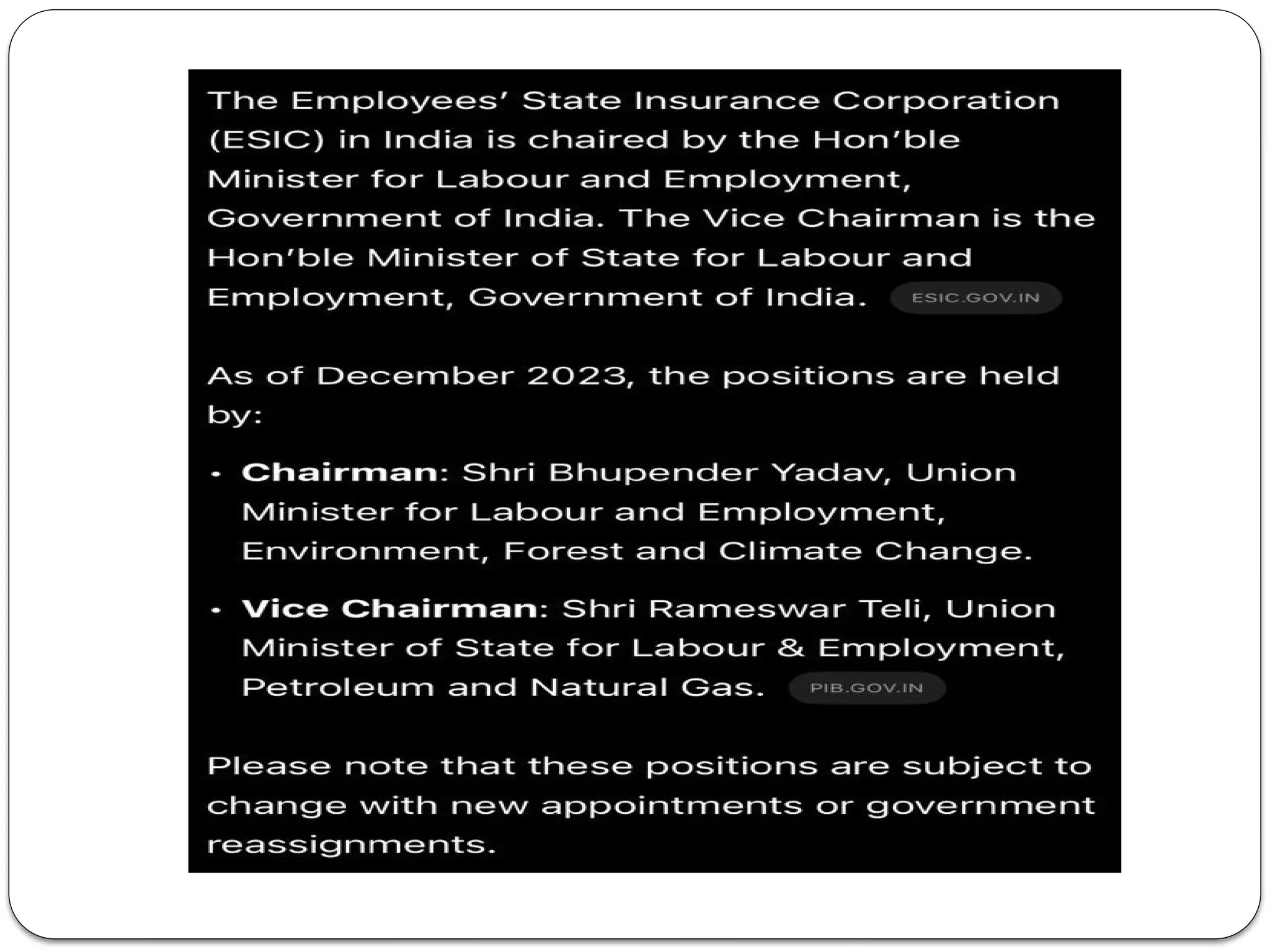
 The union minister for labor is the chairman and the secretary to
Govt. of India Ministry of Labor is the vice chairman of this
corporation.
 It consists of members representing Central and State
Govt. ,employers and employees organizations, medical profession
and Parliament.
 There is a standing committee, constituted from the members
of the corporation, which acts as an executive body for the
administration of the scheme.
 The chief executive officer of the corporation is the director
general who is assisted by four principal officers:-
1. Insurance commissioner
2. Medical commissioner
3. Financial commissioner
4. Actuary
 There is a medical benefit council which is headed by the
Director general of Health Services, Govt. of India who is assisted
by the medical commissioner in all matters relating to medical
relief.
 Besides the head office in New Delhi, the corporation has 23
regional offices and 26 sub regional offices at 2 divisional offices
and 624 branch offices, 197 cash offices and 406 inspection offices
all over the country.
 Given the huge no. of beneficiaries- about 720 lakh by
31.03.2013 – the corporation has set up a widespread
network of service outlets for prompt delivery of benefits in
cash and kind that includes full medical care.
ESI gives coverage to about 185 lakh family units of about
165 lakh employees including about 26.79 lakh females, as on
31.03.2013.
Medical facilities are provided through a network of 1384 ESI
dispensaries, over 2100 panel clinics, 307 diagnostic centers,
besides 151 ESI hospitals and 42 hospital annexes with over
27000 beds.
FINANCE
 The scheme is run by contributions by employees and employers
and grants from Central and State Governments.
 The employer contributes 4.75 percent of total wage bill;
the employees contribute 1.75 percent of wages.
Employees getting daily wages of below Rs. 70 are exempted
from payment of contribution.
The State Government’s share of expenditure on medical care
is 1/8 of the total cost of medical care; the E.S.I. Corporation’s
share of expenditure on medical care is 7/8 of total cost of
medical care.
BENEFITS TO EMPLOYEES
The act has made provision for the following benefits
to insured persons or, to other dependents as the case may
be:-
 Medical benefits
 Sickness benefits
 Maternity benefits
 Disablement benefits
 Dependant’s benefits
 Funeral expenses
 Rehabilitation allowance
DIRECT PATTERN:-
1. In areas having a concentration of 1000 or more employee’s family units,
service dispensaries are established with full time medical and
paramedical personnel.
2. In areas where the employees are less than 750, part time ESI
dispensaries are established.
3. If the residential concentration of employees is scattered over a long distance,
mobile dispensaries are established.
INDIRECT PATTERN (PANEL SYSTEM):-Registered medical
practitioners designated as Insurance Medical Practitioners are appointed to
provide medical care.
MEDICAL BENEFITS
1961-62 1969-70 1973-74 1992-93 2001-02
0
100
200
300
400
500
600
700
800
900
1000
23.79 58.91 67.53
406.78
905
Column2
EXPENDITURE ON MEDICAL BENEFITWAS Rs.4058 CRORES IN 2012-
13.
SICKNESS BENEFIT
 The benefit is payable for a maximum period of 365 days, the daily rate being
about 50% of the average daily wages.
 EXTENDED SICKNESS BENEFIT:- In addition to 91 days of sickness
benefit, insured persons suffering from certain long term diseases are entitled
to extended sickness benefit, for a maximum period of 2 years. 34 diseases for
which extended sickness benefit with effect from 1.1.2000 is payable, in case
where the insured person has been in continuous employment for 2 years.
 ENHANCED SICKNESS BENEFIT :-is payable to insured women for 14
days for tubectomy and for 7 days in case of vasectomy in respect of male IPs.
The amount payable is double the standard sickness benefit rate, i.e., equal to
full wages.
MATERNITY BENEFIT
 The benefit is payable in cash to an insured women for
confinement/miscarriage or sickness arising out of
pregnancy/confinement or premature birth of child or
miscarriage.
 For confinement, the duration of benefit is 12 week(84 days),
for miscarriage 6 weeks and for sickness arising out of
confinement etc. 30 days.
 The benefit is allowed at about full wages.
 The rate of confinement expenses has been increased from Rs.
2,500 to 5,000 per confinement.
DISABLEMENT BENEFIT
 The Act provides for cash payment , besides free medical
treatment, in the event of temporary or permanent disablement
as a result of employment injury as well as occupational diseases.
The rate of temporary disablement benefit is about 90 percent of
the wages as long as the temporary disablement lasts.
In case of total permanent disablement, the insured person is
given life pension worked out on the basis of loss of earning
capacity determined by a medical board, while in cases of partial
permanent disablement a portion of it is granted as life
pension.
DEPENDANT’S BENEFIT
 In case of death, as a result of employment injury, the
dependants of an insured person are eligible for periodical
payments.
 Pension at the rate of 90% of the wages is payable, shared
by dependants in a fixed ratio, on monthly basis in accordance with
the prescribed share.
 An eligible son or daughter is entitled to dependant’s benefit up to
the age of 18; the benefit is withdrawn if the daughter
marries earlier.
FUNERAL EXPENSES
Funeral benefit is a cash payment payable on the death of
an insured person towards the expenses on his funeral, the amount
not exceeding Rs. 10,000.
REHABILITATION
On monthly payment of Rs. 10, the insured person and
his family members continue to get medical treatment after
permanent disablement or retirement.
BENEFITS TO EMPLOYERS
1. Exemption from the applicability of Workmen’s Compensation
Act, 1923.
2. Exemption from Maternity Benefit Act, 1961.
3. Exemption from payment of medical allowance to
employees and their dependent's or arranging for their medical care.
4. Rebate under the IncomeTax Act on contribution deposited in
the ESI account.
5. Healthy work-force
As on 31.03.2013 about 6.6 lakh employers were covered under the
scheme.
Rajiv Gandhi Shramik Kalyan
Yojna
The ESI corporation has launched a newYojna for the employees
covered under the ESI scheme.This scheme provides an
unemployment allowance for the employees covered under ESI
scheme who are rendered unemployed involuntarily due to
retrenchment /closure of factory etc. after fulfilling certain eligibility
conditions.
The scheme came into effect from 1.04.2005.The
allowance can be availed in one spell or in different spells of not less
than 1 month.
The daily rate of unemployment allowance is the “Standard
benefit rate” as specified under rule 54 of ESI rules 1950, corresponding
to the average daily wage drawn by the insured person.
REFERENCES
 Textbook of Preventive and Social Medicine by K. Park, 23rd
Edition.
 Wikipedia.
esi.pptx for the students of law and management

esi.pptx for the students of law and management

  • 1.
  • 2.
    INTRODUCTION The E.S.I.Act (EmployeesState Insurance) passed in 1948 (amended in 1975, 1984, 1989 and 2010) is an important measure of social security and health insurance in this country. It provides for certain cash and medical benefits to industrial employees in case of sickness, maternity and employment injury. The act extends to the whole of India.The E.S.I.Act of 1948 covered all power using factories other than seasonal factories wherein 10 or more persons were employed (excluding mines, railways and defense establishments).
  • 3.
    SCOPE The provisions ofthe E.S.I. (amendment) act of 1975 were extended to the following new classes of establishments:-  Small factories employing 10 or more persons, whether power is used in the process of manufacturing or not.  Shops  Hotel and restaurants  Cinemas and theatres  Road-motor transport establishments  Newspaper establishments  The scheme has been extended to private medical and educational institutions employing 20 or more persons in some states.
  • 4.
    ADMINISTRATION  The administrationof the ESI scheme under the act is entrusted to an autonomous body called the ESI corporation.  The union minister for labor is the chairman and the secretary to Govt. of India Ministry of Labor is the vice chairman of this corporation.  It consists of members representing Central and State Govt. ,employers and employees organizations, medical profession and Parliament.  There is a standing committee, constituted from the members of the corporation, which acts as an executive body for the administration of the scheme.
  • 5.
     The chiefexecutive officer of the corporation is the director general who is assisted by four principal officers:- 1. Insurance commissioner 2. Medical commissioner 3. Financial commissioner 4. Actuary  There is a medical benefit council which is headed by the Director general of Health Services, Govt. of India who is assisted by the medical commissioner in all matters relating to medical relief.  Besides the head office in New Delhi, the corporation has 23 regional offices and 26 sub regional offices at 2 divisional offices and 624 branch offices, 197 cash offices and 406 inspection offices all over the country.
  • 7.
     Given thehuge no. of beneficiaries- about 720 lakh by 31.03.2013 – the corporation has set up a widespread network of service outlets for prompt delivery of benefits in cash and kind that includes full medical care. ESI gives coverage to about 185 lakh family units of about 165 lakh employees including about 26.79 lakh females, as on 31.03.2013. Medical facilities are provided through a network of 1384 ESI dispensaries, over 2100 panel clinics, 307 diagnostic centers, besides 151 ESI hospitals and 42 hospital annexes with over 27000 beds.
  • 8.
    FINANCE  The schemeis run by contributions by employees and employers and grants from Central and State Governments.  The employer contributes 4.75 percent of total wage bill; the employees contribute 1.75 percent of wages. Employees getting daily wages of below Rs. 70 are exempted from payment of contribution. The State Government’s share of expenditure on medical care is 1/8 of the total cost of medical care; the E.S.I. Corporation’s share of expenditure on medical care is 7/8 of total cost of medical care.
  • 9.
    BENEFITS TO EMPLOYEES Theact has made provision for the following benefits to insured persons or, to other dependents as the case may be:-  Medical benefits  Sickness benefits  Maternity benefits  Disablement benefits  Dependant’s benefits  Funeral expenses  Rehabilitation allowance
  • 10.
    DIRECT PATTERN:- 1. Inareas having a concentration of 1000 or more employee’s family units, service dispensaries are established with full time medical and paramedical personnel. 2. In areas where the employees are less than 750, part time ESI dispensaries are established. 3. If the residential concentration of employees is scattered over a long distance, mobile dispensaries are established. INDIRECT PATTERN (PANEL SYSTEM):-Registered medical practitioners designated as Insurance Medical Practitioners are appointed to provide medical care. MEDICAL BENEFITS
  • 11.
    1961-62 1969-70 1973-741992-93 2001-02 0 100 200 300 400 500 600 700 800 900 1000 23.79 58.91 67.53 406.78 905 Column2 EXPENDITURE ON MEDICAL BENEFITWAS Rs.4058 CRORES IN 2012- 13.
  • 12.
    SICKNESS BENEFIT  Thebenefit is payable for a maximum period of 365 days, the daily rate being about 50% of the average daily wages.  EXTENDED SICKNESS BENEFIT:- In addition to 91 days of sickness benefit, insured persons suffering from certain long term diseases are entitled to extended sickness benefit, for a maximum period of 2 years. 34 diseases for which extended sickness benefit with effect from 1.1.2000 is payable, in case where the insured person has been in continuous employment for 2 years.  ENHANCED SICKNESS BENEFIT :-is payable to insured women for 14 days for tubectomy and for 7 days in case of vasectomy in respect of male IPs. The amount payable is double the standard sickness benefit rate, i.e., equal to full wages.
  • 13.
    MATERNITY BENEFIT  Thebenefit is payable in cash to an insured women for confinement/miscarriage or sickness arising out of pregnancy/confinement or premature birth of child or miscarriage.  For confinement, the duration of benefit is 12 week(84 days), for miscarriage 6 weeks and for sickness arising out of confinement etc. 30 days.  The benefit is allowed at about full wages.  The rate of confinement expenses has been increased from Rs. 2,500 to 5,000 per confinement.
  • 14.
    DISABLEMENT BENEFIT  TheAct provides for cash payment , besides free medical treatment, in the event of temporary or permanent disablement as a result of employment injury as well as occupational diseases. The rate of temporary disablement benefit is about 90 percent of the wages as long as the temporary disablement lasts. In case of total permanent disablement, the insured person is given life pension worked out on the basis of loss of earning capacity determined by a medical board, while in cases of partial permanent disablement a portion of it is granted as life pension.
  • 15.
    DEPENDANT’S BENEFIT  Incase of death, as a result of employment injury, the dependants of an insured person are eligible for periodical payments.  Pension at the rate of 90% of the wages is payable, shared by dependants in a fixed ratio, on monthly basis in accordance with the prescribed share.  An eligible son or daughter is entitled to dependant’s benefit up to the age of 18; the benefit is withdrawn if the daughter marries earlier.
  • 16.
    FUNERAL EXPENSES Funeral benefitis a cash payment payable on the death of an insured person towards the expenses on his funeral, the amount not exceeding Rs. 10,000. REHABILITATION On monthly payment of Rs. 10, the insured person and his family members continue to get medical treatment after permanent disablement or retirement.
  • 17.
    BENEFITS TO EMPLOYERS 1.Exemption from the applicability of Workmen’s Compensation Act, 1923. 2. Exemption from Maternity Benefit Act, 1961. 3. Exemption from payment of medical allowance to employees and their dependent's or arranging for their medical care. 4. Rebate under the IncomeTax Act on contribution deposited in the ESI account. 5. Healthy work-force As on 31.03.2013 about 6.6 lakh employers were covered under the scheme.
  • 18.
    Rajiv Gandhi ShramikKalyan Yojna The ESI corporation has launched a newYojna for the employees covered under the ESI scheme.This scheme provides an unemployment allowance for the employees covered under ESI scheme who are rendered unemployed involuntarily due to retrenchment /closure of factory etc. after fulfilling certain eligibility conditions. The scheme came into effect from 1.04.2005.The allowance can be availed in one spell or in different spells of not less than 1 month. The daily rate of unemployment allowance is the “Standard benefit rate” as specified under rule 54 of ESI rules 1950, corresponding to the average daily wage drawn by the insured person.
  • 19.
    REFERENCES  Textbook ofPreventive and Social Medicine by K. Park, 23rd Edition.  Wikipedia.