ADIT | BIMA | ESTIE | ETGAR
FRISCA | HANIF | IRREZA
Group 3 F121
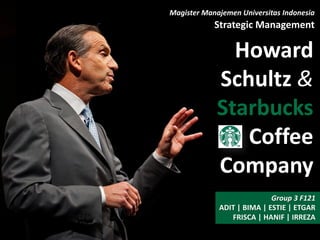
Howard
Schultz &
Starbucks
Coffee
Company
Magister Manajemen Universitas Indonesia
Strategic Management
Our Menu
• Who is Howard
Schultz?
• History of Starbucks
• Key Issues
• Conclusion &
Recommendation
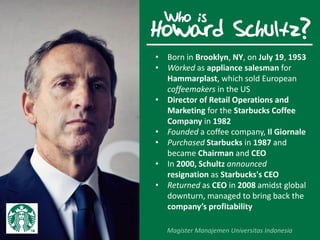
Howard Schultz?
• Born in Brooklyn, NY, on July 19, 1953
• Worked as appliance salesman for
Hammarplast, which sold European
coffeemakers in the US
• Director of Retail Operations and
Marketing for the Starbucks Coffee
Company in 1982
• Founded a coffee company, Il Giornale
• Purchased Starbucks in 1987 and
became Chairman and CEO
• In 2000, Schultz announced
resignation as Starbucks's CEO
• Returned as CEO in 2008 amidst global
downturn, managed to bring back the
company’s profitability
Who is
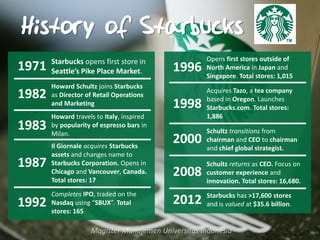
Starbucks opens first store in
Seattle’s Pike Place Market.1971
Howard Schultz joins Starbucks
as Director of Retail Operations
and Marketing
1982
1983
Howard travels to Italy, inspired
by popularity of espresso bars in
Milan.
1987
Il Giornale acquires Starbucks
assets and changes name to
Starbucks Corporation. Opens in
Chicago and Vancouver, Canada.
Total stores: 17
1992
Completes IPO, traded on the
Nasdaq using “SBUX”. Total
stores: 165
1996
Opens first stores outside of
North America in Japan and
Singapore. Total stores: 1,015
1998
Acquires Tazo, a tea company
based in Oregon. Launches
Starbucks.com. Total stores:
1,886
2000
Schultz transitions from
chairman and CEO to chairman
and chief global strategist.
2008
Schultz returns as CEO. Focus on
customer experience and
innovation. Total stores: 16,680.
2012 Starbucks has >17,600 stores
and is valued at $35.6 billion.
History of Starbucks
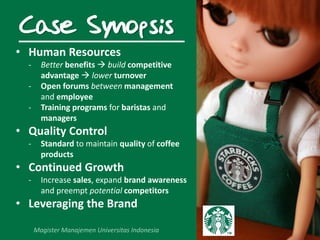
Case Synopsis
• Human Resources
- Better benefits  build competitive
advantage  lower turnover
- Open forums between management
and employee
- Training programs for baristas and
managers
• Quality Control
- Standard to maintain quality of coffee
products
• Continued Growth
- Increase sales, expand brand awareness
and preempt potential competitors
• Leveraging the Brand
Key Issues
theories & analysis
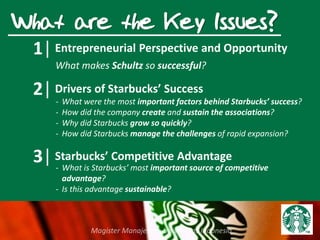
What are the Key Issues?
Entrepreneurial Perspective and Opportunity
Drivers of Starbucks’ Success
Starbucks’ Competitive Advantage
1|
2|
3|
What makes Schultz so successful?
- What were the most important factors behind Starbucks’ success?
- How did the company create and sustain the associations?
- Why did Starbucks grow so quickly?
- How did Starbucks manage the challenges of rapid expansion?
- What is Starbucks’ most important source of competitive
advantage?
- Is this advantage sustainable?
Entrepreneurial Perspective
and Opportunity
1|
Q: What makes Schultz so successful?
THEORY: How to Build a Company’s Vision
1) Core Ideology  Core Values + Purpose
a) Starbucks’ Core Values:
- Coffee: Quality, quality, and quality.
- Partner: It’s not just about work, it’s passion.
- Store: Sense of belonging
- Customer: Connect with, laugh with, and uplift the
lives of our customers
- Neighbourhood: Every store is part of a community
- Shareholders: Our success rewards the shareholders
b) Starbucks’ Core Purpose:
“to inspire and nurture the human spirit – one
person, one cup and one neighborhood at a time.”
Entrepreneurial Perspective
and Opportunity
1|
Q: What makes Schultz so successful?
THEORY: How to Build a Company’s Vision
2) Envisioned Future (B-HAGS)
“To become a giant
global coffee
company which leads
on innovation.”
Entrepreneurial Perspective
and Opportunity
1|
Q: What makes Schultz so successful?
1) “Make it your own” – Customize the
experience.
2) “Everything matters” – Focus on every aspect
of the job. Never ever lose your focus on your
customer’s experience and point of view.
3) “Surprise and delight” – Do the unexpected to
make buying a cup of coffee enjoyable.
4) “Embrace resistance” – Learn from your
mistakes.
5) “Leave your mark” – Do your job so that your
customers remember you.
THE STARBUCKS EXPERIENCE:
(Michelli, 2006)
Drivers of Starbucks’ Success2|
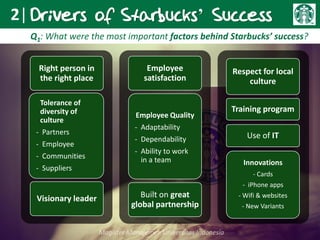
Q1: What were the most important factors behind Starbucks’ success?
Right person in
the right place
Tolerance of
diversity of
culture
Visionary leader
Employee
satisfaction
Kualitas employee
Built on great
global partnership
Respect for local
culture
Training program
Use of IT
Tolerance of
diversity of
culture
- Partners
- Employee
- Communities
- Suppliers
Employee Quality
- Adaptability
- Dependability
- Ability to work
in a team Innovations
- Cards
- iPhone apps
- Wifi & websites
- New Variants
Drivers of Starbucks’ Success2|
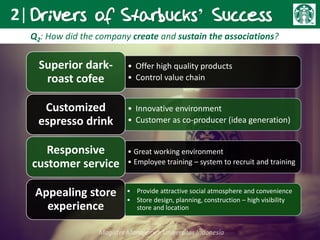
Q2: How did the company create and sustain the associations?
• Offer high quality products
• Control value chain
Superior dark-
roast cofee
• Innovative environment
• Customer as co-producer (idea generation)
Customized
espresso drink
• Great working environment
• Employee training – system to recruit and training
Responsive
customer service
Appealing store
experience
• Provide attractive social atmosphere and convenience
• Store design, planning, construction – high visibility
store and location
Drivers of Starbucks’ Success2|
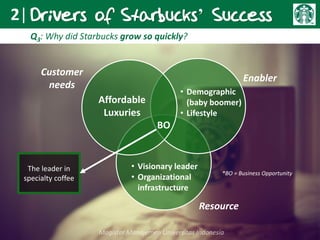
Q3: Why did Starbucks grow so quickly?
BO
The leader in
specialty coffee
Enabler
Resource
*BO = Business Opportunity
Affordable
Luxuries
• Demographic
(baby boomer)
• Lifestyle
• Visionary leader
• Organizational
infrastructure
Customer
needs
Drivers of Starbucks’ Success2|
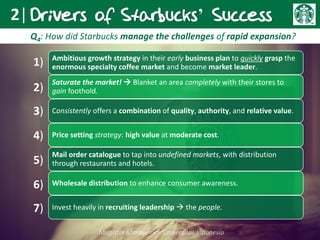
Q4: How did Starbucks manage the challenges of rapid expansion?
Ambitious growth strategy in their early business plan to quickly grasp the
enormous specialty coffee market and become market leader.
Saturate the market!  Blanket an area completely with their stores to
gain foothold.
Consistently offers a combination of quality, authority, and relative value.
Price setting strategy: high value at moderate cost.
Mail order catalogue to tap into undefined markets, with distribution
through restaurants and hotels.
Wholesale distribution to enhance consumer awareness.
Invest heavily in recruiting leadership  the people.
1)
2)
3)
4)
5)
6)
7)
Starbucks’ Competitive Advantage3|
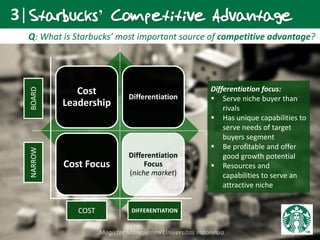
Q: What is Starbucks’ most important source of competitive advantage?
Cost
Leadership
Differentiation
Cost Focus
Differentiation
Focus
(niche market)
BOARDNARROW
DIFFERENTIATIONCOST
Differentiation focus:
 Serve niche buyer than
rivals
 Has unique capabilities to
serve needs of target
buyers segment
 Be profitable and offer
good growth potential
 Resources and
capabilities to serve an
attractive niche
Conclusion &
Recommendation
Conclusion
• Howard Schultz’s vision has led
Starbucks as the leading global
player in the young, growing market
for specialty coffee.
• Starbucks has altered the rules of
the game in the US coffee industry
from strictly commodity to a “third-
place experience”.
• Its continued success depends
critically on their consistent ability to
interest, understand, and empathize
with consumers around the world.
Recommendation
• Starbucks must retain their
inventiveness in order to stay relevant.
• Maintain their philosophy to “Get big
but stay small”.
• To stay competitive, they need:
 Expand geographically, by adding
new cafes in underserved areas 
China
 Expand its reach beyond coffee 
Tazo, Teavana
 Expand its consumer packaged
goods business, leveraging its
global brand awareness
Thank You!

Howard schultz & starbucks

  • 1.
    ADIT | BIMA| ESTIE | ETGAR FRISCA | HANIF | IRREZA Group 3 F121 Howard Schultz & Starbucks Coffee Company Magister Manajemen Universitas Indonesia Strategic Management
  • 2.
    Our Menu • Whois Howard Schultz? • History of Starbucks • Key Issues • Conclusion & Recommendation
  • 3.
    Howard Schultz? • Bornin Brooklyn, NY, on July 19, 1953 • Worked as appliance salesman for Hammarplast, which sold European coffeemakers in the US • Director of Retail Operations and Marketing for the Starbucks Coffee Company in 1982 • Founded a coffee company, Il Giornale • Purchased Starbucks in 1987 and became Chairman and CEO • In 2000, Schultz announced resignation as Starbucks's CEO • Returned as CEO in 2008 amidst global downturn, managed to bring back the company’s profitability Who is
  • 4.
    Starbucks opens firststore in Seattle’s Pike Place Market.1971 Howard Schultz joins Starbucks as Director of Retail Operations and Marketing 1982 1983 Howard travels to Italy, inspired by popularity of espresso bars in Milan. 1987 Il Giornale acquires Starbucks assets and changes name to Starbucks Corporation. Opens in Chicago and Vancouver, Canada. Total stores: 17 1992 Completes IPO, traded on the Nasdaq using “SBUX”. Total stores: 165 1996 Opens first stores outside of North America in Japan and Singapore. Total stores: 1,015 1998 Acquires Tazo, a tea company based in Oregon. Launches Starbucks.com. Total stores: 1,886 2000 Schultz transitions from chairman and CEO to chairman and chief global strategist. 2008 Schultz returns as CEO. Focus on customer experience and innovation. Total stores: 16,680. 2012 Starbucks has >17,600 stores and is valued at $35.6 billion. History of Starbucks
  • 5.
    Case Synopsis • HumanResources - Better benefits  build competitive advantage  lower turnover - Open forums between management and employee - Training programs for baristas and managers • Quality Control - Standard to maintain quality of coffee products • Continued Growth - Increase sales, expand brand awareness and preempt potential competitors • Leveraging the Brand
  • 6.
  • 7.
    What are theKey Issues? Entrepreneurial Perspective and Opportunity Drivers of Starbucks’ Success Starbucks’ Competitive Advantage 1| 2| 3| What makes Schultz so successful? - What were the most important factors behind Starbucks’ success? - How did the company create and sustain the associations? - Why did Starbucks grow so quickly? - How did Starbucks manage the challenges of rapid expansion? - What is Starbucks’ most important source of competitive advantage? - Is this advantage sustainable?
  • 8.
    Entrepreneurial Perspective and Opportunity 1| Q:What makes Schultz so successful? THEORY: How to Build a Company’s Vision 1) Core Ideology  Core Values + Purpose a) Starbucks’ Core Values: - Coffee: Quality, quality, and quality. - Partner: It’s not just about work, it’s passion. - Store: Sense of belonging - Customer: Connect with, laugh with, and uplift the lives of our customers - Neighbourhood: Every store is part of a community - Shareholders: Our success rewards the shareholders b) Starbucks’ Core Purpose: “to inspire and nurture the human spirit – one person, one cup and one neighborhood at a time.”
  • 9.
    Entrepreneurial Perspective and Opportunity 1| Q:What makes Schultz so successful? THEORY: How to Build a Company’s Vision 2) Envisioned Future (B-HAGS) “To become a giant global coffee company which leads on innovation.”
  • 10.
    Entrepreneurial Perspective and Opportunity 1| Q:What makes Schultz so successful? 1) “Make it your own” – Customize the experience. 2) “Everything matters” – Focus on every aspect of the job. Never ever lose your focus on your customer’s experience and point of view. 3) “Surprise and delight” – Do the unexpected to make buying a cup of coffee enjoyable. 4) “Embrace resistance” – Learn from your mistakes. 5) “Leave your mark” – Do your job so that your customers remember you. THE STARBUCKS EXPERIENCE: (Michelli, 2006)
  • 11.
    Drivers of Starbucks’Success2| Q1: What were the most important factors behind Starbucks’ success? Right person in the right place Tolerance of diversity of culture Visionary leader Employee satisfaction Kualitas employee Built on great global partnership Respect for local culture Training program Use of IT Tolerance of diversity of culture - Partners - Employee - Communities - Suppliers Employee Quality - Adaptability - Dependability - Ability to work in a team Innovations - Cards - iPhone apps - Wifi & websites - New Variants
  • 12.
    Drivers of Starbucks’Success2| Q2: How did the company create and sustain the associations? • Offer high quality products • Control value chain Superior dark- roast cofee • Innovative environment • Customer as co-producer (idea generation) Customized espresso drink • Great working environment • Employee training – system to recruit and training Responsive customer service Appealing store experience • Provide attractive social atmosphere and convenience • Store design, planning, construction – high visibility store and location
  • 13.
    Drivers of Starbucks’Success2| Q3: Why did Starbucks grow so quickly? BO The leader in specialty coffee Enabler Resource *BO = Business Opportunity Affordable Luxuries • Demographic (baby boomer) • Lifestyle • Visionary leader • Organizational infrastructure Customer needs
  • 14.
    Drivers of Starbucks’Success2| Q4: How did Starbucks manage the challenges of rapid expansion? Ambitious growth strategy in their early business plan to quickly grasp the enormous specialty coffee market and become market leader. Saturate the market!  Blanket an area completely with their stores to gain foothold. Consistently offers a combination of quality, authority, and relative value. Price setting strategy: high value at moderate cost. Mail order catalogue to tap into undefined markets, with distribution through restaurants and hotels. Wholesale distribution to enhance consumer awareness. Invest heavily in recruiting leadership  the people. 1) 2) 3) 4) 5) 6) 7)
  • 15.
    Starbucks’ Competitive Advantage3| Q:What is Starbucks’ most important source of competitive advantage? Cost Leadership Differentiation Cost Focus Differentiation Focus (niche market) BOARDNARROW DIFFERENTIATIONCOST Differentiation focus:  Serve niche buyer than rivals  Has unique capabilities to serve needs of target buyers segment  Be profitable and offer good growth potential  Resources and capabilities to serve an attractive niche
  • 16.
  • 17.
    Conclusion • Howard Schultz’svision has led Starbucks as the leading global player in the young, growing market for specialty coffee. • Starbucks has altered the rules of the game in the US coffee industry from strictly commodity to a “third- place experience”. • Its continued success depends critically on their consistent ability to interest, understand, and empathize with consumers around the world.
  • 18.
    Recommendation • Starbucks mustretain their inventiveness in order to stay relevant. • Maintain their philosophy to “Get big but stay small”. • To stay competitive, they need:  Expand geographically, by adding new cafes in underserved areas  China  Expand its reach beyond coffee  Tazo, Teavana  Expand its consumer packaged goods business, leveraging its global brand awareness
  • 19.