How We Hire
First, Some Assumptions
•  People and Teamwork are the most important
part of our business.
•  Our Values drive our company, therefore they drive our
hiring processes.
•  These thoughts are based on our experiences hiring
more than 150 candidates over the last 10 years, across
a mix of companies.
Three Ways to Recruit
Buy, Steal, Grow
Right now, we grow.
Hiring Prerequisites
•  Team structure (aka an Org Chart) – this is the “meat
space” API of your company!
•  Job Description that includes:
–  Day to day responsibilities (“A day in the life of”);
–  Success Factors;
–  Interfaces to other people, teams, etc.
•  Company Values.
•  Time to set aside to hire(1-2 hours per day).
•  You’ve read Peopleware and watched Office Space.
•  Company handbook and employment contract.
Don’t Have These Prerequisites?
Don’t hire. Period.
Our Interview Process
•  Hiring manager works the job themselves for a
minimum of 30 days (if it’s a new position, or if they’ve
never managed it before themselves). 
•  Refine the job description and success factors, using
what’s been learned from Step 1. 
•  Interview:
–  Review blinded CVs (remove name and university whenever
possible); 
–  Phone screen first (code test with screen sharing for devs) 
and have the money discussion.
Our Interview Process
–  In-Person interview with hiring manager (candidate meets
team, sees environment); 
–  2nd round interview (including team-mate); 
–  3rd round interview if “cross team functionality”, senior role, or
if we have a lot of great candidates. 
•  Verbal offer and acceptance.
•  Email offer and acceptance.
•  Official offer letter and acceptance. 
•  Send contract over in advance to review. 
•  Arrive and sign contract.
About Our Process
•  Candidates can (and often do) bomb out within
5-10 minutes on the phone screen. That’s OK.
We just politely say we’re not for each other
and stop wasting everyone’s time. 
•  We respond to every single CV sent in. Always. 
•  The first window into a company is the hiring
process. Don’t be late. Don’t reschedule
interviews. Respect the candidates and the
process.
About Our Process
•  We try to blind things as much as possible to
remove any potential for subconscious (or
overt) bias, racism, or discrimination. The
phone screen serves to remove appearance as
a bias point too. 
•  We sort the money question early, as it can be
a deal breaker. We are transparent about our
pay range and don’t play games. We
communicate the pay scale first.
About Our Process
•  We don’t outsource critical components of our
product or support, so we don’t outsource our hiring. 
•  We apply our “values” test during the interviews.
If a candidate is unreliable, that’s a values problem
for us, and we take it into account.
Pro Tips
•  Figure out a way or a question that can help
you test each of your corporate values. We
strongly value reliability, so we’re testing this
with every email and interview interaction. 
•  Trust your gut, but get a second opinion. 
•  Every company has a few insanely valuable
people with nontraditional credentials. Make
sure any process you put in place wouldn’t
preclude you from hiring that person again.
Pro Tips
•  If you dress casually, warn the person in
advance they don’t need to dress up! 
•  Be prepared to let your interview time run
long if necessary.
Important Things We’ve Learned
•  Transparency really matters. Almost no question is out of
bounds. Why are you hiding something? 
•  First week and first impressions are key – make sure
EVERYTHING is sorted prior to candidate arrival. 
•  We actively attempt to discourage candidates from
coming on board by contrasting how we’re different from
other companies. 
•  We anchor expectations (usually with a small salary
adjustment) around the 90 day probation period. 
•  During high growth periods, employee referrals are key. 
•  The CEO must be personally involved 
in the first 150 hires.
REALLY Important Things We’ve Learned
•  You’re changing someone’s life. This a truly
important decision. Treat it like one. 
•  Approach all HR decisions with empathy and
using the Golden Rule. 
•  The best way to create a political company
culture is to not provide a transparent
compensation path. 
•  Culture fit is really important. There’s no fixing
poor culture fit. 
•  More employees, more problems.
REALLY Important Things We’ve Learned
•  Educate, educate, educate. In all areas
(technical, interpersonal, financial, etc.). 
•  Change titles and give senior titles slowly. 
•  A startup is stressful. We’ve long understood
that lots of life changes shouldn’t be made
together, so we want to make sure if there’s
going to be lots of change in their life, we talk
about how we’ll both work to manage it.
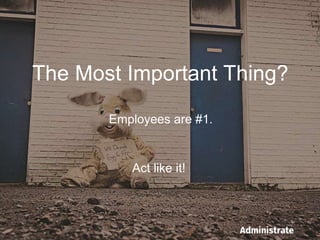
The Most Important Thing?
Employees are #1. 
Act like it!
Frequently Asked Questions
•  This sounds really complicated. You guys are
obviously a huge company. What about for
small startups? 
–  We only have 22 employees. We’ve used this process
from the beginning. You can (and should) too. 
•  What if I can’t afford to do X? 
–  Then you can’t afford to hire people. 
•  I don’t like HR. Can’t I just ignore this? 
–  We don’t like it either, but it’s part of being a
company. Do it well and nobody will notice it. Do it
poorly and it’ll destroy you. 
•  How did you learn all of this? 
–  We made a lot of mistakes. Learn from us!

How We Hire at Administrate (Hiring Tips for Startups)

  • 1.
  • 2.
    First, Some Assumptions • People and Teamwork are the most important part of our business. •  Our Values drive our company, therefore they drive our hiring processes. •  These thoughts are based on our experiences hiring more than 150 candidates over the last 10 years, across a mix of companies.
  • 3.
    Three Ways toRecruit Buy, Steal, Grow Right now, we grow.
  • 4.
    Hiring Prerequisites •  Teamstructure (aka an Org Chart) – this is the “meat space” API of your company! •  Job Description that includes: –  Day to day responsibilities (“A day in the life of”); –  Success Factors; –  Interfaces to other people, teams, etc. •  Company Values. •  Time to set aside to hire(1-2 hours per day). •  You’ve read Peopleware and watched Office Space. •  Company handbook and employment contract.
  • 5.
    Don’t Have ThesePrerequisites? Don’t hire. Period.
  • 6.
    Our Interview Process • Hiring manager works the job themselves for a minimum of 30 days (if it’s a new position, or if they’ve never managed it before themselves). •  Refine the job description and success factors, using what’s been learned from Step 1. •  Interview: –  Review blinded CVs (remove name and university whenever possible); –  Phone screen first (code test with screen sharing for devs) and have the money discussion.
  • 7.
    Our Interview Process – In-Person interview with hiring manager (candidate meets team, sees environment); –  2nd round interview (including team-mate); –  3rd round interview if “cross team functionality”, senior role, or if we have a lot of great candidates. •  Verbal offer and acceptance. •  Email offer and acceptance. •  Official offer letter and acceptance. •  Send contract over in advance to review. •  Arrive and sign contract.
  • 8.
    About Our Process • Candidates can (and often do) bomb out within 5-10 minutes on the phone screen. That’s OK. We just politely say we’re not for each other and stop wasting everyone’s time. •  We respond to every single CV sent in. Always. •  The first window into a company is the hiring process. Don’t be late. Don’t reschedule interviews. Respect the candidates and the process.
  • 9.
    About Our Process • We try to blind things as much as possible to remove any potential for subconscious (or overt) bias, racism, or discrimination. The phone screen serves to remove appearance as a bias point too. •  We sort the money question early, as it can be a deal breaker. We are transparent about our pay range and don’t play games. We communicate the pay scale first.
  • 10.
    About Our Process • We don’t outsource critical components of our product or support, so we don’t outsource our hiring. •  We apply our “values” test during the interviews. If a candidate is unreliable, that’s a values problem for us, and we take it into account.
  • 11.
    Pro Tips •  Figureout a way or a question that can help you test each of your corporate values. We strongly value reliability, so we’re testing this with every email and interview interaction. •  Trust your gut, but get a second opinion. •  Every company has a few insanely valuable people with nontraditional credentials. Make sure any process you put in place wouldn’t preclude you from hiring that person again.
  • 12.
    Pro Tips •  Ifyou dress casually, warn the person in advance they don’t need to dress up! •  Be prepared to let your interview time run long if necessary.
  • 13.
    Important Things We’veLearned •  Transparency really matters. Almost no question is out of bounds. Why are you hiding something? •  First week and first impressions are key – make sure EVERYTHING is sorted prior to candidate arrival. •  We actively attempt to discourage candidates from coming on board by contrasting how we’re different from other companies. •  We anchor expectations (usually with a small salary adjustment) around the 90 day probation period. •  During high growth periods, employee referrals are key. •  The CEO must be personally involved in the first 150 hires.
  • 14.
    REALLY Important ThingsWe’ve Learned •  You’re changing someone’s life. This a truly important decision. Treat it like one. •  Approach all HR decisions with empathy and using the Golden Rule. •  The best way to create a political company culture is to not provide a transparent compensation path. •  Culture fit is really important. There’s no fixing poor culture fit. •  More employees, more problems.
  • 15.
    REALLY Important ThingsWe’ve Learned •  Educate, educate, educate. In all areas (technical, interpersonal, financial, etc.). •  Change titles and give senior titles slowly. •  A startup is stressful. We’ve long understood that lots of life changes shouldn’t be made together, so we want to make sure if there’s going to be lots of change in their life, we talk about how we’ll both work to manage it.
  • 16.
    The Most ImportantThing? Employees are #1. Act like it!
  • 17.
    Frequently Asked Questions • This sounds really complicated. You guys are obviously a huge company. What about for small startups? –  We only have 22 employees. We’ve used this process from the beginning. You can (and should) too. •  What if I can’t afford to do X? –  Then you can’t afford to hire people. •  I don’t like HR. Can’t I just ignore this? –  We don’t like it either, but it’s part of being a company. Do it well and nobody will notice it. Do it poorly and it’ll destroy you. •  How did you learn all of this? –  We made a lot of mistakes. Learn from us!