Factors to consider – - What are the important roles in a start-up - - Differences between US and EMEA - - Options for hiring - - Types of search firm and working with them - James Brocket, Managing Partner, Europe Calibre One Hiring for success
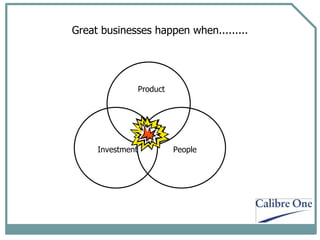
Great businesses happen when......... Product Investment People
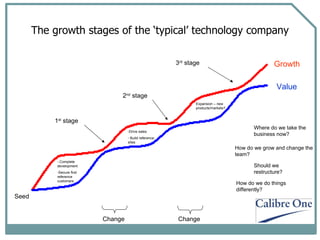
The growth stages of the ‘typical’ technology company Growth Value Seed 1 st  stage 2 nd  stage 3 rd  stage - Complete development -Secure first reference customers  Drive sales Build reference sites Expansion – new products/markets? Where do we take the business now? How do we grow and change the team? Should we restructure? How do we do things differently? Change Change
Changing management Be decisive. There never is a ‘right’ time to do it – the trick is avoiding the ‘wrong’ time Make sure you are sure – you need to be confident that you can hire someone better You can never fire the wrong person quickly enough - “Firing is not something you do  to  someone, it is something you do  for  them” Can you achieve what you need to without hiring a permanent replacement?
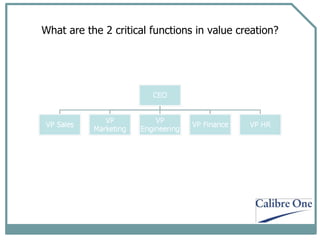
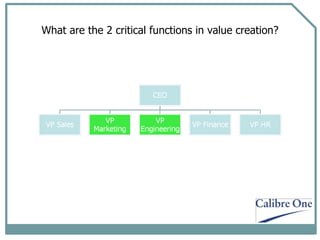
What are the 2 critical functions in value creation?
In hiring you need to be VERY systematic Create an org chart and think carefully about the jobs that need doing and create job profiles – get them vetted by an expert Start-early, if “Rock-Stars” exist in your market, try and start a dialogue with them Create a hiring plan and budget - plan on investing more than you budgeted for Think carefully about why a first-class person will want to join you on your journey - ££££ will be the #1 motivator, what are #2 and #3?
The hiring plan Four parts;  Defining the role and ideal candidate profile Finding the candidates Selecting the candidate Securing the candidate
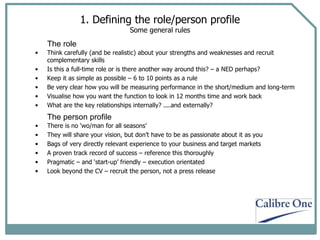
1. Defining the role/person profile Some general rules There is no ‘wo/man for all seasons’  They will share your vision, but don’t have to be as passionate about it as you Bags of very directly relevant experience to your business and target markets A proven track record of success – reference this thoroughly Pragmatic – and ‘start-up’ friendly – execution orientated Look beyond the CV – recruit the person, not a press release  Think carefully (and be realistic) about your strengths and weaknesses and recruit complementary skills Is this a full-time role or is there another way around this? – a NED perhaps? Keep it as simple as possible – 6 to 10 points as a rule Be very clear how you will be measuring performance in the short/medium and long-term Visualise how you want the function to look in 12 months time and work back What are the key relationships internally? ....and externally? The role The person profile
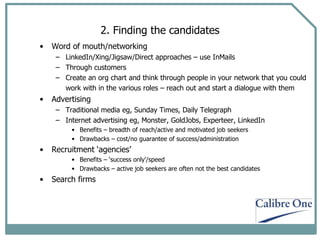
2. Finding the candidates Word of mouth/networking LinkedIn/Xing/Jigsaw/Direct approaches – use InMails Through customers Create an org chart and think through people in your network that you could work with in the various roles – reach out and start a dialogue with them Advertising Traditional media eg, Sunday Times, Daily Telegraph Internet advertising eg, Monster, GoldJobs, Experteer, LinkedIn Benefits – breadth of reach/active and motivated job seekers Drawbacks – cost/no guarantee of success/administration Recruitment ‘agencies’ Benefits – ‘success only’/speed Drawbacks – active job seekers are often not the best candidates Search firms
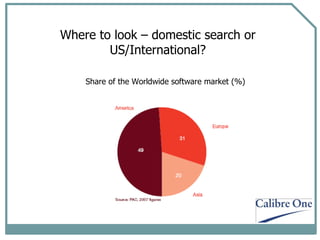
Where to look – domestic search or US/International? Share of the Worldwide software market (%)
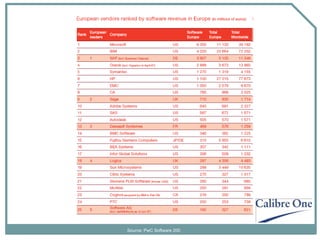
Questions? Source; PwC Software 200
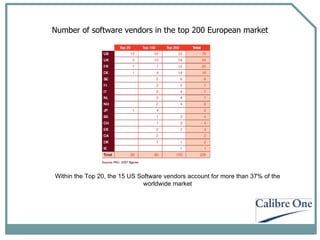
Number of software vendors in the top 200 European market Within the Top 20, the 15 US Software vendors account for more than 37% of the worldwide market
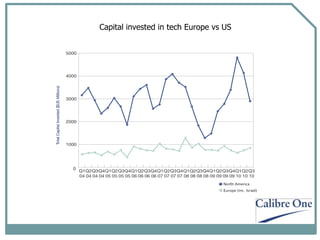
Capital invested in tech Europe vs US
Number of tech deals Europe vs US
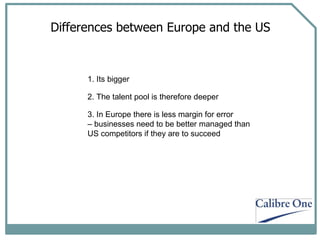
Differences between Europe and the US 1. Its bigger 2. The talent pool is therefore deeper 3. In Europe there is less margin for error  –  businesses need to be better managed than  US competitors if they are to succeed
3. Selecting the candidates 1. The interview 2 parts, the ‘sales pitch’ and  then  the interview Assume the CV is correct but ascertain reasons for moves – allows more time to focus on important matters Keep control and set the agenda Dig deep with the questions;  Get them to draw an org chart to understand the context of their role Greatest achievement/failure and strengths/weaknesses  Training needs Try and get to the bottom of the matter ask “Why” until you cannot ask “Why” any more There are no killer questions 2. Referencing 360 degree referencing if possible Approach customers/advisors for their view Use LinkedIn referencing functionality Use a friendly Headhunter
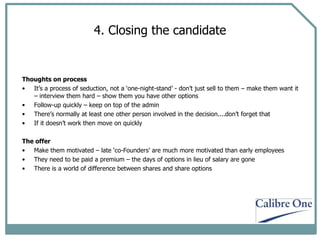
4. Closing the candidate Thoughts on process It’s a process of seduction, not a ‘one-night-stand’ - don’t just sell to them – make them want it – interview them hard – show them you have other options Follow-up quickly – keep on top of the admin There’s normally at least one other person involved in the decision....don’t forget that If it doesn’t work then move on quickly The offer Make them motivated – late ‘co-Founders’ are much more motivated than early employees They need to be paid a premium – the days of options in lieu of salary are gone There is a world of difference between shares and share options
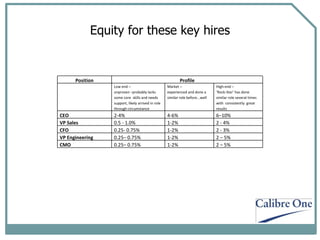
Equity for these key hires Position Profile Low end –  unproven –probably lacks some core  skills and needs support, likely arrived in role through circumstance Market –  experienced and done a similar role before...well High-end –  ‘ Rock-Star’ has done similar role several times with  consistently  great results CEO 2-4% 4-6% 6–10% VP Sales 0.5 - 1.0% 1-2% 2 - 4% CFO 0.25- 0.75% 1-2% 2 - 3% VP Engineering 0.25– 0.75% 1-2% 2 – 5% CMO 0.25– 0.75% 1-2%  2 – 5%
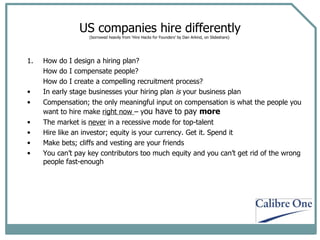
US companies hire differently (borrowed heavily from ‘Hire Hacks for Founders’ by Dan Arkind, on Slideshare)  1. How do I design a hiring plan? How do I compensate people? How do I create a compelling recruitment process? In early stage businesses your hiring plan  is  your business plan Compensation; the only meaningful input on compensation is what the people you want to hire make  right now  – y ou have to pay  more The market is  never  in a recessive mode for top-talent Hire like an investor; equity is your currency. Get it. Spend it Make bets; cliffs and vesting are your friends You can’t pay key contributors too much equity and you can’t get rid of the wrong people fast-enough
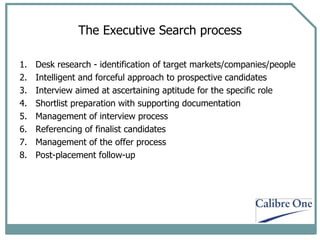
The Executive Search process Desk research - identification of target markets/companies/people Intelligent and forceful approach to prospective candidates  Interview aimed at ascertaining aptitude for the specific role Shortlist preparation with supporting documentation Management of interview process Referencing of finalist candidates Management of the offer process Post-placement follow-up
Executive search - where it works and where it doesn’t... Realism is important – search firms are in sales mode when you see them and are incentivised, to an extent, to tell you what you want to hear Experience in working with companies as a similar stage is very important – VC relationships/roles are different/they need to be sold harder Large firms/multiple offices can cause issues Search firms manage a process. Keep in touch regularly and ask for regular full written updates. If you need to get more involved then you can...quickly Demand references and speak to some yourself Don’t push too hard on the fees (!)
Calibre One – overview of the firm Est 1999 in London, SF office opened 2001. 25 employees 1700 searches completed over 10 years c.60% of work is for VC/PE backed businesses Focus on TMT sectors Significant experience in transatlantic work 50% of work in London office is outside of UK 40% of work in US is outside of CA

Hiringfor start upsuccess

  • 1.
    Factors to consider– - What are the important roles in a start-up - - Differences between US and EMEA - - Options for hiring - - Types of search firm and working with them - James Brocket, Managing Partner, Europe Calibre One Hiring for success
  • 2.
    Great businesses happenwhen......... Product Investment People
  • 3.
    The growth stagesof the ‘typical’ technology company Growth Value Seed 1 st stage 2 nd stage 3 rd stage - Complete development -Secure first reference customers Drive sales Build reference sites Expansion – new products/markets? Where do we take the business now? How do we grow and change the team? Should we restructure? How do we do things differently? Change Change
  • 4.
    Changing management Bedecisive. There never is a ‘right’ time to do it – the trick is avoiding the ‘wrong’ time Make sure you are sure – you need to be confident that you can hire someone better You can never fire the wrong person quickly enough - “Firing is not something you do to someone, it is something you do for them” Can you achieve what you need to without hiring a permanent replacement?
  • 5.
    What are the2 critical functions in value creation?
  • 6.
    What are the2 critical functions in value creation?
  • 7.
    In hiring youneed to be VERY systematic Create an org chart and think carefully about the jobs that need doing and create job profiles – get them vetted by an expert Start-early, if “Rock-Stars” exist in your market, try and start a dialogue with them Create a hiring plan and budget - plan on investing more than you budgeted for Think carefully about why a first-class person will want to join you on your journey - ££££ will be the #1 motivator, what are #2 and #3?
  • 8.
    The hiring planFour parts; Defining the role and ideal candidate profile Finding the candidates Selecting the candidate Securing the candidate
  • 9.
    1. Defining therole/person profile Some general rules There is no ‘wo/man for all seasons’ They will share your vision, but don’t have to be as passionate about it as you Bags of very directly relevant experience to your business and target markets A proven track record of success – reference this thoroughly Pragmatic – and ‘start-up’ friendly – execution orientated Look beyond the CV – recruit the person, not a press release Think carefully (and be realistic) about your strengths and weaknesses and recruit complementary skills Is this a full-time role or is there another way around this? – a NED perhaps? Keep it as simple as possible – 6 to 10 points as a rule Be very clear how you will be measuring performance in the short/medium and long-term Visualise how you want the function to look in 12 months time and work back What are the key relationships internally? ....and externally? The role The person profile
  • 10.
    2. Finding thecandidates Word of mouth/networking LinkedIn/Xing/Jigsaw/Direct approaches – use InMails Through customers Create an org chart and think through people in your network that you could work with in the various roles – reach out and start a dialogue with them Advertising Traditional media eg, Sunday Times, Daily Telegraph Internet advertising eg, Monster, GoldJobs, Experteer, LinkedIn Benefits – breadth of reach/active and motivated job seekers Drawbacks – cost/no guarantee of success/administration Recruitment ‘agencies’ Benefits – ‘success only’/speed Drawbacks – active job seekers are often not the best candidates Search firms
  • 11.
    Where to look– domestic search or US/International? Share of the Worldwide software market (%)
  • 12.
  • 13.
    Number of softwarevendors in the top 200 European market Within the Top 20, the 15 US Software vendors account for more than 37% of the worldwide market
  • 14.
    Capital invested intech Europe vs US
  • 15.
    Number of techdeals Europe vs US
  • 16.
    Differences between Europeand the US 1. Its bigger 2. The talent pool is therefore deeper 3. In Europe there is less margin for error – businesses need to be better managed than US competitors if they are to succeed
  • 17.
    3. Selecting thecandidates 1. The interview 2 parts, the ‘sales pitch’ and then the interview Assume the CV is correct but ascertain reasons for moves – allows more time to focus on important matters Keep control and set the agenda Dig deep with the questions; Get them to draw an org chart to understand the context of their role Greatest achievement/failure and strengths/weaknesses Training needs Try and get to the bottom of the matter ask “Why” until you cannot ask “Why” any more There are no killer questions 2. Referencing 360 degree referencing if possible Approach customers/advisors for their view Use LinkedIn referencing functionality Use a friendly Headhunter
  • 18.
    4. Closing thecandidate Thoughts on process It’s a process of seduction, not a ‘one-night-stand’ - don’t just sell to them – make them want it – interview them hard – show them you have other options Follow-up quickly – keep on top of the admin There’s normally at least one other person involved in the decision....don’t forget that If it doesn’t work then move on quickly The offer Make them motivated – late ‘co-Founders’ are much more motivated than early employees They need to be paid a premium – the days of options in lieu of salary are gone There is a world of difference between shares and share options
  • 19.
    Equity for thesekey hires Position Profile Low end – unproven –probably lacks some core skills and needs support, likely arrived in role through circumstance Market – experienced and done a similar role before...well High-end – ‘ Rock-Star’ has done similar role several times with consistently great results CEO 2-4% 4-6% 6–10% VP Sales 0.5 - 1.0% 1-2% 2 - 4% CFO 0.25- 0.75% 1-2% 2 - 3% VP Engineering 0.25– 0.75% 1-2% 2 – 5% CMO 0.25– 0.75% 1-2% 2 – 5%
  • 20.
    US companies hiredifferently (borrowed heavily from ‘Hire Hacks for Founders’ by Dan Arkind, on Slideshare) 1. How do I design a hiring plan? How do I compensate people? How do I create a compelling recruitment process? In early stage businesses your hiring plan is your business plan Compensation; the only meaningful input on compensation is what the people you want to hire make right now – y ou have to pay more The market is never in a recessive mode for top-talent Hire like an investor; equity is your currency. Get it. Spend it Make bets; cliffs and vesting are your friends You can’t pay key contributors too much equity and you can’t get rid of the wrong people fast-enough
  • 21.
    The Executive Searchprocess Desk research - identification of target markets/companies/people Intelligent and forceful approach to prospective candidates Interview aimed at ascertaining aptitude for the specific role Shortlist preparation with supporting documentation Management of interview process Referencing of finalist candidates Management of the offer process Post-placement follow-up
  • 22.
    The Executive Searchprocess Desk research - identification of target markets/companies/people Intelligent and forceful approach to prospective candidates Interview aimed at ascertaining aptitude for the specific role Shortlist preparation with supporting documentation Management of interview process Referencing of finalist candidates Management of the offer process Post-placement follow-up
  • 23.
    Executive search -where it works and where it doesn’t... Realism is important – search firms are in sales mode when you see them and are incentivised, to an extent, to tell you what you want to hear Experience in working with companies as a similar stage is very important – VC relationships/roles are different/they need to be sold harder Large firms/multiple offices can cause issues Search firms manage a process. Keep in touch regularly and ask for regular full written updates. If you need to get more involved then you can...quickly Demand references and speak to some yourself Don’t push too hard on the fees (!)
  • 24.
    Calibre One –overview of the firm Est 1999 in London, SF office opened 2001. 25 employees 1700 searches completed over 10 years c.60% of work is for VC/PE backed businesses Focus on TMT sectors Significant experience in transatlantic work 50% of work in London office is outside of UK 40% of work in US is outside of CA

Editor's Notes

  • #3 Great businesses are created when great people, great products and investment come together Interesting - most tech entrepreneurs tend to be product guys…. Would have done a straw poll – Which most important? If you could have only two which would you compromise on? If “people” – you’re wrong – saved you the embarrassment Good product/with investment – might work by accident If you have great people ……..
  • #15 … from C1 Index Note dif’ in scale Look at the last year