HOW TO WRITE AN EFFECTIVEHOW TO WRITE AN EFFECTIVE
RESEARCH PAPERRESEARCH PAPER
• Getting ready with data
• First draft
• Structure of a scientific paper
• Selecting a journal
• Submission
• Revision and galley proof
Disclaimer: The suggestions and remarks in this presentation are based on
personal research experience. Research practices and approaches vary.
Exercise your own judgment regarding the suitability of the content.
Getting ready with dataGetting ready with data
Gather all important data, analyses, plots and tables
Organize results so that they follow a logical sequence (this may
or may not be in the order of experiments conducted)
Consolidate data plots and create figures for the manuscript
(Limit the number of total figures (6-8 is usually a good number).
Include additional data, multimedia in the Supporting Information.)
Discuss the data with your advisor and note down important
points
?
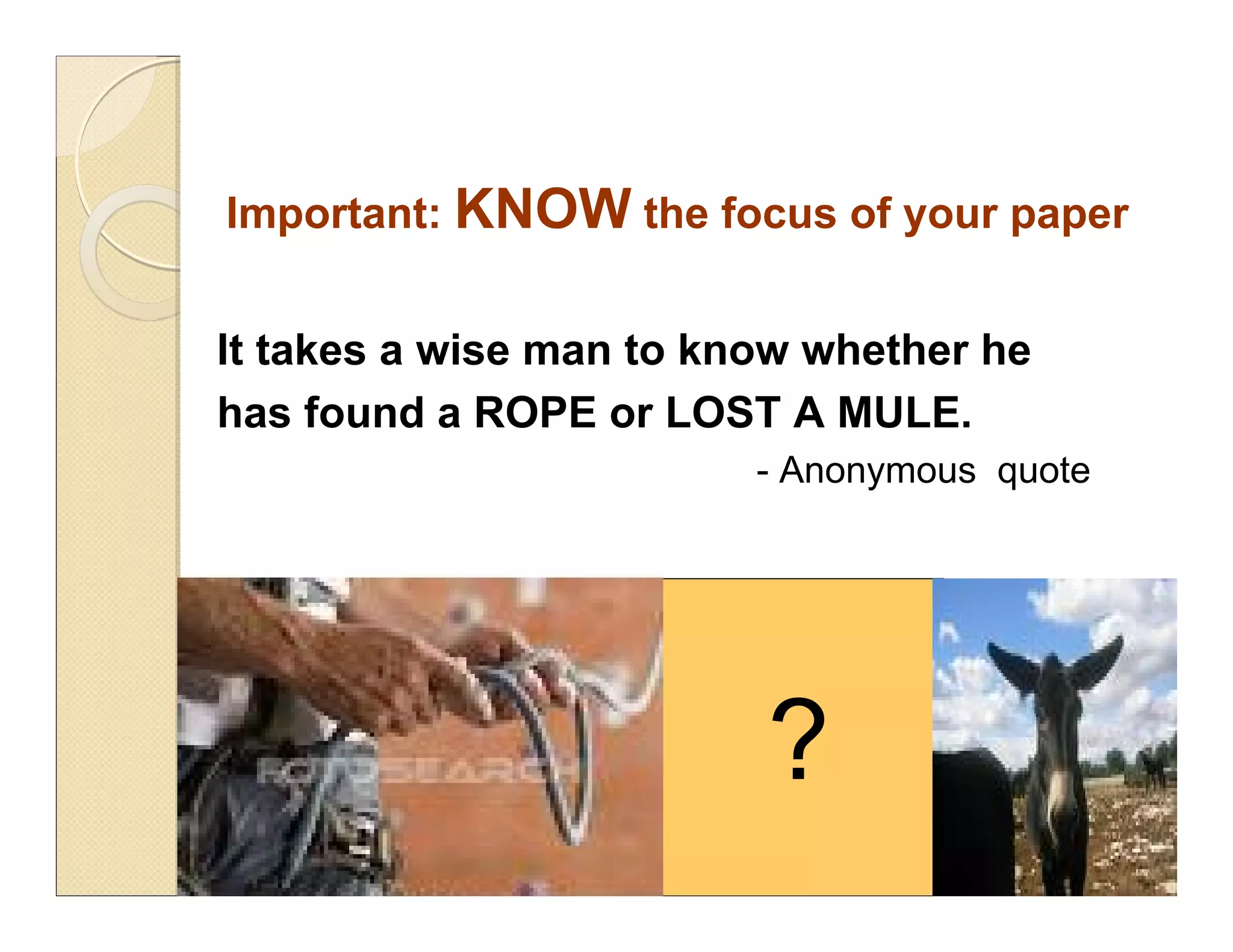
Important: KNOW the focus of your paper
It takes a wise man to know whether he
has found a ROPE or LOST A MULE.
- Anonymous quote
First draftFirst draft
Identify two or three important findings emerging from the
experiments. Make them the central theme of the article.
Note good and bad writing styles in the literature. Some are simple
and easy to follow, some are just too complex.
Note the readership of the journal that you are considering to
publish your work
Prepare figures, schemes and tables in a professional manner
(Pay attention to quantification of data accuracy, significant digits,
error bars,)
0.001 1x10⁻³ -- one sig fig
0.00100 1.00x10⁻³ -- three sig figs
Structure of a scientific paperStructure of a scientific paper
Title
Abstract
TOC Graphics
Introduction
Experimental Section
(Some papers require this section to be at the end)
Results and Discussion
Conclusions
Acknowledgments
References
Supporting Information
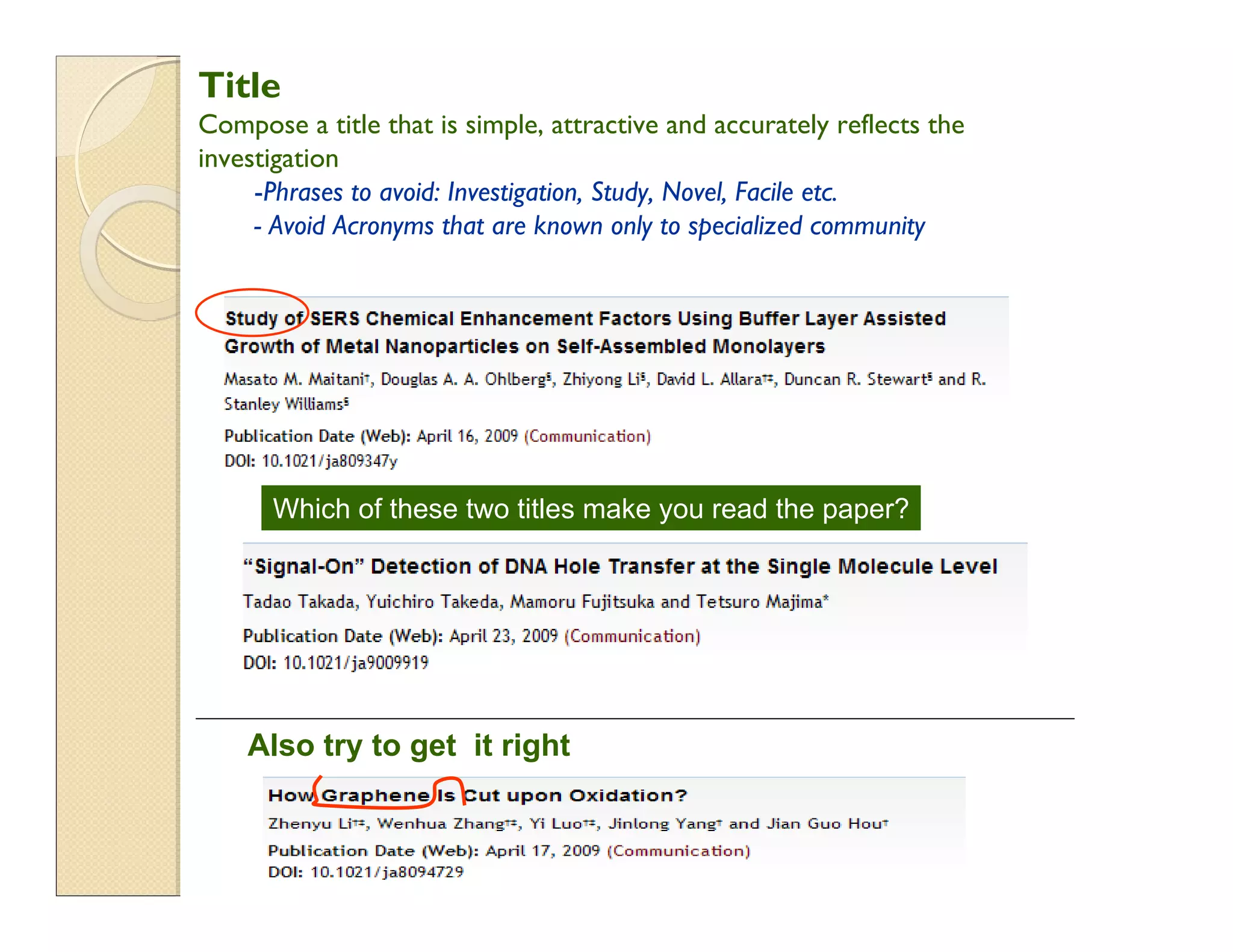
Also try to get it right
Title
Compose a title that is simple, attractive and accurately reflects the
investigation
-Phrases to avoid: Investigation, Study, Novel, Facile etc.
- Avoid Acronyms that are known only to specialized community
Which of these two titles make you read the paper?
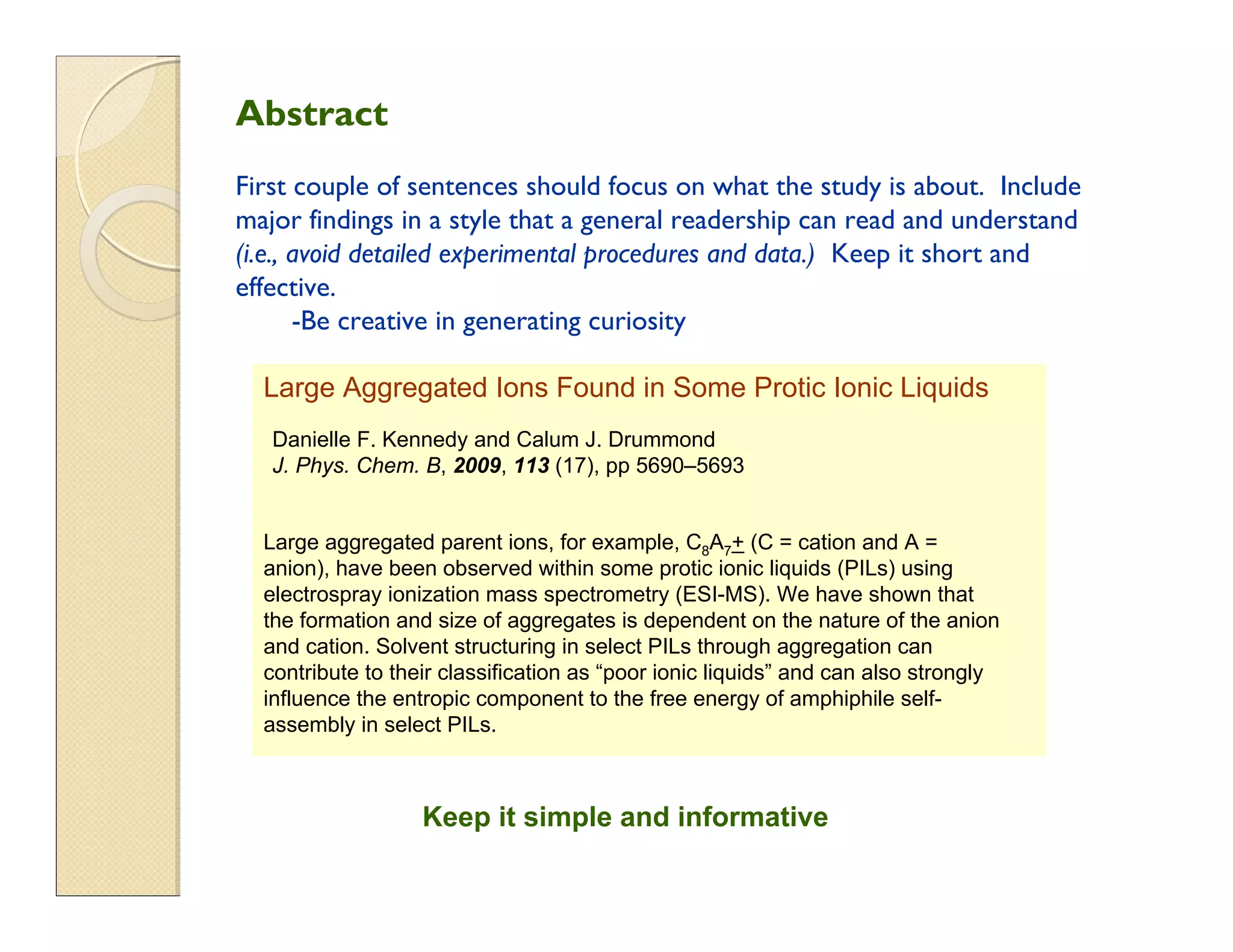
Large Aggregated Ions Found in Some Protic Ionic Liquids
Danielle F. Kennedy and Calum J. Drummond
J. Phys. Chem. B, 2009, 113 (17), pp 5690–5693
Large aggregated parent ions, for example, C8A7+ (C = cation and A =
anion), have been observed within some protic ionic liquids (PILs) using
electrospray ionization mass spectrometry (ESI-MS). We have shown that
the formation and size of aggregates is dependent on the nature of the anion
and cation. Solvent structuring in select PILs through aggregation can
contribute to their classification as “poor ionic liquids” and can also strongly
influence the entropic component to the free energy of amphiphile self-
assembly in select PILs.
Keep it simple and informative
Abstract
First couple of sentences should focus on what the study is about. Include
major findings in a style that a general readership can read and understand
(i.e., avoid detailed experimental procedures and data.) Keep it short and
effective.
-Be creative in generating curiosity
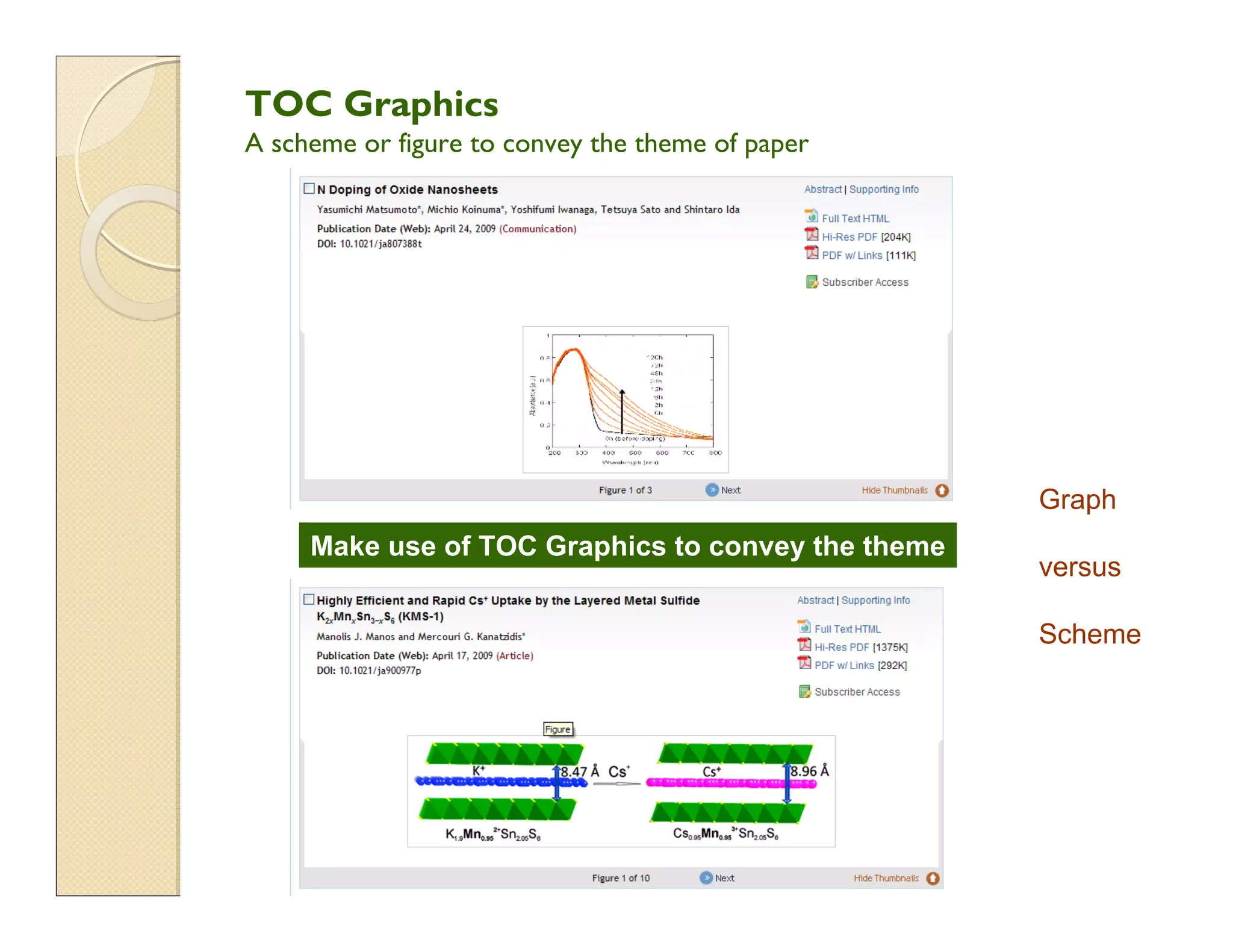
Make use of TOC Graphics to convey the theme
TOC Graphics
A scheme or figure to convey the theme of paper
Graph
versus
Scheme
Introduction
• Start the section with a general background of the topic.
• Add 2-3 paragraphs that discuss previous work.
• Point out issues that are being addressed in the present work.
Experimental Section
• Divide this section into Materials & Methods, Characterization,
Measurements and Data analysis
Results and Discussion
(These two sections can be combined or separate)
• Describe the results in detail and include a healthy, detailed
discussion
• The order of figures should follow the discussion themes and not
the sequence they were conducted
• Discuss how your data compare or contrast with previous results.
• Include schemes, photographs to enhance the scope of discussion
Avoid
• Excessive presentation of data/results without any discussion
• Citing every argument with a published work
Structure of a scientific paperStructure of a scientific paper
Conclusions
Include major findings followed by brief discussion on future
perspectives and/or application of present work to other disciplines.
Important: Do not rewrite the abstract.
Statements with “Investigated” or “Studied” are not conclusions!
Acknowledgments
Remember to thank the funding agency and
Colleagues/scientists/technicians who might have provided assistance
References
The styles vary for different journals. (Use ENDNOTE, RefWorks)
Some journals require complete titles of the cited references
Please check for the accuracy of all citations
Supporting Information
Include methods, analysis, blank experiments, additional data
Structure of a scientific paperStructure of a scientific paper
Selecting a journalSelecting a journal
Each journal specializes in a specific area of research. Hence its
readership varies. A proper choice of journal can make a larger
impact of your research.
Get to know the focus and readership of the journal that you are
considering. - general vs. specialized area journal
Select 2 or 3 journals in the chosen area with relatively high impact
factors. Discuss with your advisor and decide on the journal
Find out the journal’s submission criteria and format
Tip: Does your references cite journals in the appropriate area?
SubmissionSubmission
Read the finalized paper carefully. Check for accuracy of figures and
captions. Are the figures correctly referred to in the text?
Get feedback from advisor and colleagues.
Make sure the paper is read by at least one or two colleagues who is
not familiar with the specific work.
Provide a cover letter to the editor along with a brief paragraph
highlighting the importance of this work and names of possible
reviewers.
Have all coauthors approve the finalized version of the paper
Submit the paper online along with copyright form.
Revision and galley proofRevision and galley proof
• The manuscript is usually reviewed by 2-3 reviewers
• Reviewers point out deficiencies and/or suggestions to improve the
scientific content
• Read their comments carefully. (If reviewer misunderstands a point,
the point probably needs revision or additional support.)
-Do not blame the reviewer for his/her misunderstanding!
• Be polite and respectful when disagreeing a reviewer’s comment
• Include a point-by-point explanation of changes made in the text in
response to reviewers’ comments
• Once again, carefully read the paper for its accuracy in presenting
the data
• Submit the revised version
• Once accepted for publication you should receive the galley proof
within a month. This is one last chance to make any final
corrections.
What to do if a paper gets rejected……
Do not get discouraged. Read editorial comments and discuss
with advisor/students/collaborators. Find out how you can make
this study stronger and acceptable for publication.
Do not just turn around and submit the paper to another journal.
Read carefully the comments and find ways to improve the
scientific quality of the papers
Carry out additional experiments and improve the quality of
scientific discussions. (Journals often look for papers with
quantitative and mechanistic information that represent new
physical insights )
Rejected papers can be resubmitted if and only the concerns of
the reviewers are adequately addressed and new results are
included.
If you have questions, please feel free to contact the
editorial office.
• Data without scientific discussion, applications of data, or
reviews of the literature are not sufficient.
• Routine synthesis and characterization of nanomaterials or
studies that report incremental advance are not considered
suitable for publication.
• Use of the phrase “Novel” or “First-time” in the title or
abstract. Such descriptions do not impress the reader or
the reviewer.
(Other over used phrases “One-pot synthesis”, “Facile” )
• Names of flowers, fruits and vegetables to describe the
nanoparticle/nanostructure shapes/morphology
What to Avoid?
The authors should make every effort to make a
good presentation with proper usage of English
grammar.
Ask a colleague to comment on your paper before
sending it for publication.
“English is not my Native Language” is not a valid
justification for reviewer who cannot comprehend.
Reviewers do not wish to review papers that are not
readable. Badly written papers are often
recommended as “REJECT” by the Reviewers
ACS Publication office helps to edit the language for
accepted manuscripts, but this only happens if the
English was good enough to be reviewed.
To do even better ….
Ten characteristics of an incredibly dull paper
Sand-Jenson in Oikos 2007, 116 723 (C&E News Sept 10, 2007)
1. Avoid Focus
2. Avoid originality and personality
3. Make the article really really long
4. Do not indicate any potential implications
5. Leave out illustrations (…too much effort to draw a
sensible drawing)
6. Omit necessary steps of reasoning
7. Use abbreviations and technical terms that only
specialists in the field can understand
8. Make it sound too serious with no significant
discussion
9. Focus only on statistics
10.Support every statement with a reference
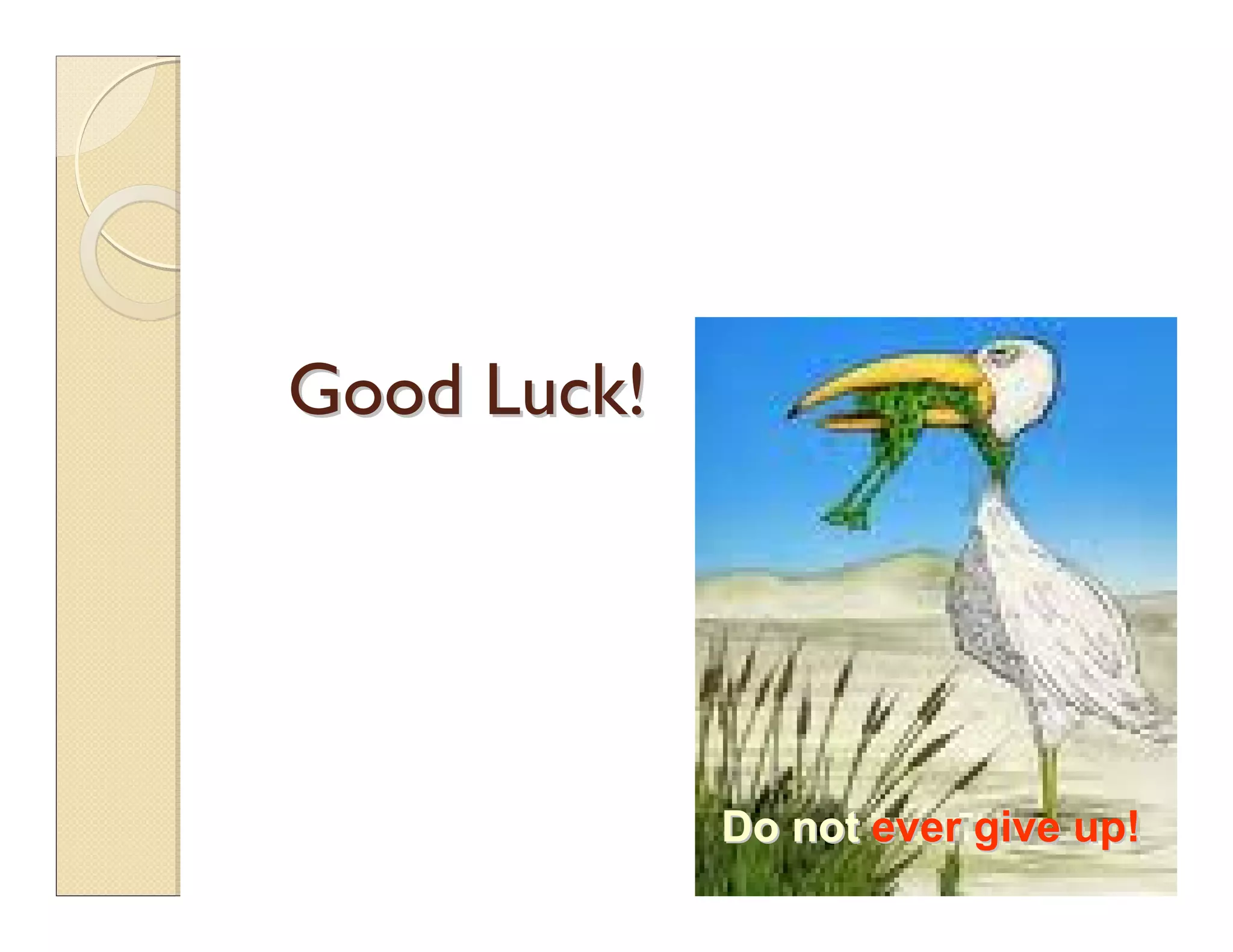
Good Luck!Good Luck!
Do notDo not everever give up!give up!

How to write an effective research paper

  • 1.
    HOW TO WRITEAN EFFECTIVEHOW TO WRITE AN EFFECTIVE RESEARCH PAPERRESEARCH PAPER • Getting ready with data • First draft • Structure of a scientific paper • Selecting a journal • Submission • Revision and galley proof Disclaimer: The suggestions and remarks in this presentation are based on personal research experience. Research practices and approaches vary. Exercise your own judgment regarding the suitability of the content.
  • 2.
    Getting ready withdataGetting ready with data Gather all important data, analyses, plots and tables Organize results so that they follow a logical sequence (this may or may not be in the order of experiments conducted) Consolidate data plots and create figures for the manuscript (Limit the number of total figures (6-8 is usually a good number). Include additional data, multimedia in the Supporting Information.) Discuss the data with your advisor and note down important points
  • 3.
    ? Important: KNOW thefocus of your paper It takes a wise man to know whether he has found a ROPE or LOST A MULE. - Anonymous quote
  • 4.
    First draftFirst draft Identifytwo or three important findings emerging from the experiments. Make them the central theme of the article. Note good and bad writing styles in the literature. Some are simple and easy to follow, some are just too complex. Note the readership of the journal that you are considering to publish your work Prepare figures, schemes and tables in a professional manner (Pay attention to quantification of data accuracy, significant digits, error bars,) 0.001 1x10⁻³ -- one sig fig 0.00100 1.00x10⁻³ -- three sig figs
  • 5.
    Structure of ascientific paperStructure of a scientific paper Title Abstract TOC Graphics Introduction Experimental Section (Some papers require this section to be at the end) Results and Discussion Conclusions Acknowledgments References Supporting Information
  • 6.
    Also try toget it right Title Compose a title that is simple, attractive and accurately reflects the investigation -Phrases to avoid: Investigation, Study, Novel, Facile etc. - Avoid Acronyms that are known only to specialized community Which of these two titles make you read the paper?
  • 7.
    Large Aggregated IonsFound in Some Protic Ionic Liquids Danielle F. Kennedy and Calum J. Drummond J. Phys. Chem. B, 2009, 113 (17), pp 5690–5693 Large aggregated parent ions, for example, C8A7+ (C = cation and A = anion), have been observed within some protic ionic liquids (PILs) using electrospray ionization mass spectrometry (ESI-MS). We have shown that the formation and size of aggregates is dependent on the nature of the anion and cation. Solvent structuring in select PILs through aggregation can contribute to their classification as “poor ionic liquids” and can also strongly influence the entropic component to the free energy of amphiphile self- assembly in select PILs. Keep it simple and informative Abstract First couple of sentences should focus on what the study is about. Include major findings in a style that a general readership can read and understand (i.e., avoid detailed experimental procedures and data.) Keep it short and effective. -Be creative in generating curiosity
  • 8.
    Make use ofTOC Graphics to convey the theme TOC Graphics A scheme or figure to convey the theme of paper Graph versus Scheme
  • 9.
    Introduction • Start thesection with a general background of the topic. • Add 2-3 paragraphs that discuss previous work. • Point out issues that are being addressed in the present work. Experimental Section • Divide this section into Materials & Methods, Characterization, Measurements and Data analysis Results and Discussion (These two sections can be combined or separate) • Describe the results in detail and include a healthy, detailed discussion • The order of figures should follow the discussion themes and not the sequence they were conducted • Discuss how your data compare or contrast with previous results. • Include schemes, photographs to enhance the scope of discussion Avoid • Excessive presentation of data/results without any discussion • Citing every argument with a published work Structure of a scientific paperStructure of a scientific paper
  • 10.
    Conclusions Include major findingsfollowed by brief discussion on future perspectives and/or application of present work to other disciplines. Important: Do not rewrite the abstract. Statements with “Investigated” or “Studied” are not conclusions! Acknowledgments Remember to thank the funding agency and Colleagues/scientists/technicians who might have provided assistance References The styles vary for different journals. (Use ENDNOTE, RefWorks) Some journals require complete titles of the cited references Please check for the accuracy of all citations Supporting Information Include methods, analysis, blank experiments, additional data Structure of a scientific paperStructure of a scientific paper
  • 11.
    Selecting a journalSelectinga journal Each journal specializes in a specific area of research. Hence its readership varies. A proper choice of journal can make a larger impact of your research. Get to know the focus and readership of the journal that you are considering. - general vs. specialized area journal Select 2 or 3 journals in the chosen area with relatively high impact factors. Discuss with your advisor and decide on the journal Find out the journal’s submission criteria and format Tip: Does your references cite journals in the appropriate area?
  • 12.
    SubmissionSubmission Read the finalizedpaper carefully. Check for accuracy of figures and captions. Are the figures correctly referred to in the text? Get feedback from advisor and colleagues. Make sure the paper is read by at least one or two colleagues who is not familiar with the specific work. Provide a cover letter to the editor along with a brief paragraph highlighting the importance of this work and names of possible reviewers. Have all coauthors approve the finalized version of the paper Submit the paper online along with copyright form.
  • 13.
    Revision and galleyproofRevision and galley proof • The manuscript is usually reviewed by 2-3 reviewers • Reviewers point out deficiencies and/or suggestions to improve the scientific content • Read their comments carefully. (If reviewer misunderstands a point, the point probably needs revision or additional support.) -Do not blame the reviewer for his/her misunderstanding! • Be polite and respectful when disagreeing a reviewer’s comment • Include a point-by-point explanation of changes made in the text in response to reviewers’ comments • Once again, carefully read the paper for its accuracy in presenting the data • Submit the revised version • Once accepted for publication you should receive the galley proof within a month. This is one last chance to make any final corrections.
  • 14.
    What to doif a paper gets rejected…… Do not get discouraged. Read editorial comments and discuss with advisor/students/collaborators. Find out how you can make this study stronger and acceptable for publication. Do not just turn around and submit the paper to another journal. Read carefully the comments and find ways to improve the scientific quality of the papers Carry out additional experiments and improve the quality of scientific discussions. (Journals often look for papers with quantitative and mechanistic information that represent new physical insights ) Rejected papers can be resubmitted if and only the concerns of the reviewers are adequately addressed and new results are included. If you have questions, please feel free to contact the editorial office.
  • 15.
    • Data withoutscientific discussion, applications of data, or reviews of the literature are not sufficient. • Routine synthesis and characterization of nanomaterials or studies that report incremental advance are not considered suitable for publication. • Use of the phrase “Novel” or “First-time” in the title or abstract. Such descriptions do not impress the reader or the reviewer. (Other over used phrases “One-pot synthesis”, “Facile” ) • Names of flowers, fruits and vegetables to describe the nanoparticle/nanostructure shapes/morphology What to Avoid?
  • 16.
    The authors shouldmake every effort to make a good presentation with proper usage of English grammar. Ask a colleague to comment on your paper before sending it for publication. “English is not my Native Language” is not a valid justification for reviewer who cannot comprehend. Reviewers do not wish to review papers that are not readable. Badly written papers are often recommended as “REJECT” by the Reviewers ACS Publication office helps to edit the language for accepted manuscripts, but this only happens if the English was good enough to be reviewed. To do even better ….
  • 17.
    Ten characteristics ofan incredibly dull paper Sand-Jenson in Oikos 2007, 116 723 (C&E News Sept 10, 2007) 1. Avoid Focus 2. Avoid originality and personality 3. Make the article really really long 4. Do not indicate any potential implications 5. Leave out illustrations (…too much effort to draw a sensible drawing) 6. Omit necessary steps of reasoning 7. Use abbreviations and technical terms that only specialists in the field can understand 8. Make it sound too serious with no significant discussion 9. Focus only on statistics 10.Support every statement with a reference
  • 18.
    Good Luck!Good Luck! DonotDo not everever give up!give up!