HOW TO WRITE
RESEARCH “TOPIC”
RESEARCH METHODOLOGY
SAN VIBOL
DEFINITION OF TOPIC
2
A topic is the main organizing principle guiding the
analysis of your research. Topics offer us an occasion for
writing and a focus that governs what we want to say.
Topics represent the core subject matter of scholarly
communication, and the means by which we arrive at other
topics of conversations and discover new knowledge.
CHOOSE A TOPIC
Do not expect choosing the topic to be a quick or easy task!
You should be thinking about it right from the start of the
course. There are generally three ways you are asked to write
about a research problem:
1.your professor provides you with a general topic from which
you study a particular aspect of;
2.your professor provides you with a list of possible topics; or
3.your professor leaves it up to you to choose a topic and you
only have to obtain his/her permission to write about it
before beginning your investigation.
1. HOW TO
BEGIN: YOU
ARE GIVEN
THE TOPIC
TO WRITE
ABOUT
Step 1: Identify concepts and terms that make up the topic statement. For
example, your professor wants the class to focus on the following research
problem: “Is the European Union as a whole becoming a credible security actor
with the ability to contribute to global security?” The main concepts are:
European Union, global security, credibility
hint: focus on identifying proper nouns, nouns or noun phrases, and action
verbs in the assignment description.
Step 2: Review related literature to help refine how you will approach focusing
on the topic and finding a way to analyze it. Use the main concept terms you
developed in Step 1 to retrieve relevant articles. This will help you refine and
frame the research problem. Don’t be surprised if you need to do this several
times before you finalize how to approach writing about the topic.
1. HOW TO
BEGIN: YOU
ARE GIVEN
THE TOPIC
TO WRITE
ABOUT: STEP
3
• Step 3: Since social science research papers are generally
designed to get you to develop your own ideas and
arguments, look for sources that can help broaden, modify,
or strengthen your initial thoughts and arguments
For example, if you decide to argue that the European Union is
ill prepared to take on responsibilities for broader global
security because of the debt crisis in many EU countries, then
focus on identifying sources that support as well as refute this
position.
I. HOW TO
BEGIN: YOU
ARE GIVEN
THE TOPIC
TO WRITE
ABOUT: STEP
3 (CON’T)
There are least four appropriate roles your related literature plays in
helping you formulate how to begin your analysis:
• Sources of criticism -- frequently, you'll find yourself reading materials
that are relevant to your chosen topic, but you disagree with the author's
position. Therefore, one way that you can use a source is to describe the
counter-argument, provide evidence from your review of the literature as
to why it is unsatisfactory, and discuss how your own view is more
appropriate based upon your interpretation of the evidence.
• Sources of new ideas -- while a general goal in writing college research
papers is to approach a research problem with some basic idea of what
position you'd like to take and what grounds you'd like to stand upon, it
is certainly acceptable [and often encouraged] to read the literature and
extend, modify, and refine your own position in light of the ideas
proposed by others. Just make sure that you cite the sources!
I. HOW TO
BEGIN: YOU
ARE GIVEN
THE TOPIC
TO WRITE
ABOUT: STEP
3 (CON’T)
• Sources for historical context -- another role your related literature plays in helping you
formulate how to begin your analysis is to place issues and events in proper historical
context. This can help to demonstrate familiarity with developments in relevant
scholarship about your topic, provide a means of comparing historical versus
contemporary issues and events, and identifying key people, places, and things that had
an important role related to the research problem.
• Sources of interdisciplinary insight -- Another way to formulate how to study the topic is
to look at it from different disciplinary perspectives. If the topic concerns immigration
reform, ask yourself, for example, how do studies from sociological journals vary in
their analysis from those in law journals. Another role of related literature is to provide
a means of approaching a topic from multiple perspectives rather than the perspective
offered from just one discipline.
• NOTE: Remember to keep careful notes at every stage. You may think you'll remember
what you have searched and where you found things, but it’s easy to forget.
I. HOW TO
BEGIN: YOU
ARE GIVEN
THE TOPIC
TO WRITE
ABOUT: STEP
4
• Step 4: Assuming you've done an effective job of
synthesizing and thinking about the results of our initial
search for related literature, you're ready to prepare a
detailed outline for your paper that lays the foundation for a
more in-depth and focused review of relevant research
literature.
II. HOW TO
BEGIN: YOU
ARE
PROVIDED A
LIST OF
POSSIBLE
TOPICS TO
CHOOSE
FROM
Step 1: I know what you’re thinking--which topic from this list is the easiest to
find the most information on? An effective instructor should never include a
topic that is so obscure or complex that no research is available to review and
from which to begin to design a study. Instead of searching for the path of least
resistance, begin by choosing a topic that you find interesting in some way, or
that is controversial and you have a strong opinion about, or that has some
personal meaning for you. You're going to be working on your topic for quite
some time, so choose one that's interesting or that makes you want to take a
position on.
Once you’ve settled on a topic of interest from the list, follow Steps 1 - 4
listed above to further develop it into a research paper.
NOTE: It’s ok to review related literature to help refine how you will approach
analyzing a topic, and then discover that the topic isn’t all that interesting after
all. In that case, you can choose another from the list. Just don’t wait too long
to make a switch and be sure to consult with your professor first.
III. HOW TO
BEGIN: YOUR
PROFESSOR
LEAVES IT UP
TO YOU TO
CHOOSE A
TOPIC
Step 1: Under this scenario, the key process is turning an idea or
general thought into a topic that can be cast as a research
problem. When given an assignment where you choose the
research topic, don't begin by thinking about what to write about,
but rather, ask yourself the question, "What do I want to know?"
Treat an open-ended assignment as an opportunity to learn about
something that's new or exciting to you.
III. HOW TO
BEGIN: YOUR
PROFESSOR
LEAVES IT UP
TO YOU TO
CHOOSE A
TOPIC
Step 2: If you lack ideas, or wish to gain focus, try some or all of the following
strategies:
• Review your course readings, particularly the suggested readings, for topic ideas.
• Search for a good, recent introductory book and, if appropriate, more specialized
works related to the discipline area of the interest.
• Browse through some current journals in your subject discipline. Even if most of
the articles are not relevant, you can skim through the contents quickly. You only
need one to be the spark that begins the process of wanting to learn more about a
topic. Consult your professor about the core journals within your subject discipline.
• Search online media sources to see if your idea has been covered in the news.
Use this coverage to refine your idea into something that you'd like to investigate
further but in a more deliberate, scholarly way based on a problem to research.
III. HOW TO
BEGIN: YOUR
PROFESSOR
LEAVES IT UP
TO YOU TO
CHOOSE A
TOPIC
• Step 3: To build upon your initial idea, use the suggestions under
this tab to help narrow, broaden, or increase the timeliness of your
idea so you can write it out as a research problem.
• Once you are comfortable with having turned your idea into a
topic, follow Steps 1 - 4 listed in Part I above to further develop it
into a research paper.
NARROWING A
TOPIC IDEA
IMPORTANCE OF NARROWING A TOPIC IDEA
• Whether assigned a general issue to investigate, you are given a list of problems to study, or
you have to make up your own research topic, it is important that the research problem that
guides your study is not too broad, otherwise, it will be very difficult to adequately address the
problem in the space and time allowed. You could experience a number of problems if your
topic is too broad, including:
• You find too many information sources and, as a consequence, it is difficult to decide what
to include or exclude or what are the most important.
• You find information that is too general and, as a consequence, it is difficult to develop a clear
framework for understanding the research problem and the methods needed to analyze it.
• You find information that covers a wide variety of concepts or ideas that can't be integrated
into one paper and, as a consequence, you easily trail off into unnecessary tangents.
STRATEGIES FOR NARROWING THE RESEARCH TOPIC
• The most common challenge when beginning to write a research paper is narrowing down
your topic. Even if your professor gives you a specific topic to study, it will almost never be so
specific that you won’t have to narrow it down at least to some degree [besides, grading fifty
papers that are all on exactly the same thing is very boring!].
• A topic is too broad to be manageable when you find that you have too many different, and
oftentimes conflicting and only remotely related, ideas about how to investigate the research
problem. While you will want to start the writing process by considering a variety of different
approaches to studying the problem, you will need to narrow the focus of your research at
some point so don't attempt to do too much in one paper.
STRATEGIES FOR NARROWING THE RESEARCH TOPIC
Here are some strategies to help focus your topic into something more manageable:
• Aspect -- choose one lens through which to view the research problem, or look at just one facet of it [e.g., rather than
studying the role of food in Eastern religious rituals; study the role of food in Hindu ceremonies].
• Components -- determine if your initial variables or unit of analyses can be broken into smaller parts, which can then be
analyzed more precisely [e.g., a study of tobacco use among adolescents can focus on just chewing tobacco rather
than all forms of usage or, rather than adolescents in general, focus on female adolescents of a certain age who
smoke].
• Place -- the smaller the area of analysis, the more narrow the focus [e.g., rather than study trade relations in West
Africa, study trade relations between Niger and Cameroon].
• Relationship -- how do two or more different perspectives or variables relate to one another? [e.g., cause/effect,
compare/contrast, group/individual, male/female, contemporary/historical, etc.].
• Time -- the shorter the time period, the more narrow the focus.
• Type -- focus your topic in terms of a specific type or class of people, places, or things [e.g., a study of traffic patterns
near schools can focus only on SUVs, or just student drivers, or just the timing of stoplights in the area].
• Combination -- use two or more of the above strategies to focus your topic very narrowly.
NOTE: Apply one of the above first to determine if that gives you a manageable study; combining multiple strategies risks
creating the opposite problem--your topic becomes too narrowly defined.
BROADENING A
TOPIC IDEA
IMPORTANCE OF BROADENING A TOPIC IDEA
It is important to adopt a flexible approach when choosing a topic to investigate. The
goal when writing any research paper is to choose a research problem that is focused
and time-limited. However, your starting point should not be so narrowly defined that
you unnecessarily constrict your opportunity to investigate the topic thoroughly. A
research problem that is too narrowly defined leads to any of the following:
• You don't find enough information and what you do find is tangential or irrelevant.
• You find information that is so specific that it can't lead to any significant
conclusions.
• Your sources cover so few ideas that you can't expand them into a significant
paper.
STRATEGIES FOR BROADENING
THE RESEARCH TOPIC
In general, a research problem is too narrowly defined if you can't find any
relevant or meaningful information about it. If this happens, don't immediately
abandon your efforts to study the problem because it could very well be an
excellent topic of study. A good way to begin is to look for parallels and
opportunities for broader associations that apply to the initial research
problem. A strategy for doing this is to ask yourself the basic six questions of
who, what, where, when, how, and why.
STRATEGIES FOR BROADENING THE
RESEARCH TOPIC
Here is an example of how to apply the six questions strategy to broadening your topic. The research problem is to
investigate ways to improve trade relations between Peru and Bolivia. Ask yourself:
• Who? -- are there other countries involved in the relations between these two countries that might want to challenge
or encourage this relationship? Are there particular individuals [e.g., politicians, union leaders, etc.] promoting trade
relations or trying to inhibit it? [remember to ask both the individual who question and the collective who question].
• What? -- what are the specific trading commodities you are examining? Are there commodities not currently traded
between Peru and Bolivia that could be?
• Where? -- are there examples of other bi-lateral trade agreements that could model the potential for closer trade
relations between Peru and Bolivia? Note that the question of where can also relate to spatial issues, such as, are
there geographic barriers impeding transportation of goods?
• When? -- how long have these countries had or not had trade relations? How far into the future might a trade
relationship last given other factors?
• How? -- how might Peru and Bolivia forge these ties in relation to, for example, long-standing internal conflicts within
each country? Note that the how question can also be framed as, "In what way might...." [e.g., In what way might
improved trade relations lead to other forms of economic exchanges between the two countries?].
• Why? -- what advantages can each country gain by pursuing active trade relations? Why might other countries be
concerned about closer ties between these two countries?
Reflecting upon these six questions can help you formulate ways to expand the parameters of your initial research
problem, giving you new ideas that can be investigated. Once you've found additional directions in which to procede with
your topic, you can try narrowing it down again, if needed.
NOTE: Your initial review of the research literature can help you answer these questions as well as identify gaps in the
literature when answers cannot be found.
EXTENDING THE
TIMELINESS OF A
TOPIC IDEA
IMPORTANCE
OF …………
It is often the case that a research problem, even one assigned by your
professor, interests you because it relates to a current issue in the news or it
is something you have very recently experienced. Choosing a research
problem that connects to current affairs is an excellent way to remain
engaged in the topic; you feel a connection to the issue or event because it's
happening now and a definitive outcome has yet to play itself out. However,
you could experience a number of problems if your topic focuses on a very
recent issue or event, including:
• It can be particularly difficult to find scholarly sources and, as a
consequence, your study may be considered less rigorous and valid
because it does not cite studies that include a detailed analysis of the topic.
• Ironically, examination of a very recent event or issue may force you to draw
upon historical precedents in order to effectively frame the research
problem and, as a consequence, the scholarly sources supporting your
paper ends up being more about the historical context than the current
event or issue.
• The consequences or results of a current event or issue have yet to be
determined and, therefore, the conclusions or any recommendations
presented in your paper may be rendered less relevant as things unfold.
STRATEGIES
FOR EXTENDING
THE
TIMELINESS OF
THE RESEARCH
TOPIC
A topic is too current if the only information you find is from
news service organizations, blogs, articles from popular
magazines and newspapers, and other non-scholarly sources.
Depending on the assignment, relying on non-scholarly sources
may be acceptable. More frequently, though, professors will
require you to cite scholarly research studies as part of your
analysis.
STRATEGIES
FOR EXTENDING
THE
TIMELINESS OF
THE RESEARCH
TOPIC
The obvious solution is to choose a different research problem to
investigate. However, if the topic is of particular interest to you, here are
several strategies you can use to find scholarly or related research-level
analysis of a very current issue or event:
• Look for related literature that provide opportunities for comparative
analysis.
• Locate opinions/statements of prominant authors and researchers.
• Identify research centers and special interest organizations that focus on
studying current issues and events.
• Look for government agency reports.
CHOOSING A TITLE
DEFINITION
The title summarizes the main idea or ideas of your study. A
good title contains the fewest possible words that adequately
describe the contents and/or purpose of your research paper.
The title is without doubt the part of a paper that is read the
most, and it is usually read first. If the title is too long it usually
contains too many unnecessary words, e.g., "A Study to
Investigate the...." On the other hand, a title which is too short
often uses words which are too general. For example, "African
Politics" could be the title of a book, but it does not provide any
information on the focus of a research paper.
STRUCTURE AND WRITING STYLE OF A TITLE
The following parameters can be used to help you formulate a suitable
research paper title:
1.The purpose of the research
2.The narrative tone of the paper [typically defined by the type of the
research]
3.The methods used
The initial aim of a title is to capture the reader’s attention and to draw his
or her attention to the research problem being investigated.
Frame of a title
- “What” to study
- Among “whom” to study
- “Where” to study
Ex: waste management practices among slum dwellers in Phnom penh,
cambodia
CREATE A WORKING TITLE
Typically, the final title you submit to your professor is created after the
research is complete so that the title accurately captures what was done.
The working title should be developed early in the research process because it
can help anchor the focus of the study in much the same way the research
problem does. Referring back to the working title can help you reorient
yourself back to the main purpose of the study if you feel yourself drifting off
on a tangent while writing.
FINAL TITLE
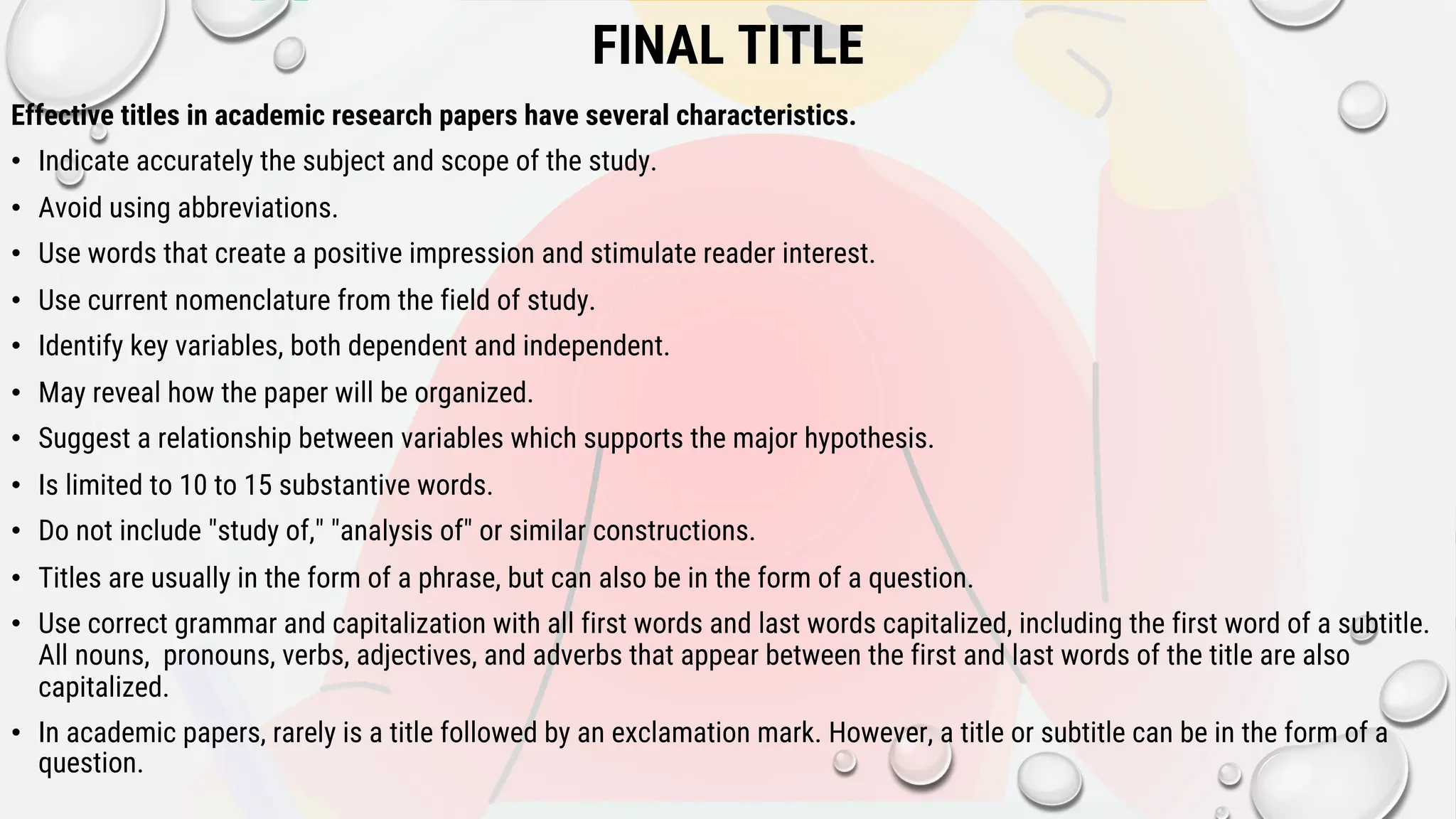
Effective titles in academic research papers have several characteristics.
• Indicate accurately the subject and scope of the study.
• Avoid using abbreviations.
• Use words that create a positive impression and stimulate reader interest.
• Use current nomenclature from the field of study.
• Identify key variables, both dependent and independent.
• May reveal how the paper will be organized.
• Suggest a relationship between variables which supports the major hypothesis.
• Is limited to 10 to 15 substantive words.
• Do not include "study of," "analysis of" or similar constructions.
• Titles are usually in the form of a phrase, but can also be in the form of a question.
• Use correct grammar and capitalization with all first words and last words capitalized, including the first word of a subtitle.
All nouns, pronouns, verbs, adjectives, and adverbs that appear between the first and last words of the title are also
capitalized.
• In academic papers, rarely is a title followed by an exclamation mark. However, a title or subtitle can be in the form of a
question.
THE SUB-TITLE
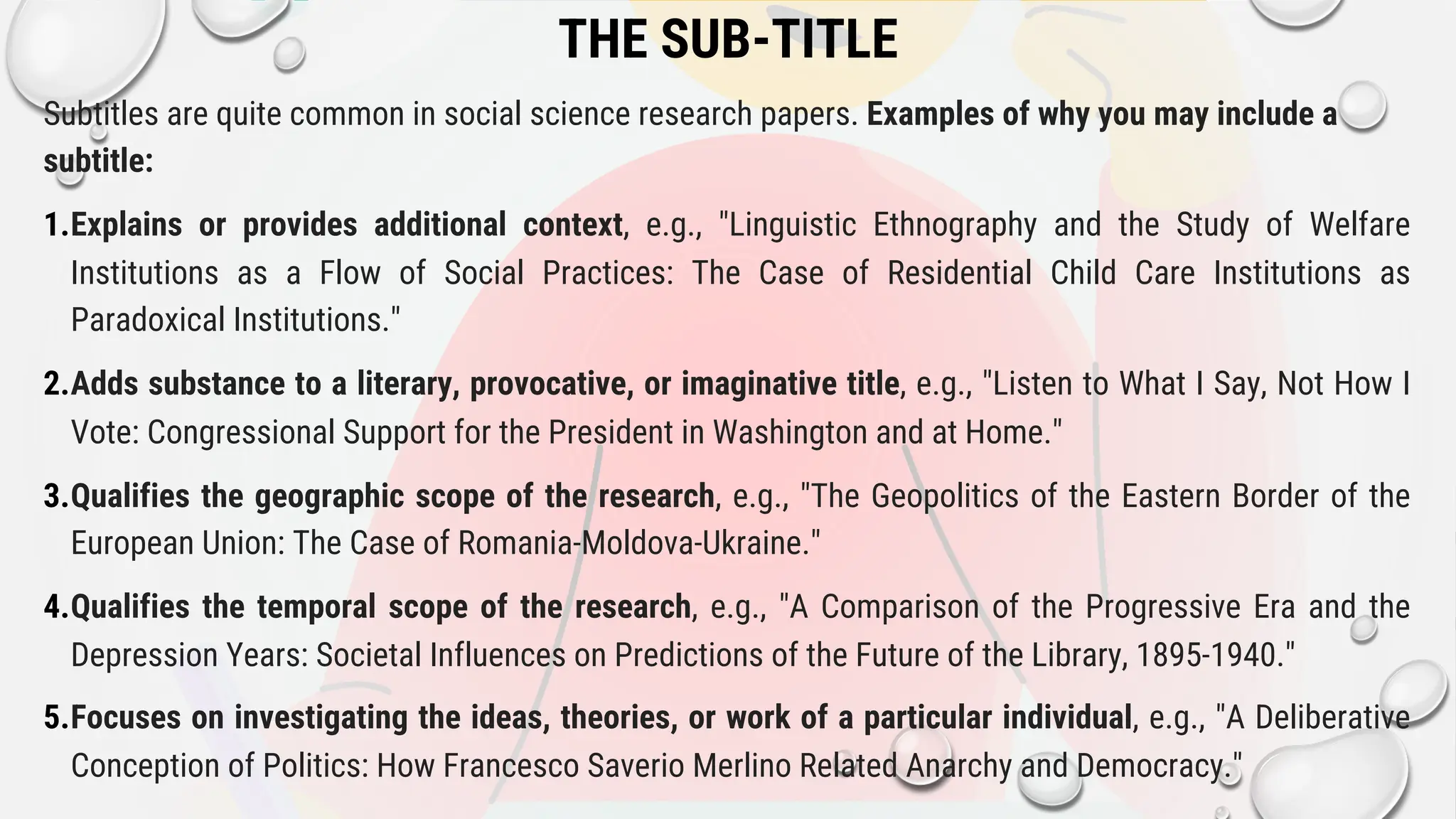
Subtitles are quite common in social science research papers. Examples of why you may include a
subtitle:
1.Explains or provides additional context, e.g., "Linguistic Ethnography and the Study of Welfare
Institutions as a Flow of Social Practices: The Case of Residential Child Care Institutions as
Paradoxical Institutions."
2.Adds substance to a literary, provocative, or imaginative title, e.g., "Listen to What I Say, Not How I
Vote: Congressional Support for the President in Washington and at Home."
3.Qualifies the geographic scope of the research, e.g., "The Geopolitics of the Eastern Border of the
European Union: The Case of Romania-Moldova-Ukraine."
4.Qualifies the temporal scope of the research, e.g., "A Comparison of the Progressive Era and the
Depression Years: Societal Influences on Predictions of the Future of the Library, 1895-1940."
5.Focuses on investigating the ideas, theories, or work of a particular individual, e.g., "A Deliberative
Conception of Politics: How Francesco Saverio Merlino Related Anarchy and Democracy."
Chapter 1_How to write research topic.pdf

Chapter 1_How to write research topic.pdf

  • 1.
    HOW TO WRITE RESEARCH“TOPIC” RESEARCH METHODOLOGY SAN VIBOL
  • 2.
    DEFINITION OF TOPIC 2 Atopic is the main organizing principle guiding the analysis of your research. Topics offer us an occasion for writing and a focus that governs what we want to say. Topics represent the core subject matter of scholarly communication, and the means by which we arrive at other topics of conversations and discover new knowledge.
  • 3.
    CHOOSE A TOPIC Donot expect choosing the topic to be a quick or easy task! You should be thinking about it right from the start of the course. There are generally three ways you are asked to write about a research problem: 1.your professor provides you with a general topic from which you study a particular aspect of; 2.your professor provides you with a list of possible topics; or 3.your professor leaves it up to you to choose a topic and you only have to obtain his/her permission to write about it before beginning your investigation.
  • 4.
    1. HOW TO BEGIN:YOU ARE GIVEN THE TOPIC TO WRITE ABOUT Step 1: Identify concepts and terms that make up the topic statement. For example, your professor wants the class to focus on the following research problem: “Is the European Union as a whole becoming a credible security actor with the ability to contribute to global security?” The main concepts are: European Union, global security, credibility hint: focus on identifying proper nouns, nouns or noun phrases, and action verbs in the assignment description. Step 2: Review related literature to help refine how you will approach focusing on the topic and finding a way to analyze it. Use the main concept terms you developed in Step 1 to retrieve relevant articles. This will help you refine and frame the research problem. Don’t be surprised if you need to do this several times before you finalize how to approach writing about the topic.
  • 5.
    1. HOW TO BEGIN:YOU ARE GIVEN THE TOPIC TO WRITE ABOUT: STEP 3 • Step 3: Since social science research papers are generally designed to get you to develop your own ideas and arguments, look for sources that can help broaden, modify, or strengthen your initial thoughts and arguments For example, if you decide to argue that the European Union is ill prepared to take on responsibilities for broader global security because of the debt crisis in many EU countries, then focus on identifying sources that support as well as refute this position.
  • 6.
    I. HOW TO BEGIN:YOU ARE GIVEN THE TOPIC TO WRITE ABOUT: STEP 3 (CON’T) There are least four appropriate roles your related literature plays in helping you formulate how to begin your analysis: • Sources of criticism -- frequently, you'll find yourself reading materials that are relevant to your chosen topic, but you disagree with the author's position. Therefore, one way that you can use a source is to describe the counter-argument, provide evidence from your review of the literature as to why it is unsatisfactory, and discuss how your own view is more appropriate based upon your interpretation of the evidence. • Sources of new ideas -- while a general goal in writing college research papers is to approach a research problem with some basic idea of what position you'd like to take and what grounds you'd like to stand upon, it is certainly acceptable [and often encouraged] to read the literature and extend, modify, and refine your own position in light of the ideas proposed by others. Just make sure that you cite the sources!
  • 7.
    I. HOW TO BEGIN:YOU ARE GIVEN THE TOPIC TO WRITE ABOUT: STEP 3 (CON’T) • Sources for historical context -- another role your related literature plays in helping you formulate how to begin your analysis is to place issues and events in proper historical context. This can help to demonstrate familiarity with developments in relevant scholarship about your topic, provide a means of comparing historical versus contemporary issues and events, and identifying key people, places, and things that had an important role related to the research problem. • Sources of interdisciplinary insight -- Another way to formulate how to study the topic is to look at it from different disciplinary perspectives. If the topic concerns immigration reform, ask yourself, for example, how do studies from sociological journals vary in their analysis from those in law journals. Another role of related literature is to provide a means of approaching a topic from multiple perspectives rather than the perspective offered from just one discipline. • NOTE: Remember to keep careful notes at every stage. You may think you'll remember what you have searched and where you found things, but it’s easy to forget.
  • 8.
    I. HOW TO BEGIN:YOU ARE GIVEN THE TOPIC TO WRITE ABOUT: STEP 4 • Step 4: Assuming you've done an effective job of synthesizing and thinking about the results of our initial search for related literature, you're ready to prepare a detailed outline for your paper that lays the foundation for a more in-depth and focused review of relevant research literature.
  • 9.
    II. HOW TO BEGIN:YOU ARE PROVIDED A LIST OF POSSIBLE TOPICS TO CHOOSE FROM Step 1: I know what you’re thinking--which topic from this list is the easiest to find the most information on? An effective instructor should never include a topic that is so obscure or complex that no research is available to review and from which to begin to design a study. Instead of searching for the path of least resistance, begin by choosing a topic that you find interesting in some way, or that is controversial and you have a strong opinion about, or that has some personal meaning for you. You're going to be working on your topic for quite some time, so choose one that's interesting or that makes you want to take a position on. Once you’ve settled on a topic of interest from the list, follow Steps 1 - 4 listed above to further develop it into a research paper. NOTE: It’s ok to review related literature to help refine how you will approach analyzing a topic, and then discover that the topic isn’t all that interesting after all. In that case, you can choose another from the list. Just don’t wait too long to make a switch and be sure to consult with your professor first.
  • 10.
    III. HOW TO BEGIN:YOUR PROFESSOR LEAVES IT UP TO YOU TO CHOOSE A TOPIC Step 1: Under this scenario, the key process is turning an idea or general thought into a topic that can be cast as a research problem. When given an assignment where you choose the research topic, don't begin by thinking about what to write about, but rather, ask yourself the question, "What do I want to know?" Treat an open-ended assignment as an opportunity to learn about something that's new or exciting to you.
  • 11.
    III. HOW TO BEGIN:YOUR PROFESSOR LEAVES IT UP TO YOU TO CHOOSE A TOPIC Step 2: If you lack ideas, or wish to gain focus, try some or all of the following strategies: • Review your course readings, particularly the suggested readings, for topic ideas. • Search for a good, recent introductory book and, if appropriate, more specialized works related to the discipline area of the interest. • Browse through some current journals in your subject discipline. Even if most of the articles are not relevant, you can skim through the contents quickly. You only need one to be the spark that begins the process of wanting to learn more about a topic. Consult your professor about the core journals within your subject discipline. • Search online media sources to see if your idea has been covered in the news. Use this coverage to refine your idea into something that you'd like to investigate further but in a more deliberate, scholarly way based on a problem to research.
  • 12.
    III. HOW TO BEGIN:YOUR PROFESSOR LEAVES IT UP TO YOU TO CHOOSE A TOPIC • Step 3: To build upon your initial idea, use the suggestions under this tab to help narrow, broaden, or increase the timeliness of your idea so you can write it out as a research problem. • Once you are comfortable with having turned your idea into a topic, follow Steps 1 - 4 listed in Part I above to further develop it into a research paper.
  • 13.
  • 14.
    IMPORTANCE OF NARROWINGA TOPIC IDEA • Whether assigned a general issue to investigate, you are given a list of problems to study, or you have to make up your own research topic, it is important that the research problem that guides your study is not too broad, otherwise, it will be very difficult to adequately address the problem in the space and time allowed. You could experience a number of problems if your topic is too broad, including: • You find too many information sources and, as a consequence, it is difficult to decide what to include or exclude or what are the most important. • You find information that is too general and, as a consequence, it is difficult to develop a clear framework for understanding the research problem and the methods needed to analyze it. • You find information that covers a wide variety of concepts or ideas that can't be integrated into one paper and, as a consequence, you easily trail off into unnecessary tangents.
  • 15.
    STRATEGIES FOR NARROWINGTHE RESEARCH TOPIC • The most common challenge when beginning to write a research paper is narrowing down your topic. Even if your professor gives you a specific topic to study, it will almost never be so specific that you won’t have to narrow it down at least to some degree [besides, grading fifty papers that are all on exactly the same thing is very boring!]. • A topic is too broad to be manageable when you find that you have too many different, and oftentimes conflicting and only remotely related, ideas about how to investigate the research problem. While you will want to start the writing process by considering a variety of different approaches to studying the problem, you will need to narrow the focus of your research at some point so don't attempt to do too much in one paper.
  • 16.
    STRATEGIES FOR NARROWINGTHE RESEARCH TOPIC Here are some strategies to help focus your topic into something more manageable: • Aspect -- choose one lens through which to view the research problem, or look at just one facet of it [e.g., rather than studying the role of food in Eastern religious rituals; study the role of food in Hindu ceremonies]. • Components -- determine if your initial variables or unit of analyses can be broken into smaller parts, which can then be analyzed more precisely [e.g., a study of tobacco use among adolescents can focus on just chewing tobacco rather than all forms of usage or, rather than adolescents in general, focus on female adolescents of a certain age who smoke]. • Place -- the smaller the area of analysis, the more narrow the focus [e.g., rather than study trade relations in West Africa, study trade relations between Niger and Cameroon]. • Relationship -- how do two or more different perspectives or variables relate to one another? [e.g., cause/effect, compare/contrast, group/individual, male/female, contemporary/historical, etc.]. • Time -- the shorter the time period, the more narrow the focus. • Type -- focus your topic in terms of a specific type or class of people, places, or things [e.g., a study of traffic patterns near schools can focus only on SUVs, or just student drivers, or just the timing of stoplights in the area]. • Combination -- use two or more of the above strategies to focus your topic very narrowly. NOTE: Apply one of the above first to determine if that gives you a manageable study; combining multiple strategies risks creating the opposite problem--your topic becomes too narrowly defined.
  • 17.
  • 18.
    IMPORTANCE OF BROADENINGA TOPIC IDEA It is important to adopt a flexible approach when choosing a topic to investigate. The goal when writing any research paper is to choose a research problem that is focused and time-limited. However, your starting point should not be so narrowly defined that you unnecessarily constrict your opportunity to investigate the topic thoroughly. A research problem that is too narrowly defined leads to any of the following: • You don't find enough information and what you do find is tangential or irrelevant. • You find information that is so specific that it can't lead to any significant conclusions. • Your sources cover so few ideas that you can't expand them into a significant paper.
  • 19.
    STRATEGIES FOR BROADENING THERESEARCH TOPIC In general, a research problem is too narrowly defined if you can't find any relevant or meaningful information about it. If this happens, don't immediately abandon your efforts to study the problem because it could very well be an excellent topic of study. A good way to begin is to look for parallels and opportunities for broader associations that apply to the initial research problem. A strategy for doing this is to ask yourself the basic six questions of who, what, where, when, how, and why.
  • 20.
    STRATEGIES FOR BROADENINGTHE RESEARCH TOPIC Here is an example of how to apply the six questions strategy to broadening your topic. The research problem is to investigate ways to improve trade relations between Peru and Bolivia. Ask yourself: • Who? -- are there other countries involved in the relations between these two countries that might want to challenge or encourage this relationship? Are there particular individuals [e.g., politicians, union leaders, etc.] promoting trade relations or trying to inhibit it? [remember to ask both the individual who question and the collective who question]. • What? -- what are the specific trading commodities you are examining? Are there commodities not currently traded between Peru and Bolivia that could be? • Where? -- are there examples of other bi-lateral trade agreements that could model the potential for closer trade relations between Peru and Bolivia? Note that the question of where can also relate to spatial issues, such as, are there geographic barriers impeding transportation of goods? • When? -- how long have these countries had or not had trade relations? How far into the future might a trade relationship last given other factors? • How? -- how might Peru and Bolivia forge these ties in relation to, for example, long-standing internal conflicts within each country? Note that the how question can also be framed as, "In what way might...." [e.g., In what way might improved trade relations lead to other forms of economic exchanges between the two countries?]. • Why? -- what advantages can each country gain by pursuing active trade relations? Why might other countries be concerned about closer ties between these two countries? Reflecting upon these six questions can help you formulate ways to expand the parameters of your initial research problem, giving you new ideas that can be investigated. Once you've found additional directions in which to procede with your topic, you can try narrowing it down again, if needed. NOTE: Your initial review of the research literature can help you answer these questions as well as identify gaps in the literature when answers cannot be found.
  • 21.
  • 22.
    IMPORTANCE OF ………… It isoften the case that a research problem, even one assigned by your professor, interests you because it relates to a current issue in the news or it is something you have very recently experienced. Choosing a research problem that connects to current affairs is an excellent way to remain engaged in the topic; you feel a connection to the issue or event because it's happening now and a definitive outcome has yet to play itself out. However, you could experience a number of problems if your topic focuses on a very recent issue or event, including: • It can be particularly difficult to find scholarly sources and, as a consequence, your study may be considered less rigorous and valid because it does not cite studies that include a detailed analysis of the topic. • Ironically, examination of a very recent event or issue may force you to draw upon historical precedents in order to effectively frame the research problem and, as a consequence, the scholarly sources supporting your paper ends up being more about the historical context than the current event or issue. • The consequences or results of a current event or issue have yet to be determined and, therefore, the conclusions or any recommendations presented in your paper may be rendered less relevant as things unfold.
  • 23.
    STRATEGIES FOR EXTENDING THE TIMELINESS OF THERESEARCH TOPIC A topic is too current if the only information you find is from news service organizations, blogs, articles from popular magazines and newspapers, and other non-scholarly sources. Depending on the assignment, relying on non-scholarly sources may be acceptable. More frequently, though, professors will require you to cite scholarly research studies as part of your analysis.
  • 24.
    STRATEGIES FOR EXTENDING THE TIMELINESS OF THERESEARCH TOPIC The obvious solution is to choose a different research problem to investigate. However, if the topic is of particular interest to you, here are several strategies you can use to find scholarly or related research-level analysis of a very current issue or event: • Look for related literature that provide opportunities for comparative analysis. • Locate opinions/statements of prominant authors and researchers. • Identify research centers and special interest organizations that focus on studying current issues and events. • Look for government agency reports.
  • 25.
  • 26.
    DEFINITION The title summarizesthe main idea or ideas of your study. A good title contains the fewest possible words that adequately describe the contents and/or purpose of your research paper. The title is without doubt the part of a paper that is read the most, and it is usually read first. If the title is too long it usually contains too many unnecessary words, e.g., "A Study to Investigate the...." On the other hand, a title which is too short often uses words which are too general. For example, "African Politics" could be the title of a book, but it does not provide any information on the focus of a research paper.
  • 27.
    STRUCTURE AND WRITINGSTYLE OF A TITLE The following parameters can be used to help you formulate a suitable research paper title: 1.The purpose of the research 2.The narrative tone of the paper [typically defined by the type of the research] 3.The methods used The initial aim of a title is to capture the reader’s attention and to draw his or her attention to the research problem being investigated. Frame of a title - “What” to study - Among “whom” to study - “Where” to study Ex: waste management practices among slum dwellers in Phnom penh, cambodia
  • 28.
    CREATE A WORKINGTITLE Typically, the final title you submit to your professor is created after the research is complete so that the title accurately captures what was done. The working title should be developed early in the research process because it can help anchor the focus of the study in much the same way the research problem does. Referring back to the working title can help you reorient yourself back to the main purpose of the study if you feel yourself drifting off on a tangent while writing.
  • 29.
    FINAL TITLE Effective titlesin academic research papers have several characteristics. • Indicate accurately the subject and scope of the study. • Avoid using abbreviations. • Use words that create a positive impression and stimulate reader interest. • Use current nomenclature from the field of study. • Identify key variables, both dependent and independent. • May reveal how the paper will be organized. • Suggest a relationship between variables which supports the major hypothesis. • Is limited to 10 to 15 substantive words. • Do not include "study of," "analysis of" or similar constructions. • Titles are usually in the form of a phrase, but can also be in the form of a question. • Use correct grammar and capitalization with all first words and last words capitalized, including the first word of a subtitle. All nouns, pronouns, verbs, adjectives, and adverbs that appear between the first and last words of the title are also capitalized. • In academic papers, rarely is a title followed by an exclamation mark. However, a title or subtitle can be in the form of a question.
  • 30.
    THE SUB-TITLE Subtitles arequite common in social science research papers. Examples of why you may include a subtitle: 1.Explains or provides additional context, e.g., "Linguistic Ethnography and the Study of Welfare Institutions as a Flow of Social Practices: The Case of Residential Child Care Institutions as Paradoxical Institutions." 2.Adds substance to a literary, provocative, or imaginative title, e.g., "Listen to What I Say, Not How I Vote: Congressional Support for the President in Washington and at Home." 3.Qualifies the geographic scope of the research, e.g., "The Geopolitics of the Eastern Border of the European Union: The Case of Romania-Moldova-Ukraine." 4.Qualifies the temporal scope of the research, e.g., "A Comparison of the Progressive Era and the Depression Years: Societal Influences on Predictions of the Future of the Library, 1895-1940." 5.Focuses on investigating the ideas, theories, or work of a particular individual, e.g., "A Deliberative Conception of Politics: How Francesco Saverio Merlino Related Anarchy and Democracy."