How toWrite a Research
Introduction
Introduction
•Establishes the foundation of a research paper
•Readers rules set in introduction apply to all parts of the
paper
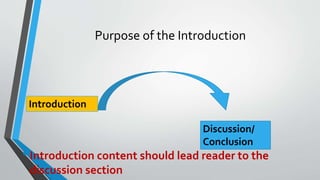
Purpose of the Introduction
•Introduction content should lead reader to the
discussion section
Introduction
Discussion/
Conclusion
Answer two major questions
•Why was this study needed to fill the gap in scientific
knowledge
•Why does this gap need filling
Known
Knowledge
gap
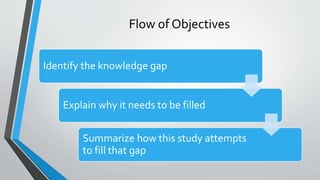
Flow of Objectives
Identify the knowledge gap
Explain why it needs to be filled
Summarize how this study attempts
to fill that gap
Introduction Content
Sales
-Brief background information about research topic
-Rationale for undertaking this study
(reason for “filling the gap”)
-Key references to preliminary work or
Closely related papers
-Clarification of terms, definitions or abbreviations
-Review of pertinent literature
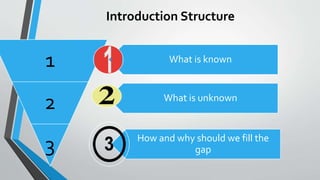
Introduction Structure
1
2
3
What is known
What is unknown
How and why should we fill the
gap
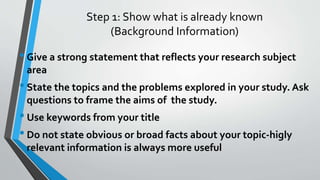
Step 1: Show what is already known
(Background Information)
•Give a strong statement that reflects your research subject
area
•State the topics and the problems explored in your study. Ask
questions to frame the aims of the study.
•Use keywords from your title
•Do not state obvious or broad facts about your topic-higly
relevant information is always more useful
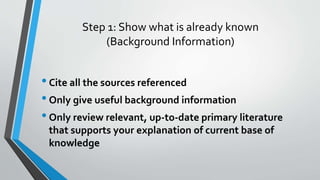
Step 1: Show what is already known
(Background Information)
•Cite all the sources referenced
•Only give useful background information
•Only review relevant, up-to-date primary literature
that supports your explanation of current base of
knowledge
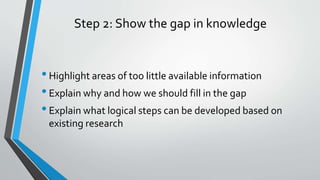
Step 2: Show the gap in knowledge
•Highlight areas of too little available information
•Explain why and how we should fill in the gap
•Explain what logical steps can be developed based on
existing research
Step 2: Show the gap in knowledge
•Show you have examined the current data and devised a
plan
•Show your awareness of the direction of your field
•Show confidence in pursuing this study
Step 3: Show how your study fills in the
knowledge gap
•State your purpose and give a clear hypothesis of
objective of the study
•Tell what useful knowledge will be gained

How to Write a Research Introduction.pptx

  • 1.
    How toWrite aResearch Introduction
  • 2.
    Introduction •Establishes the foundationof a research paper •Readers rules set in introduction apply to all parts of the paper
  • 3.
    Purpose of theIntroduction •Introduction content should lead reader to the discussion section Introduction Discussion/ Conclusion
  • 4.
    Answer two majorquestions •Why was this study needed to fill the gap in scientific knowledge •Why does this gap need filling
  • 5.
  • 6.
    Flow of Objectives Identifythe knowledge gap Explain why it needs to be filled Summarize how this study attempts to fill that gap
  • 7.
    Introduction Content Sales -Brief backgroundinformation about research topic -Rationale for undertaking this study (reason for “filling the gap”) -Key references to preliminary work or Closely related papers -Clarification of terms, definitions or abbreviations -Review of pertinent literature
  • 8.
    Introduction Structure 1 2 3 What isknown What is unknown How and why should we fill the gap
  • 9.
    Step 1: Showwhat is already known (Background Information) •Give a strong statement that reflects your research subject area •State the topics and the problems explored in your study. Ask questions to frame the aims of the study. •Use keywords from your title •Do not state obvious or broad facts about your topic-higly relevant information is always more useful
  • 10.
    Step 1: Showwhat is already known (Background Information) •Cite all the sources referenced •Only give useful background information •Only review relevant, up-to-date primary literature that supports your explanation of current base of knowledge
  • 11.
    Step 2: Showthe gap in knowledge •Highlight areas of too little available information •Explain why and how we should fill in the gap •Explain what logical steps can be developed based on existing research
  • 12.
    Step 2: Showthe gap in knowledge •Show you have examined the current data and devised a plan •Show your awareness of the direction of your field •Show confidence in pursuing this study
  • 13.
    Step 3: Showhow your study fills in the knowledge gap •State your purpose and give a clear hypothesis of objective of the study •Tell what useful knowledge will be gained

Editor's Notes

  • #9 2.What is unknown (What is the gap we want to fill) 3. The rationale and purpose /hypothesis
  • #12 In step two you should
  • #14 In step 3: State the purpose and hypothesis of the study