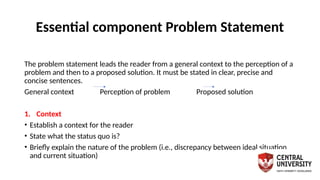
The presentation talks about the systematic journey of inquiry undertaken to investigate [Your Research Topic]. It is more than a simple report of facts; it is a structured argument that validates a specific hypothesis or explores a complex phenomenon through rigorous academic discipline. The presentation is designed to move the audience through the four pillars of formal research: the Motivation, the Mechanism, the Evidence, and the Implication.
The Intellectual Catalyst: Framing the Inquiry
The presentation begins by establishing the Rationale for Study. It talks about the "Knowledge Gap"—the specific area within the current field where information is missing, outdated, or contradictory. By reviewing the existing Literature and Theoretical Framework, the presentation grounds the research in historical context. It then culminates in the formal Research Question or Hypothesis, clearly stating the specific variable or social issue the project aimed to dissect. This section is vital because it proves that the research is not only interesting but necessary for the advancement of the field.
The Rigor of Inquiry: Methodology and Design
Transitioning into the technical heart of the project, the presentation talks about the Research Design. This provides a detailed look at the "Laboratory of Ideas," describing:
* The Paradigm: Whether the approach was Qualitative (focused on nuance and meaning), Quantitative (focused on data and scale), or Mixed-Methods.
* Data Collection Protocols: The presentation details the instruments used—surveys, interviews, longitudinal observations, or archival research—and justifies why these tools were the most effective for this specific inquiry.
* Sampling and Ethics: It addresses the "Who" and "How," explaining the selection of subjects or data points and the ethical safeguards (such as informed consent or data anonymization) that ensured the integrity of the study.
The Evidence: Data Analysis and Synthesis
A significant portion of the presentation talks about the Empirical Findings. This is where raw data is transformed into "Intelligence." Using advanced analytical techniques—such as Regression\ Analysis, Thematic\ Coding, or Statistical\ Significance testing—the presentation reveals the patterns discovered during the research. It doesn't just show graphs; it interprets them. It talks about the correlations found, the anomalies that appeared, and the moments where the data either supported or challenged the initial hypothesis. This section demonstrates the researcher's ability to remain objective while navigating complex information.
The Final Synthesis: Discussion and Contribution
In its final phase, the presentation talks about the Interpretation of Results. It connects the new findings back to the original literature review, discussing how this research adds to the "Global Conversation" on the topic.
* Limitations: The presentation provides a transparent look at the constraints of the study, such as sample size .