HOW TO WRITE A GOOD
FORUM ENTRY
INTERNET FORUM -new form of communication
-its own set of RULES.
1: RESPECT: NEVER ATTACK THE PERSON, focus on the argument.
2: QUOTES for precision.
3: LINKS, images, videos for variety.
4: SPACING for clarity.
5: SHORT PARAGRAPHS.
6: LOGICAL, sound argument.
7: CASUAL, conversational tone.
8: CHECK! For correct SPELLING and GRAMMAR
Match them to the following paragraphs.
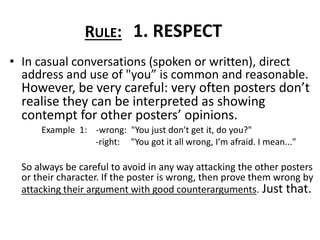
• In casual conversations (spoken or written), direct
address and use of "you” is common and reasonable.
However, be very careful: very often posters don’t
realise they can be interpreted as showing
contempt for other posters’ opinions.
Example 1: -wrong: "You just don't get it, do you?"
-right: "You got it all wrong, I’m afraid. I mean..."
So always be careful to avoid in any way attacking the other posters
or their character. If the poster is wrong, then prove them wrong by
attacking their argument with good counterarguments. Just that.
RULE: 1. RESPECT
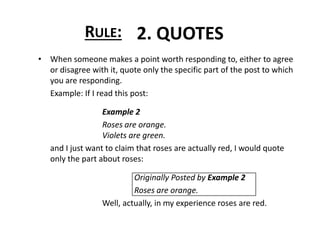
• When someone makes a point worth responding to, either to agree
or disagree with it, quote only the specific part of the post to which
you are responding.
Example: If I read this post:
Example 2
Roses are orange.
Violets are green.
and I just want to claim that roses are actually red, I would quote
only the part about roses:
Originally Posted by Example 2
Roses are orange.
Well, actually, in my experience roses are red.
RULE: 2. QUOTES
RULE:
• Curiosity and desire to break up the
monotony of reading a text will make
people happy to click on links, look at
pictures, and watch videos.
3. LINKS
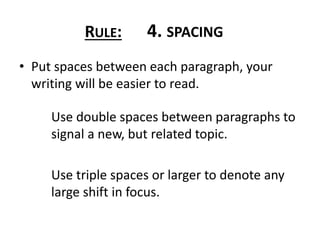
• Put spaces between each paragraph, your
writing will be easier to read.
Use double spaces between paragraphs to
signal a new, but related topic.
Use triple spaces or larger to denote any
large shift in focus.
RULE: 4. SPACING
• Each idea within a topic should have
its own paragraph. Another idea
which supports a topic should start a
new paragraph.
RULE: 5. PARAGRAPHS
• Do your best to support your argumentation.
Proving a point adequately is not easy. But
basically, try to present the relevant
evidence, better in the form of facts, figures,
and outside sources.
RULE: 6. SOUND ARGUMENT
• contractions
• personal pronouns
(though remember to be respectful when addressing others directly)
• parentheses
• idioms, clichés
• banter and light sarcasm (if subtle and respectful enough)
• clearly intentional misspellings and dialect
• bold text and italics to signify a tone of voice
-bold text implies strong, serious statements
-italics are an emphasizing stress on a particular word or phrase.
RULE: 7. CASUAL TONE
• Written errors are always a problem.
Misspellings and incorrect grammar are annoying to the reader.
A single misplaced letter may impair communication.
There is no good excuse for misspelling words
RULE: 8. CHECK
DOS
• Language reflects daily
conversation
• Reasons & examples
• Opinions
• Personal anecdote
• Suggestions, advice
• Rhetorical question inviting
response
DONTS
• No argumentative linkers
• No formal language

How to write a good forum entry

  • 1.
    HOW TO WRITEA GOOD FORUM ENTRY
  • 2.
    INTERNET FORUM -newform of communication -its own set of RULES. 1: RESPECT: NEVER ATTACK THE PERSON, focus on the argument. 2: QUOTES for precision. 3: LINKS, images, videos for variety. 4: SPACING for clarity. 5: SHORT PARAGRAPHS. 6: LOGICAL, sound argument. 7: CASUAL, conversational tone. 8: CHECK! For correct SPELLING and GRAMMAR Match them to the following paragraphs.
  • 3.
    • In casualconversations (spoken or written), direct address and use of "you” is common and reasonable. However, be very careful: very often posters don’t realise they can be interpreted as showing contempt for other posters’ opinions. Example 1: -wrong: "You just don't get it, do you?" -right: "You got it all wrong, I’m afraid. I mean..." So always be careful to avoid in any way attacking the other posters or their character. If the poster is wrong, then prove them wrong by attacking their argument with good counterarguments. Just that. RULE: 1. RESPECT
  • 4.
    • When someonemakes a point worth responding to, either to agree or disagree with it, quote only the specific part of the post to which you are responding. Example: If I read this post: Example 2 Roses are orange. Violets are green. and I just want to claim that roses are actually red, I would quote only the part about roses: Originally Posted by Example 2 Roses are orange. Well, actually, in my experience roses are red. RULE: 2. QUOTES
  • 5.
    RULE: • Curiosity anddesire to break up the monotony of reading a text will make people happy to click on links, look at pictures, and watch videos. 3. LINKS
  • 6.
    • Put spacesbetween each paragraph, your writing will be easier to read. Use double spaces between paragraphs to signal a new, but related topic. Use triple spaces or larger to denote any large shift in focus. RULE: 4. SPACING
  • 7.
    • Each ideawithin a topic should have its own paragraph. Another idea which supports a topic should start a new paragraph. RULE: 5. PARAGRAPHS
  • 8.
    • Do yourbest to support your argumentation. Proving a point adequately is not easy. But basically, try to present the relevant evidence, better in the form of facts, figures, and outside sources. RULE: 6. SOUND ARGUMENT
  • 9.
    • contractions • personalpronouns (though remember to be respectful when addressing others directly) • parentheses • idioms, clichés • banter and light sarcasm (if subtle and respectful enough) • clearly intentional misspellings and dialect • bold text and italics to signify a tone of voice -bold text implies strong, serious statements -italics are an emphasizing stress on a particular word or phrase. RULE: 7. CASUAL TONE
  • 10.
    • Written errorsare always a problem. Misspellings and incorrect grammar are annoying to the reader. A single misplaced letter may impair communication. There is no good excuse for misspelling words RULE: 8. CHECK
  • 11.
    DOS • Language reflectsdaily conversation • Reasons & examples • Opinions • Personal anecdote • Suggestions, advice • Rhetorical question inviting response DONTS • No argumentative linkers • No formal language