how to
up-skill
in it
What’s the future of IT?
I
nformation technology was dominated by a few big names, and the number of
programming languages that would lead to a good corporate job could be counted
on both hands. This was a time when ‘real’ IT was only done inside very large
organizations with huge mainframes and IT helpdesks.
That was then.
The term ‘IT’ is now much harder to pigeonhole. The industry (if it can indeed be
called that) is a varied and prolific inventor of software solutions, hardware tools, user
experiences and applications—and virtually every other industry now has some form of
IT at its center. IT is now just as much a technical skill as it is a creative one, depending
on when, where and how you apply it.
This relatively swift evolution has made defining one’s career “in IT” a little more difficult
than it has been previously.
There are now more choices to make about what kind of IT expert you really want to be,
which industry you want to work in, where you want to live and work, and how you wish
to apply the skills that you’re going to have to keep amassing (almost on a daily basis).
If you have:
•	 a qualification in an IT discipline, programming language or software solution;
•	 at least a year or two of experience applying that skill in the business world; and
•	 the desire to take your career to the next level, then this e-book is for you.
Here, we explore the key trends in technology, what career paths might look like and
how to plan your next steps in selling your skills as a tech expert.
2
Not so long ago, IT was an industry and a skill-set that had relatively well-defined boundaries.
3
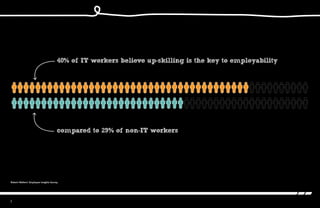
Robert Walters’ Employee Insights Survey
40% of IT workers believe up-skilling is the key to employability
compared to 29% of non-IT workers
Technology is constantly moving and changing, and IT pros know they must change with it.
What’s different about up-skilling in IT?
The trouble with technical skills is:
•	 They are very easily commoditized and out-sourced unless you’re constantly
retraining. If you stay in a pure technical role for more than a few years, you will need
access to ongoing training and a career plan to expand your skill base.
•	 There is constant competition from new software solutions. Even in large
corporations, the dominance of single software solutions for the majority of business
processes/products is waning. Businesses invest in a larger number of niche solutions,
which will have to be adapted, upgraded or replaced more frequently than in the
past, so expertise in one solution is not a career-long proposition any longer.
So, you think of your career path in IT as cyclical.
Although you may not always need to learn new coding languages or programs inside
and out, you’ll always need to maintain a passion for technology and keep up with
trends and what they really mean for the business you’re working in. A career in IT
means consistently developing technical expertise alongside business knowledge and
strategic management skills.
4
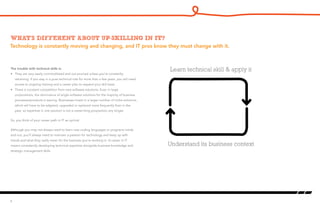
Learn technical skill & apply it
Understand its business context
5
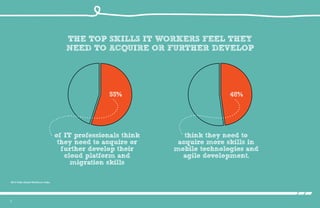
2013 Kelly Global Workforce Index
of IT professionals think
they need to acquire or
further develop their
cloud platform and
migration skills
think they need to
acquire more skills in
mobile technologies and
agile development.
48%55%
The top skills IT workers feel they
need to acquire or further develop
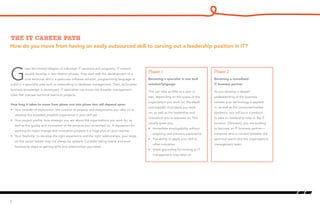
How do you move from having an easily outsourced skill to carving out a leadership position in IT?
The IT career path
G
iven the limited lifespan of individual IT solutions and programs, IT careers
usually develop in two distinct phases. They start with the development of a
core technical skill in a particular software solution, programming language or
a skill in a specialist area such as networking or database management. Then, as broader
business knowledge is developed, IT specialists can move into broader management
roles that oversee technical teams or projects.
How long it takes to move from phase one into phase two will depend upon:
•	 Your breadth of experience: the number of projects and assignments you take on to
develop the broadest possible experience in your skill set.
•	 Your project profile: how strategic you are about the organizations you work for, as
well as the quality and innovation of the projects you’ve worked on. A reputation for
working on major change and innovation projects is a huge plus on your resume.
•	 Your flexibility: to develop the right experience and the right relationships, your steps
on the career ladder may not always be upward. Consider taking lateral and even
backwards steps to get key skills and relationships you need.
6
Becoming a specialist in one tech
solution/language
This can take as little as a year or
two, depending on the scope of the
organization you work for, the depth
and breadth of projects you work
on, as well as the leadership and
innovation you’re exposed to. This
usually gives you:
•	 Immediate employability without
requiring vast previous experience
•	 The ability to apply your skill to
other industries
•	 Great grounding for moving to IT
management roles later on
Becoming a consultant/
IT business partner
As you develop a deeper
understanding of the business
context your technology is applied
in, as well as the consumer/market
dynamics, you will be in a position
to take on leadership roles in the IT
function. Ultimately, you are working
to become an IT business partner—
someone who is conduit between the
technical teams and the organization’s
management team.
Phase 1 Phase 2
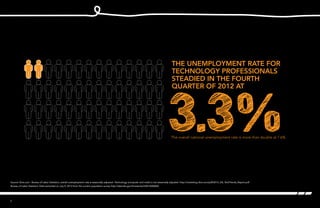
3.3%
7
The unemployment rate for
technology professionals
steadied in the fourth
quarter of 2012 at
Source: Dice.com - Bureau of Labor Statistics; overall unemployment rate is seasonally adjusted –Technology (computer and math) is not seasonally adjusted. http://marketing.dice.com/pdf/2012_Q4_TechTrends_Report.pdf
Bureau of Labor Statistics: Date extracted on July 9, 2013 from the current population survey http://data.bls.gov/timeseries/LNS14000000
The overall national unemployment rate is more than double at 7.6%.
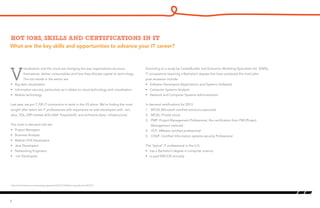
What are the key skills and opportunities to advance your IT career?
Hot jobs, skills and certifications in IT
V
irtualization and the cloud are changing the way organizations structure
themselves, deliver consumables and how they allocate capital to technology.
The hot trends in the sector are:
•	 Big data visualization
•	 Information security, particularly as it relates to cloud technology and virtualization
•	 Mobile technology
Last year, we put 7,700 IT contractors to work in the US alone. We’re finding the most
sought after talent are IT professionals with experience as web developers with .net,
Java, SQL, ERP-related skills (SAP, PeopleSoft), and architects (data, infrastructure)
The most in-demand role are:
•	 Project Managers
•	 Business Analysts
•	 Mobile I/OS Developers
•	 Java Developers
•	 Networking Engineers
•	 .net Developers
According to a study by CareerBuilder and Economic Modeling Specialists Intl. (EMSI),
IT occupations requiring a Bachelor’s degree that have produced the most jobs
post-recession include:
•	 Software Developers (Applications and Systems Software)
•	 Computer Systems Analysts
•	 Network and Computer Systems Administrators1
In demand certifications for 2013:
1.	 MCSA (Microsoft certified solutions associate)
2.	 MCSE: Private cloud
3.	 PMP: Project Management Professional, the certification from PMI (Project
Management institute)
4.	 VCP: VMware certified professional
5.	 CISSP: Certified Information systems security Professional
The ‘typical’ IT professional in the U.S:
•	 has a Bachelor’s degree in computer science
•	 Is paid $90,530 annually
8
1
http://www.forbes.com/sites/jacquelynsmith/2012/12/06/the-top-jobs-for-2013/2/
9
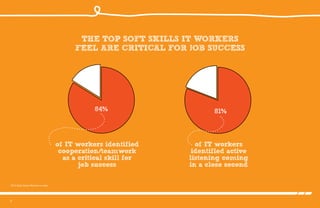
2013 Kelly Global Workforce Index
of IT workers identified
cooperation/teamwork
as a critical skill for
job success
of IT workers
identified active
listening coming
in a close second
84% 81%
The top soft skills IT workers
feel are critical for job success
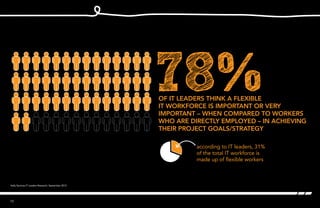
78%
10
of IT leaders think a flexible
IT workforce is important or very
important – when compared to workers
who are directly employed – in achieving
their project goals/strategy
according to IT leaders, 31%
of the total IT workforce is
made up of flexible workers
Kelly Services IT Leaders Research, September 2012
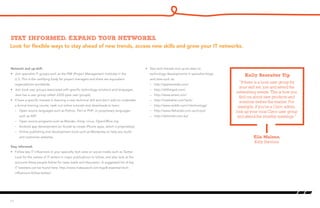
Look for flexible ways to stay ahead of new trends, access new skills and grow your IT networks.
Stay informed. Expand your networks.
Network and up-skill:
•	 Join specialist IT groups such as the PMI (Project Management Institute) in the
U.S. This is the certifying body for project managers and there are equivalent
organizations worldwide.
•	 Join local user groups associated with specific technology solutions and languages.
Java has a user group called JUGS (java user groups).
•	 If have a specific interest in learning a new technical skill and don’t wish to undertake
a formal training course, seek out online tutorials and downloads to learn:
–	 Open source languages such as Python, Perl or PHP; or proprietary languages
such as ASP.
–	 Open source programs such as Blender, Gimp, Linux, OpenOffice.org
–	 Android app development (or Xcode to create iPhone apps, which is proprietary)
–	 Online publishing and development tools such as Wordpress to help you build
and customize websites
Stay informed:
•	 Follow key IT influencers in your specialty tech area on social media such as Twitter.
Look for the names of IT writers in major publications to follow, and also look at the
accounts these people follow for news leads and discussion. A suggested list of key
IT tweeters can be found here: http://www.makeuseof.com/tag/8-essential-tech-
influencers-follow-twitter/
•	 Stay tech-literate and up-to-date on
technology developments in specialist blogs
and sites such as:
–	 http://appleinsider.com/
–	 http://allthingsd.com/
–	 http://www.wired.com/
–	 http://mashable.com/tech/
–	 http://www.reddit.com/r/technology/
–	 http://www.lifehacker.com.au/it-pro/
–	 http://delimiter.com.au/
11
“If there is a local user group for
your skill set, join and attend the
networking events. This is how you
find out about new products and
solutions before the market. For
example, if you’re a Cisco admin,
look up your local Cisco user group
and attend the monthly meetings.”
Ella Malone,
Kelly Services
Kelly Recruiter Tip
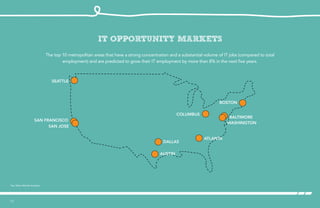
The top 10 metropolitan areas that have a strong concentration and a substantial volume of IT jobs (compared to total
employment) and are predicted to grow their IT employment by more than 8% in the next five years.
IT opportunity markets
Atlanta
baltimore
washington
boston
dallas
austin
columbus
seattle
san francisco
san jose
12
Key Talent Market Analyzer
Did you know Kelly hires 3,300 new Information Technology
contractors every year? Kelly®
is dedicated to helping you
find your ideal job. So, what are you waiting for?
Search for jobs on our Kelly Career Network®, join our Talent Network,
or visit www.kellyservices.com to get started today.
References
•	 Hot Cities for IT Talent
•	 Kelly IT STEM Infographic
•	 Information security professionals must keep skills up to date
•	 http://www.economist.com/news/21566567-it-services-and-software
•	 http://mobile.itnews.com.au/Article.aspx?CIID=337744&type=News
•	 The top jobs for 2013
•	 Funding upskilling in the 21st Century
•	 Workers up-skill to remain employable in crisis
13
EXIT
This information may not be published, broadcast, sold, or otherwise distributed without prior written permission from the authorized party.
All trademarks are property of their respective owners. An Equal Opportunity Employer. © 2012 Kelly Services, Inc.
About the Author
Johnny Jiang is a Recruiting Manager for Kelly Services Strategic Accounts
and Operations (SAO) with an expertise in High-Tech recruitment and market
strategy, spanning across several industries such as Consumer, Life Sciences
and Automotive. After a six-year career in the Silicon Valley encompassing roles
ranging from Technical Recruiter to Recruiting Manager, Johnny decided it was
time for a change of scenery and moved to Roseville, CA; shortly after he joined Kelly Services.
He currently manages the SAO IT vertical, focused on servicing the IT recruitment needs of multiple
key SAO accounts nationwide. Johnny received a B.S. and B.A. degree from UC San Diego, in
Management Science and Psychology.
About Kelly Services®
Kelly Services, Inc. (NASDAQ: KELYA, KELYB) is a leader in providing workforce solutions.
Kelly®
offers a comprehensive array of outsourcing and consulting services as well as world-class
staffing on a temporary, temporary-to-hire, and direct-hire basis. Serving clients around the
globe, Kelly provides employment to more than 560,000 employees annually. Revenue in 2012
was $5.5 billion. Visit kellyservices.com and connect with us on Facebook, LinkedIn, and Twitter.
Download The Talent Project, a free iPad app by Kelly Services.

How To Up-Skill in IT

  • 1.
  • 2.
    What’s the futureof IT? I nformation technology was dominated by a few big names, and the number of programming languages that would lead to a good corporate job could be counted on both hands. This was a time when ‘real’ IT was only done inside very large organizations with huge mainframes and IT helpdesks. That was then. The term ‘IT’ is now much harder to pigeonhole. The industry (if it can indeed be called that) is a varied and prolific inventor of software solutions, hardware tools, user experiences and applications—and virtually every other industry now has some form of IT at its center. IT is now just as much a technical skill as it is a creative one, depending on when, where and how you apply it. This relatively swift evolution has made defining one’s career “in IT” a little more difficult than it has been previously. There are now more choices to make about what kind of IT expert you really want to be, which industry you want to work in, where you want to live and work, and how you wish to apply the skills that you’re going to have to keep amassing (almost on a daily basis). If you have: • a qualification in an IT discipline, programming language or software solution; • at least a year or two of experience applying that skill in the business world; and • the desire to take your career to the next level, then this e-book is for you. Here, we explore the key trends in technology, what career paths might look like and how to plan your next steps in selling your skills as a tech expert. 2 Not so long ago, IT was an industry and a skill-set that had relatively well-defined boundaries.
  • 3.
    3 Robert Walters’ EmployeeInsights Survey 40% of IT workers believe up-skilling is the key to employability compared to 29% of non-IT workers
  • 4.
    Technology is constantlymoving and changing, and IT pros know they must change with it. What’s different about up-skilling in IT? The trouble with technical skills is: • They are very easily commoditized and out-sourced unless you’re constantly retraining. If you stay in a pure technical role for more than a few years, you will need access to ongoing training and a career plan to expand your skill base. • There is constant competition from new software solutions. Even in large corporations, the dominance of single software solutions for the majority of business processes/products is waning. Businesses invest in a larger number of niche solutions, which will have to be adapted, upgraded or replaced more frequently than in the past, so expertise in one solution is not a career-long proposition any longer. So, you think of your career path in IT as cyclical. Although you may not always need to learn new coding languages or programs inside and out, you’ll always need to maintain a passion for technology and keep up with trends and what they really mean for the business you’re working in. A career in IT means consistently developing technical expertise alongside business knowledge and strategic management skills. 4 Learn technical skill & apply it Understand its business context
  • 5.
    5 2013 Kelly GlobalWorkforce Index of IT professionals think they need to acquire or further develop their cloud platform and migration skills think they need to acquire more skills in mobile technologies and agile development. 48%55% The top skills IT workers feel they need to acquire or further develop
  • 6.
    How do youmove from having an easily outsourced skill to carving out a leadership position in IT? The IT career path G iven the limited lifespan of individual IT solutions and programs, IT careers usually develop in two distinct phases. They start with the development of a core technical skill in a particular software solution, programming language or a skill in a specialist area such as networking or database management. Then, as broader business knowledge is developed, IT specialists can move into broader management roles that oversee technical teams or projects. How long it takes to move from phase one into phase two will depend upon: • Your breadth of experience: the number of projects and assignments you take on to develop the broadest possible experience in your skill set. • Your project profile: how strategic you are about the organizations you work for, as well as the quality and innovation of the projects you’ve worked on. A reputation for working on major change and innovation projects is a huge plus on your resume. • Your flexibility: to develop the right experience and the right relationships, your steps on the career ladder may not always be upward. Consider taking lateral and even backwards steps to get key skills and relationships you need. 6 Becoming a specialist in one tech solution/language This can take as little as a year or two, depending on the scope of the organization you work for, the depth and breadth of projects you work on, as well as the leadership and innovation you’re exposed to. This usually gives you: • Immediate employability without requiring vast previous experience • The ability to apply your skill to other industries • Great grounding for moving to IT management roles later on Becoming a consultant/ IT business partner As you develop a deeper understanding of the business context your technology is applied in, as well as the consumer/market dynamics, you will be in a position to take on leadership roles in the IT function. Ultimately, you are working to become an IT business partner— someone who is conduit between the technical teams and the organization’s management team. Phase 1 Phase 2
  • 7.
    3.3% 7 The unemployment ratefor technology professionals steadied in the fourth quarter of 2012 at Source: Dice.com - Bureau of Labor Statistics; overall unemployment rate is seasonally adjusted –Technology (computer and math) is not seasonally adjusted. http://marketing.dice.com/pdf/2012_Q4_TechTrends_Report.pdf Bureau of Labor Statistics: Date extracted on July 9, 2013 from the current population survey http://data.bls.gov/timeseries/LNS14000000 The overall national unemployment rate is more than double at 7.6%.
  • 8.
    What are thekey skills and opportunities to advance your IT career? Hot jobs, skills and certifications in IT V irtualization and the cloud are changing the way organizations structure themselves, deliver consumables and how they allocate capital to technology. The hot trends in the sector are: • Big data visualization • Information security, particularly as it relates to cloud technology and virtualization • Mobile technology Last year, we put 7,700 IT contractors to work in the US alone. We’re finding the most sought after talent are IT professionals with experience as web developers with .net, Java, SQL, ERP-related skills (SAP, PeopleSoft), and architects (data, infrastructure) The most in-demand role are: • Project Managers • Business Analysts • Mobile I/OS Developers • Java Developers • Networking Engineers • .net Developers According to a study by CareerBuilder and Economic Modeling Specialists Intl. (EMSI), IT occupations requiring a Bachelor’s degree that have produced the most jobs post-recession include: • Software Developers (Applications and Systems Software) • Computer Systems Analysts • Network and Computer Systems Administrators1 In demand certifications for 2013: 1. MCSA (Microsoft certified solutions associate) 2. MCSE: Private cloud 3. PMP: Project Management Professional, the certification from PMI (Project Management institute) 4. VCP: VMware certified professional 5. CISSP: Certified Information systems security Professional The ‘typical’ IT professional in the U.S: • has a Bachelor’s degree in computer science • Is paid $90,530 annually 8 1 http://www.forbes.com/sites/jacquelynsmith/2012/12/06/the-top-jobs-for-2013/2/
  • 9.
    9 2013 Kelly GlobalWorkforce Index of IT workers identified cooperation/teamwork as a critical skill for job success of IT workers identified active listening coming in a close second 84% 81% The top soft skills IT workers feel are critical for job success
  • 10.
    78% 10 of IT leadersthink a flexible IT workforce is important or very important – when compared to workers who are directly employed – in achieving their project goals/strategy according to IT leaders, 31% of the total IT workforce is made up of flexible workers Kelly Services IT Leaders Research, September 2012
  • 11.
    Look for flexibleways to stay ahead of new trends, access new skills and grow your IT networks. Stay informed. Expand your networks. Network and up-skill: • Join specialist IT groups such as the PMI (Project Management Institute) in the U.S. This is the certifying body for project managers and there are equivalent organizations worldwide. • Join local user groups associated with specific technology solutions and languages. Java has a user group called JUGS (java user groups). • If have a specific interest in learning a new technical skill and don’t wish to undertake a formal training course, seek out online tutorials and downloads to learn: – Open source languages such as Python, Perl or PHP; or proprietary languages such as ASP. – Open source programs such as Blender, Gimp, Linux, OpenOffice.org – Android app development (or Xcode to create iPhone apps, which is proprietary) – Online publishing and development tools such as Wordpress to help you build and customize websites Stay informed: • Follow key IT influencers in your specialty tech area on social media such as Twitter. Look for the names of IT writers in major publications to follow, and also look at the accounts these people follow for news leads and discussion. A suggested list of key IT tweeters can be found here: http://www.makeuseof.com/tag/8-essential-tech- influencers-follow-twitter/ • Stay tech-literate and up-to-date on technology developments in specialist blogs and sites such as: – http://appleinsider.com/ – http://allthingsd.com/ – http://www.wired.com/ – http://mashable.com/tech/ – http://www.reddit.com/r/technology/ – http://www.lifehacker.com.au/it-pro/ – http://delimiter.com.au/ 11 “If there is a local user group for your skill set, join and attend the networking events. This is how you find out about new products and solutions before the market. For example, if you’re a Cisco admin, look up your local Cisco user group and attend the monthly meetings.” Ella Malone, Kelly Services Kelly Recruiter Tip
  • 12.
    The top 10metropolitan areas that have a strong concentration and a substantial volume of IT jobs (compared to total employment) and are predicted to grow their IT employment by more than 8% in the next five years. IT opportunity markets Atlanta baltimore washington boston dallas austin columbus seattle san francisco san jose 12 Key Talent Market Analyzer
  • 13.
    Did you knowKelly hires 3,300 new Information Technology contractors every year? Kelly® is dedicated to helping you find your ideal job. So, what are you waiting for? Search for jobs on our Kelly Career Network®, join our Talent Network, or visit www.kellyservices.com to get started today. References • Hot Cities for IT Talent • Kelly IT STEM Infographic • Information security professionals must keep skills up to date • http://www.economist.com/news/21566567-it-services-and-software • http://mobile.itnews.com.au/Article.aspx?CIID=337744&type=News • The top jobs for 2013 • Funding upskilling in the 21st Century • Workers up-skill to remain employable in crisis 13
  • 14.
    EXIT This information maynot be published, broadcast, sold, or otherwise distributed without prior written permission from the authorized party. All trademarks are property of their respective owners. An Equal Opportunity Employer. © 2012 Kelly Services, Inc. About the Author Johnny Jiang is a Recruiting Manager for Kelly Services Strategic Accounts and Operations (SAO) with an expertise in High-Tech recruitment and market strategy, spanning across several industries such as Consumer, Life Sciences and Automotive. After a six-year career in the Silicon Valley encompassing roles ranging from Technical Recruiter to Recruiting Manager, Johnny decided it was time for a change of scenery and moved to Roseville, CA; shortly after he joined Kelly Services. He currently manages the SAO IT vertical, focused on servicing the IT recruitment needs of multiple key SAO accounts nationwide. Johnny received a B.S. and B.A. degree from UC San Diego, in Management Science and Psychology. About Kelly Services® Kelly Services, Inc. (NASDAQ: KELYA, KELYB) is a leader in providing workforce solutions. Kelly® offers a comprehensive array of outsourcing and consulting services as well as world-class staffing on a temporary, temporary-to-hire, and direct-hire basis. Serving clients around the globe, Kelly provides employment to more than 560,000 employees annually. Revenue in 2012 was $5.5 billion. Visit kellyservices.com and connect with us on Facebook, LinkedIn, and Twitter. Download The Talent Project, a free iPad app by Kelly Services.