How to Take BP
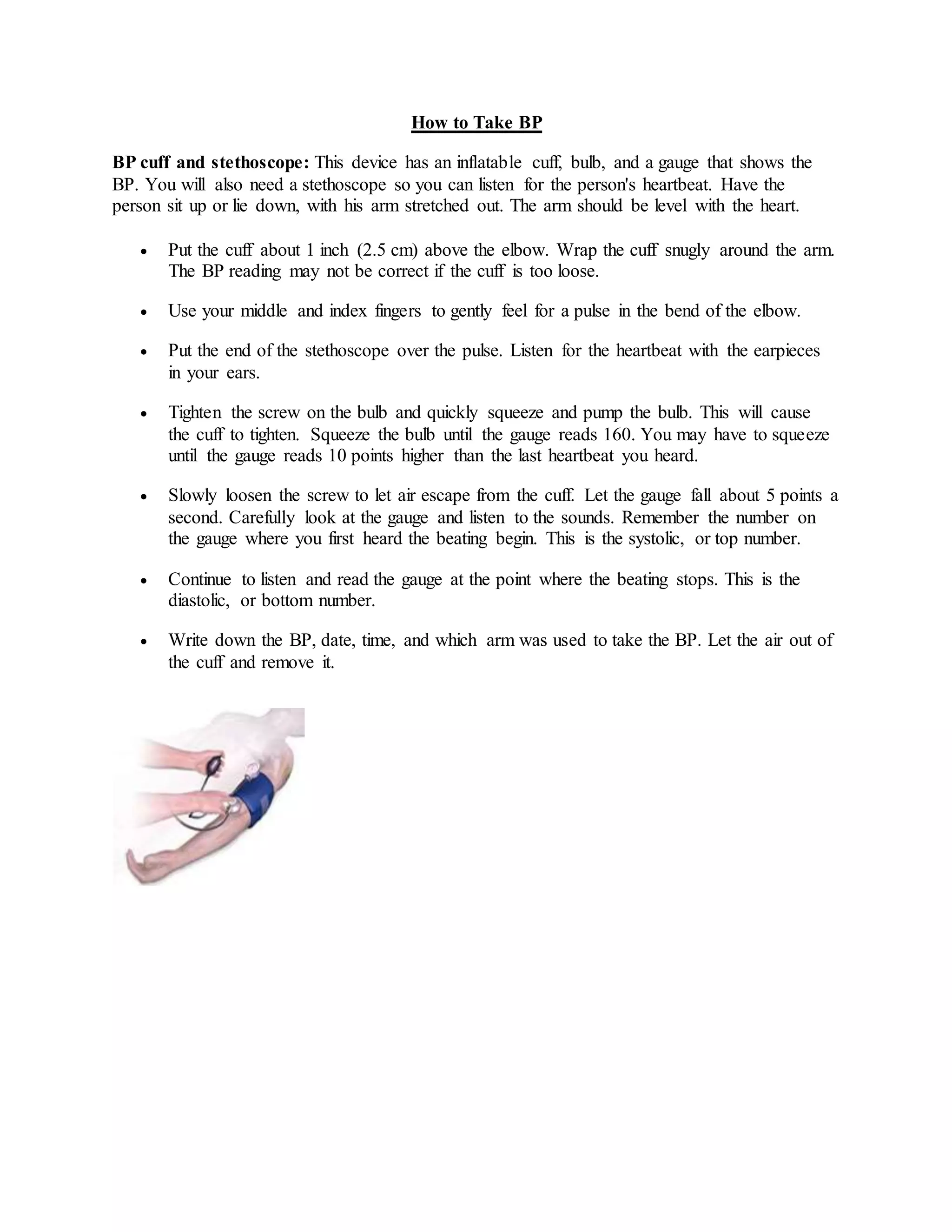
BP cuff and stethoscope: This device has an inflatable cuff, bulb, and a gauge that shows the
BP. You will also need a stethoscope so you can listen for the person's heartbeat. Have the
person sit up or lie down, with his arm stretched out. The arm should be level with the heart.
 Put the cuff about 1 inch (2.5 cm) above the elbow. Wrap the cuff snugly around the arm.
The BP reading may not be correct if the cuff is too loose.
 Use your middle and index fingers to gently feel for a pulse in the bend of the elbow.
 Put the end of the stethoscope over the pulse. Listen for the heartbeat with the earpieces
in your ears.
 Tighten the screw on the bulb and quickly squeeze and pump the bulb. This will cause
the cuff to tighten. Squeeze the bulb until the gauge reads 160. You may have to squeeze
until the gauge reads 10 points higher than the last heartbeat you heard.
 Slowly loosen the screw to let air escape from the cuff. Let the gauge fall about 5 points a
second. Carefully look at the gauge and listen to the sounds. Remember the number on
the gauge where you first heard the beating begin. This is the systolic, or top number.
 Continue to listen and read the gauge at the point where the beating stops. This is the
diastolic, or bottom number.
 Write down the BP, date, time, and which arm was used to take the BP. Let the air out of
the cuff and remove it.

How To Take BP

  • 1.
    How to TakeBP BP cuff and stethoscope: This device has an inflatable cuff, bulb, and a gauge that shows the BP. You will also need a stethoscope so you can listen for the person's heartbeat. Have the person sit up or lie down, with his arm stretched out. The arm should be level with the heart.  Put the cuff about 1 inch (2.5 cm) above the elbow. Wrap the cuff snugly around the arm. The BP reading may not be correct if the cuff is too loose.  Use your middle and index fingers to gently feel for a pulse in the bend of the elbow.  Put the end of the stethoscope over the pulse. Listen for the heartbeat with the earpieces in your ears.  Tighten the screw on the bulb and quickly squeeze and pump the bulb. This will cause the cuff to tighten. Squeeze the bulb until the gauge reads 160. You may have to squeeze until the gauge reads 10 points higher than the last heartbeat you heard.  Slowly loosen the screw to let air escape from the cuff. Let the gauge fall about 5 points a second. Carefully look at the gauge and listen to the sounds. Remember the number on the gauge where you first heard the beating begin. This is the systolic, or top number.  Continue to listen and read the gauge at the point where the beating stops. This is the diastolic, or bottom number.  Write down the BP, date, time, and which arm was used to take the BP. Let the air out of the cuff and remove it.