Biology 120 ww5
Medical Terminology
Chapter 13 Presentation
The Special Senses
By: Jennifer Stevenson
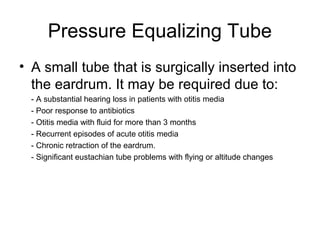
Pressure Equalizing Tube
• Abbreviation:
PE tube
Pressure Equalizing Tube
• A small tube that is surgically inserted into
the eardrum. It may be required due to:
- A substantial hearing loss in patients with otitis media
- Poor response to antibiotics
- Otitis media with fluid for more than 3 months
- Recurrent episodes of acute otitis media
- Chronic retraction of the eardrum.
- Significant eustachian tube problems with flying or altitude changes
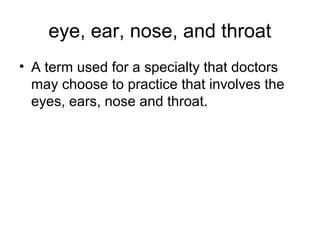
eye, ear, nose, and throat
• Abbreviation:
EENT
eye, ear, nose, and throat
• A term used for a specialty that doctors
may choose to practice that involves the
eyes, ears, nose and throat.
Bone Conduction
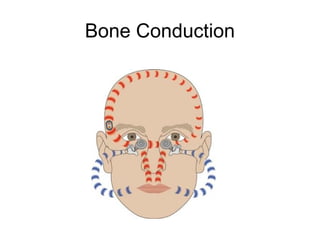
Bone Conduction
• Abbreviated BC
• The conduction of sound to the inner ear through the bones of
the skull.
• Bone conduction is the reason why a person's voice sounds
different to him/her when it is recorded and played back.
• There are 2 types of bone conduction that are recognized
-compressional bone conduction: high pitched
sounds cause segments of the skull to vibrate
individually which stimulate the sensory cells that are involved
in receiving sound waves in the air.
-inertial bone conduction: low pitched sounds vibrate the entire
skull, causing it to move while the suspended sensory parts of
the inner ear remain at rest.
Both ears
• Abbreviated AU
• Abbreviation used in charting to quickly
denote that the patient is having issues
with both of their ears.
Otitis Media
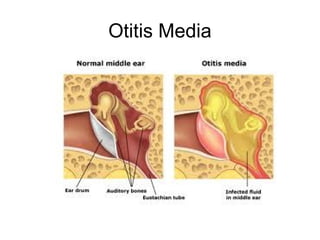
Otitis Media
• Abbreviated OM
• Inflammation of the middle ear, a middle
ear infection.
• Usually what is the cause for most ear
aches, the other being otitis externa.
• Though severely painful, otitis media is not
threatening and usually heals on its own
within 2–4 weeks.
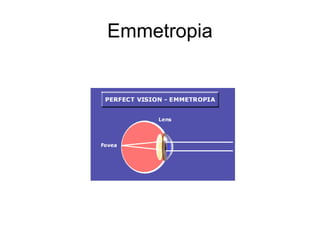
Emmetropia
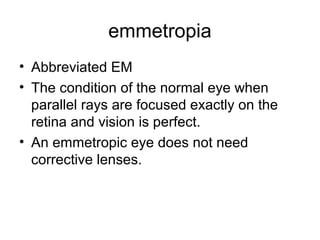
emmetropia
• Abbreviated EM
• The condition of the normal eye when
parallel rays are focused exactly on the
retina and vision is perfect.
• An emmetropic eye does not need
corrective lenses.
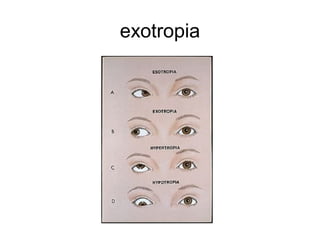
exotropia
exotropia
• Abbreviated XT
• refers to an outward deviation of the eyes
(outward drift)
• Although it commonly begins around age
2 to 4 years, it can appear at any age.
Left eye
• Abbreviated OS
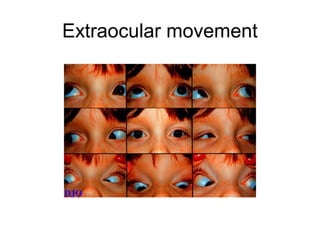
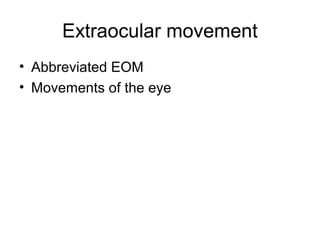
Extraocular movement
• Abbreviated EOM
• Movements of the eye
Visual acuity
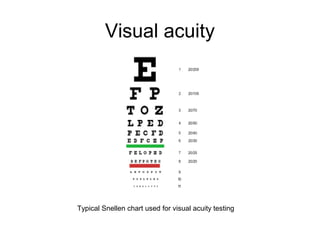
Typical Snellen chart used for visual acuity testing
Visual acuity
• Abbreviated VA
• Is acuteness or clearness of vision, which
is dependent on the sharpness of the
retinal focus within the eye and the
sensitivity of the interpretative faculty of
the brain.

Presentation 13

  • 1.
    Biology 120 ww5 MedicalTerminology Chapter 13 Presentation The Special Senses By: Jennifer Stevenson
  • 2.
    Pressure Equalizing Tube •Abbreviation: PE tube
  • 3.
    Pressure Equalizing Tube •A small tube that is surgically inserted into the eardrum. It may be required due to: - A substantial hearing loss in patients with otitis media - Poor response to antibiotics - Otitis media with fluid for more than 3 months - Recurrent episodes of acute otitis media - Chronic retraction of the eardrum. - Significant eustachian tube problems with flying or altitude changes
  • 4.
    eye, ear, nose,and throat • Abbreviation: EENT
  • 5.
    eye, ear, nose,and throat • A term used for a specialty that doctors may choose to practice that involves the eyes, ears, nose and throat.
  • 6.
  • 7.
    Bone Conduction • AbbreviatedBC • The conduction of sound to the inner ear through the bones of the skull. • Bone conduction is the reason why a person's voice sounds different to him/her when it is recorded and played back. • There are 2 types of bone conduction that are recognized -compressional bone conduction: high pitched sounds cause segments of the skull to vibrate individually which stimulate the sensory cells that are involved in receiving sound waves in the air. -inertial bone conduction: low pitched sounds vibrate the entire skull, causing it to move while the suspended sensory parts of the inner ear remain at rest.
  • 8.
    Both ears • AbbreviatedAU • Abbreviation used in charting to quickly denote that the patient is having issues with both of their ears.
  • 9.
  • 10.
    Otitis Media • AbbreviatedOM • Inflammation of the middle ear, a middle ear infection. • Usually what is the cause for most ear aches, the other being otitis externa. • Though severely painful, otitis media is not threatening and usually heals on its own within 2–4 weeks.
  • 11.
  • 12.
    emmetropia • Abbreviated EM •The condition of the normal eye when parallel rays are focused exactly on the retina and vision is perfect. • An emmetropic eye does not need corrective lenses.
  • 13.
  • 14.
    exotropia • Abbreviated XT •refers to an outward deviation of the eyes (outward drift) • Although it commonly begins around age 2 to 4 years, it can appear at any age.
  • 15.
  • 16.
  • 17.
    Extraocular movement • AbbreviatedEOM • Movements of the eye
  • 18.
    Visual acuity Typical Snellenchart used for visual acuity testing
  • 19.
    Visual acuity • AbbreviatedVA • Is acuteness or clearness of vision, which is dependent on the sharpness of the retinal focus within the eye and the sensitivity of the interpretative faculty of the brain.