Welcome!
Genius Mind Reading
     Seminar


          .

                  1
Preview
• Look over the material

• Appraise the value for your
  purpose
• Decide to go or not go
  further


                                2
The procedure is actually quite simple. First you arrange things into
different groups. Of course one pile may be sufficient depending on
how much there is to do. If you have to go somewhere else due to lack
of facilities that is the next step, otherwise you are pretty well set. It is
 important not to overdo things. That is, it is better to do too few things
 at once than too many. In the short run this may not seem important,
 but complications can easily arise.A mistake can be expensive as well.
At first the whole procedure will seem complicated. Soon, however, it
will become just another facet of life. It is difficult to foresee any end
 to the necessity for this task in the immediate future, but then one
 never can tell. After the procedure is completed one arranges the
 materials into different groups again. Then they can be put into their
 appropriate places. Eventually they will be used once more, and the
 whole cycle will then have to be repeated. However, this is a
  part of life.

                                                                      3
Pre View
• Why Preview –
• to learn about the subject before reading.
• Pre View = Viewing in advance = looking
  ahead and checking for information.
• Get a general idea of a book before you
  actually read it.
• Knowing in advance helps you understand a
  little about its content and about its special
  features.


                                                   4
Why Preview?
• Refine purpose
• Determine “go or no go” with the material
• Invest little time for huge payoff


                                          5
How to Pre view
• Survey
• Question
• Pull out trigger words


                           6
Pre view ( contd.)
• The Preface
• A brief essay in which an author gives
  reasons for writing the book
• Not every book..
• But authors who do give you a personal
  message -
•   tells you the kind of reader the author is writing for –
•   the aims of the book –
•   what the author expects you to learn as a result of reading the
    book –
•   the topics in the book and the best approaches to those topics


                                                                      7
Introduction
• Often the first chapter..
• States the basic idea, issue or problem dealt
  with..
• Background information
• The history of the topic
• Summarise what others have said about the
  subject
• Even explain the research the author did
• Some one else may write it
• Explaining the main ideas worth noting.


                                                  8
Questions ???
•   Surveying will lead to many questions..
•   They help to warm up the mind.
•   Absorb information faster..
•   Retain longer
•   Arouse curiosity..
•   Turn the main headings, subheadings
    and key ideas into questions.


                                              9
The Five Wise Men.
•   Who
•   What
•   Where
•   How
•   Why


                         10
Pre View Long
           Articles
•   Look at the title
•   Look for the subtitles or headings
•   Look at lists of goals or objectives
•   Look at the pictures, charts or drawings.
•   Look at the first sentence of each paragraph.
•   Look at the last paragraph
•   Look for key words in different print
•   Look for a summary.


                                                11
Trigger words.
           ( contd)
• For long articles or reports
• Take 30 seconds
• For books, open the book every 20 pages or
  so
• Let your eyes skim down the pages and
  notice trigger words that catch your attention
• Take 2-3 minutes to pull out a total of 20-25
  words or phrases and write them down.


                                               12
Word Map
• Summarise your pre viewing in the form
  of a word map
• Jot down your questions
• Trigger words
• Use pictures, symbols, arrows colours


                                       13
Step 2: Preview
• Look Over the Material
   - 30-60 seconds for articles
   - 60-90 seconds for most books
   - Look at the title and structure of
     articles or at the front and back cover
     of a book and the table of
     contents
• Appraise the Value for
  Your Purpose
• Determine Go or No Go
                                               14
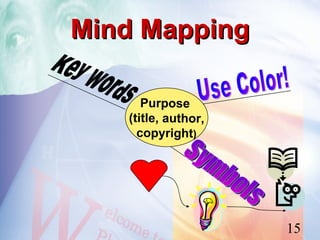
Mind Mapping

      Purpose
   (title, author,
     copyright)


                     15
Why Mind Map?
• Utilize whole brain -
  logical and creative
• Create a visual and
  natural representation
  of associations
• Establish foundations
  for long term memory


                           16

How To Preview A Book2

  • 1.
  • 2.
    Preview • Look overthe material • Appraise the value for your purpose • Decide to go or not go further 2
  • 3.
    The procedure isactually quite simple. First you arrange things into different groups. Of course one pile may be sufficient depending on how much there is to do. If you have to go somewhere else due to lack of facilities that is the next step, otherwise you are pretty well set. It is important not to overdo things. That is, it is better to do too few things at once than too many. In the short run this may not seem important, but complications can easily arise.A mistake can be expensive as well. At first the whole procedure will seem complicated. Soon, however, it will become just another facet of life. It is difficult to foresee any end to the necessity for this task in the immediate future, but then one never can tell. After the procedure is completed one arranges the materials into different groups again. Then they can be put into their appropriate places. Eventually they will be used once more, and the whole cycle will then have to be repeated. However, this is a part of life. 3
  • 4.
    Pre View • WhyPreview – • to learn about the subject before reading. • Pre View = Viewing in advance = looking ahead and checking for information. • Get a general idea of a book before you actually read it. • Knowing in advance helps you understand a little about its content and about its special features. 4
  • 5.
    Why Preview? • Refinepurpose • Determine “go or no go” with the material • Invest little time for huge payoff 5
  • 6.
    How to Preview • Survey • Question • Pull out trigger words 6
  • 7.
    Pre view (contd.) • The Preface • A brief essay in which an author gives reasons for writing the book • Not every book.. • But authors who do give you a personal message - • tells you the kind of reader the author is writing for – • the aims of the book – • what the author expects you to learn as a result of reading the book – • the topics in the book and the best approaches to those topics 7
  • 8.
    Introduction • Often thefirst chapter.. • States the basic idea, issue or problem dealt with.. • Background information • The history of the topic • Summarise what others have said about the subject • Even explain the research the author did • Some one else may write it • Explaining the main ideas worth noting. 8
  • 9.
    Questions ??? • Surveying will lead to many questions.. • They help to warm up the mind. • Absorb information faster.. • Retain longer • Arouse curiosity.. • Turn the main headings, subheadings and key ideas into questions. 9
  • 10.
    The Five WiseMen. • Who • What • Where • How • Why 10
  • 11.
    Pre View Long Articles • Look at the title • Look for the subtitles or headings • Look at lists of goals or objectives • Look at the pictures, charts or drawings. • Look at the first sentence of each paragraph. • Look at the last paragraph • Look for key words in different print • Look for a summary. 11
  • 12.
    Trigger words. ( contd) • For long articles or reports • Take 30 seconds • For books, open the book every 20 pages or so • Let your eyes skim down the pages and notice trigger words that catch your attention • Take 2-3 minutes to pull out a total of 20-25 words or phrases and write them down. 12
  • 13.
    Word Map • Summariseyour pre viewing in the form of a word map • Jot down your questions • Trigger words • Use pictures, symbols, arrows colours 13
  • 14.
    Step 2: Preview •Look Over the Material - 30-60 seconds for articles - 60-90 seconds for most books - Look at the title and structure of articles or at the front and back cover of a book and the table of contents • Appraise the Value for Your Purpose • Determine Go or No Go 14
  • 15.
    Mind Mapping Purpose (title, author, copyright) 15
  • 16.
    Why Mind Map? •Utilize whole brain - logical and creative • Create a visual and natural representation of associations • Establish foundations for long term memory 16