Writing a Report
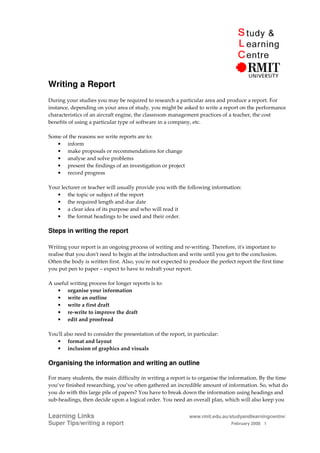
During your studies you may be required to research a particular area and produce a report. For
instance, depending on your area of study, you might be asked to write a report on the performance
characteristics of an aircraft engine, the classroom management practices of a teacher, the cost
benefits of using a particular type of software in a company, etc.

Some of the reasons we write reports are to:
   • inform
   • make proposals or recommendations for change
   • analyse and solve problems
   • present the findings of an investigation or project
   • record progress

Your lecturer or teacher will usually provide you with the following information:
   • the topic or subject of the report
   • the required length and due date
   • a clear idea of its purpose and who will read it
   • the format headings to be used and their order.

Steps in writing the report

Writing your report is an ongoing process of writing and re-writing. Therefore, it's important to
realise that you don't need to begin at the introduction and write until you get to the conclusion.
Often the body is written first. Also, you're not expected to produce the perfect report the first time
you put pen to paper – expect to have to redraft your report.

A useful writing process for longer reports is to:
   • organise your information
   • write an outline
   • write a first draft
   • re-write to improve the draft
   • edit and proofread

You'll also need to consider the presentation of the report, in particular:
   • format and layout
   • inclusion of graphics and visuals

Organising the information and writing an outline

For many students, the main difficulty in writing a report is to organise the information. By the time
you’ve finished researching, you’ve often gathered an incredible amount of information. So, what do
you do with this large pile of papers? You have to break down the information using headings and
sub-headings, then decide upon a logical order. You need an overall plan, which will also keep you


Learning Links                                                www.rmit.edu.au/studyandlearningcentre/
Super Tips/writing a report                                                     February 2008 1
on the subject. You’ll find some useful strategies for writing an outline in the Learning Links – Writing
Essays, and Learning Links – Sample Essay resources.


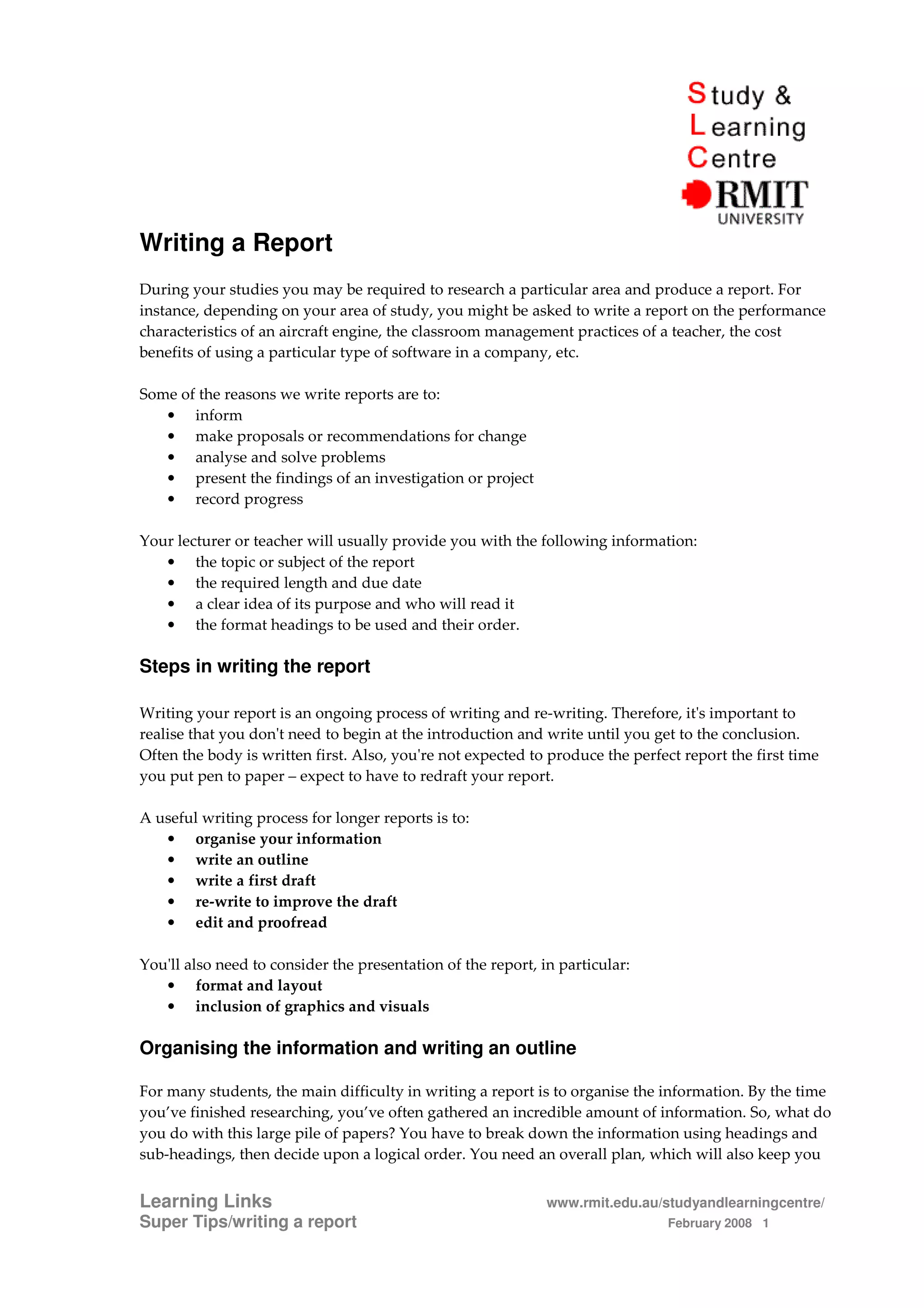
Here’s a sample outline:

Topic: The Australian Wine Industry Today

Introduction
    - why this report is written
    - what it will cover
History
    - first vineyards in Australia
    - where/when/who
    - what they produced
    - quality of the wine
    - progress from then until now
    - very brief
    - per state/development of major areas
               - SA
              - NSW
               - Victoria
               - Tasmania
               - Western Australia
Consumption of wine in the 1990s
    - comparison with other decades
    - by types of wine
    - popularity table
    - by areas
    - how the wine drinker profile has changed in recent times
The export industry
    - early exporting
         - what ?
         - where?
    - response from overseas
    - exports trends in the 90s
         - what?
         - where?
         - how much?
         - trend chart
The future of the industry
   - domestic markets
    - international markets
    - threats
    - opportunities
    - what is required of growers and government

Because all good reports have the material organized into a logical order, here are two Learning
Activities for you to practise this skill.


Learning Links                                               www.rmit.edu.au/studyandlearningcentre/
Super Tips/writing a report                                                     February 2008 2
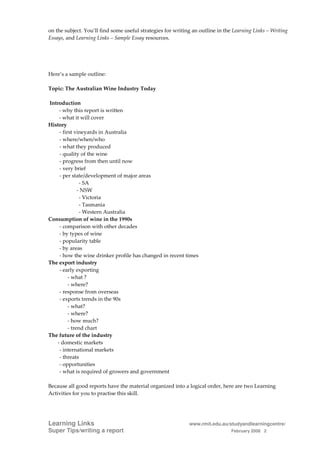
Learning Activity 1
   You’ve been asked to write a report on skills and strategies you need to be a successful tertiary
   student. You’ve brainstormed and come up with these:

     taking notes from texts                organizing the information

     reading                   report writing               note-taking
                                                                     writing a draft
                        scanning
      formatting                           taking notes from lectures           skimming


   Now you need to organise this information into headings and sub-headings. When you’ve done
   it, check out the answer on the last page. (Hint: there are 3 headings).


   Learning Activity 2
   This one’s a bit more difficult. As with the first activity, the idea is to organise the list into
   headings and sub-headings. This time, the list will become the contents page for a report
   outlining strategies for managing a national park. You might want to try a numbering system
   (see information below) with this one. When you’ve completed it, check out the answer on the
   last page.
   (Hint: There are 4 Recommendations sections as well as a General Recommendations, which means
   that there are at least 4 main sections in the body of the report).


   Defence Forces Training        General Recommendations               Introduction

   General Management Strategies           Management for Conservation of Resources

   Recommendations              Conservation of Native Fauna        Recommendations

   Contents             Management for Visitor Use                          Conclusion

   Monitoring and Minimising Visitor Impacts                       Recommendations

   Management for Resource Use                    Conservation of Native Flora

   Timber Harvesting             Recommendations            Recreation Opportunities

   Management of Authorised Uses                Sponsorship and Advertising

                    Mining and Mineral Exploration


Learning Links                                                 www.rmit.edu.au/studyandlearningcentre/
Super Tips/writing a report                                                            February 2008 3
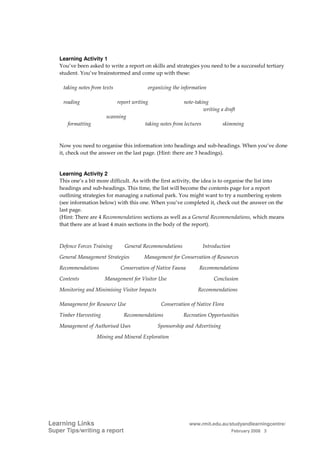
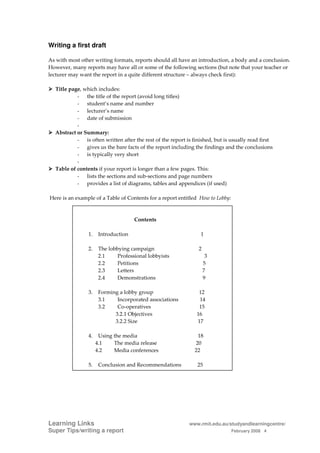
Writing a first draft

As with most other writing formats, reports should all have an introduction, a body and a conclusion.
However, many reports may have all or some of the following sections (but note that your teacher or
lecturer may want the report in a quite different structure – always check first):

  Title page, which includes:
           - the title of the report (avoid long titles)
           - student’s name and number
           - lecturer’s name
           - date of submission
           -
  Abstract or Summary:
           - is often written after the rest of the report is finished, but is usually read first
           - gives us the bare facts of the report including the findings and the conclusions
           - is typically very short
           -
  Table of contents if your report is longer than a few pages. This:
           - lists the sections and sub-sections and page numbers
           - provides a list of diagrams, tables and appendices (if used)

Here is an example of a Table of Contents for a report entitled How to Lobby:


                                     Contents

                1.    Introduction                               1

                2.    The lobbying campaign                     2
                      2.1     Professional lobbyists                 3
                      2.2     Petitions                             5
                      2.3     Letters                               7
                      2.4     Demonstrations                        9

                3.    Forming a lobby group                     12
                      3.1    Incorporated associations          14
                      3.2    Co-operatives                      15
                            3.2.1 Objectives                   16
                            3.2.2 Size                         17

                4.    Using the media                          18
                     4.1    The media release                 20
                     4.2    Media conferences                 22

                5.    Conclusion and Recommendations            25


Learning Links                                              www.rmit.edu.au/studyandlearningcentre/
Super Tips/writing a report                                                     February 2008 4
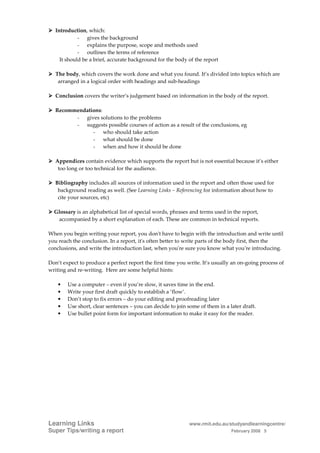
Introduction, which:
             - gives the background
             - explains the purpose, scope and methods used
             - outlines the terms of reference
     It should be a brief, accurate background for the body of the report

   The body, which covers the work done and what you found. It’s divided into topics which are
    arranged in a logical order with headings and sub-headings

   Conclusion covers the writer’s judgement based on information in the body of the report.

   Recommendations:
         - gives solutions to the problems
         - suggests possible courses of action as a result of the conclusions, eg
               - who should take action
               - what should be done
               - when and how it should be done

   Appendices contain evidence which supports the report but is not essential because it’s either
    too long or too technical for the audience.

   Bibliography includes all sources of information used in the report and often those used for
    background reading as well. (See Learning Links – Referencing for information about how to
    cite your sources, etc)

  Glossary is an alphabetical list of special words, phrases and terms used in the report,
   accompanied by a short explanation of each. These are common in technical reports.

When you begin writing your report, you don't have to begin with the introduction and write until
you reach the conclusion. In a report, it's often better to write parts of the body first, then the
conclusions, and write the introduction last, when you're sure you know what you're introducing.

Don’t expect to produce a perfect report the first time you write. It’s usually an on-going process of
writing and re-writing. Here are some helpful hints:

    •   Use a computer – even if you’re slow, it saves time in the end.
    •   Write your first draft quickly to establish a ‘flow’.
    •   Don’t stop to fix errors – do your editing and proofreading later
    •   Use short, clear sentences – you can decide to join some of them in a later draft.
    •   Use bullet point form for important information to make it easy for the reader.


Learning Links                                               www.rmit.edu.au/studyandlearningcentre/
Super Tips/writing a report                                                    February 2008 5
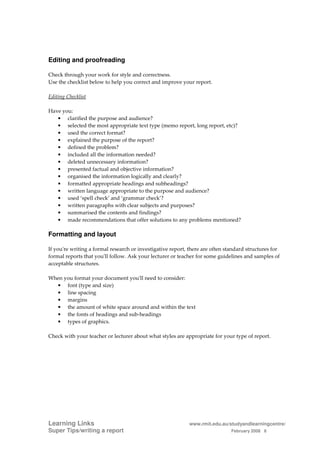
Editing and proofreading

Check through your work for style and correctness.
Use the checklist below to help you correct and improve your report.

Editing Checklist

Have you:
   • clarified the purpose and audience?
   • selected the most appropriate text type (memo report, long report, etc)?
   • used the correct format?
   • explained the purpose of the report?
   • defined the problem?
   • included all the information needed?
   • deleted unnecessary information?
   • presented factual and objective information?
   • organised the information logically and clearly?
   • formatted appropriate headings and subheadings?
   • written language appropriate to the purpose and audience?
   • used ‘spell check’ and ‘grammar check’?
   • written paragraphs with clear subjects and purposes?
   • summarised the contents and findings?
   • made recommendations that offer solutions to any problems mentioned?

Formatting and layout

If you're writing a formal research or investigative report, there are often standard structures for
formal reports that you'll follow. Ask your lecturer or teacher for some guidelines and samples of
acceptable structures.

When you format your document you'll need to consider:
  • font (type and size)
  • line spacing
  • margins
  • the amount of white space around and within the text
  • the fonts of headings and sub-headings
  • types of graphics.

Check with your teacher or lecturer about what styles are appropriate for your type of report.


Learning Links                                              www.rmit.edu.au/studyandlearningcentre/
Super Tips/writing a report                                                    February 2008 6
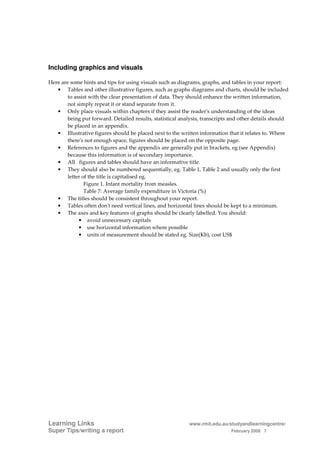
Including graphics and visuals

Here are some hints and tips for using visuals such as diagrams, graphs, and tables in your report:
   • Tables and other illustrative figures, such as graphs diagrams and charts, should be included
        to assist with the clear presentation of data. They should enhance the written information,
        not simply repeat it or stand separate from it.
   • Only place visuals within chapters if they assist the reader's understanding of the ideas
        being put forward. Detailed results, statistical analysis, transcripts and other details should
        be placed in an appendix.
   • Illustrative figures should be placed next to the written information that it relates to. Where
        there's not enough space, figures should be placed on the opposite page.
   • References to figures and the appendix are generally put in brackets, eg (see Appendix)
        because this information is of secondary importance.
   • All figures and tables should have an informative title.
   • They should also be numbered sequentially, eg. Table 1, Table 2 and usually only the first
        letter of the title is capitalised eg.
                Figure 1. Infant mortality from measles.
                Table 7: Average family expenditure in Victoria (%)
   • The titles should be consistent throughout your report.
   • Tables often don't need vertical lines, and horizontal lines should be kept to a minimum.
   • The axes and key features of graphs should be clearly labelled. You should:
             • avoid unnecessary capitals
             • use horizontal information where possible
             • units of measurement should be stated eg. Size(Kb), cost US$


Learning Links                                              www.rmit.edu.au/studyandlearningcentre/
Super Tips/writing a report                                                   February 2008 7
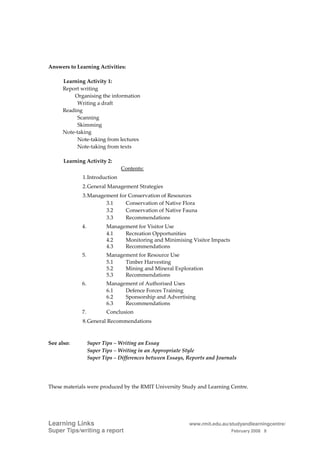
Answers to Learning Activities:

      Learning Activity 1:
      Report writing
          Organising the information
            Writing a draft
      Reading
            Scanning
            Skimming
      Note-taking
            Note-taking from lectures
            Note-taking from texts

      Learning Activity 2:
                               Contents:
             1. Introduction
             2. General Management Strategies
             3. Management for Conservation of Resources
                      3.1     Conservation of Native Flora
                      3.2     Conservation of Native Fauna
                      3.3     Recommendations
             4.          Management for Visitor Use
                         4.1   Recreation Opportunities
                         4.2   Monitoring and Minimising Visitor Impacts
                         4.3   Recommendations
             5.          Management for Resource Use
                         5.1   Timber Harvesting
                         5.2   Mining and Mineral Exploration
                         5.3   Recommendations
             6.          Management of Authorised Uses
                         6.1   Defence Forces Training
                         6.2   Sponsorship and Advertising
                         6.3   Recommendations
             7.          Conclusion
             8. General Recommendations


See also:         Super Tips – Writing an Essay
                  Super Tips – Writing in an Appropriate Style
                  Super Tips – Differences between Essays, Reports and Journals


These materials were produced by the RMIT University Study and Learning Centre.


Learning Links                                             www.rmit.edu.au/studyandlearningcentre/
Super Tips/writing a report                                                 February 2008 8

Super report

  • 1.
    Writing a Report Duringyour studies you may be required to research a particular area and produce a report. For instance, depending on your area of study, you might be asked to write a report on the performance characteristics of an aircraft engine, the classroom management practices of a teacher, the cost benefits of using a particular type of software in a company, etc. Some of the reasons we write reports are to: • inform • make proposals or recommendations for change • analyse and solve problems • present the findings of an investigation or project • record progress Your lecturer or teacher will usually provide you with the following information: • the topic or subject of the report • the required length and due date • a clear idea of its purpose and who will read it • the format headings to be used and their order. Steps in writing the report Writing your report is an ongoing process of writing and re-writing. Therefore, it's important to realise that you don't need to begin at the introduction and write until you get to the conclusion. Often the body is written first. Also, you're not expected to produce the perfect report the first time you put pen to paper – expect to have to redraft your report. A useful writing process for longer reports is to: • organise your information • write an outline • write a first draft • re-write to improve the draft • edit and proofread You'll also need to consider the presentation of the report, in particular: • format and layout • inclusion of graphics and visuals Organising the information and writing an outline For many students, the main difficulty in writing a report is to organise the information. By the time you’ve finished researching, you’ve often gathered an incredible amount of information. So, what do you do with this large pile of papers? You have to break down the information using headings and sub-headings, then decide upon a logical order. You need an overall plan, which will also keep you Learning Links www.rmit.edu.au/studyandlearningcentre/ Super Tips/writing a report February 2008 1
  • 2.
    on the subject.You’ll find some useful strategies for writing an outline in the Learning Links – Writing Essays, and Learning Links – Sample Essay resources. Here’s a sample outline: Topic: The Australian Wine Industry Today Introduction - why this report is written - what it will cover History - first vineyards in Australia - where/when/who - what they produced - quality of the wine - progress from then until now - very brief - per state/development of major areas - SA - NSW - Victoria - Tasmania - Western Australia Consumption of wine in the 1990s - comparison with other decades - by types of wine - popularity table - by areas - how the wine drinker profile has changed in recent times The export industry - early exporting - what ? - where? - response from overseas - exports trends in the 90s - what? - where? - how much? - trend chart The future of the industry - domestic markets - international markets - threats - opportunities - what is required of growers and government Because all good reports have the material organized into a logical order, here are two Learning Activities for you to practise this skill. Learning Links www.rmit.edu.au/studyandlearningcentre/ Super Tips/writing a report February 2008 2
  • 3.
    Learning Activity 1 You’ve been asked to write a report on skills and strategies you need to be a successful tertiary student. You’ve brainstormed and come up with these: taking notes from texts organizing the information reading report writing note-taking writing a draft scanning formatting taking notes from lectures skimming Now you need to organise this information into headings and sub-headings. When you’ve done it, check out the answer on the last page. (Hint: there are 3 headings). Learning Activity 2 This one’s a bit more difficult. As with the first activity, the idea is to organise the list into headings and sub-headings. This time, the list will become the contents page for a report outlining strategies for managing a national park. You might want to try a numbering system (see information below) with this one. When you’ve completed it, check out the answer on the last page. (Hint: There are 4 Recommendations sections as well as a General Recommendations, which means that there are at least 4 main sections in the body of the report). Defence Forces Training General Recommendations Introduction General Management Strategies Management for Conservation of Resources Recommendations Conservation of Native Fauna Recommendations Contents Management for Visitor Use Conclusion Monitoring and Minimising Visitor Impacts Recommendations Management for Resource Use Conservation of Native Flora Timber Harvesting Recommendations Recreation Opportunities Management of Authorised Uses Sponsorship and Advertising Mining and Mineral Exploration Learning Links www.rmit.edu.au/studyandlearningcentre/ Super Tips/writing a report February 2008 3
  • 4.
    Writing a firstdraft As with most other writing formats, reports should all have an introduction, a body and a conclusion. However, many reports may have all or some of the following sections (but note that your teacher or lecturer may want the report in a quite different structure – always check first): Title page, which includes: - the title of the report (avoid long titles) - student’s name and number - lecturer’s name - date of submission - Abstract or Summary: - is often written after the rest of the report is finished, but is usually read first - gives us the bare facts of the report including the findings and the conclusions - is typically very short - Table of contents if your report is longer than a few pages. This: - lists the sections and sub-sections and page numbers - provides a list of diagrams, tables and appendices (if used) Here is an example of a Table of Contents for a report entitled How to Lobby: Contents 1. Introduction 1 2. The lobbying campaign 2 2.1 Professional lobbyists 3 2.2 Petitions 5 2.3 Letters 7 2.4 Demonstrations 9 3. Forming a lobby group 12 3.1 Incorporated associations 14 3.2 Co-operatives 15 3.2.1 Objectives 16 3.2.2 Size 17 4. Using the media 18 4.1 The media release 20 4.2 Media conferences 22 5. Conclusion and Recommendations 25 Learning Links www.rmit.edu.au/studyandlearningcentre/ Super Tips/writing a report February 2008 4
  • 5.
    Introduction, which: - gives the background - explains the purpose, scope and methods used - outlines the terms of reference It should be a brief, accurate background for the body of the report The body, which covers the work done and what you found. It’s divided into topics which are arranged in a logical order with headings and sub-headings Conclusion covers the writer’s judgement based on information in the body of the report. Recommendations: - gives solutions to the problems - suggests possible courses of action as a result of the conclusions, eg - who should take action - what should be done - when and how it should be done Appendices contain evidence which supports the report but is not essential because it’s either too long or too technical for the audience. Bibliography includes all sources of information used in the report and often those used for background reading as well. (See Learning Links – Referencing for information about how to cite your sources, etc) Glossary is an alphabetical list of special words, phrases and terms used in the report, accompanied by a short explanation of each. These are common in technical reports. When you begin writing your report, you don't have to begin with the introduction and write until you reach the conclusion. In a report, it's often better to write parts of the body first, then the conclusions, and write the introduction last, when you're sure you know what you're introducing. Don’t expect to produce a perfect report the first time you write. It’s usually an on-going process of writing and re-writing. Here are some helpful hints: • Use a computer – even if you’re slow, it saves time in the end. • Write your first draft quickly to establish a ‘flow’. • Don’t stop to fix errors – do your editing and proofreading later • Use short, clear sentences – you can decide to join some of them in a later draft. • Use bullet point form for important information to make it easy for the reader. Learning Links www.rmit.edu.au/studyandlearningcentre/ Super Tips/writing a report February 2008 5
  • 6.
    Editing and proofreading Checkthrough your work for style and correctness. Use the checklist below to help you correct and improve your report. Editing Checklist Have you: • clarified the purpose and audience? • selected the most appropriate text type (memo report, long report, etc)? • used the correct format? • explained the purpose of the report? • defined the problem? • included all the information needed? • deleted unnecessary information? • presented factual and objective information? • organised the information logically and clearly? • formatted appropriate headings and subheadings? • written language appropriate to the purpose and audience? • used ‘spell check’ and ‘grammar check’? • written paragraphs with clear subjects and purposes? • summarised the contents and findings? • made recommendations that offer solutions to any problems mentioned? Formatting and layout If you're writing a formal research or investigative report, there are often standard structures for formal reports that you'll follow. Ask your lecturer or teacher for some guidelines and samples of acceptable structures. When you format your document you'll need to consider: • font (type and size) • line spacing • margins • the amount of white space around and within the text • the fonts of headings and sub-headings • types of graphics. Check with your teacher or lecturer about what styles are appropriate for your type of report. Learning Links www.rmit.edu.au/studyandlearningcentre/ Super Tips/writing a report February 2008 6
  • 7.
    Including graphics andvisuals Here are some hints and tips for using visuals such as diagrams, graphs, and tables in your report: • Tables and other illustrative figures, such as graphs diagrams and charts, should be included to assist with the clear presentation of data. They should enhance the written information, not simply repeat it or stand separate from it. • Only place visuals within chapters if they assist the reader's understanding of the ideas being put forward. Detailed results, statistical analysis, transcripts and other details should be placed in an appendix. • Illustrative figures should be placed next to the written information that it relates to. Where there's not enough space, figures should be placed on the opposite page. • References to figures and the appendix are generally put in brackets, eg (see Appendix) because this information is of secondary importance. • All figures and tables should have an informative title. • They should also be numbered sequentially, eg. Table 1, Table 2 and usually only the first letter of the title is capitalised eg. Figure 1. Infant mortality from measles. Table 7: Average family expenditure in Victoria (%) • The titles should be consistent throughout your report. • Tables often don't need vertical lines, and horizontal lines should be kept to a minimum. • The axes and key features of graphs should be clearly labelled. You should: • avoid unnecessary capitals • use horizontal information where possible • units of measurement should be stated eg. Size(Kb), cost US$ Learning Links www.rmit.edu.au/studyandlearningcentre/ Super Tips/writing a report February 2008 7
  • 8.
    Answers to LearningActivities: Learning Activity 1: Report writing Organising the information Writing a draft Reading Scanning Skimming Note-taking Note-taking from lectures Note-taking from texts Learning Activity 2: Contents: 1. Introduction 2. General Management Strategies 3. Management for Conservation of Resources 3.1 Conservation of Native Flora 3.2 Conservation of Native Fauna 3.3 Recommendations 4. Management for Visitor Use 4.1 Recreation Opportunities 4.2 Monitoring and Minimising Visitor Impacts 4.3 Recommendations 5. Management for Resource Use 5.1 Timber Harvesting 5.2 Mining and Mineral Exploration 5.3 Recommendations 6. Management of Authorised Uses 6.1 Defence Forces Training 6.2 Sponsorship and Advertising 6.3 Recommendations 7. Conclusion 8. General Recommendations See also: Super Tips – Writing an Essay Super Tips – Writing in an Appropriate Style Super Tips – Differences between Essays, Reports and Journals These materials were produced by the RMIT University Study and Learning Centre. Learning Links www.rmit.edu.au/studyandlearningcentre/ Super Tips/writing a report February 2008 8