How To Lecture Dr. Bryan Carter Associate Professor Department of English and Philosophy [email_address] AIM - bcrx7 MSN - bc69@graffiti (not for email) Yahoo - hannibal697 ICQ - 152347003 Skype - bcmini753 Second Life - Bryan Mnemonic
What Exactly “is” a Lecture? One of the many teaching processes Began with “literal reading of important passages of text by the master” Followed by the masterʻs interpretation of the text Frequently a one-way process unaccompanied by discussion, questioning or immediate practice
Why Do We Lecture? I teach as I was taught... To communicate pivotal content material An opportunity to emphasize important ideas An opportunity to present the most up-to-date information An opportunity to present a synthesis of diverse and related information from a variety of sources Provides a springboard for development of further understanding places a “human” face to the discipline
Benefits of the Lecture Opportunity to further explore the discipline Opportunity to develop articles for publication The chance to impart your knowledge to students Opportunity to perform, as many good lectures are also good performances
Characteristics of an Effective Lecture Educator-student interaction Two-way communication Educator-student questions Shared responsibility for active learning Small group, problem-solving activities Variety of supporting media
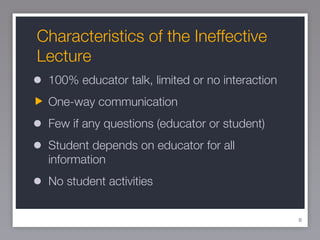
Characteristics of the Ineffective Lecture 100% educator talk, limited or no interaction One-way communication Few if any questions (educator or student) Student depends on educator for all information No student activities
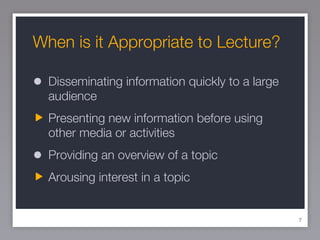
When is it Appropriate to Lecture? Disseminating information quickly to a large audience Presenting new information before using other media or activities Providing an overview of a topic Arousing interest in a topic
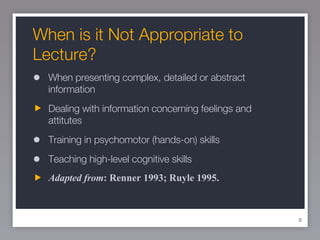
When is it Not Appropriate to Lecture? When presenting complex, detailed or abstract information Dealing with information concerning feelings and attitutes Training in psychomotor (hands-on) skills Teaching high-level cognitive skills Adapted from : Renner 1993; Ruyle 1995.
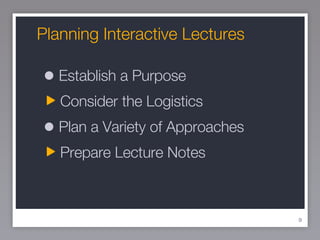
Planning Interactive Lectures  Establish a Purpose Consider the Logistics Plan a Variety of Approaches Prepare Lecture Notes
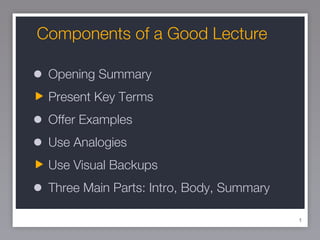
Components of a Good Lecture Opening Summary Present Key Terms Offer Examples Use Analogies Use Visual Backups Three Main Parts: Intro, Body, Summary
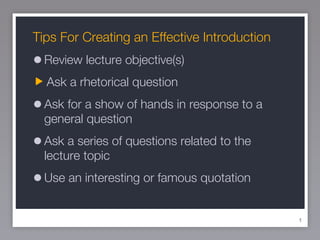
Tips For Creating an Effective Introduction Review lecture objective(s) Ask a rhetorical question Ask for a show of hands in response to a general question Ask a series of questions related to the lecture topic Use an interesting or famous quotation
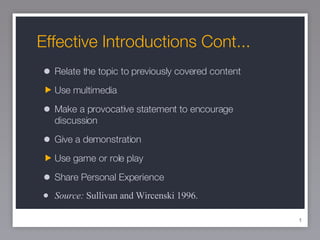
Effective Introductions Cont... Relate the topic to previously covered content Use multimedia Make a provocative statement to encourage discussion Give a demonstration Use game or role play Share Personal Experience Source:  Sullivan and Wircenski 1996.
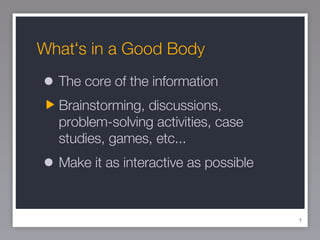
Whatʻs in a Good Body The core of the information Brainstorming, discussions, problem-solving activities, case studies, games, etc... Make it as interactive as possible
The Summary Brief and to the point Draw together critical information Ask for questions from students Ask students questions
How Important are  Lecture Notes? Serve as a script of sorts Cover main points Key words, phrases, reminders Use outline format, not a text They help you relax Source:  Sullivan and Wircenski 1996.
Presentation Counts Use your notes Capture attention immediately Communicate on a personal level Maintain eye contact
Presentation Cont... Exhibit enthusiasm Project your voice, speak clearly and slowly - Pause Avoid slang, fillers and repetitive movements/motions Ask questions Positive use of humor Smooth transitions between topics
Lecturing in Other Environments: Clear Communication is the Key Presentations, Lecturing, what’s the difference? Chat Rooms/Blackboard’s Lecture Hall Videoconferencing Instant Messaging Voice over IP (VoIP) - Skype, etc... Virtual Environments
References http://online.fsu.edu/learningresources/handbook/instructionatfsu/PDF-Chptr7.pdf http://www.flinders.edu.au/teach/teach/lecturing.htm http://www.crlt.umich.edu/tstrategies/tsllc.html http://www.cat.ilstu.edu/teaching_tips/lectures.shtml http://cte.umdnj.edu/traditional_teaching/traditional_lecture.cfm http://www.gmu.edu/facstaff/part-time/strategy.html http://www.oberlin.edu/cot/lecture.htm

How To Lecture

  • 1.
    How To LectureDr. Bryan Carter Associate Professor Department of English and Philosophy [email_address] AIM - bcrx7 MSN - bc69@graffiti (not for email) Yahoo - hannibal697 ICQ - 152347003 Skype - bcmini753 Second Life - Bryan Mnemonic
  • 2.
    What Exactly “is”a Lecture? One of the many teaching processes Began with “literal reading of important passages of text by the master” Followed by the masterʻs interpretation of the text Frequently a one-way process unaccompanied by discussion, questioning or immediate practice
  • 3.
    Why Do WeLecture? I teach as I was taught... To communicate pivotal content material An opportunity to emphasize important ideas An opportunity to present the most up-to-date information An opportunity to present a synthesis of diverse and related information from a variety of sources Provides a springboard for development of further understanding places a “human” face to the discipline
  • 4.
    Benefits of theLecture Opportunity to further explore the discipline Opportunity to develop articles for publication The chance to impart your knowledge to students Opportunity to perform, as many good lectures are also good performances
  • 5.
    Characteristics of anEffective Lecture Educator-student interaction Two-way communication Educator-student questions Shared responsibility for active learning Small group, problem-solving activities Variety of supporting media
  • 6.
    Characteristics of theIneffective Lecture 100% educator talk, limited or no interaction One-way communication Few if any questions (educator or student) Student depends on educator for all information No student activities
  • 7.
    When is itAppropriate to Lecture? Disseminating information quickly to a large audience Presenting new information before using other media or activities Providing an overview of a topic Arousing interest in a topic
  • 8.
    When is itNot Appropriate to Lecture? When presenting complex, detailed or abstract information Dealing with information concerning feelings and attitutes Training in psychomotor (hands-on) skills Teaching high-level cognitive skills Adapted from : Renner 1993; Ruyle 1995.
  • 9.
    Planning Interactive Lectures Establish a Purpose Consider the Logistics Plan a Variety of Approaches Prepare Lecture Notes
  • 10.
    Components of aGood Lecture Opening Summary Present Key Terms Offer Examples Use Analogies Use Visual Backups Three Main Parts: Intro, Body, Summary
  • 11.
    Tips For Creatingan Effective Introduction Review lecture objective(s) Ask a rhetorical question Ask for a show of hands in response to a general question Ask a series of questions related to the lecture topic Use an interesting or famous quotation
  • 12.
    Effective Introductions Cont...Relate the topic to previously covered content Use multimedia Make a provocative statement to encourage discussion Give a demonstration Use game or role play Share Personal Experience Source: Sullivan and Wircenski 1996.
  • 13.
    Whatʻs in aGood Body The core of the information Brainstorming, discussions, problem-solving activities, case studies, games, etc... Make it as interactive as possible
  • 14.
    The Summary Briefand to the point Draw together critical information Ask for questions from students Ask students questions
  • 15.
    How Important are Lecture Notes? Serve as a script of sorts Cover main points Key words, phrases, reminders Use outline format, not a text They help you relax Source: Sullivan and Wircenski 1996.
  • 16.
    Presentation Counts Useyour notes Capture attention immediately Communicate on a personal level Maintain eye contact
  • 17.
    Presentation Cont... Exhibitenthusiasm Project your voice, speak clearly and slowly - Pause Avoid slang, fillers and repetitive movements/motions Ask questions Positive use of humor Smooth transitions between topics
  • 18.
    Lecturing in OtherEnvironments: Clear Communication is the Key Presentations, Lecturing, what’s the difference? Chat Rooms/Blackboard’s Lecture Hall Videoconferencing Instant Messaging Voice over IP (VoIP) - Skype, etc... Virtual Environments
  • 19.
    References http://online.fsu.edu/learningresources/handbook/instructionatfsu/PDF-Chptr7.pdf http://www.flinders.edu.au/teach/teach/lecturing.htmhttp://www.crlt.umich.edu/tstrategies/tsllc.html http://www.cat.ilstu.edu/teaching_tips/lectures.shtml http://cte.umdnj.edu/traditional_teaching/traditional_lecture.cfm http://www.gmu.edu/facstaff/part-time/strategy.html http://www.oberlin.edu/cot/lecture.htm