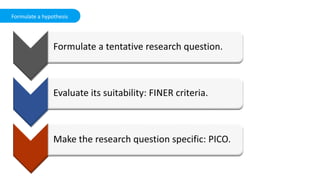
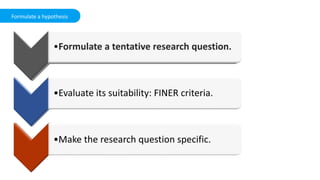
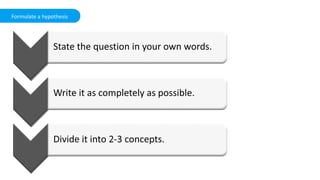
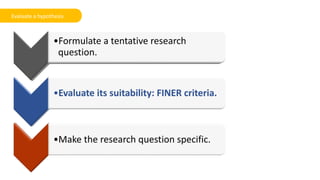
Formulate a hypothesis Evaluating a hypothesis Types of hypothesis Well formed hypothesis
How to form a
hypothesis?
Harsh Srivastava, Final Year MBBS
UPUMS, Saifai
UPUMS SCIENTIFIC SOCIETY
Session Objectives
To be able to-
•Form your own hypothesis.
•Evaluate the quality of a hypothesis.
•Understand various types of hypothesis.
•Identify a well formed hypothesis.
Learning obectives
Formulate a hypothesis
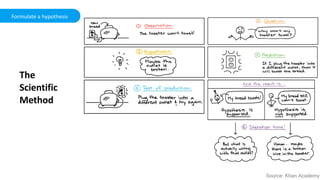
The
Scientific
Method
Source: Khan Academy
Formulate a hypothesis
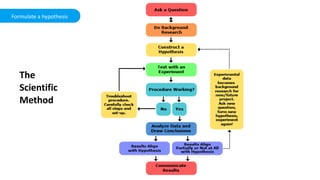
The
Scientific
Method
Formulate a hypothesis
What is a hypothesis?
•“Hypo”-less than; “thesis”- less certain than a thesis.
•It’s simply an educated guess about your research question.
•Tentative or working proposition suggested as a solution to a
problem or to identify the unknown, based on available evidence,
which the researcher seeks to prove through his study via empirical
methods.
Formulate a hypothesis
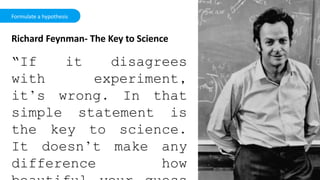
Richard Feynman- The Key to Science
“If it disagrees
with experiment,
it’s wrong. In that
simple statement is
the key to science.
It doesn’t make any
difference how
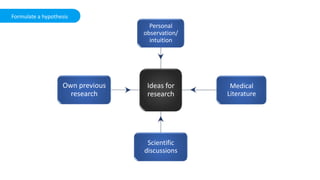
Ideas for
research
Personal
observation/
intuition
Medical
Literature
Scientific
discussions
Own previous
research
Formulate a hypothesis
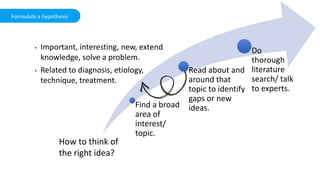
Find a broad
area of
interest/
topic.
Read about and
around that
topic to identify
gaps or new
ideas.
Do
thorough
literature
search/ talk
to experts.
How to think of
the right idea?
• Related to diagnosis, etiology,
technique, treatment.
• Important, interesting, new, extend
knowledge, solve a problem.
Formulate a hypothesis
Evaluate a hypothesis
Formulate a hypothesis
Example
Formulate a hypothesis
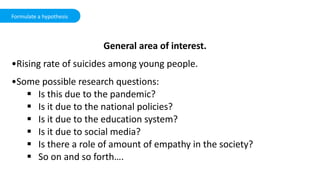
General area of interest.
•Rising rate of suicides among young people.
•Some possible research questions:
 Is this due to the pandemic?
 Is it due to the national policies?
 Is it due to the education system?
 Is it due to social media?
 Is there a role of amount of empathy in the society?
 So on and so forth….
Formulate a hypothesis
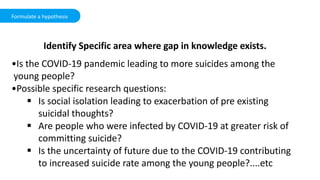
Identify Specific area where gap in knowledge exists.
•Is the COVID-19 pandemic leading to more suicides among the
young people?
•Possible specific research questions:
 Is social isolation leading to exacerbation of pre existing
suicidal thoughts?
 Are people who were infected by COVID-19 at greater risk of
committing suicide?
 Is the uncertainty of future due to the COVID-19 contributing
to increased suicide rate among the young people?....etc
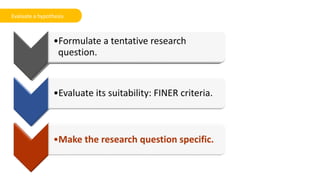
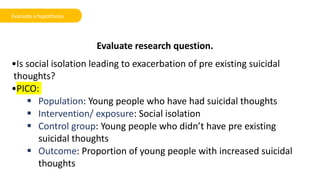
Evaluate research question.
•Is social isolation leading to exacerbation of pre existing suicidal
thoughts?
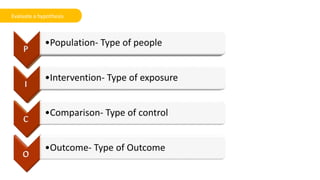
•PICO:
 Population: Young people who have had suicidal thoughts
 Intervention/ exposure: Social isolation
 Control group: Young people who didn’t have pre existing
suicidal thoughts
 Outcome: Proportion of young people with increased suicidal
thoughts
Evaluate a hypothesis
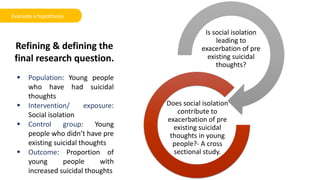
Refining & defining the
final research question.
Is social isolation
leading to
exacerbation of pre
existing suicidal
thoughts?
Does social isolation
contribute to
exacerbation of pre
existing suicidal
thoughts in young
people?- A cross
sectional study.
 Population: Young people
who have had suicidal
thoughts
 Intervention/ exposure:
Social isolation
 Control group: Young
people who didn’t have pre
existing suicidal thoughts
 Outcome: Proportion of
young people with
increased suicidal thoughts
Evaluate a hypothesis
Refining & defining the
final research question.
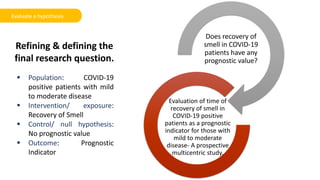
Does recovery of
smell in COVID-19
patients have any
prognostic value?
Evaluation of time of
recovery of smell in
COVID-19 positive
patients as a prognostic
indicator for those with
mild to moderate
disease- A prospective
multicentric study.
 Population: COVID-19
positive patients with mild
to moderate disease
 Intervention/ exposure:
Recovery of Smell
 Control/ null hypothesis:
No prognostic value
 Outcome: Prognostic
Indicator
Evaluate a hypothesis
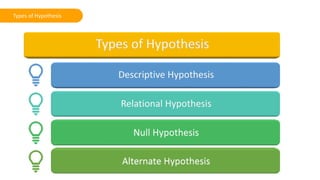
Types of Hypothesis
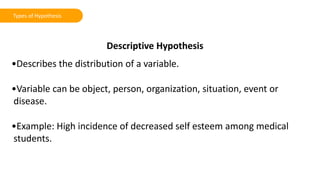
Descriptive Hypothesis
•Describes the distribution of a variable.
•Variable can be object, person, organization, situation, event or
disease.
•Example: High incidence of decreased self esteem among medical
students.
Types of Hypothesis
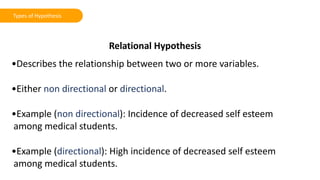
Relational Hypothesis
•Describes the relationship between two or more variables.
•Either non directional or directional.
•Example (non directional): Incidence of decreased self esteem
among medical students.
•Example (directional): High incidence of decreased self esteem
among medical students.
Types of Hypothesis
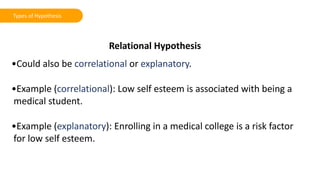
Relational Hypothesis
•Could also be correlational or explanatory.
•Example (correlational): Low self esteem is associated with being a
medical student.
•Example (explanatory): Enrolling in a medical college is a risk factor
for low self esteem.
Types of Hypothesis
Types of Hypothesis
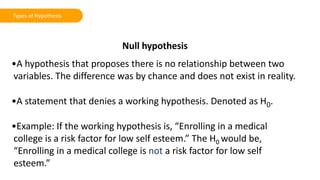
Null hypothesis
•A hypothesis that proposes there is no relationship between two
variables. The difference was by chance and does not exist in reality.
•A statement that denies a working hypothesis. Denoted as H0.
•Example: If the working hypothesis is, “Enrolling in a medical
college is a risk factor for low self esteem.” The H0 would be,
“Enrolling in a medical college is not a risk factor for low self
esteem.”
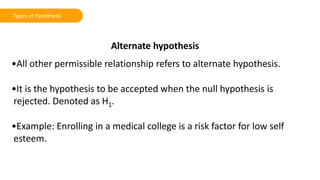
Alternate hypothesis
•All other permissible relationship refers to alternate hypothesis.
•It is the hypothesis to be accepted when the null hypothesis is
rejected. Denoted as H1.
•Example: Enrolling in a medical college is a risk factor for low self
esteem.
Types of Hypothesis
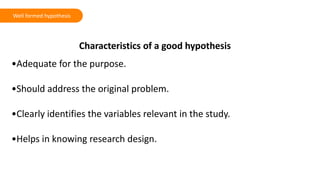
Characteristics of a good hypothesis
•Adequate for the purpose.
•Should address the original problem.
•Clearly identifies the variables relevant in the study.
•Helps in knowing research design.
Well formed hypothesis
Characteristics of a good hypothesis.
•Testable.
•Uses available and acceptable techniques.
•Explanation can be given from theoretical framework.
•Simple, not too complex.
Well formed hypothesis
Thank you!

How to form a hypothesis?

  • 1.
    Formulate a hypothesisEvaluating a hypothesis Types of hypothesis Well formed hypothesis How to form a hypothesis? Harsh Srivastava, Final Year MBBS UPUMS, Saifai UPUMS SCIENTIFIC SOCIETY
  • 2.
    Session Objectives To beable to- •Form your own hypothesis. •Evaluate the quality of a hypothesis. •Understand various types of hypothesis. •Identify a well formed hypothesis. Learning obectives
  • 3.
  • 4.
  • 5.
    Formulate a hypothesis Whatis a hypothesis? •“Hypo”-less than; “thesis”- less certain than a thesis. •It’s simply an educated guess about your research question. •Tentative or working proposition suggested as a solution to a problem or to identify the unknown, based on available evidence, which the researcher seeks to prove through his study via empirical methods.
  • 6.
    Formulate a hypothesis RichardFeynman- The Key to Science “If it disagrees with experiment, it’s wrong. In that simple statement is the key to science. It doesn’t make any difference how
  • 7.
  • 8.
    Formulate a hypothesis Finda broad area of interest/ topic. Read about and around that topic to identify gaps or new ideas. Do thorough literature search/ talk to experts. How to think of the right idea? • Related to diagnosis, etiology, technique, treatment. • Important, interesting, new, extend knowledge, solve a problem.
  • 9.
  • 10.
  • 11.
  • 12.
  • 13.
  • 14.
  • 15.
  • 16.
  • 17.
    Formulate a hypothesis Generalarea of interest. •Rising rate of suicides among young people. •Some possible research questions:  Is this due to the pandemic?  Is it due to the national policies?  Is it due to the education system?  Is it due to social media?  Is there a role of amount of empathy in the society?  So on and so forth….
  • 18.
    Formulate a hypothesis IdentifySpecific area where gap in knowledge exists. •Is the COVID-19 pandemic leading to more suicides among the young people? •Possible specific research questions:  Is social isolation leading to exacerbation of pre existing suicidal thoughts?  Are people who were infected by COVID-19 at greater risk of committing suicide?  Is the uncertainty of future due to the COVID-19 contributing to increased suicide rate among the young people?....etc
  • 19.
    Evaluate research question. •Issocial isolation leading to exacerbation of pre existing suicidal thoughts? •PICO:  Population: Young people who have had suicidal thoughts  Intervention/ exposure: Social isolation  Control group: Young people who didn’t have pre existing suicidal thoughts  Outcome: Proportion of young people with increased suicidal thoughts Evaluate a hypothesis
  • 20.
    Refining & definingthe final research question. Is social isolation leading to exacerbation of pre existing suicidal thoughts? Does social isolation contribute to exacerbation of pre existing suicidal thoughts in young people?- A cross sectional study.  Population: Young people who have had suicidal thoughts  Intervention/ exposure: Social isolation  Control group: Young people who didn’t have pre existing suicidal thoughts  Outcome: Proportion of young people with increased suicidal thoughts Evaluate a hypothesis
  • 21.
    Refining & definingthe final research question. Does recovery of smell in COVID-19 patients have any prognostic value? Evaluation of time of recovery of smell in COVID-19 positive patients as a prognostic indicator for those with mild to moderate disease- A prospective multicentric study.  Population: COVID-19 positive patients with mild to moderate disease  Intervention/ exposure: Recovery of Smell  Control/ null hypothesis: No prognostic value  Outcome: Prognostic Indicator Evaluate a hypothesis
  • 22.
  • 23.
    Descriptive Hypothesis •Describes thedistribution of a variable. •Variable can be object, person, organization, situation, event or disease. •Example: High incidence of decreased self esteem among medical students. Types of Hypothesis
  • 24.
    Relational Hypothesis •Describes therelationship between two or more variables. •Either non directional or directional. •Example (non directional): Incidence of decreased self esteem among medical students. •Example (directional): High incidence of decreased self esteem among medical students. Types of Hypothesis
  • 25.
    Relational Hypothesis •Could alsobe correlational or explanatory. •Example (correlational): Low self esteem is associated with being a medical student. •Example (explanatory): Enrolling in a medical college is a risk factor for low self esteem. Types of Hypothesis
  • 26.
    Types of Hypothesis Nullhypothesis •A hypothesis that proposes there is no relationship between two variables. The difference was by chance and does not exist in reality. •A statement that denies a working hypothesis. Denoted as H0. •Example: If the working hypothesis is, “Enrolling in a medical college is a risk factor for low self esteem.” The H0 would be, “Enrolling in a medical college is not a risk factor for low self esteem.”
  • 27.
    Alternate hypothesis •All otherpermissible relationship refers to alternate hypothesis. •It is the hypothesis to be accepted when the null hypothesis is rejected. Denoted as H1. •Example: Enrolling in a medical college is a risk factor for low self esteem. Types of Hypothesis
  • 28.
    Characteristics of agood hypothesis •Adequate for the purpose. •Should address the original problem. •Clearly identifies the variables relevant in the study. •Helps in knowing research design. Well formed hypothesis
  • 29.
    Characteristics of agood hypothesis. •Testable. •Uses available and acceptable techniques. •Explanation can be given from theoretical framework. •Simple, not too complex. Well formed hypothesis
  • 30.

Editor's Notes

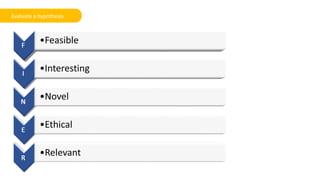
  • #14 Is my RQ measurable? What type of information do I need? Can I find actual data to support or contradict a position? Is my RQ researchable… …within the time frame of the assignment? …given the resources available at my location? Is my RQ something that I am curious about and that others might care about? Does my RQ put a new spin on an old issue, or does it try to solve a problem? Is my RQ too broad, too narrow, or OK? Is it ethical?