HYPOTHESIS AND ITSIMPORTANCE
NAME- SHUBHASHIS MONDAL
STUDENT CODE- BWU/BRI/22/117
PROGRAM NAME- BMRIT
COURSE NAME- RESEARCH METHODOLOGY
COURSE CODE- BMRITC606
2.
Introduction of Hypothesis
Hypothesisare define as the formal statement of the
tentative or expected prediction or explanation of the
relationship between two or more variable under study.
A hypothesis in medical research helps to translate the
research problem and objective into a clear explanation or
prediction of the expected result or out come of the study.
Ex: Students who receive counselling will show a greater
increase in creativity than students not receiving counselling
3.
Types of hypothesis
Differenttypes of hypotheses:
Simple hypothesis.
Complex hypothesis.
Null hypothesis.
Alternative hypothesis
4.
Simple hypothesis
• Asimple hypothesis predicts a relationship between one
independent variable (IV) and one dependent variable (DV)
Ex: Administering 500 mg of paracetamol reduces body temperature in
patients with fever.
Ex: smoking leads to cancers.
• The higher ratio of unemployment lead to crime.
5.
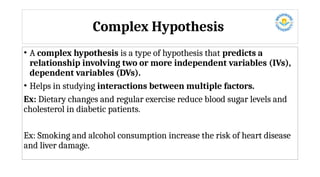
Complex Hypothesis
• Acomplex hypothesis is a type of hypothesis that predicts a
relationship involving two or more independent variables (IVs),
dependent variables (DVs).
• Helps in studying interactions between multiple factors.
Ex: Dietary changes and regular exercise reduce blood sugar levels and
cholesterol in diabetic patients.
Ex: Smoking and alcohol consumption increase the risk of heart disease
and liver damage.
6.
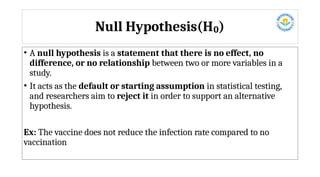
Null Hypothesis(H )
₀
•A null hypothesis is a statement that there is no effect, no
difference, or no relationship between two or more variables in a
study.
• It acts as the default or starting assumption in statistical testing,
and researchers aim to reject it in order to support an alternative
hypothesis.
Ex: The vaccine does not reduce the infection rate compared to no
vaccination
7.
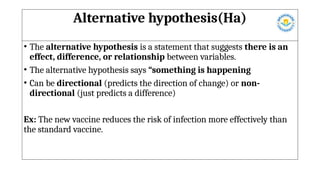
Alternative hypothesis(Ha)
• Thealternative hypothesis is a statement that suggests there is an
effect, difference, or relationship between variables.
• The alternative hypothesis says “something is happening
• Can be directional (predicts the direction of change) or non-
directional (just predicts a difference)
Ex: The new vaccine reduces the risk of infection more effectively than
the standard vaccine.
8.
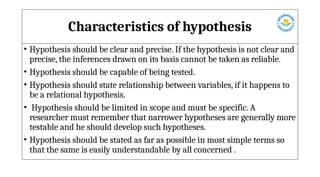
Characteristics of hypothesis
•Hypothesis should be clear and precise. If the hypothesis is not clear and
precise, the inferences drawn on its basis cannot be taken as reliable.
• Hypothesis should be capable of being tested.
• Hypothesis should state relationship between variables, if it happens to
be a relational hypothesis.
• Hypothesis should be limited in scope and must be specific. A
researcher must remember that narrower hypotheses are generally more
testable and he should develop such hypotheses.
• Hypothesis should be stated as far as possible in most simple terms so
that the same is easily understandable by all concerned .
9.
Important of hypothesis
•It gives the study a clear direction and focus.
• identify what the researcher aims to investigate or prove
• In applied fields like medicine or policy-making, it guides practical
decisions
• Encourages follow-up studies and in-depth exploration
• Reduces the chance of irrelevant findings or bias
• Keeps the researcher from straying off-topic or collecting
unnecessary data.