© Fraunhofer Institute for Intelligent Analysis and Information Systems IAIS
© University of Bonn
Research Careers
in Applied Computer Science
Dr. Christoph Lange, University of Bonn and Fraunhofer IAIS
2016-12-13, Saint-Étienne
© Christoph Lange 2016
Fraunhofer Institute for Intelligent Analysis and Information Systems IAIS & University of Bonn
Perspectives with a Master‘s Degree and Beyond
2
Practice
Master
Research
Icons: made by Gregor Cesnar and Freepik from www.flaticon.com
© Christoph Lange 2016
Fraunhofer Institute for Intelligent Analysis and Information Systems IAIS & University of Bonn
Perspectives with a Master‘s Degree and Beyond
2
Practice
Master
Research
Where do you
see yourselves?
Icons: made by Gregor Cesnar and Freepik from www.flaticon.com
© Christoph Lange 2016
Fraunhofer Institute for Intelligent Analysis and Information Systems IAIS & University of Bonn
Perspectives with a Master‘s Degree and Beyond
2
Practice
Practice:
 Company /
start-up / public
service
 Self-employed
Master
Research
Research:
 University
 Research
institute
 Company
Where do you
see yourselves?
Icons: made by Gregor Cesnar and Freepik from www.flaticon.com
© Christoph Lange 2016
Fraunhofer Institute for Intelligent Analysis and Information Systems IAIS & University of Bonn
Perspectives with a Master‘s Degree and Beyond
2
Practice
Practice:
 Company /
start-up / public
service
 Self-employed
Master
Research
Research:
 University
 Research
institute
 Company
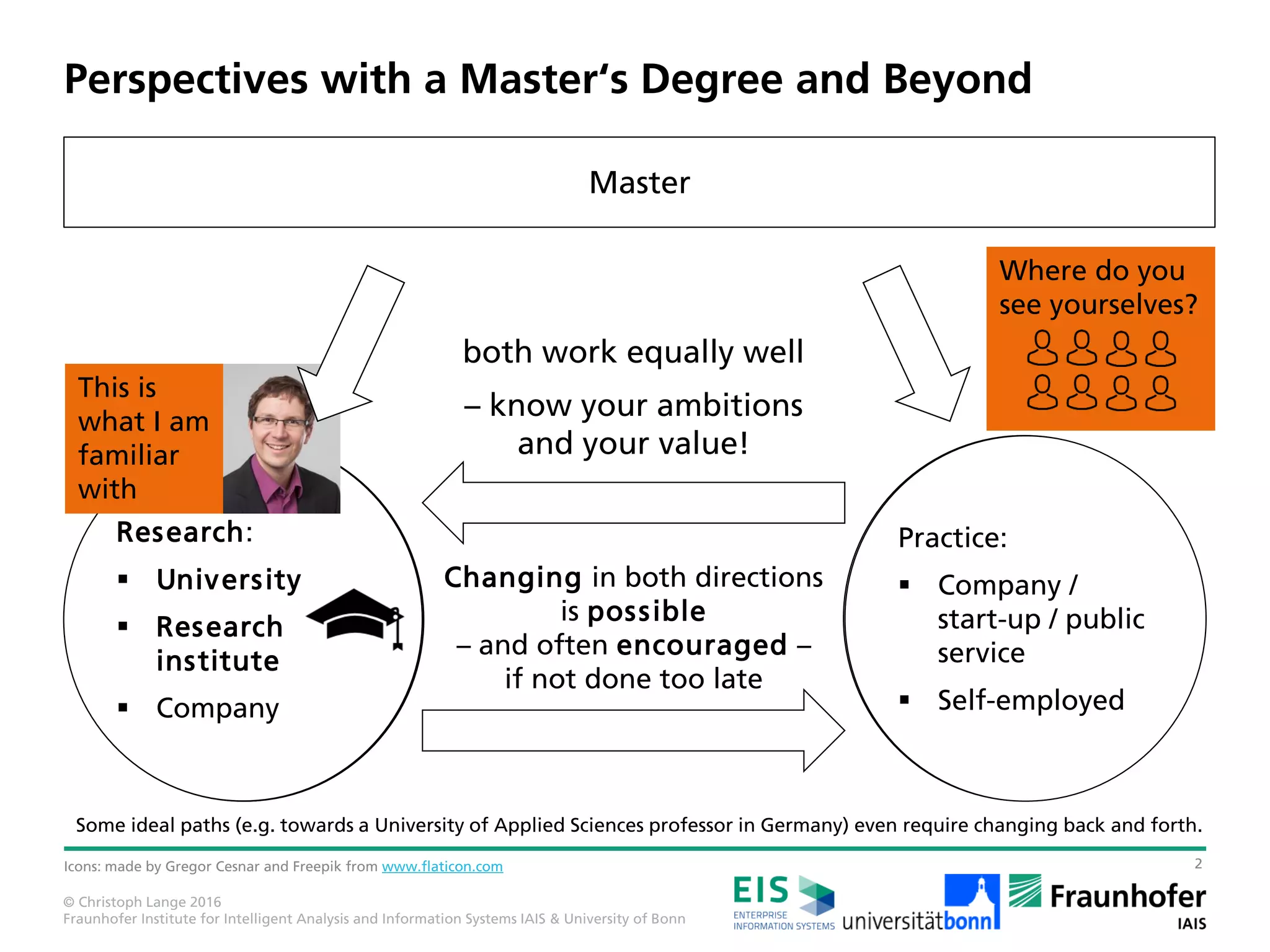
Changing in both directions
is possible
– and often encouraged –
if not done too late
both work equally well
– know your ambitions
and your value!
Some ideal paths (e.g. towards a University of Applied Sciences professor in Germany) even require changing back and forth.
Where do you
see yourselves?
Icons: made by Gregor Cesnar and Freepik from www.flaticon.com
© Christoph Lange 2016
Fraunhofer Institute for Intelligent Analysis and Information Systems IAIS & University of Bonn
Perspectives with a Master‘s Degree and Beyond
2
Practice
Practice:
 Company /
start-up / public
service
 Self-employed
Master
Research
Research:
 University
 Research
institute
 Company
Changing in both directions
is possible
– and often encouraged –
if not done too late
both work equally well
– know your ambitions
and your value!
Some ideal paths (e.g. towards a University of Applied Sciences professor in Germany) even require changing back and forth.
Research:
 University
 Research
institute
 Company
This is
what I am
familiar
with
Where do you
see yourselves?
Icons: made by Gregor Cesnar and Freepik from www.flaticon.com
© Christoph Lange 2016
Fraunhofer Institute for Intelligent Analysis and Information Systems IAIS & University of Bonn
Structure of a Research Project
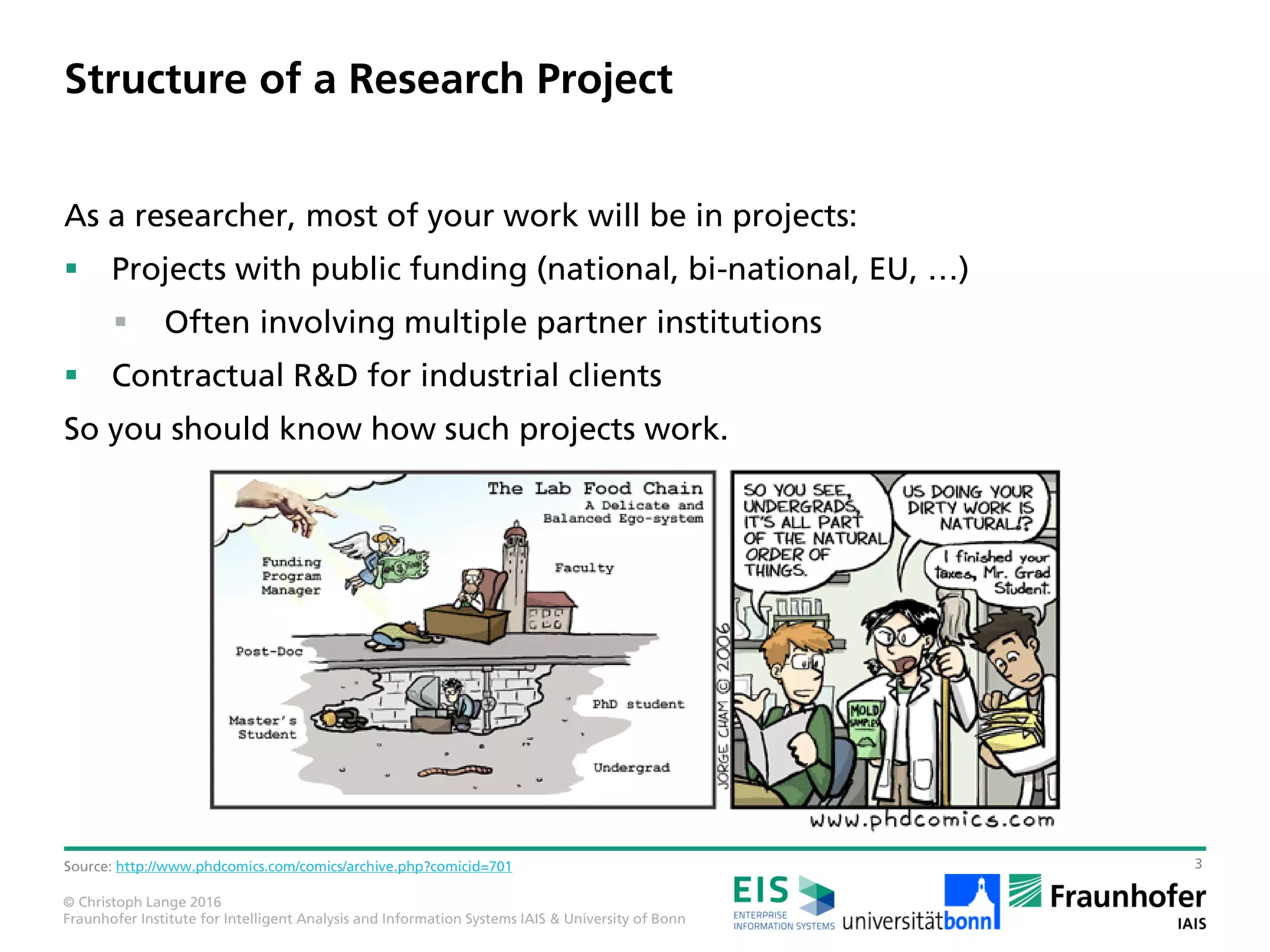
As a researcher, most of your work will be in projects:
 Projects with public funding (national, bi-national, EU, …)
 Often involving multiple partner institutions
 Contractual R&D for industrial clients
So you should know how such projects work.
3Source: http://www.phdcomics.com/comics/archive.php?comicid=701
© Christoph Lange 2016
Fraunhofer Institute for Intelligent Analysis and Information Systems IAIS & University of Bonn
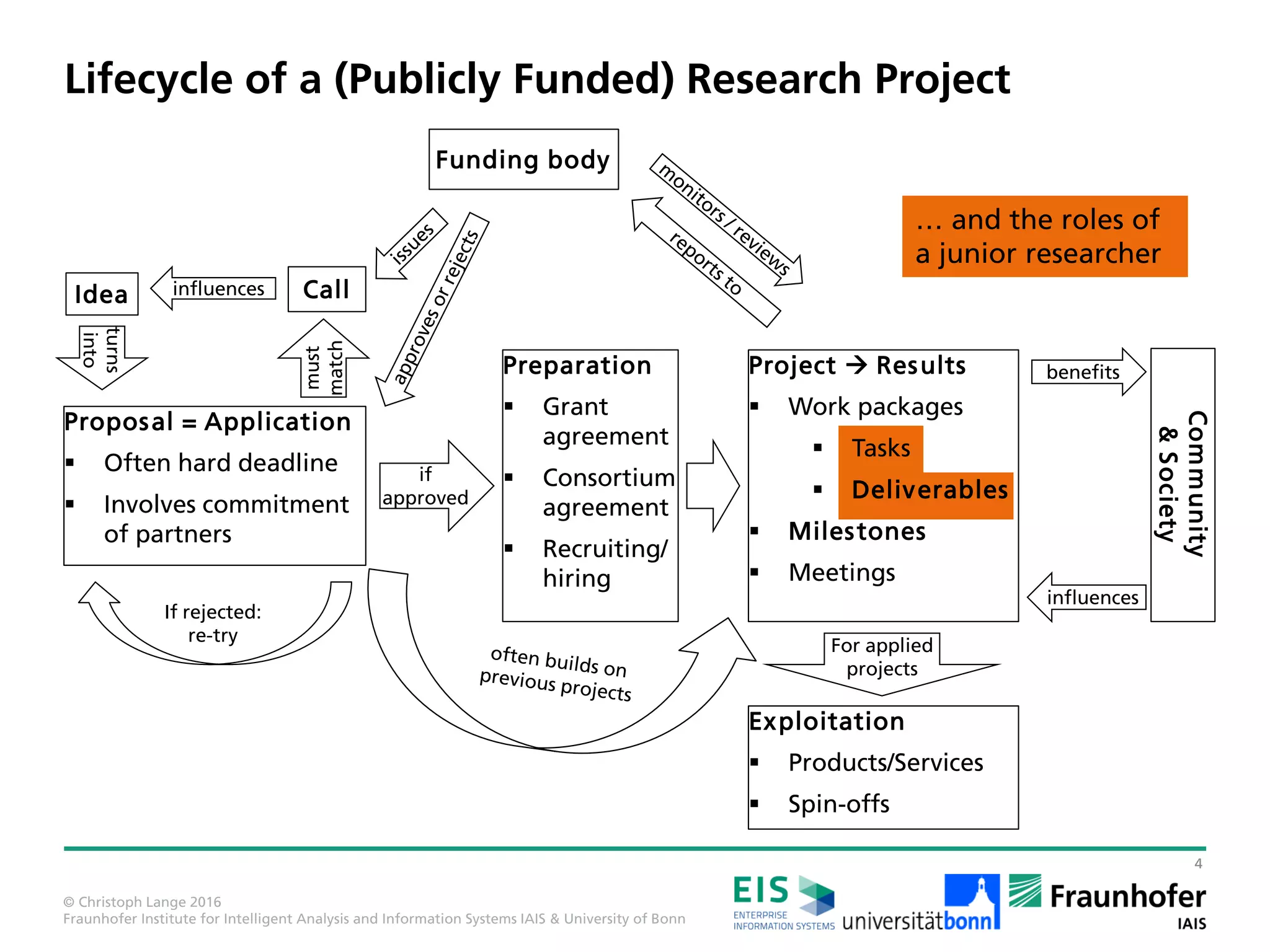
Lifecycle of a (Publicly Funded) Research Project
4
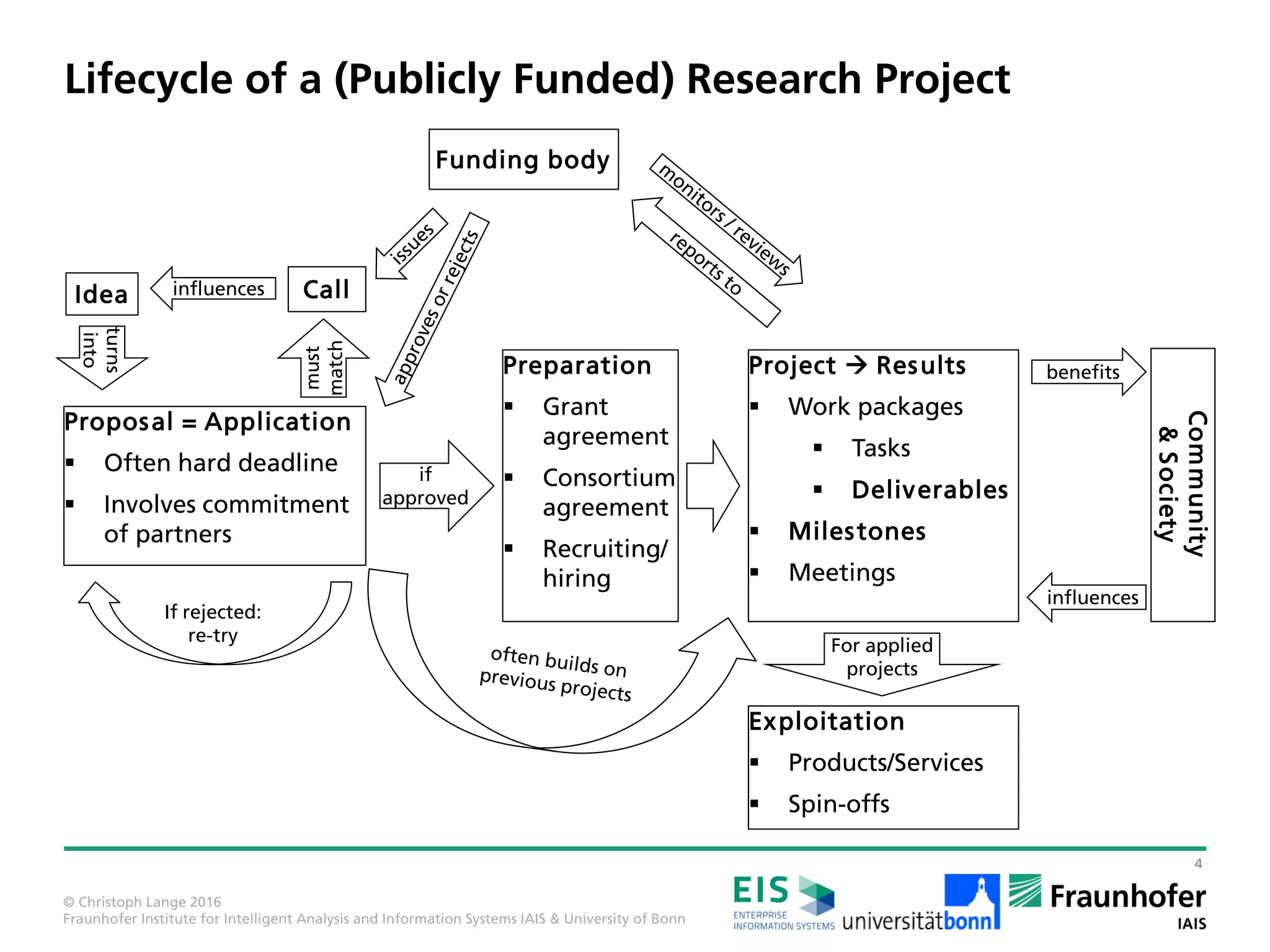
Idea
Proposal = Application
 Often hard deadline
 Involves commitment
of partners
Preparation
 Grant
agreement
 Consortium
agreement
 Recruiting/
hiring
Funding body
Project  Results
 Work packages
 Tasks
 Deliverables
 Milestones
 Meetings
Call
influences
influences
turns
into
if
approved
If rejected:
re-try
For applied
projects
Exploitation
 Products/Services
 Spin-offs
must
match
Community
&Society
benefits
© Christoph Lange 2016
Fraunhofer Institute for Intelligent Analysis and Information Systems IAIS & University of Bonn
Lifecycle of a (Publicly Funded) Research Project
4
Idea
Proposal = Application
 Often hard deadline
 Involves commitment
of partners
Preparation
 Grant
agreement
 Consortium
agreement
 Recruiting/
hiring
Funding body
Project  Results
 Work packages
 Tasks
 Deliverables
 Milestones
 Meetings
Call
influences
influences
turns
into
if
approved
If rejected:
re-try
For applied
projects
Exploitation
 Products/Services
 Spin-offs
must
match
Community
&Society
benefits
… and the roles of
a junior researcher
© Christoph Lange 2016
Fraunhofer Institute for Intelligent Analysis and Information Systems IAIS & University of Bonn
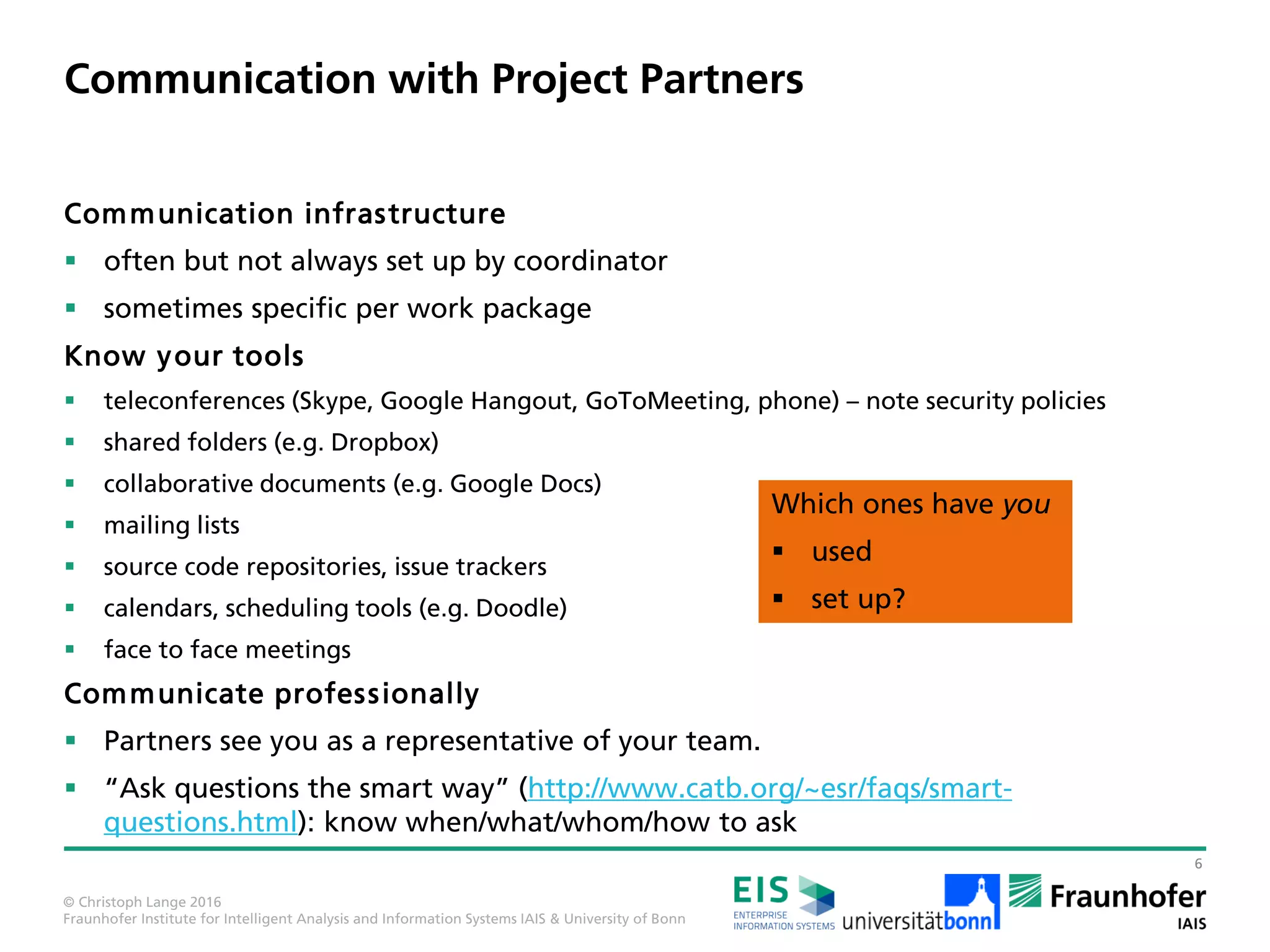
Communication with Project Partners
Communication infrastructure
 often but not always set up by coordinator
 sometimes specific per work package
Know your tools
 teleconferences (Skype, Google Hangout, GoToMeeting, phone) – note security policies
 shared folders (e.g. Dropbox)
 collaborative documents (e.g. Google Docs)
 mailing lists
 source code repositories, issue trackers
 calendars, scheduling tools (e.g. Doodle)
 face to face meetings
Communicate professionally
 Partners see you as a representative of your team.
 “Ask questions the smart way” (http://www.catb.org/~esr/faqs/smart-
questions.html): know when/what/whom/how to ask
6
© Christoph Lange 2016
Fraunhofer Institute for Intelligent Analysis and Information Systems IAIS & University of Bonn
Communication with Project Partners
Communication infrastructure
 often but not always set up by coordinator
 sometimes specific per work package
Know your tools
 teleconferences (Skype, Google Hangout, GoToMeeting, phone) – note security policies
 shared folders (e.g. Dropbox)
 collaborative documents (e.g. Google Docs)
 mailing lists
 source code repositories, issue trackers
 calendars, scheduling tools (e.g. Doodle)
 face to face meetings
Communicate professionally
 Partners see you as a representative of your team.
 “Ask questions the smart way” (http://www.catb.org/~esr/faqs/smart-
questions.html): know when/what/whom/how to ask
6
Which ones have you
 used
 set up?
© Christoph Lange 2016
Fraunhofer Institute for Intelligent Analysis and Information Systems IAIS & University of Bonn
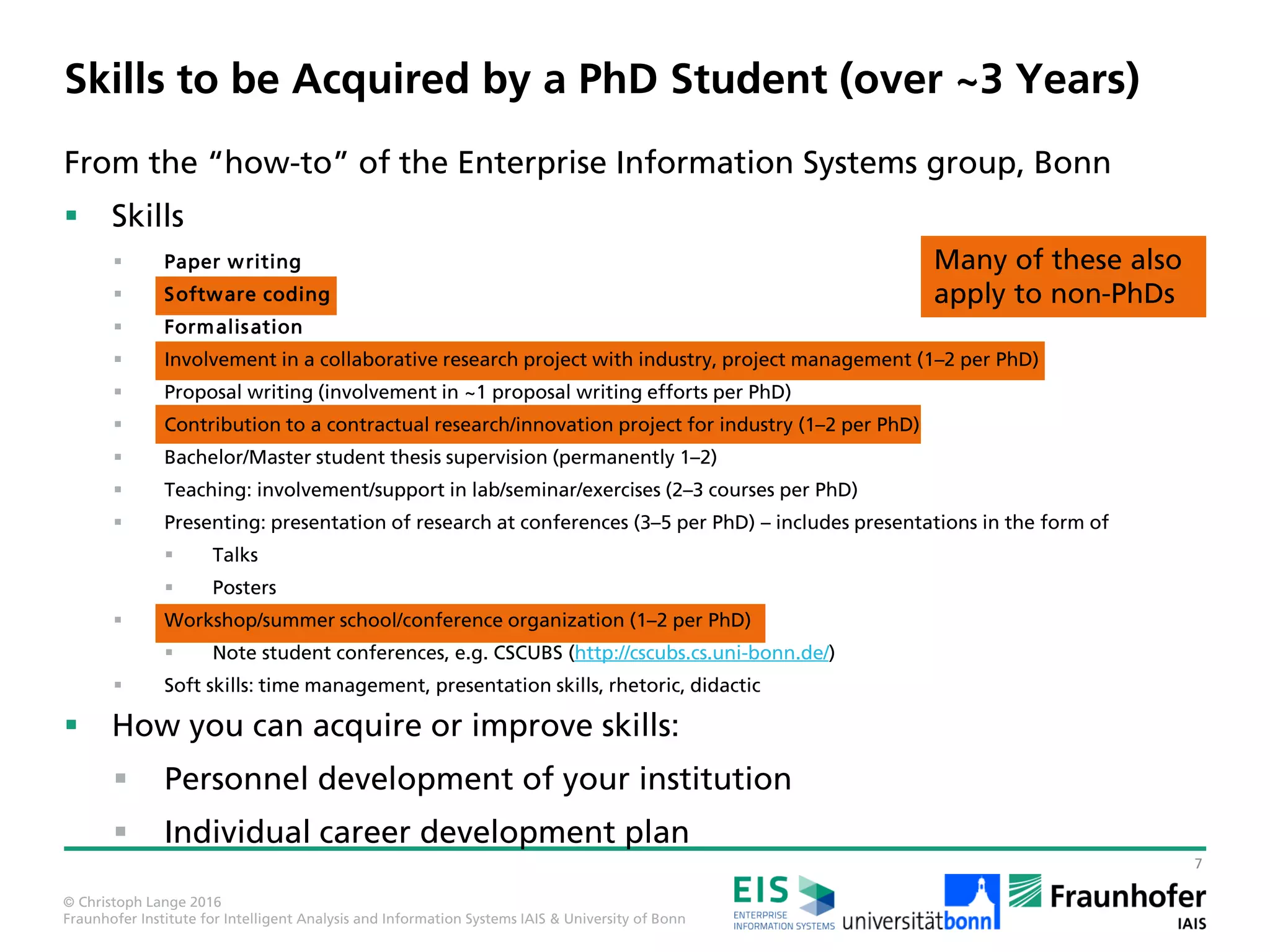
Skills to be Acquired by a PhD Student (over ~3 Years)
From the “how-to” of the Enterprise Information Systems group, Bonn
 Skills
 Paper writing
 Software coding
 Formalisation
 Involvement in a collaborative research project with industry, project management (1–2 per PhD)
 Proposal writing (involvement in ~1 proposal writing efforts per PhD)
 Contribution to a contractual research/innovation project for industry (1–2 per PhD)
 Bachelor/Master student thesis supervision (permanently 1–2)
 Teaching: involvement/support in lab/seminar/exercises (2–3 courses per PhD)
 Presenting: presentation of research at conferences (3–5 per PhD) – includes presentations in the form of
 Talks
 Posters
 Workshop/summer school/conference organization (1–2 per PhD)
 Note student conferences, e.g. CSCUBS (http://cscubs.cs.uni-bonn.de/)
 Soft skills: time management, presentation skills, rhetoric, didactic
 How you can acquire or improve skills:
 Personnel development of your institution
 Individual career development plan
7
© Christoph Lange 2016
Fraunhofer Institute for Intelligent Analysis and Information Systems IAIS & University of Bonn
Skills to be Acquired by a PhD Student (over ~3 Years)
From the “how-to” of the Enterprise Information Systems group, Bonn
 Skills
 Paper writing
 Software coding
 Formalisation
 Involvement in a collaborative research project with industry, project management (1–2 per PhD)
 Proposal writing (involvement in ~1 proposal writing efforts per PhD)
 Contribution to a contractual research/innovation project for industry (1–2 per PhD)
 Bachelor/Master student thesis supervision (permanently 1–2)
 Teaching: involvement/support in lab/seminar/exercises (2–3 courses per PhD)
 Presenting: presentation of research at conferences (3–5 per PhD) – includes presentations in the form of
 Talks
 Posters
 Workshop/summer school/conference organization (1–2 per PhD)
 Note student conferences, e.g. CSCUBS (http://cscubs.cs.uni-bonn.de/)
 Soft skills: time management, presentation skills, rhetoric, didactic
 How you can acquire or improve skills:
 Personnel development of your institution
 Individual career development plan
7
Many of these also
apply to non-PhDs

Research Careers in Applied Computer Science

  • 1.
    © Fraunhofer Institutefor Intelligent Analysis and Information Systems IAIS © University of Bonn Research Careers in Applied Computer Science Dr. Christoph Lange, University of Bonn and Fraunhofer IAIS 2016-12-13, Saint-Étienne
  • 2.
    © Christoph Lange2016 Fraunhofer Institute for Intelligent Analysis and Information Systems IAIS & University of Bonn Perspectives with a Master‘s Degree and Beyond 2 Practice Master Research Icons: made by Gregor Cesnar and Freepik from www.flaticon.com
  • 3.
    © Christoph Lange2016 Fraunhofer Institute for Intelligent Analysis and Information Systems IAIS & University of Bonn Perspectives with a Master‘s Degree and Beyond 2 Practice Master Research Where do you see yourselves? Icons: made by Gregor Cesnar and Freepik from www.flaticon.com
  • 4.
    © Christoph Lange2016 Fraunhofer Institute for Intelligent Analysis and Information Systems IAIS & University of Bonn Perspectives with a Master‘s Degree and Beyond 2 Practice Practice:  Company / start-up / public service  Self-employed Master Research Research:  University  Research institute  Company Where do you see yourselves? Icons: made by Gregor Cesnar and Freepik from www.flaticon.com
  • 5.
    © Christoph Lange2016 Fraunhofer Institute for Intelligent Analysis and Information Systems IAIS & University of Bonn Perspectives with a Master‘s Degree and Beyond 2 Practice Practice:  Company / start-up / public service  Self-employed Master Research Research:  University  Research institute  Company Changing in both directions is possible – and often encouraged – if not done too late both work equally well – know your ambitions and your value! Some ideal paths (e.g. towards a University of Applied Sciences professor in Germany) even require changing back and forth. Where do you see yourselves? Icons: made by Gregor Cesnar and Freepik from www.flaticon.com
  • 6.
    © Christoph Lange2016 Fraunhofer Institute for Intelligent Analysis and Information Systems IAIS & University of Bonn Perspectives with a Master‘s Degree and Beyond 2 Practice Practice:  Company / start-up / public service  Self-employed Master Research Research:  University  Research institute  Company Changing in both directions is possible – and often encouraged – if not done too late both work equally well – know your ambitions and your value! Some ideal paths (e.g. towards a University of Applied Sciences professor in Germany) even require changing back and forth. Research:  University  Research institute  Company This is what I am familiar with Where do you see yourselves? Icons: made by Gregor Cesnar and Freepik from www.flaticon.com
  • 7.
    © Christoph Lange2016 Fraunhofer Institute for Intelligent Analysis and Information Systems IAIS & University of Bonn Structure of a Research Project As a researcher, most of your work will be in projects:  Projects with public funding (national, bi-national, EU, …)  Often involving multiple partner institutions  Contractual R&D for industrial clients So you should know how such projects work. 3Source: http://www.phdcomics.com/comics/archive.php?comicid=701
  • 8.
    © Christoph Lange2016 Fraunhofer Institute for Intelligent Analysis and Information Systems IAIS & University of Bonn Lifecycle of a (Publicly Funded) Research Project 4 Idea Proposal = Application  Often hard deadline  Involves commitment of partners Preparation  Grant agreement  Consortium agreement  Recruiting/ hiring Funding body Project  Results  Work packages  Tasks  Deliverables  Milestones  Meetings Call influences influences turns into if approved If rejected: re-try For applied projects Exploitation  Products/Services  Spin-offs must match Community &Society benefits
  • 9.
    © Christoph Lange2016 Fraunhofer Institute for Intelligent Analysis and Information Systems IAIS & University of Bonn Lifecycle of a (Publicly Funded) Research Project 4 Idea Proposal = Application  Often hard deadline  Involves commitment of partners Preparation  Grant agreement  Consortium agreement  Recruiting/ hiring Funding body Project  Results  Work packages  Tasks  Deliverables  Milestones  Meetings Call influences influences turns into if approved If rejected: re-try For applied projects Exploitation  Products/Services  Spin-offs must match Community &Society benefits … and the roles of a junior researcher
  • 10.
    © Christoph Lange2016 Fraunhofer Institute for Intelligent Analysis and Information Systems IAIS & University of Bonn Communication with Project Partners Communication infrastructure  often but not always set up by coordinator  sometimes specific per work package Know your tools  teleconferences (Skype, Google Hangout, GoToMeeting, phone) – note security policies  shared folders (e.g. Dropbox)  collaborative documents (e.g. Google Docs)  mailing lists  source code repositories, issue trackers  calendars, scheduling tools (e.g. Doodle)  face to face meetings Communicate professionally  Partners see you as a representative of your team.  “Ask questions the smart way” (http://www.catb.org/~esr/faqs/smart- questions.html): know when/what/whom/how to ask 6
  • 11.
    © Christoph Lange2016 Fraunhofer Institute for Intelligent Analysis and Information Systems IAIS & University of Bonn Communication with Project Partners Communication infrastructure  often but not always set up by coordinator  sometimes specific per work package Know your tools  teleconferences (Skype, Google Hangout, GoToMeeting, phone) – note security policies  shared folders (e.g. Dropbox)  collaborative documents (e.g. Google Docs)  mailing lists  source code repositories, issue trackers  calendars, scheduling tools (e.g. Doodle)  face to face meetings Communicate professionally  Partners see you as a representative of your team.  “Ask questions the smart way” (http://www.catb.org/~esr/faqs/smart- questions.html): know when/what/whom/how to ask 6 Which ones have you  used  set up?
  • 12.
    © Christoph Lange2016 Fraunhofer Institute for Intelligent Analysis and Information Systems IAIS & University of Bonn Skills to be Acquired by a PhD Student (over ~3 Years) From the “how-to” of the Enterprise Information Systems group, Bonn  Skills  Paper writing  Software coding  Formalisation  Involvement in a collaborative research project with industry, project management (1–2 per PhD)  Proposal writing (involvement in ~1 proposal writing efforts per PhD)  Contribution to a contractual research/innovation project for industry (1–2 per PhD)  Bachelor/Master student thesis supervision (permanently 1–2)  Teaching: involvement/support in lab/seminar/exercises (2–3 courses per PhD)  Presenting: presentation of research at conferences (3–5 per PhD) – includes presentations in the form of  Talks  Posters  Workshop/summer school/conference organization (1–2 per PhD)  Note student conferences, e.g. CSCUBS (http://cscubs.cs.uni-bonn.de/)  Soft skills: time management, presentation skills, rhetoric, didactic  How you can acquire or improve skills:  Personnel development of your institution  Individual career development plan 7
  • 13.
    © Christoph Lange2016 Fraunhofer Institute for Intelligent Analysis and Information Systems IAIS & University of Bonn Skills to be Acquired by a PhD Student (over ~3 Years) From the “how-to” of the Enterprise Information Systems group, Bonn  Skills  Paper writing  Software coding  Formalisation  Involvement in a collaborative research project with industry, project management (1–2 per PhD)  Proposal writing (involvement in ~1 proposal writing efforts per PhD)  Contribution to a contractual research/innovation project for industry (1–2 per PhD)  Bachelor/Master student thesis supervision (permanently 1–2)  Teaching: involvement/support in lab/seminar/exercises (2–3 courses per PhD)  Presenting: presentation of research at conferences (3–5 per PhD) – includes presentations in the form of  Talks  Posters  Workshop/summer school/conference organization (1–2 per PhD)  Note student conferences, e.g. CSCUBS (http://cscubs.cs.uni-bonn.de/)  Soft skills: time management, presentation skills, rhetoric, didactic  How you can acquire or improve skills:  Personnel development of your institution  Individual career development plan 7 Many of these also apply to non-PhDs