DIGITAL MARKETING
PLAN
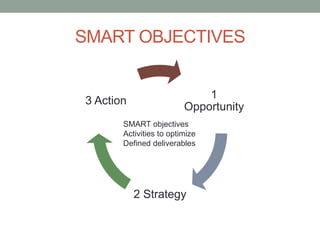
SMART OBJECTIVES
1
Opportunity
2 Strategy
3 Action
SMART objectives
Activities to optimize
Defined deliverables
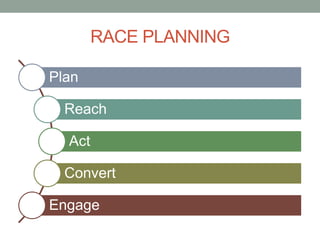
RACE PLANNING
Plan
Reach
Act
Convert
Engage
STEP 1 - PLAN
Create a digital marketing strategy
PLAN
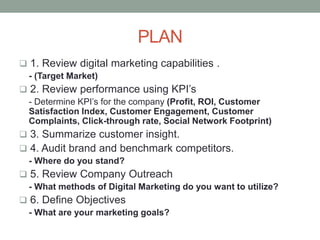
 1. Review digital marketing capabilities .
- (Target Market)
 2. Review performance using KPI’s
- Determine KPI’s for the company (Profit, ROI, Customer
Satisfaction Index, Customer Engagement, Customer
Complaints, Click-through rate, Social Network Footprint)
 3. Summarize customer insight.
 4. Audit brand and benchmark competitors.
- Where do you stand?
 5. Review Company Outreach
- What methods of Digital Marketing do you want to utilize?
 6. Define Objectives
- What are your marketing goals?
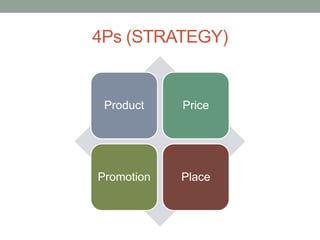
4Ps (STRATEGY)
Product Price
Promotion Place
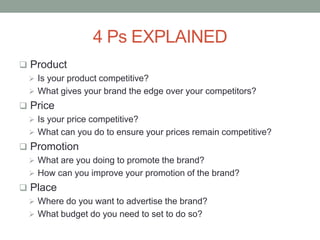
4 Ps EXPLAINED
 Product
 Is your product competitive?
 What gives your brand the edge over your competitors?
 Price
 Is your price competitive?
 What can you do to ensure your prices remain competitive?
 Promotion
 What are you doing to promote the brand?
 How can you improve your promotion of the brand?
 Place
 Where do you want to advertise the brand?
 What budget do you need to set to do so?
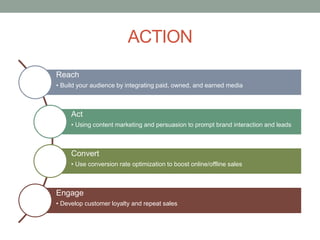
ACTION
Reach
• Build your audience by integrating paid, owned, and earned media
Act
• Using content marketing and persuasion to prompt brand interaction and leads
Convert
• Use conversion rate optimization to boost online/offline sales
Engage
• Develop customer loyalty and repeat sales
STEP 2 - REACH
Grow your audience online
BUYER STAGE: EXPLORATION
• Search Engines, Social Networks, Publishers, Blogs
 Publish and promote your content, encourage and allow sharing,
network, promote your brand.
 Key measures:
 Unique Visitors
 Value Per visit
 Followers/Customers
 Build awareness of brand on other websites with planned
campaigns to create multiple interactions using different media and
social networking outlets. (paid/unpaid)
DEFINE ONLINE AUDIENCE
POTENTIAL
• Set realistic targets for building traffic, awareness, and
social media followers.
• Reaching the Audience
 Linkedin (Update with new information monthly)
 Facebook (4-1-1: For every promotion driven post create four new
product or brand posts and one refurbished content post)
 Twitter (3-1: Daily updates on promotions, For every 3 tweets of
promotion 1 tweet should be of brand content)
 YouTube (Promote YT videos frequently on other Social Sites)
 Blog (Weekly Posts about products, promotions etc)
 Press Releases (Every 4-6 weeks create a press release about
new company information)
 Monthly newsletters to current clients to keep them updated on
current promotions and product changes.
OPTIMIZE YOUR DIGITAL
COMMUNICATIONS
• Optimize content marketing to support key digital
communications for the business.
 Set Marketing Budget for Paid Advertisements
 PR and SEO
 Optimize Google AdWords Searches
 Review opportunities for Display Advertising
 Social Media Marketing Optimization
 Facebook Ads
 Instagram Ads
 Google Ads
 Linkedin Marketing
STEP 3 - ACT
Encourage brand interactions and pursue leads
INCREASING INTERACTIONS
• Website, Blog, and Social Media
 Be worth finding via clear customer journeys and a relevant
content hub that is useful and can create leads.
 Key Measures
 Leads/Lead Conversion Rate
 Time on Site (Click-through rate)
 Shares/Comments/Likes
 Have content that persuades visitors or prospects to take the step
from lead to paying client when they are engaged on your website
or social media page.
IDENTIFY BEST OPTIONS TO
INCREASE LEAD CONVERSION
• Use analytics and feedback tools to determined click-
through rates.
 How can you increase click-through rates?
• Review social media and mobile marketing platform
engagement.
 Once a week check social media and other platforms engagement
levels. See where you are struggling and design plans to increase
their click-through rates.
• Define goals, events and dashboards for measuring
customer interaction.
 Stay on top of customer interaction. Send thank you notes and
reply to all negative comments or posts in a timely manner.
PRIORITIZE CONTENT MARKETING
AND CUSTOMER JOURNEYS
• Define Target Market
 Market Demographics
 Does your market change per product or is it a generalized market
demographic?
• Define content marketing plan
 What content do you want to share with the public?
 Create a plan of what to post and when including timelines and
posting outlines
• Create a website and improvement plan including lead
profiling
 Does your website accurately represent your demographics
usage?
 Does your target demographic have a way to find your product
without going directly to your website? (blogs, social media, etc.)
MANAGE CONTENT MARKETING AND
LEAD GENERATION
• Create campaign plans, editorial calendars and outreach
plans
• Create content assets including video marketing, social
media outreach, and blog posts
• Improve landing pages and site page templates to lead
customers to important information quickly.
• Personalize the online experience to match the online
usage of your target demographic.
STEP 4 - CONVERT
Increase sales through CRO
INCREASING CONVERSION
• E-commerce process, product, price and promotion
• Capitalize on marketing
 Investment using Conversion Rate Optimization (CRO), marketing
automation and remarketing to ensure content relevance which will
drive conversion.
• Key Measures
 Sales (on/offline)
 Revenue/Profit
 Average Order Value
• CRO involves the conversion from lead to sale.
Make sure to get the audience to the next step to turn them into
paying customers.
Then ensure their experience is such that they become return
investors who spread word about your product to people they know.
REVIEW FOCUS TO INCREASE
CONVERSION TO SALE
• Create and review site conversion and paths to purchase
(online/offline) and quantify targets for KPI review
• Review multichannel interactions to increase revenue per
visit
• Review analytics and customer feedback
CREATE AND APPROACH FOR
CONVERSION RATE OPTIMIZATION
• Define online CRO approaches
 What do you need to do to have convert into clients?
• Define how key online communications drive sales
 Look at all marketing strategies (SEO, email, social, mobile, PR)
are being used to drive sales.
 Is there any area that is lacking and could use some boost to help
with the CRO rates?
• Define offline integrations paths to purchase
 Do you have effective ways of offline purchase?
 What are your plans to convert the offline buyers into clients?
MANAGE CONTINUOUS
IMPROVEMENT OF CONVERSION
• Implement CRO through test plan for AB and multivariate site
tests and experiments
 Use different techniques of marketing to find what type works best for
your target demographic. These techniques will help to drive CRO.
• Implement lead retargeting programs using site
personalization, and behavioral email programs
 Do you need a referral program? If so, does the client get a percent
off or incentive to refer clients to your brand?
 Do you include discount codes or contests for following your company
on specific social media accounts?
• Optimize Research Online Purchase Offline(ROPO) Behavior
 Is your information optimized in such a way that an ROPO customer
can place an order with a customer service agent without having to do
so online?
STEP 5 - ENGAGE
Build customer loyalty and advocay
IMPROVING CUSTOMER
ENGAGEMENT
• Thrilled customers are the key to social media marketing,
social proof, repeat sales, and referrals.
• This long term engagement is to help build CRO through
clients who are active on your social media. Don’t forget
to build advocacy or recommendations through word-of-
mouth.
• Key Measures
 Repeat Purchases (Lifetime Customers)
 Satisfaction and Loyalty
 Advocacy
REVIEW POTENTIAL TO INCREASE
CUSTOMER ACTIVITY LEVELS
• Review customer loyalty using RFM (Recency,
Frequency, Monetary)
 How recently did the client convert?
 How frequent do they order?
 How much do they spend?
• Use this data to quantify the revenue potential which can
help increase your profit and ROI.
• Review all customer satisfaction drivers
 Deal with any angry and negative customers quickly to avoid
damage to brand or company reputation
 Be active in social media comments and reply to everyone
• Review effectiveness of customer communications
 Does your current form of customer communication work? If not,
how can you improve your communication in the future?
DEFINEA PLAN TO IMPROVE CUSTOMER
RETENTION AND ENGAGEMENT
• Create a customer engagement plan
• Create online personalization and merchandising plan for
revenue
 Birthday promotions, referral promotions, social media contests
• Create customer contact plans
 Email marketing
 Social Media marketing
 Offline marketing
IMPLEMENT ONLINE CUSTOMER
COMMUNICATIONS PLAN
• Implement or refine personalization rules on desktop and
mobile devices
 Can the client tailor their buying expirence to what they feel
comfortable with? (ROPO, Mobile purchasing)
• Customer onboarding including even-triggered-
personalization emails and newsletters
 Can the customer request specific notifications from the company
such as sales, promotions etc.? Or do all customers receive the
same information?
• Mange social media and email campaigns for customer
engagement and advocacy
 Make sure to follow your social media timeline
 Engage customers through various social media platforms

Digital Marketing Plan

  • 1.
  • 2.
    SMART OBJECTIVES 1 Opportunity 2 Strategy 3Action SMART objectives Activities to optimize Defined deliverables
  • 3.
  • 4.
    STEP 1 -PLAN Create a digital marketing strategy
  • 5.
    PLAN  1. Reviewdigital marketing capabilities . - (Target Market)  2. Review performance using KPI’s - Determine KPI’s for the company (Profit, ROI, Customer Satisfaction Index, Customer Engagement, Customer Complaints, Click-through rate, Social Network Footprint)  3. Summarize customer insight.  4. Audit brand and benchmark competitors. - Where do you stand?  5. Review Company Outreach - What methods of Digital Marketing do you want to utilize?  6. Define Objectives - What are your marketing goals?
  • 6.
  • 7.
    4 Ps EXPLAINED Product  Is your product competitive?  What gives your brand the edge over your competitors?  Price  Is your price competitive?  What can you do to ensure your prices remain competitive?  Promotion  What are you doing to promote the brand?  How can you improve your promotion of the brand?  Place  Where do you want to advertise the brand?  What budget do you need to set to do so?
  • 8.
    ACTION Reach • Build youraudience by integrating paid, owned, and earned media Act • Using content marketing and persuasion to prompt brand interaction and leads Convert • Use conversion rate optimization to boost online/offline sales Engage • Develop customer loyalty and repeat sales
  • 9.
    STEP 2 -REACH Grow your audience online
  • 10.
    BUYER STAGE: EXPLORATION •Search Engines, Social Networks, Publishers, Blogs  Publish and promote your content, encourage and allow sharing, network, promote your brand.  Key measures:  Unique Visitors  Value Per visit  Followers/Customers  Build awareness of brand on other websites with planned campaigns to create multiple interactions using different media and social networking outlets. (paid/unpaid)
  • 11.
    DEFINE ONLINE AUDIENCE POTENTIAL •Set realistic targets for building traffic, awareness, and social media followers. • Reaching the Audience  Linkedin (Update with new information monthly)  Facebook (4-1-1: For every promotion driven post create four new product or brand posts and one refurbished content post)  Twitter (3-1: Daily updates on promotions, For every 3 tweets of promotion 1 tweet should be of brand content)  YouTube (Promote YT videos frequently on other Social Sites)  Blog (Weekly Posts about products, promotions etc)  Press Releases (Every 4-6 weeks create a press release about new company information)  Monthly newsletters to current clients to keep them updated on current promotions and product changes.
  • 12.
    OPTIMIZE YOUR DIGITAL COMMUNICATIONS •Optimize content marketing to support key digital communications for the business.  Set Marketing Budget for Paid Advertisements  PR and SEO  Optimize Google AdWords Searches  Review opportunities for Display Advertising  Social Media Marketing Optimization  Facebook Ads  Instagram Ads  Google Ads  Linkedin Marketing
  • 13.
    STEP 3 -ACT Encourage brand interactions and pursue leads
  • 14.
    INCREASING INTERACTIONS • Website,Blog, and Social Media  Be worth finding via clear customer journeys and a relevant content hub that is useful and can create leads.  Key Measures  Leads/Lead Conversion Rate  Time on Site (Click-through rate)  Shares/Comments/Likes  Have content that persuades visitors or prospects to take the step from lead to paying client when they are engaged on your website or social media page.
  • 15.
    IDENTIFY BEST OPTIONSTO INCREASE LEAD CONVERSION • Use analytics and feedback tools to determined click- through rates.  How can you increase click-through rates? • Review social media and mobile marketing platform engagement.  Once a week check social media and other platforms engagement levels. See where you are struggling and design plans to increase their click-through rates. • Define goals, events and dashboards for measuring customer interaction.  Stay on top of customer interaction. Send thank you notes and reply to all negative comments or posts in a timely manner.
  • 16.
    PRIORITIZE CONTENT MARKETING ANDCUSTOMER JOURNEYS • Define Target Market  Market Demographics  Does your market change per product or is it a generalized market demographic? • Define content marketing plan  What content do you want to share with the public?  Create a plan of what to post and when including timelines and posting outlines • Create a website and improvement plan including lead profiling  Does your website accurately represent your demographics usage?  Does your target demographic have a way to find your product without going directly to your website? (blogs, social media, etc.)
  • 17.
    MANAGE CONTENT MARKETINGAND LEAD GENERATION • Create campaign plans, editorial calendars and outreach plans • Create content assets including video marketing, social media outreach, and blog posts • Improve landing pages and site page templates to lead customers to important information quickly. • Personalize the online experience to match the online usage of your target demographic.
  • 18.
    STEP 4 -CONVERT Increase sales through CRO
  • 19.
    INCREASING CONVERSION • E-commerceprocess, product, price and promotion • Capitalize on marketing  Investment using Conversion Rate Optimization (CRO), marketing automation and remarketing to ensure content relevance which will drive conversion. • Key Measures  Sales (on/offline)  Revenue/Profit  Average Order Value • CRO involves the conversion from lead to sale. Make sure to get the audience to the next step to turn them into paying customers. Then ensure their experience is such that they become return investors who spread word about your product to people they know.
  • 20.
    REVIEW FOCUS TOINCREASE CONVERSION TO SALE • Create and review site conversion and paths to purchase (online/offline) and quantify targets for KPI review • Review multichannel interactions to increase revenue per visit • Review analytics and customer feedback
  • 21.
    CREATE AND APPROACHFOR CONVERSION RATE OPTIMIZATION • Define online CRO approaches  What do you need to do to have convert into clients? • Define how key online communications drive sales  Look at all marketing strategies (SEO, email, social, mobile, PR) are being used to drive sales.  Is there any area that is lacking and could use some boost to help with the CRO rates? • Define offline integrations paths to purchase  Do you have effective ways of offline purchase?  What are your plans to convert the offline buyers into clients?
  • 22.
    MANAGE CONTINUOUS IMPROVEMENT OFCONVERSION • Implement CRO through test plan for AB and multivariate site tests and experiments  Use different techniques of marketing to find what type works best for your target demographic. These techniques will help to drive CRO. • Implement lead retargeting programs using site personalization, and behavioral email programs  Do you need a referral program? If so, does the client get a percent off or incentive to refer clients to your brand?  Do you include discount codes or contests for following your company on specific social media accounts? • Optimize Research Online Purchase Offline(ROPO) Behavior  Is your information optimized in such a way that an ROPO customer can place an order with a customer service agent without having to do so online?
  • 23.
    STEP 5 -ENGAGE Build customer loyalty and advocay
  • 24.
    IMPROVING CUSTOMER ENGAGEMENT • Thrilledcustomers are the key to social media marketing, social proof, repeat sales, and referrals. • This long term engagement is to help build CRO through clients who are active on your social media. Don’t forget to build advocacy or recommendations through word-of- mouth. • Key Measures  Repeat Purchases (Lifetime Customers)  Satisfaction and Loyalty  Advocacy
  • 25.
    REVIEW POTENTIAL TOINCREASE CUSTOMER ACTIVITY LEVELS • Review customer loyalty using RFM (Recency, Frequency, Monetary)  How recently did the client convert?  How frequent do they order?  How much do they spend? • Use this data to quantify the revenue potential which can help increase your profit and ROI. • Review all customer satisfaction drivers  Deal with any angry and negative customers quickly to avoid damage to brand or company reputation  Be active in social media comments and reply to everyone • Review effectiveness of customer communications  Does your current form of customer communication work? If not, how can you improve your communication in the future?
  • 26.
    DEFINEA PLAN TOIMPROVE CUSTOMER RETENTION AND ENGAGEMENT • Create a customer engagement plan • Create online personalization and merchandising plan for revenue  Birthday promotions, referral promotions, social media contests • Create customer contact plans  Email marketing  Social Media marketing  Offline marketing
  • 27.
    IMPLEMENT ONLINE CUSTOMER COMMUNICATIONSPLAN • Implement or refine personalization rules on desktop and mobile devices  Can the client tailor their buying expirence to what they feel comfortable with? (ROPO, Mobile purchasing) • Customer onboarding including even-triggered- personalization emails and newsletters  Can the customer request specific notifications from the company such as sales, promotions etc.? Or do all customers receive the same information? • Mange social media and email campaigns for customer engagement and advocacy  Make sure to follow your social media timeline  Engage customers through various social media platforms