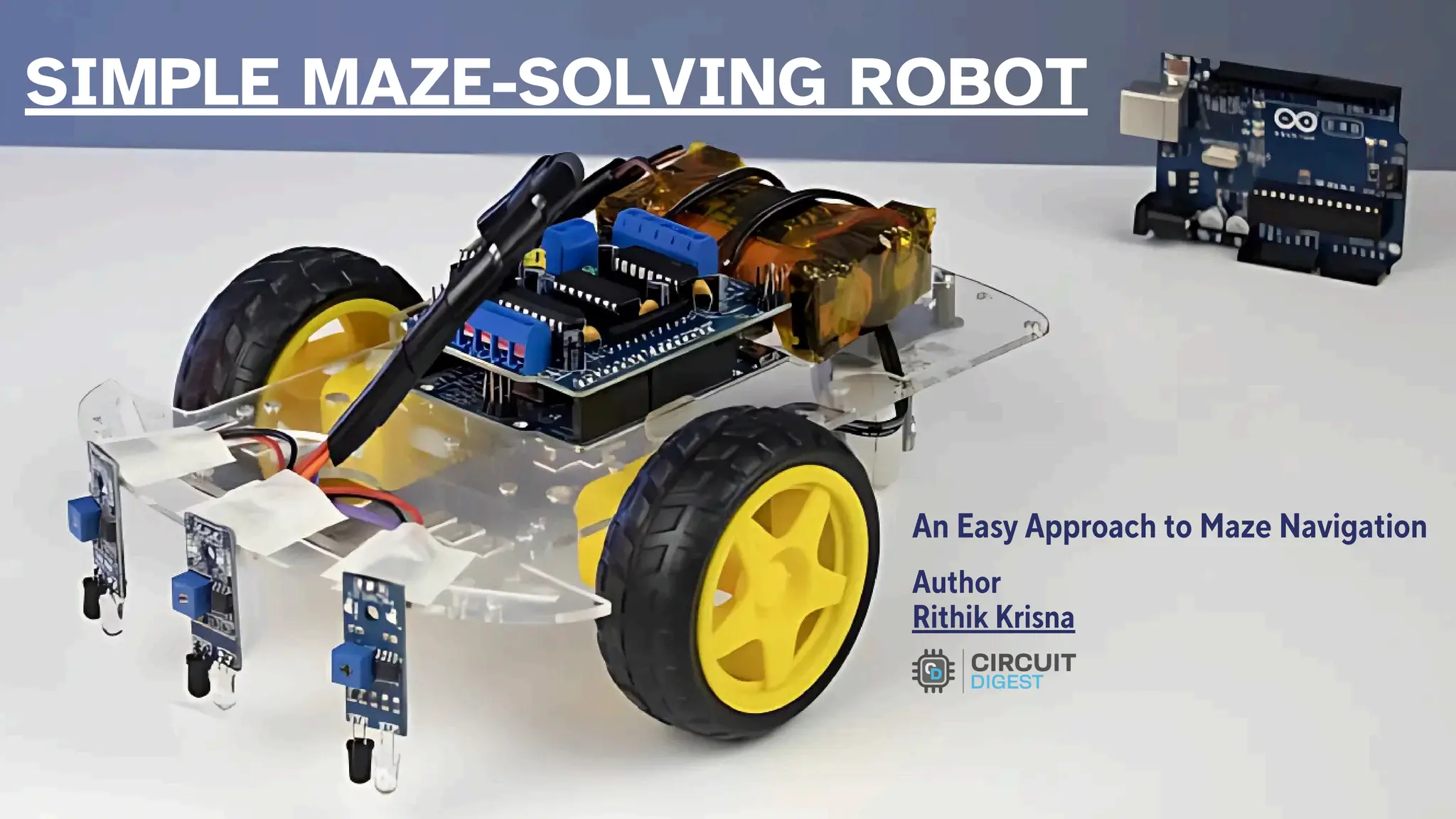
SIMPLE MAZE-SOLVING ROBOT
An Easy Approach to Maze Navigation
Author
Rithik Krisna
What is a Maze-Solving
Robot?
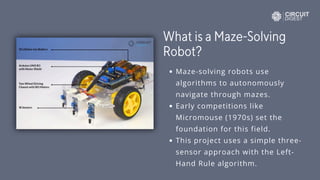
Maze-solving robots use
algorithms to autonomously
navigate through mazes.
Early competitions like
Micromouse (1970s) set the
foundation for this field.
This project uses a simple three-
sensor approach with the Left-
Hand Rule algorithm.
Maze-Solving Algorithm: The Left-
Hand Rule
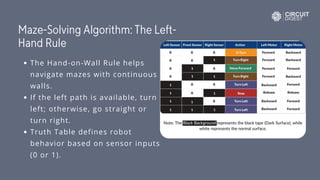
The Hand-on-Wall Rule helps
navigate mazes with continuous
walls.
If the left path is available, turn
left; otherwise, go straight or
turn right.
Truth Table defines robot
behavior based on sensor inputs
(0 or 1).
Components &
Circuit Design
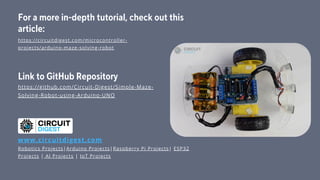
Key Components:
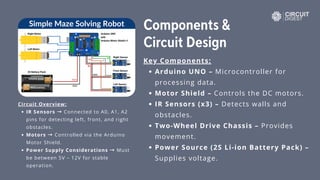
Arduino UNO – Microcontroller for
processing data.
Motor Shield – Controls the DC motors.
IR Sensors (x3) – Detects walls and
obstacles.
Two-Wheel Drive Chassis – Provides
movement.
Power Source (2S Li-ion Battery Pack) –
Supplies voltage.
Circuit Overview:
IR Sensors → Connected to A0, A1, A2
pins for detecting left, front, and right
obstacles.
Motors → Controlled via the Arduino
Motor Shield.
Power Supply Considerations → Must
be between 5V – 12V for stable
operation.
Assembly & Working
Assembling the Robot:
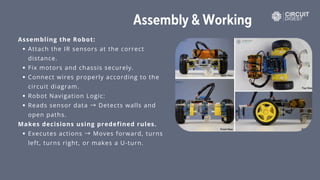
Attach the IR sensors at the correct
distance.
Fix motors and chassis securely.
Connect wires properly according to the
circuit diagram.
Robot Navigation Logic:
Reads sensor data → Detects walls and
open paths.
Makes decisions using predefined rules.
Executes actions → Moves forward, turns
left, turns right, or makes a U-turn.
Coding & Demonstration
Key Code Functions:
moveForward(), turnLeft(), turnRight(), uTurn()
Uses switch-case logic to make decisions.
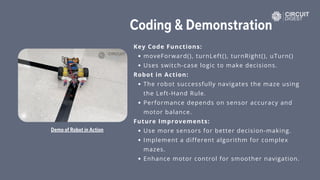
Robot in Action:
The robot successfully navigates the maze using
the Left-Hand Rule.
Performance depends on sensor accuracy and
motor balance.
Future Improvements:
Use more sensors for better decision-making.
Implement a different algorithm for complex
mazes.
Enhance motor control for smoother navigation.
Demo of Robot in Action
Link to GitHub Repository
https://github.com/Circuit-Digest/Simple-Maze-
Solving-Robot-using-Arduino-UNO
For a more in-depth tutorial, check out this
article:
https://circuitdigest.com/microcontroller-
projects/arduino-maze-solving-robot
www.circuitdigest.com
Robotics Projects|Arduino Projects|Raspberry Pi Projects| ESP32
Projects | AI Projects | IoT Projects
How to Build a Maze Solving Robot Using Arduino

  • 1.
    SIMPLE MAZE-SOLVING ROBOT AnEasy Approach to Maze Navigation Author Rithik Krisna
  • 2.
    What is aMaze-Solving Robot? Maze-solving robots use algorithms to autonomously navigate through mazes. Early competitions like Micromouse (1970s) set the foundation for this field. This project uses a simple three- sensor approach with the Left- Hand Rule algorithm.
  • 3.
    Maze-Solving Algorithm: TheLeft- Hand Rule The Hand-on-Wall Rule helps navigate mazes with continuous walls. If the left path is available, turn left; otherwise, go straight or turn right. Truth Table defines robot behavior based on sensor inputs (0 or 1).
  • 4.
    Components & Circuit Design KeyComponents: Arduino UNO – Microcontroller for processing data. Motor Shield – Controls the DC motors. IR Sensors (x3) – Detects walls and obstacles. Two-Wheel Drive Chassis – Provides movement. Power Source (2S Li-ion Battery Pack) – Supplies voltage. Circuit Overview: IR Sensors → Connected to A0, A1, A2 pins for detecting left, front, and right obstacles. Motors → Controlled via the Arduino Motor Shield. Power Supply Considerations → Must be between 5V – 12V for stable operation.
  • 5.
    Assembly & Working Assemblingthe Robot: Attach the IR sensors at the correct distance. Fix motors and chassis securely. Connect wires properly according to the circuit diagram. Robot Navigation Logic: Reads sensor data → Detects walls and open paths. Makes decisions using predefined rules. Executes actions → Moves forward, turns left, turns right, or makes a U-turn.
  • 6.
    Coding & Demonstration KeyCode Functions: moveForward(), turnLeft(), turnRight(), uTurn() Uses switch-case logic to make decisions. Robot in Action: The robot successfully navigates the maze using the Left-Hand Rule. Performance depends on sensor accuracy and motor balance. Future Improvements: Use more sensors for better decision-making. Implement a different algorithm for complex mazes. Enhance motor control for smoother navigation. Demo of Robot in Action
  • 7.
    Link to GitHubRepository https://github.com/Circuit-Digest/Simple-Maze- Solving-Robot-using-Arduino-UNO For a more in-depth tutorial, check out this article: https://circuitdigest.com/microcontroller- projects/arduino-maze-solving-robot www.circuitdigest.com Robotics Projects|Arduino Projects|Raspberry Pi Projects| ESP32 Projects | AI Projects | IoT Projects