FRM-513
Climate change: Aquatic ecosystems
and fisheries
Climate mitigation strategies: for long
term sustainability
Presented by
Meenatchi S
FRM-MB0-02
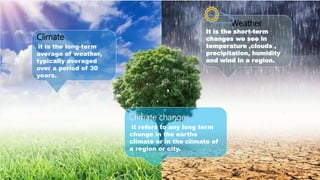
Climate
it is the long-term
average of weather,
typically averaged
over a period of 30
years.
Weather
It is the short-term
changes we see in
temperature ,clouds ,
precipitation, humidity
and wind in a region.
Climate change
it refers to any long term
change in the earths
climate or in the climate of
a region or city.
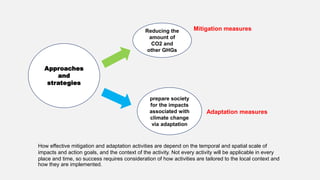
Approaches
and
strategies
Reducing the
amount of
CO2 and
other GHGs
prepare society
for the impacts
associated with
climate change
via adaptation
How effective mitigation and adaptation activities are depend on the temporal and spatial scale of
impacts and action goals, and the context of the activity. Not every activity will be applicable in every
place and time, so success requires consideration of how activities are tailored to the local context and
how they are implemented.
Mitigation measures
Adaptation measures
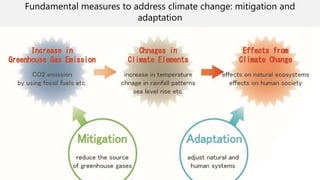
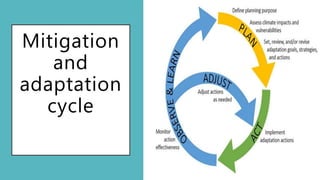
Fundamental measures to address climate change: mitigation and
adaptation
and enhance the
https://adaptation-platform.nies.go.jp/
Mitigation
and
adaptation
cycle
Management measures
• Scientific measures
• Technological measures
• Legal measures
• Economical measures
• Individual/Societal
measures
Scientific measures
• Skilled community of scientists with a strong scientific base
• Scientific research
• Possible solutions for climate change mitigation and adaptation
• Incorporating Indigenous Technical Knowledge in the research
• Involving local people and their inputs for more localised solutions
Carbon sequestration
• The Kyoto Protocol under the United Nations
Framework Convention on Climate Change allows
countries to receive credits for their carbon-
sequestration activities in the area of land use, land-use
change, and forestry as part of their obligations under
the protocol
• Such activities could include afforestation (conversion of
no forested land to forest), reforestation (conversion of
previously forested land to forest), improved forestry or
agricultural practices, and revegetation
• According to the Intergovernmental Panel on Climate
Change (IPCC), improved agricultural practices and
forest-related mitigation activities can make a
significant contribution to the removal of carbon
dioxide from the atmosphere at relatively low cost
• These activities could include improved crop and
grazing land management—for instance, more efficient
fertilizer use to prevent the leaching of unused nitrates,
tillage practices that minimize soil erosion, the
restoration of organic soils, and the restoration of
degraded lands
• In addition, the preservation of existing forests,
especially the rainforests of the Amazon and elsewhere,
Carbon sequestration:
the long-term storage of
carbon in plants, soils,
geologic formations, and
the ocean
• carbon in vegetation, soil, and detritus is roughly 2,200
terrestrial ecosystems -2.6 gigatonsT
• oceans - 920 gigatons
• atmosphere - 760 gigatons
• Of the carbon emitted to the atmosphere by human
activities, only 45 percent remains in the atmosphere;
about 30 percent is taken up by the oceans, and the
remainder is incorporated into terrestrial ecosystems
Ocean afforestation
 Seaweed grows quickly and takes no space on
land
 Afforesting 9% of the ocean could sequester 53
billion tons of carbon dioxide annually
 One side-effect is a short-term rise in CO2,
which limits its attractiveness
Ocean afforestation is a proposal
for farming seaweed for carbon
removal
Technological measures
• Increasing efficiency of existing systems
• Low cost, sustainable technologies suitable
locally
• Appropriate development, deployment and
diffusion of technologies
• Iron fertilization
• Synthetic limestone
• Reflective sand
Each kilogram of
iron can fix 83 t of
CO2 and generate
100 t of
phytoplankton
Green technology
Green technology is an umbrella
term that encapsulates any
technology that is created to be
environmentally friendly from its
production line all the way to its
usage
To meet and cater
the needs of society
in such a way without
damaging or
depleting natural
resources on earth is
the main objective of
green technology
To meet present
needs without
making any
compromises
It is essential to
develop
alternative
technologies to
prevent any
further damage
to health of
human beings
and other living
beings
1. Solar energy
2. Wind energy
3. Ocean energy
4. Geothermal energy
5. Biofuels
6. Electric cars
Green technology in
aquaculture
• Recently, in aquaculture sector a wide adaptation
of technologies and management such as intensive
culture practices such as raceways, cages, racks are
being practiced
• However an alarming situation has been generated
due to the rapid expansion with the associated
issues and concerns such as effluent discharge,
degradation of genetics resources, havoc diseases
and environment impact
• Green technologies can be applicable in all the
practices of aquaculture and fisheries activities that
include innovative aquaculture production systems
using environmental friendly feeds and diseases
preventive measures, low impact and fuel efficient
fishing methods, reduced energy use an greener
refrigeration technologies, and waste management
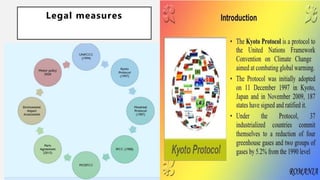
Legal measures
UNFCCC AND LEDS
• Belgium’s strategy (submitted in French) outlines measures to achieve climate neutrality by 2050
across sectors, adaptation actions, and cross-cutting goals of ensuring a socially just transition, a
secure and sufficient supply of sustainable and affordable energy, and a circular economy through
innovation and research and development, and investment and finance.
• Denmark’s ‘Climate Programme 2020’ lays out the government’s approach to reaching climate
neutrality “by 2050 at the latest.” The strategy states the government “will work to ensure an ambitious
effort for climate adaptation and resilience, as well as for sustainable development” by promoting
more ambitious climate and environmental goals, including for the trade policy in the EU and the
World Trade Organization (WTO).
• The key steps “towards a sustainable and green society” outlined in the ‘2050 Carbon Neutral Strategy
of the Republic of Korea’ include expanding the use of clean power and hydrogen across all sectors,
improving energy efficiency, commercial deployment of carbon removal and other “future
technologies,” scaling up the circular economy to improve industrial sustainability, and enhancing
carbon sinks. The document presents visions and strategies by sector, including energy, industry,
transport, buildings, agriculture, and waste. Among mitigation measures that “will provide an
opportunity for sustainable development,” the strategy highlights Korea’s emissions trading scheme
(ETS) and efforts to transition to green energy.
• Latvia’s long-term strategy integrates climate change mitigation and adaptation goals in all sectors of
the economy, and aims to increase the country’s economic competitiveness and to ensure a safe living
UNFCCC AND LEDS
• The Netherlands’ ‘Long term strategy on climate mitigation’ suggest that climate
become a cornerstone of the EU’s foreign, trade, and development relations and that
signing the Paris Agreement on climate change “become an essential precondition for
new trade agreements with countries outside the EU.”
• Norway’s strategy contains a vision for a low-emission society and a global low-
emission development pathway, and highlights efforts to include youth – “adults in
2050” – in the formulation of this vision. It outlines Norway’s circumstances,
opportunities, and challenges across sectors, including development of a diversified
economy and green competitiveness, and climate-smart cities and communities.
• Spain’s long-term strategy (submitted in Spanish) envisions a modern, competitive,
and climate-neutral economy by 2050. Its “triple objective” is to comply with the Paris
Agreement, plan a comprehensive transition to climate-neutral economy and society,
and maximize the opportunities derived from the energy transition.
• Among Sweden’s efforts to fulfill its long-term strategy for reducing GHG emissions, its
LEDS highlights the target of reducing emissions from domestic transport (excluding
domestic aviation, covered by the EU ETS) by at least 70% by 2030 compared with
2010.
Economy & policy measures
• Funds for adaptation and mitigation of climate change and ozone depletion in the National
budget
• Climate change research fund to be created- the Green Climate Fund
• Private sector initiatives to be encouraged through venture capital funds
• ICZM
• Ecosystem-based approach to management
• Carbon budget
• Carbon credit & Emissions Trading Scheme
• Incentives
• Circular economy
• Green economy
• National Action Plan for Climate Change (NAPCC), 2008
• Ecosystem valuation
• Green tax
Ecosystem-based approach to
management
ICZM
Eco-tax is imposed on
emissions like CO2, on
consumption of energy
or on dangerous
pollutants, emitted by
any industrial activity
Carbon tax is a tax
imposed on the carbon
emissions required to
produce goods and
services and intended to
make visible the hidden
social costs of carbon
emission
Importance of economic
valuation
• Raising awareness of the value of the
environment
• Revealing the distribution of costs and
benefits of a project among winners and
losers
• Designing appropriate regulations, fees or
incentives for use of ecosystem services
• Calculating potential returns on investment
for projects that impact the environment
• Calculating values for ecosystem services and
natural capital for input into green accounts
• Calculating environmental damages and
Individual/societal
measures
• Public Awareness- Green literacy, Green
advocacy
• UN Years and Decades-
• 2021- International Year of Creative Economy for
Sustainable Development
• 2014-24- UN’s Decade for Sustainable Energy for
All
• 2018-28- International Decade for Action Water
for Sustainable Development
• 2021-30- International Decade of Ocean Science
for Sustainable Development
• UN’s Decade on Ecosystem Restoration
Carbon
footprints of
fisheries and
aquaculture
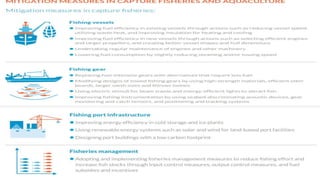
Summary of mitigation procedures in fisheries
sector
Impact of covid-19 pandemic on global mitigation process
•
 SHORT TERM IMPLICATIONS:
• Adaptation and mitigation topics have
fallen down the political agenda at all
levels of gov.
• Resources reallocated towards efforts to
manage impacts of the virus
• Challenges for adaptation planning and
implementation processes due to logistic
restrictions
• Adoption of new operational modes due
to changing priorities and operational
realities
 LONG TERM IMPLICATIONS:
• Long term socioeconomic consequences
• Reduction in availability of adaptation
finance
• Sources of external finance expected to
decrease in developing countries including
foreign direct investment, remittances and
domestic direct investment
• Viability of many countries’ long-term
adaptation plans under doubt
• United Nations, the International Monetary
Fund and the OECD- COVID-19 recovery
packages- investing in NbS- economic
recovery, employment, gender and wealth
inequalities, health systems, climate
resilience and red. emissions
REFERENCES
• https://www.slideshare.net/polylsgiedx/lecture-11-mitigation-and-adaptation-
52280407
• https://countercurrents.org/2019/09/inevitable-climate-crisis-adaptation-can-deliver-
7-1-trillion-in-benefits-says-global-report/
• https://www.iberdrola.com/environment/climate-change-mitigation-and-adaptation
• https://www.mrgscience.com/ess-topic-73-climate-change-ndash-mitigation-and-
adaptation.html
• http://www.wamis.org/agm/meetings/rsama08/S512-Vivekanandan-Fisheries-
Aquaculture.pdf
• https://warmheartworldwide.org/
• IPCC, 2019: IPCC Special Report on the Ocean and Cryosphere in a Changing Climate
[H.-O. Pörtner, D.C. Roberts, V. Masson-Delmotte, P. Zhai, M. Tignor, E. Poloczanska,
K. Mintenbeck, A. Alegría, M. Nicolai, A. Okem, J. Petzold, B. Rama, N.M. Weyer (eds.)].
In press.
• FAO. 2016. Climate change implications for fisheries and aquaculture: Summary of the
findings of the Intergovernmental Panel on Climate Change Fifth Assessment Report,
“ THE HEALTH OF OUR PLANET
AS WELL AS OUR OWN HEALTH
AND FUTURE FOOD SECURITY
ALL HINGE ON
HOW WE TREAT THE BLUE
WORLD”
FAO DIRECTOR-GENERAL JOSÉ GRAZIANO DA SILVA

Climate mitigation strategies

  • 1.
    FRM-513 Climate change: Aquaticecosystems and fisheries Climate mitigation strategies: for long term sustainability Presented by Meenatchi S FRM-MB0-02
  • 2.
    Climate it is thelong-term average of weather, typically averaged over a period of 30 years. Weather It is the short-term changes we see in temperature ,clouds , precipitation, humidity and wind in a region. Climate change it refers to any long term change in the earths climate or in the climate of a region or city.
  • 3.
    Approaches and strategies Reducing the amount of CO2and other GHGs prepare society for the impacts associated with climate change via adaptation How effective mitigation and adaptation activities are depend on the temporal and spatial scale of impacts and action goals, and the context of the activity. Not every activity will be applicable in every place and time, so success requires consideration of how activities are tailored to the local context and how they are implemented. Mitigation measures Adaptation measures
  • 4.
    Fundamental measures toaddress climate change: mitigation and adaptation and enhance the https://adaptation-platform.nies.go.jp/
  • 5.
  • 6.
    Management measures • Scientificmeasures • Technological measures • Legal measures • Economical measures • Individual/Societal measures
  • 7.
    Scientific measures • Skilledcommunity of scientists with a strong scientific base • Scientific research • Possible solutions for climate change mitigation and adaptation • Incorporating Indigenous Technical Knowledge in the research • Involving local people and their inputs for more localised solutions
  • 8.
    Carbon sequestration • TheKyoto Protocol under the United Nations Framework Convention on Climate Change allows countries to receive credits for their carbon- sequestration activities in the area of land use, land-use change, and forestry as part of their obligations under the protocol • Such activities could include afforestation (conversion of no forested land to forest), reforestation (conversion of previously forested land to forest), improved forestry or agricultural practices, and revegetation • According to the Intergovernmental Panel on Climate Change (IPCC), improved agricultural practices and forest-related mitigation activities can make a significant contribution to the removal of carbon dioxide from the atmosphere at relatively low cost • These activities could include improved crop and grazing land management—for instance, more efficient fertilizer use to prevent the leaching of unused nitrates, tillage practices that minimize soil erosion, the restoration of organic soils, and the restoration of degraded lands • In addition, the preservation of existing forests, especially the rainforests of the Amazon and elsewhere, Carbon sequestration: the long-term storage of carbon in plants, soils, geologic formations, and the ocean • carbon in vegetation, soil, and detritus is roughly 2,200 terrestrial ecosystems -2.6 gigatonsT • oceans - 920 gigatons • atmosphere - 760 gigatons • Of the carbon emitted to the atmosphere by human activities, only 45 percent remains in the atmosphere; about 30 percent is taken up by the oceans, and the remainder is incorporated into terrestrial ecosystems
  • 9.
    Ocean afforestation  Seaweedgrows quickly and takes no space on land  Afforesting 9% of the ocean could sequester 53 billion tons of carbon dioxide annually  One side-effect is a short-term rise in CO2, which limits its attractiveness Ocean afforestation is a proposal for farming seaweed for carbon removal
  • 10.
    Technological measures • Increasingefficiency of existing systems • Low cost, sustainable technologies suitable locally • Appropriate development, deployment and diffusion of technologies • Iron fertilization • Synthetic limestone • Reflective sand Each kilogram of iron can fix 83 t of CO2 and generate 100 t of phytoplankton
  • 11.
    Green technology Green technologyis an umbrella term that encapsulates any technology that is created to be environmentally friendly from its production line all the way to its usage To meet and cater the needs of society in such a way without damaging or depleting natural resources on earth is the main objective of green technology To meet present needs without making any compromises It is essential to develop alternative technologies to prevent any further damage to health of human beings and other living beings 1. Solar energy 2. Wind energy 3. Ocean energy 4. Geothermal energy 5. Biofuels 6. Electric cars
  • 12.
    Green technology in aquaculture •Recently, in aquaculture sector a wide adaptation of technologies and management such as intensive culture practices such as raceways, cages, racks are being practiced • However an alarming situation has been generated due to the rapid expansion with the associated issues and concerns such as effluent discharge, degradation of genetics resources, havoc diseases and environment impact • Green technologies can be applicable in all the practices of aquaculture and fisheries activities that include innovative aquaculture production systems using environmental friendly feeds and diseases preventive measures, low impact and fuel efficient fishing methods, reduced energy use an greener refrigeration technologies, and waste management
  • 13.
  • 18.
    UNFCCC AND LEDS •Belgium’s strategy (submitted in French) outlines measures to achieve climate neutrality by 2050 across sectors, adaptation actions, and cross-cutting goals of ensuring a socially just transition, a secure and sufficient supply of sustainable and affordable energy, and a circular economy through innovation and research and development, and investment and finance. • Denmark’s ‘Climate Programme 2020’ lays out the government’s approach to reaching climate neutrality “by 2050 at the latest.” The strategy states the government “will work to ensure an ambitious effort for climate adaptation and resilience, as well as for sustainable development” by promoting more ambitious climate and environmental goals, including for the trade policy in the EU and the World Trade Organization (WTO). • The key steps “towards a sustainable and green society” outlined in the ‘2050 Carbon Neutral Strategy of the Republic of Korea’ include expanding the use of clean power and hydrogen across all sectors, improving energy efficiency, commercial deployment of carbon removal and other “future technologies,” scaling up the circular economy to improve industrial sustainability, and enhancing carbon sinks. The document presents visions and strategies by sector, including energy, industry, transport, buildings, agriculture, and waste. Among mitigation measures that “will provide an opportunity for sustainable development,” the strategy highlights Korea’s emissions trading scheme (ETS) and efforts to transition to green energy. • Latvia’s long-term strategy integrates climate change mitigation and adaptation goals in all sectors of the economy, and aims to increase the country’s economic competitiveness and to ensure a safe living
  • 19.
    UNFCCC AND LEDS •The Netherlands’ ‘Long term strategy on climate mitigation’ suggest that climate become a cornerstone of the EU’s foreign, trade, and development relations and that signing the Paris Agreement on climate change “become an essential precondition for new trade agreements with countries outside the EU.” • Norway’s strategy contains a vision for a low-emission society and a global low- emission development pathway, and highlights efforts to include youth – “adults in 2050” – in the formulation of this vision. It outlines Norway’s circumstances, opportunities, and challenges across sectors, including development of a diversified economy and green competitiveness, and climate-smart cities and communities. • Spain’s long-term strategy (submitted in Spanish) envisions a modern, competitive, and climate-neutral economy by 2050. Its “triple objective” is to comply with the Paris Agreement, plan a comprehensive transition to climate-neutral economy and society, and maximize the opportunities derived from the energy transition. • Among Sweden’s efforts to fulfill its long-term strategy for reducing GHG emissions, its LEDS highlights the target of reducing emissions from domestic transport (excluding domestic aviation, covered by the EU ETS) by at least 70% by 2030 compared with 2010.
  • 20.
    Economy & policymeasures • Funds for adaptation and mitigation of climate change and ozone depletion in the National budget • Climate change research fund to be created- the Green Climate Fund • Private sector initiatives to be encouraged through venture capital funds • ICZM • Ecosystem-based approach to management • Carbon budget • Carbon credit & Emissions Trading Scheme • Incentives • Circular economy • Green economy • National Action Plan for Climate Change (NAPCC), 2008 • Ecosystem valuation • Green tax
  • 21.
  • 22.
  • 23.
    Eco-tax is imposedon emissions like CO2, on consumption of energy or on dangerous pollutants, emitted by any industrial activity Carbon tax is a tax imposed on the carbon emissions required to produce goods and services and intended to make visible the hidden social costs of carbon emission
  • 24.
    Importance of economic valuation •Raising awareness of the value of the environment • Revealing the distribution of costs and benefits of a project among winners and losers • Designing appropriate regulations, fees or incentives for use of ecosystem services • Calculating potential returns on investment for projects that impact the environment • Calculating values for ecosystem services and natural capital for input into green accounts • Calculating environmental damages and
  • 25.
    Individual/societal measures • Public Awareness-Green literacy, Green advocacy • UN Years and Decades- • 2021- International Year of Creative Economy for Sustainable Development • 2014-24- UN’s Decade for Sustainable Energy for All • 2018-28- International Decade for Action Water for Sustainable Development • 2021-30- International Decade of Ocean Science for Sustainable Development • UN’s Decade on Ecosystem Restoration
  • 26.
  • 29.
    Summary of mitigationprocedures in fisheries sector
  • 30.
    Impact of covid-19pandemic on global mitigation process •  SHORT TERM IMPLICATIONS: • Adaptation and mitigation topics have fallen down the political agenda at all levels of gov. • Resources reallocated towards efforts to manage impacts of the virus • Challenges for adaptation planning and implementation processes due to logistic restrictions • Adoption of new operational modes due to changing priorities and operational realities  LONG TERM IMPLICATIONS: • Long term socioeconomic consequences • Reduction in availability of adaptation finance • Sources of external finance expected to decrease in developing countries including foreign direct investment, remittances and domestic direct investment • Viability of many countries’ long-term adaptation plans under doubt • United Nations, the International Monetary Fund and the OECD- COVID-19 recovery packages- investing in NbS- economic recovery, employment, gender and wealth inequalities, health systems, climate resilience and red. emissions
  • 31.
    REFERENCES • https://www.slideshare.net/polylsgiedx/lecture-11-mitigation-and-adaptation- 52280407 • https://countercurrents.org/2019/09/inevitable-climate-crisis-adaptation-can-deliver- 7-1-trillion-in-benefits-says-global-report/ •https://www.iberdrola.com/environment/climate-change-mitigation-and-adaptation • https://www.mrgscience.com/ess-topic-73-climate-change-ndash-mitigation-and- adaptation.html • http://www.wamis.org/agm/meetings/rsama08/S512-Vivekanandan-Fisheries- Aquaculture.pdf • https://warmheartworldwide.org/ • IPCC, 2019: IPCC Special Report on the Ocean and Cryosphere in a Changing Climate [H.-O. Pörtner, D.C. Roberts, V. Masson-Delmotte, P. Zhai, M. Tignor, E. Poloczanska, K. Mintenbeck, A. Alegría, M. Nicolai, A. Okem, J. Petzold, B. Rama, N.M. Weyer (eds.)]. In press. • FAO. 2016. Climate change implications for fisheries and aquaculture: Summary of the findings of the Intergovernmental Panel on Climate Change Fifth Assessment Report,
  • 32.
    “ THE HEALTHOF OUR PLANET AS WELL AS OUR OWN HEALTH AND FUTURE FOOD SECURITY ALL HINGE ON HOW WE TREAT THE BLUE WORLD” FAO DIRECTOR-GENERAL JOSÉ GRAZIANO DA SILVA