HOW THE CROWD
CHANGES SUPPLY CHAINSEXCHAiNGE 2014 / Frankfurt / @JonathanWich / 24.06.2014
Chapter1:

TheCollaborativeEconomy
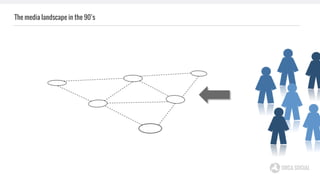
The media landscape in the 90’s
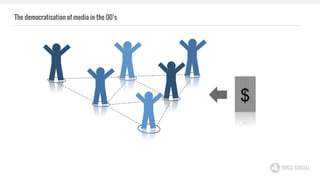
The democratisation of media in the 00’s
“Peoplearecreatingandsharingmedia”
St. Peter’s Square, 2005
St. Peter’s Square, 2013
“Peoplearecreatingandsharingphysicalgoods”
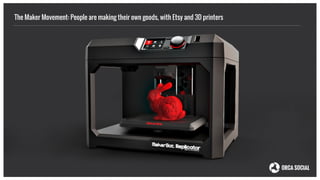
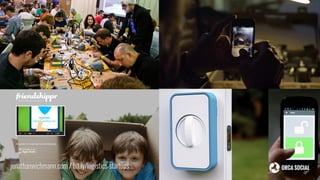
The Maker Movement: People are making their own goods, with Etsy and 3D printers
From 1 to 6: The collaborative economy is a major disruption
• If social media has been big, then you can’t imagine what this could potentially mean to businesses.
• In the collaborative economy people are sharing 6 things:
!
1. Goods (e.g. Yerdle, get physical things from your neighbour)
2. Services (on Taskrabbit and oDesk people are sharing their time)
3. Space (e.g. AirBnB, and Liquidspace on the business side)
4. Transportation (e.g. ride sharing rather than buying cars anew)
5. Money (sharing money, crowd-funding)
6. Food (e.g. Feastly, connecting homechefs, or LeftoverSwap)
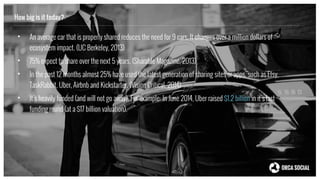
How big is it today?
• An average car that is properly shared reduces the need for 9 cars. It changes over a million dollars of
ecosystem impact. (UC Berkeley, 2013)
• 75% expect to share over the next 5 years. (Sharable Magazine, 2013)
• In the past 12 months almost 25% have used the latest generation of sharing sites or apps, such as Etsy,
TaskRabbit, Uber, Airbnb and Kickstarter. (Vision Critical, 2014)
• It’s heavily funded (and will not go away). For example: In June 2014, Uber raised $1.2 billion in it’s last
funding round (at a $17 billion valuation).
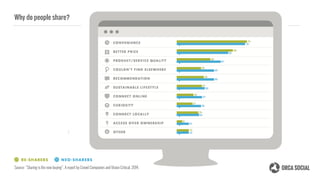
Why do people share?
Source: “Sharing is the new buying”. A report by Crowd Companies and Vision Critical, 2014.
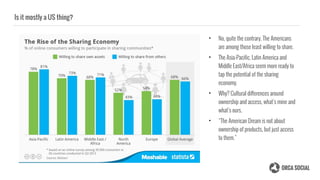
Is it mostly a US thing?
• No, quite the contrary. The Americans
are among those least willing to share.
• The Asia-Pacific, Latin America and
Middle East/Africa seem more ready to
tap the potential of the sharing
economy.
• Why? Cultural differences around
ownership and access, what’s mine and
what’s ours.
• “The American Dream is not about
ownership of products, but just access
to them.”
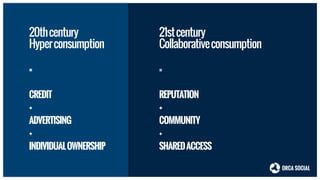
21stcentury
Collaborativeconsumption
!
=
!
REPUTATION
+
COMMUNITY
+
SHAREDACCESS
20thcentury
Hyperconsumption
!
=
!
CREDIT
+
ADVERTISING
+
INDIVIDUALOWNERSHIP
Chapter2:

Whatcancompaniesdo?
“Whatroledocompaniesplay,ifpeoplegetwhat
theyneedfromeachother?”
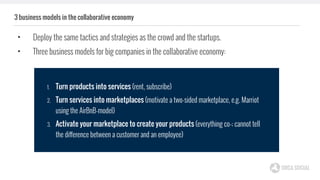
3 business models in the collaborative economy
• Deploy the same tactics and strategies as the crowd and the startups.
• Three business models for big companies in the collaborative economy:
1. Turn products into services (rent, subscribe)
2. Turn services into marketplaces (motivate a two-sided marketplace, e.g. Marriot
using the AirBnB-model)
3. Activate your marketplace to create your products (everything co-; cannot tell
the difference between a customer and an employee)
Both BMW and Toyota launch on-demand car rentals in cities
• In 2050, there’s simply no enough space for all the cars in the world.
• Find your car using the app and return anywhere.
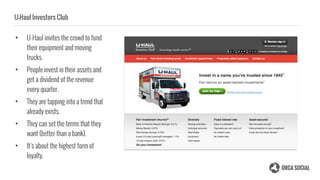
U-Haul Investors Club
• U-Haul invites the crowd to fund
their equipment and moving
trucks.
• People invest in their assets and
get a dividend of the revenue
every quarter.
• They are tapping into a trend that
already exists.
• They can set the terms that they
want (better than a bank).
• It’s about the highest form of
loyalty.
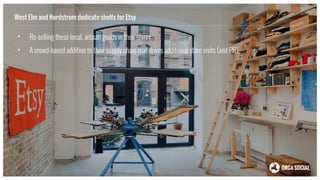
West Elm and Nordstrom dedicate shelfs for Etsy
• Re-selling these local, artisan goods in their stores.
• A crowd-based addition to their supply chain that drives additional store visits (and PR).
But why should you invite the crowd into your company?
• Basically, there’s two reasons why it’s a good idea: Efficiency gains + Developing a long-term
relationship with your customers.
• The crowd is good at: Innovation, flexibility and speed.
• Companies are good at: A trusted brand, consistency and scale.
Chapter3:

Thecrowd-basedsupplychain
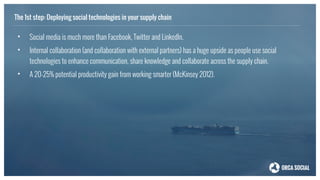
The 1st step: Deploying social technologies in your supply chain
• Social media is much more than Facebook, Twitter and LinkedIn.
• Internal collaboration (and collaboration with external partners) has a huge upside as people use social
technologies to enhance communication, share knowledge and collaborate across the supply chain.
• A 20-25% potential productivity gain from working smarter (McKinsey 2012).
Three short-term opportunities from deploying social technologies
1. Demand management. What do customers want?
2. Operations/Lean. Empower employees, through the cloud, to share experiences, ideas and
problems.
3. Real-time data. Today, problems within the supply chain can be detected fairly quickly. Useful
for both exceptions management and risk management.
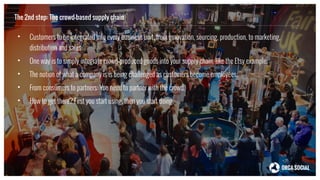
The 2nd step: The crowd-based supply chain
• Customers to be integrated into every business unit, from innovation, sourcing, production, to marketing,
distribution and sales.
• One way is to simply integrate crowd-produced goods into your supply chain, like the Etsy example.
• The notion of what a company is is being challenged as customers become employees.
• From consumers to partners: You need to partner with the crowd.
• How to get there? First you start using, then you start doing.
jonathanwichmann.com / bit.ly/logistics-startups
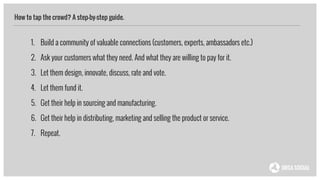
How to tap the crowd? A step-by-step guide.
1. Build a community of valuable connections (customers, experts, ambassadors etc.)
2. Ask your customers what they need. And what they are willing to pay for it.
3. Let them design, innovate, discuss, rate and vote.
4. Let them fund it.
5. Get their help in sourcing and manufacturing.
6. Get their help in distributing, marketing and selling the product or service.
7. Repeat.
Youneedtoletgotogainthemarket.
Anyquestions?
Twitter: @JonathanWich
www: jonathanwichmann.com / orcasocial.com

How the crowd changes supply chains

  • 1.
    HOW THE CROWD CHANGESSUPPLY CHAINSEXCHAiNGE 2014 / Frankfurt / @JonathanWich / 24.06.2014
  • 2.
  • 3.
    The media landscapein the 90’s
  • 4.
    The democratisation ofmedia in the 00’s
  • 5.
  • 6.
  • 7.
  • 10.
  • 11.
    The Maker Movement:People are making their own goods, with Etsy and 3D printers
  • 12.
    From 1 to6: The collaborative economy is a major disruption • If social media has been big, then you can’t imagine what this could potentially mean to businesses. • In the collaborative economy people are sharing 6 things: ! 1. Goods (e.g. Yerdle, get physical things from your neighbour) 2. Services (on Taskrabbit and oDesk people are sharing their time) 3. Space (e.g. AirBnB, and Liquidspace on the business side) 4. Transportation (e.g. ride sharing rather than buying cars anew) 5. Money (sharing money, crowd-funding) 6. Food (e.g. Feastly, connecting homechefs, or LeftoverSwap)
  • 13.
    How big isit today? • An average car that is properly shared reduces the need for 9 cars. It changes over a million dollars of ecosystem impact. (UC Berkeley, 2013) • 75% expect to share over the next 5 years. (Sharable Magazine, 2013) • In the past 12 months almost 25% have used the latest generation of sharing sites or apps, such as Etsy, TaskRabbit, Uber, Airbnb and Kickstarter. (Vision Critical, 2014) • It’s heavily funded (and will not go away). For example: In June 2014, Uber raised $1.2 billion in it’s last funding round (at a $17 billion valuation).
  • 14.
    Why do peopleshare? Source: “Sharing is the new buying”. A report by Crowd Companies and Vision Critical, 2014.
  • 15.
    Is it mostlya US thing? • No, quite the contrary. The Americans are among those least willing to share. • The Asia-Pacific, Latin America and Middle East/Africa seem more ready to tap the potential of the sharing economy. • Why? Cultural differences around ownership and access, what’s mine and what’s ours. • “The American Dream is not about ownership of products, but just access to them.”
  • 16.
  • 17.
  • 18.
  • 19.
    3 business modelsin the collaborative economy • Deploy the same tactics and strategies as the crowd and the startups. • Three business models for big companies in the collaborative economy: 1. Turn products into services (rent, subscribe) 2. Turn services into marketplaces (motivate a two-sided marketplace, e.g. Marriot using the AirBnB-model) 3. Activate your marketplace to create your products (everything co-; cannot tell the difference between a customer and an employee)
  • 20.
    Both BMW andToyota launch on-demand car rentals in cities • In 2050, there’s simply no enough space for all the cars in the world. • Find your car using the app and return anywhere.
  • 21.
    U-Haul Investors Club •U-Haul invites the crowd to fund their equipment and moving trucks. • People invest in their assets and get a dividend of the revenue every quarter. • They are tapping into a trend that already exists. • They can set the terms that they want (better than a bank). • It’s about the highest form of loyalty.
  • 22.
    West Elm andNordstrom dedicate shelfs for Etsy • Re-selling these local, artisan goods in their stores. • A crowd-based addition to their supply chain that drives additional store visits (and PR).
  • 23.
    But why shouldyou invite the crowd into your company? • Basically, there’s two reasons why it’s a good idea: Efficiency gains + Developing a long-term relationship with your customers. • The crowd is good at: Innovation, flexibility and speed. • Companies are good at: A trusted brand, consistency and scale.
  • 24.
  • 25.
    The 1st step:Deploying social technologies in your supply chain • Social media is much more than Facebook, Twitter and LinkedIn. • Internal collaboration (and collaboration with external partners) has a huge upside as people use social technologies to enhance communication, share knowledge and collaborate across the supply chain. • A 20-25% potential productivity gain from working smarter (McKinsey 2012).
  • 26.
    Three short-term opportunitiesfrom deploying social technologies 1. Demand management. What do customers want? 2. Operations/Lean. Empower employees, through the cloud, to share experiences, ideas and problems. 3. Real-time data. Today, problems within the supply chain can be detected fairly quickly. Useful for both exceptions management and risk management.
  • 27.
    The 2nd step:The crowd-based supply chain • Customers to be integrated into every business unit, from innovation, sourcing, production, to marketing, distribution and sales. • One way is to simply integrate crowd-produced goods into your supply chain, like the Etsy example. • The notion of what a company is is being challenged as customers become employees. • From consumers to partners: You need to partner with the crowd. • How to get there? First you start using, then you start doing.
  • 28.
  • 29.
    How to tapthe crowd? A step-by-step guide. 1. Build a community of valuable connections (customers, experts, ambassadors etc.) 2. Ask your customers what they need. And what they are willing to pay for it. 3. Let them design, innovate, discuss, rate and vote. 4. Let them fund it. 5. Get their help in sourcing and manufacturing. 6. Get their help in distributing, marketing and selling the product or service. 7. Repeat.
  • 30.
  • 32.