How starting small
can change the
(museum) world
Sharing is Caring X
Hamburg 20-21 April 2017
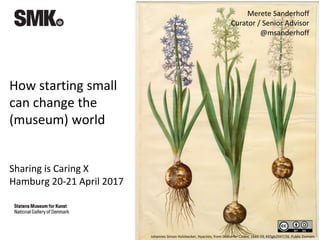
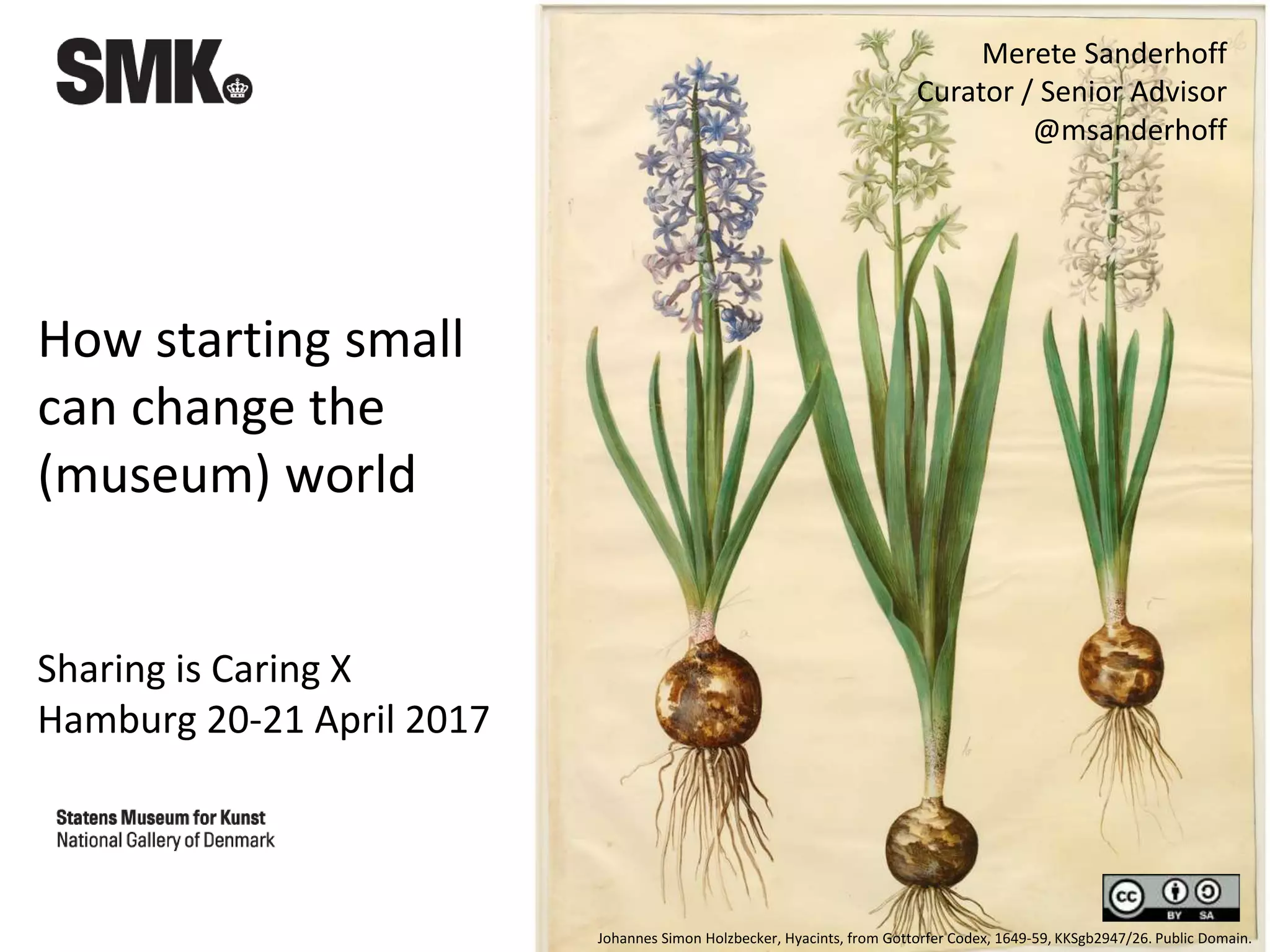
Johannes Simon Holzbecker, Hyacints, from Gottorfer Codex, 1649-59, KKSgb2947/26. Public Domain.
Merete Sanderhoff
Curator / Senior Advisor
@msanderhoff
Or, the story of
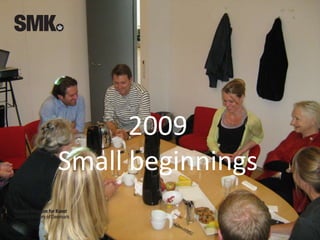
2009
Small beginnings
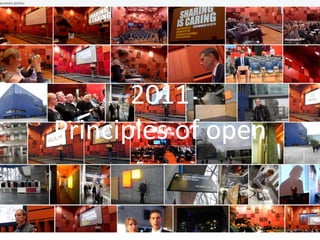
2011
Principles of open
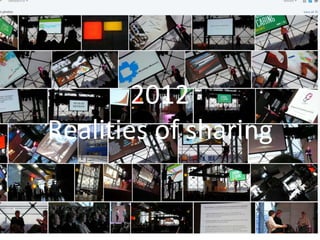
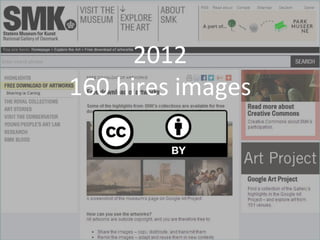
2012
Realities of sharing
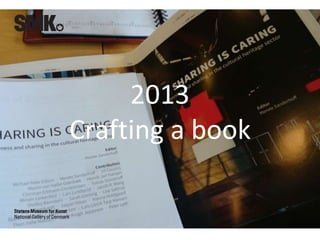
2013
Crafting a book
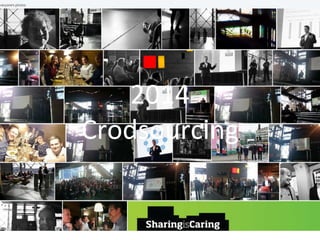
2014
Crowdsourcing
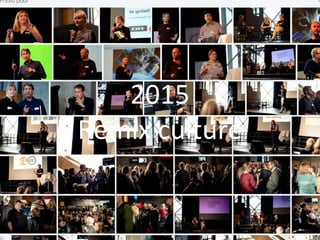
2015
Remix culture
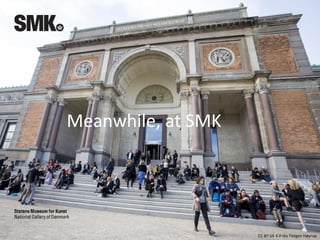
CC BY-SA 4.0 Ida Tietgen Høyrup
Meanwhile, at SMK
Galleries
Libraries
Archives
Museums
openglam.org
We want to be a catalyst
for our users’ creativity
2009 digital strategy
CC BY-SA 4.0 Ida Tietgen Høyrup
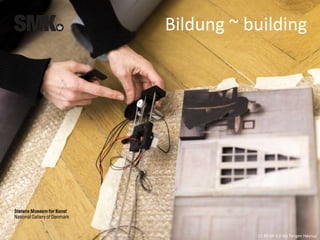
Bildung ~ building
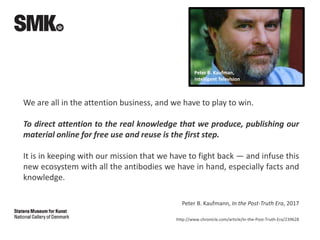
We are all in the attention business, and we have to play to win (…)
To direct attention to the real knowledge that we produce, publishing our
material online for free use and reuse is the first step.
It is in keeping with our mission that we have to fight back — and infuse this
new ecosystem with all the antibodies we have in hand, especially facts and
knowledge.
Peter B. Kaufman, In the Post-Truth Era, 2017
http://www.chronicle.com/article/In-the-Post-Truth-Era/239628
Peter B. Kaufman,
Intelligent Television
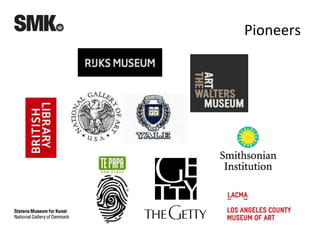
Pioneers
Our understanding of research, education,
artistic creativity, and the progress of
knowledge is built upon the axiom that no
idea stands alone, and that all innovation is
built on the ideas and innovation of others.
Smithsonian Web and New Media Strategy, Version 1.0, 2009
http://www.si.edu/content/pdf/about/web-new-media-strategy_v1.0.pdf
The preservation, transmission, and
advancement of knowledge in the digital age
are promoted by the unencumbered use and
reuse of digitized content for research,
teaching, learning, and creative activities.”
Memo on open access to digital representations of works in the public domain from
museum, library, and archive collections at Yale University, May 2011
http://odai.yale.edu/sites/default/files/OpenAccessLAMSFinal.pdf
To be a public museum your digital data should be free. And
digital data is not a threat to the real data, it’s just an
advertisement that only increases the aura of the original.
People go to the Louvre because they’ve seen the Mona
Lisa; the reason people might not be going to an institution
is because they don’t know what’s in your institution.
Digitization is a way to address that issue, in a way that
simply wasn’t possible before.
William Noel, The Wide Open Future of the Art Museum, 2012
http://blog.ted.com/the-wide-open-future-of-the-art-museum-qa-with-william-noel/
Our primary mission is to ‘tell the truth’. We put as
much quality in our work as possible. That is why
we share the best quality we have. If people google
‘The Milkmaid’ by Vermeer then we want them to
find our good quality image, not all the bad and
deformed versions of this beautiful painting.
Lizzy Jongma, former data manager, Rijksmuseum, 2012
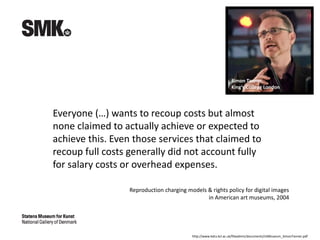
Everyone (…) wants to recoup costs but almost
none claimed to actually achieve or expected to
achieve this. Even those services that claimed to
recoup full costs generally did not account fully
for salary costs or overhead expenses.
http://www.kdcs.kcl.ac.uk/fileadmin/documents/USMuseum_SimonTanner.pdf
Simon Tanner,
King’s College London
Reproduction charging models & rights policy for digital images
in American art museums, 2004
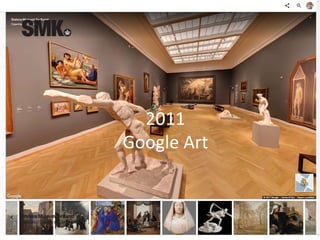
2011
Google Art
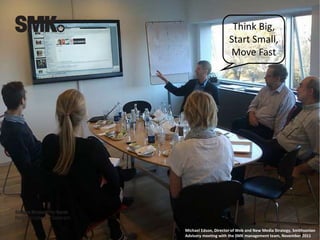
Think Big,
Start Small,
Move Fast
Michael Edson, Director of Web and New Media Strategy, Smithsonian
Advisory meeting with the SMK management team, November 2011
2012
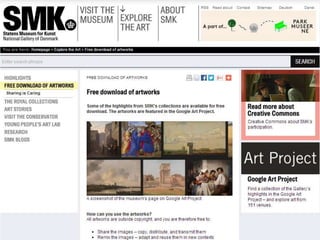
160 hires images
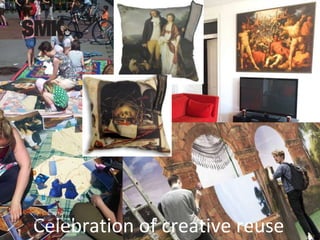
Celebration of creative reuse
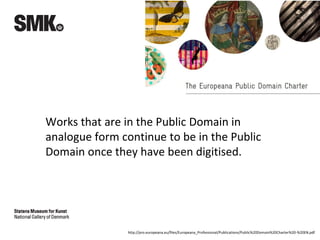
Works that are in the Public Domain in
analogue form continue to be in the Public
Domain once they have been digitised.
http://pro.europeana.eu/files/Europeana_Professional/Publications/Public%20Domain%20Charter%20-%20EN.pdf
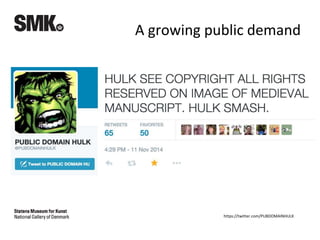
https://twitter.com/PUBDOMAINHULK
A growing public demand
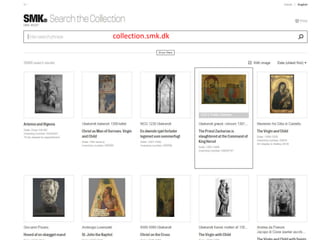
collection.smk.dk
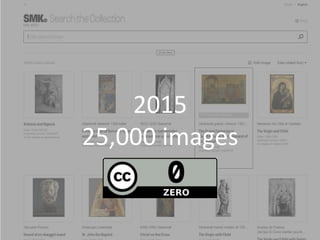
2015
25,000 images
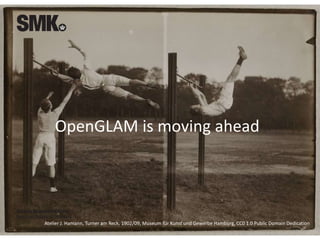
Atelier J. Hamann, Turner am Reck, 1902/09, Museum für Kunst und Gewerbe Hamburg, CC0 1.0 Public Domain Dedication
OpenGLAM is moving ahead
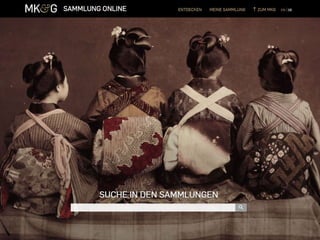
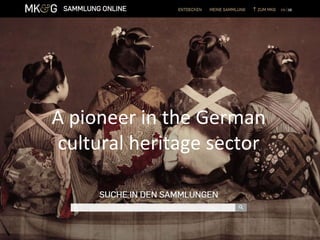
A pioneer in the German
cultural heritage sector
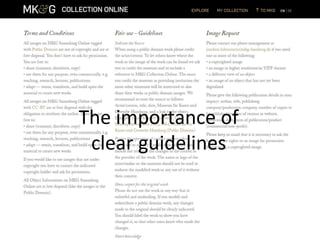
The importance of
clear guidelines
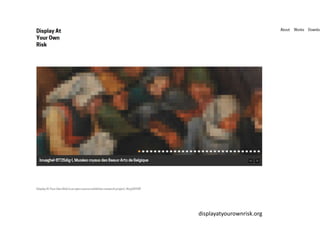
displayatyourownrisk.org
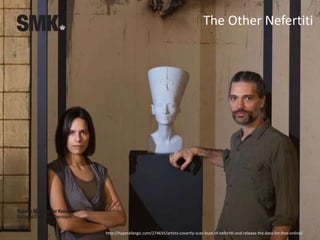
The Other Nefertiti
http://hyperallergic.com/274635/artists-covertly-scan-bust-of-nefertiti-and-release-the-data-for-free-online/
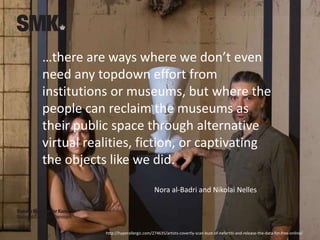
…there are ways where we don’t even
need any topdown effort from
institutions or museums, but where the
people can reclaim the museums as
their public space through alternative
virtual realities, fiction, or captivating
the objects like we did.
Nora al-Badri and Nikolai Nelles
http://hyperallergic.com/274635/artists-covertly-scan-bust-of-nefertiti-and-release-the-data-for-free-online/
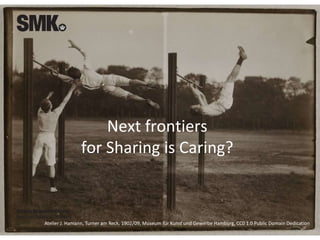
Atelier J. Hamann, Turner am Reck, 1902/09, Museum für Kunst und Gewerbe Hamburg, CC0 1.0 Public Domain Dedication
Next frontiers
for Sharing is Caring?
CC BY-SA 4.0 Ida Tietgen Høyrup
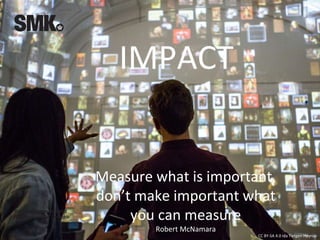
IMPACT
Measure what is important,
don’t make important what
you can measure
Robert McNamara
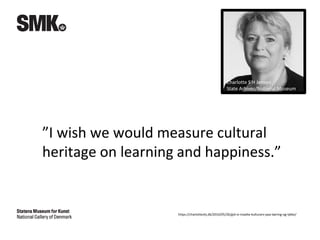
”I wish we would measure cultural
heritage on learning and happiness.”
https://charlotteshj.dk/2016/05/26/gid-vi-maalte-kulturarv-paa-laering-og-lykke/
Charlotte S H Jensen
State Arhives/National Museum
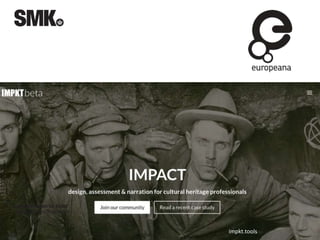
impkt.tools
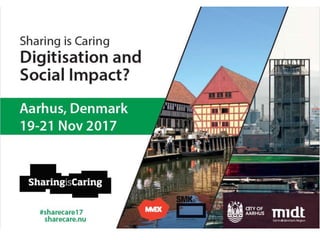
It’s growing!
#sharecarexBXL
Brussels 20 June
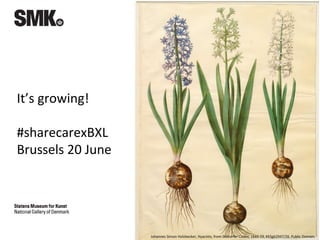
Johannes Simon Holzbecker, Hyacints, from Gottorfer Codex, 1649-59, KKSgb2947/26. Public Domain.
As museums, we do not hold any patent on how cultural heritage
can and should be interpreted and used.
Our role is increasingly to facilitate the general public’s use of
cultural heritage for learning, creativity and innovation.
Today, the museum as a place of enlightenment is based on
interaction. We are all part of this web. We enlighten each other.
Mikkel Bogh
Director, SMK
http://www.smk.dk/en/explore-the-art/smk-blogs/artikel/mikkel-bogh-blogs-enlightenment-in-the-age-of-digitisation/
Vielen Dank :)
Sharing is Caring X
Hamburg 20-21 April 2017
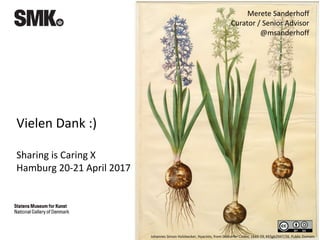
Johannes Simon Holzbecker, Hyacints, from Gottorfer Codex, 1649-59, KKSgb2947/26. Public Domain.
Merete Sanderhoff
Curator / Senior Advisor
@msanderhoff

How starting small can change the (museum) world

  • 1.
    How starting small canchange the (museum) world Sharing is Caring X Hamburg 20-21 April 2017 Johannes Simon Holzbecker, Hyacints, from Gottorfer Codex, 1649-59, KKSgb2947/26. Public Domain. Merete Sanderhoff Curator / Senior Advisor @msanderhoff
  • 2.
  • 3.
  • 4.
  • 5.
  • 6.
  • 7.
  • 8.
  • 9.
    CC BY-SA 4.0Ida Tietgen Høyrup Meanwhile, at SMK
  • 10.
  • 11.
    We want tobe a catalyst for our users’ creativity 2009 digital strategy
  • 12.
    CC BY-SA 4.0Ida Tietgen Høyrup Bildung ~ building
  • 14.
    We are allin the attention business, and we have to play to win (…) To direct attention to the real knowledge that we produce, publishing our material online for free use and reuse is the first step. It is in keeping with our mission that we have to fight back — and infuse this new ecosystem with all the antibodies we have in hand, especially facts and knowledge. Peter B. Kaufman, In the Post-Truth Era, 2017 http://www.chronicle.com/article/In-the-Post-Truth-Era/239628 Peter B. Kaufman, Intelligent Television
  • 15.
  • 16.
    Our understanding ofresearch, education, artistic creativity, and the progress of knowledge is built upon the axiom that no idea stands alone, and that all innovation is built on the ideas and innovation of others. Smithsonian Web and New Media Strategy, Version 1.0, 2009 http://www.si.edu/content/pdf/about/web-new-media-strategy_v1.0.pdf
  • 17.
    The preservation, transmission,and advancement of knowledge in the digital age are promoted by the unencumbered use and reuse of digitized content for research, teaching, learning, and creative activities.” Memo on open access to digital representations of works in the public domain from museum, library, and archive collections at Yale University, May 2011 http://odai.yale.edu/sites/default/files/OpenAccessLAMSFinal.pdf
  • 18.
    To be apublic museum your digital data should be free. And digital data is not a threat to the real data, it’s just an advertisement that only increases the aura of the original. People go to the Louvre because they’ve seen the Mona Lisa; the reason people might not be going to an institution is because they don’t know what’s in your institution. Digitization is a way to address that issue, in a way that simply wasn’t possible before. William Noel, The Wide Open Future of the Art Museum, 2012 http://blog.ted.com/the-wide-open-future-of-the-art-museum-qa-with-william-noel/
  • 19.
    Our primary missionis to ‘tell the truth’. We put as much quality in our work as possible. That is why we share the best quality we have. If people google ‘The Milkmaid’ by Vermeer then we want them to find our good quality image, not all the bad and deformed versions of this beautiful painting. Lizzy Jongma, former data manager, Rijksmuseum, 2012
  • 20.
    Everyone (…) wantsto recoup costs but almost none claimed to actually achieve or expected to achieve this. Even those services that claimed to recoup full costs generally did not account fully for salary costs or overhead expenses. http://www.kdcs.kcl.ac.uk/fileadmin/documents/USMuseum_SimonTanner.pdf Simon Tanner, King’s College London Reproduction charging models & rights policy for digital images in American art museums, 2004
  • 21.
  • 22.
    Think Big, Start Small, MoveFast Michael Edson, Director of Web and New Media Strategy, Smithsonian Advisory meeting with the SMK management team, November 2011
  • 24.
  • 25.
  • 26.
    Works that arein the Public Domain in analogue form continue to be in the Public Domain once they have been digitised. http://pro.europeana.eu/files/Europeana_Professional/Publications/Public%20Domain%20Charter%20-%20EN.pdf
  • 27.
  • 28.
  • 29.
  • 30.
    Atelier J. Hamann,Turner am Reck, 1902/09, Museum für Kunst und Gewerbe Hamburg, CC0 1.0 Public Domain Dedication OpenGLAM is moving ahead
  • 32.
    A pioneer inthe German cultural heritage sector
  • 33.
  • 36.
  • 37.
  • 38.
    …there are wayswhere we don’t even need any topdown effort from institutions or museums, but where the people can reclaim the museums as their public space through alternative virtual realities, fiction, or captivating the objects like we did. Nora al-Badri and Nikolai Nelles http://hyperallergic.com/274635/artists-covertly-scan-bust-of-nefertiti-and-release-the-data-for-free-online/
  • 39.
    Atelier J. Hamann,Turner am Reck, 1902/09, Museum für Kunst und Gewerbe Hamburg, CC0 1.0 Public Domain Dedication Next frontiers for Sharing is Caring?
  • 40.
    CC BY-SA 4.0Ida Tietgen Høyrup IMPACT Measure what is important, don’t make important what you can measure Robert McNamara
  • 41.
    ”I wish wewould measure cultural heritage on learning and happiness.” https://charlotteshj.dk/2016/05/26/gid-vi-maalte-kulturarv-paa-laering-og-lykke/ Charlotte S H Jensen State Arhives/National Museum
  • 42.
  • 44.
    It’s growing! #sharecarexBXL Brussels 20June Johannes Simon Holzbecker, Hyacints, from Gottorfer Codex, 1649-59, KKSgb2947/26. Public Domain.
  • 45.
    As museums, wedo not hold any patent on how cultural heritage can and should be interpreted and used. Our role is increasingly to facilitate the general public’s use of cultural heritage for learning, creativity and innovation. Today, the museum as a place of enlightenment is based on interaction. We are all part of this web. We enlighten each other. Mikkel Bogh Director, SMK http://www.smk.dk/en/explore-the-art/smk-blogs/artikel/mikkel-bogh-blogs-enlightenment-in-the-age-of-digitisation/
  • 46.
    Vielen Dank :) Sharingis Caring X Hamburg 20-21 April 2017 Johannes Simon Holzbecker, Hyacints, from Gottorfer Codex, 1649-59, KKSgb2947/26. Public Domain. Merete Sanderhoff Curator / Senior Advisor @msanderhoff