Public Domain Day
2018
Sam Donvil
sam@packed.be
@PACKEDvzw
• 2006 - 2010: Platform for Archiving and Conservation of Art on Electronic
and Digital Media
• 2011 - present: Centre of Expertise Digital Heritage
• Flemish, Belgian and European projects
• Support for ICT-processes at heritage and arts organisations (o.a.
creating, storage, cataloguing, online access, exchange and reuse) and
policy thereof
www.packed.be | www.projectcest.be | www.scart.be | www.projecttracks.be | www.scoremodel.org ...
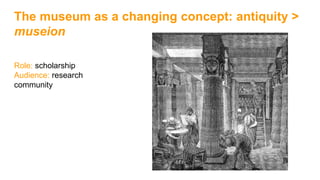
The museum as a changing concept: antiquity >
museion
Role: scholarship
Audience: research
community
The museum as a changing concept:
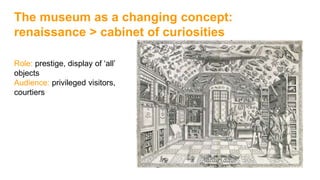
renaissance > cabinet of curiosities
Role: prestige, display of ‘all’
objects
Audience: privileged visitors,
courtiers
The museum as a changing concept:
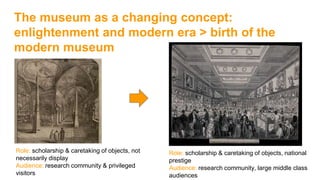
enlightenment and modern era > birth of the
modern museum
Role: scholarship & caretaking of objects, not
necessarily display
Audience: research community & privileged
visitors
Role: scholarship & caretaking of objects, national
prestige
Audience: research community, large middle class
audiences
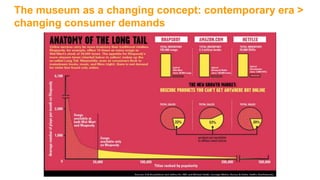
The museum as a changing concept: contemporary era >
changing consumer demands
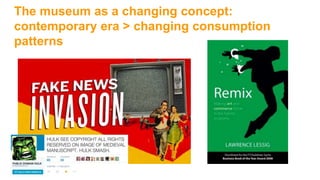
The museum as a changing concept: contemporary era >
changing consumption patterns
Serendipity
“The internet and the growth of digital libraries holds the promise of democratizing access not
just to knowledge, but to the opportunities to discover things you did NOT know you
wanted to discover.”
“We need serendipity now more than ever – and we need it for as many people as possible.
Because encountering new, unexpected ideas and information – being exposed to data,
arguments, concepts – through books, for example — that we didn’t know existed, just might
be the key to helping us all think in new ways, see the world through a different lens, and see
new ways to solve old and sticky problems.
Chris Bourg – Director of Libraries at MIT
The museum as a changing concept:
contemporary era > changing consumption
patterns
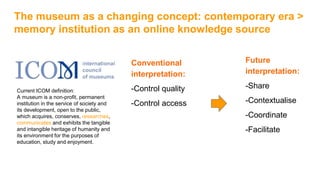
The museum as a changing concept: contemporary era >
memory institution as an online knowledge source
Future
interpretation:
-Share
-Contextualise
-Coordinate
-Facilitate
Conventional
interpretation:
-Control quality
-Control access
Current ICOM definition:
A museum is a non-profit, permanent
institution in the service of society and
its development, open to the public,
which acquires, conserves, researches,
communicates and exhibits the tangible
and intangible heritage of humanity and
its environment for the purposes of
education, study and enjoyment.
Why is open not the norm yet? > Fear of change
“To be a public museum your digital data should be free. And digital data is not a
threat to the real data, it’s just an advertisement that only increases the aura of
the original. People go to the Louvre because they’ve seen the Mona Lisa; the
reason people might not be going to an institution is because they don’t know
what’s in your institution. Digitization is a way to address that issue, in a way that
simply wasn’t possible before.”
William Noel, The Wide Open Future of the Art Museum, 2012
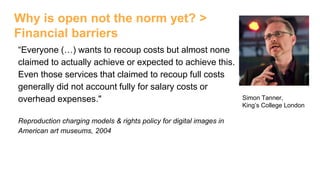
Why is open not the norm yet? >
Financial barriers
“Everyone (…) wants to recoup costs but almost none
claimed to actually achieve or expected to achieve this.
Even those services that claimed to recoup full costs
generally did not account fully for salary costs or
overhead expenses."
Reproduction charging models & rights policy for digital images in
American art museums, 2004
Simon Tanner,
King’s College London
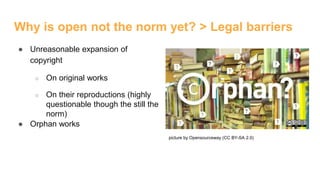
Why is open not the norm yet? > Legal barriers
● Unreasonable expansion of
copyright
○ On original works
○ On their reproductions (highly
questionable though the still the
norm)
● Orphan works
picture by Opensourceway (CC BY-SA 2.0)
How can we change our business model to allow opening up
our digital collections now, in the absence of conclusive
evidenve about its long term impact on our institutions, if we
need to have that evidence to convince our colleagues and
management to start in the first place?
Solution: Think big, start small, move fast
● Overcoming the Catch-22 by doing as a matter of
principle within the possibilities and opportunities of
each institution
● Support network to exchange experiences, practices
and inspiration
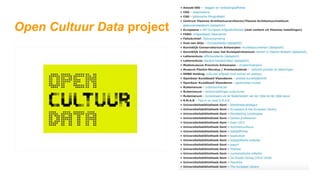
Open Cultuur Data project
Open data on Wikimedia platforms
Why Wikimedia?
● visibility
● reuse
● engagement
● free + active community
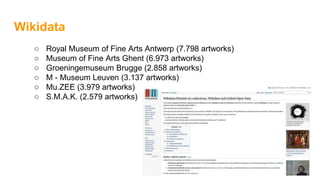
Wikidata
○ Royal Museum of Fine Arts Antwerp (7.798 artworks)
○ Museum of Fine Arts Ghent (6.973 artworks)
○ Groeningemuseum Brugge (2.858 artworks)
○ M - Museum Leuven (3.137 artworks)
○ Mu.ZEE (3.979 artworks)
○ S.M.A.K. (2.579 artworks)
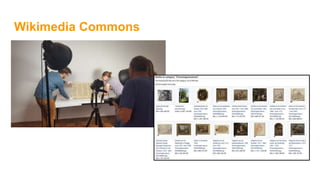
Wikimedia Commons
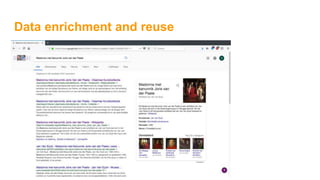
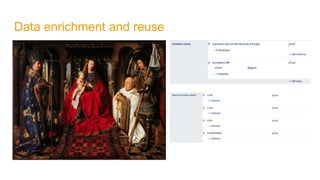
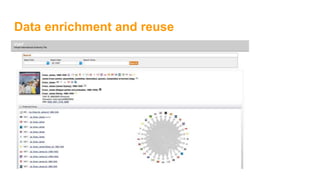
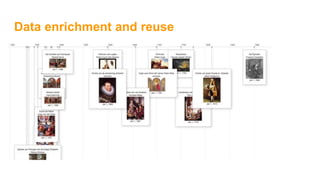
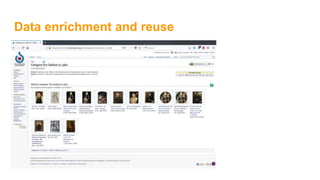
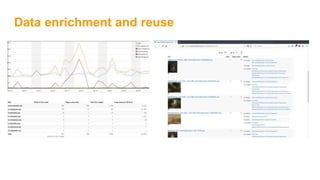
Data enrichment and reuse
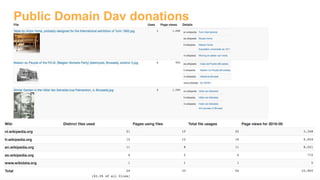
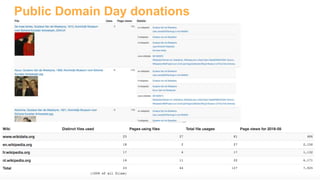
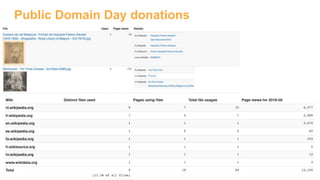
Public Domain Day donations
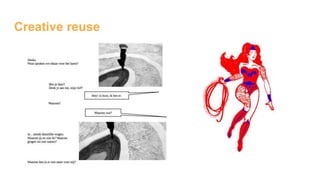
Creative reuse
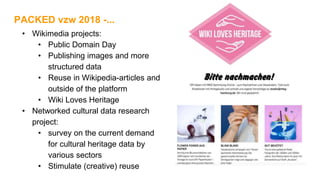
• Wikimedia projects:
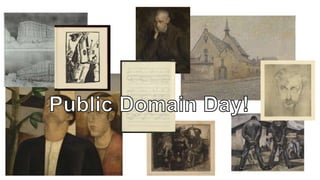
• Public Domain Day
• Publishing images and more
structured data
• Reuse in Wikipedia-articles and
outside of the platform
• Wiki Loves Heritage
• Networked cultural data research
project:
• survey on the current demand
for cultural heritage data by
various sectors
• Stimulate (creative) reuse
PACKED vzw 2018 -...
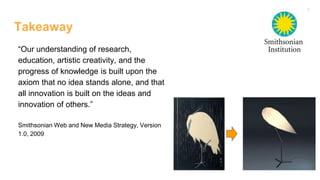
Takeaway
“Our understanding of research,
education, artistic creativity, and the
progress of knowledge is built upon the
axiom that no idea stands alone, and that
all innovation is built on the ideas and
innovation of others.”
Smithsonian Web and New Media Strategy, Version
1.0, 2009
Thank you!
Questions? Feedback?
Sam Donvil
sam@packed.be
@PACKEDvzw

Sam Donvil PACKED public domain day 2018

  • 1.
    Public Domain Day 2018 SamDonvil sam@packed.be @PACKEDvzw
  • 2.
    • 2006 -2010: Platform for Archiving and Conservation of Art on Electronic and Digital Media • 2011 - present: Centre of Expertise Digital Heritage • Flemish, Belgian and European projects • Support for ICT-processes at heritage and arts organisations (o.a. creating, storage, cataloguing, online access, exchange and reuse) and policy thereof www.packed.be | www.projectcest.be | www.scart.be | www.projecttracks.be | www.scoremodel.org ...
  • 4.
    The museum asa changing concept: antiquity > museion Role: scholarship Audience: research community
  • 5.
    The museum asa changing concept: renaissance > cabinet of curiosities Role: prestige, display of ‘all’ objects Audience: privileged visitors, courtiers
  • 6.
    The museum asa changing concept: enlightenment and modern era > birth of the modern museum Role: scholarship & caretaking of objects, not necessarily display Audience: research community & privileged visitors Role: scholarship & caretaking of objects, national prestige Audience: research community, large middle class audiences
  • 7.
    The museum asa changing concept: contemporary era > changing consumer demands
  • 8.
    The museum asa changing concept: contemporary era > changing consumption patterns Serendipity “The internet and the growth of digital libraries holds the promise of democratizing access not just to knowledge, but to the opportunities to discover things you did NOT know you wanted to discover.” “We need serendipity now more than ever – and we need it for as many people as possible. Because encountering new, unexpected ideas and information – being exposed to data, arguments, concepts – through books, for example — that we didn’t know existed, just might be the key to helping us all think in new ways, see the world through a different lens, and see new ways to solve old and sticky problems. Chris Bourg – Director of Libraries at MIT
  • 9.
    The museum asa changing concept: contemporary era > changing consumption patterns
  • 10.
    The museum asa changing concept: contemporary era > memory institution as an online knowledge source Future interpretation: -Share -Contextualise -Coordinate -Facilitate Conventional interpretation: -Control quality -Control access Current ICOM definition: A museum is a non-profit, permanent institution in the service of society and its development, open to the public, which acquires, conserves, researches, communicates and exhibits the tangible and intangible heritage of humanity and its environment for the purposes of education, study and enjoyment.
  • 11.
    Why is opennot the norm yet? > Fear of change “To be a public museum your digital data should be free. And digital data is not a threat to the real data, it’s just an advertisement that only increases the aura of the original. People go to the Louvre because they’ve seen the Mona Lisa; the reason people might not be going to an institution is because they don’t know what’s in your institution. Digitization is a way to address that issue, in a way that simply wasn’t possible before.” William Noel, The Wide Open Future of the Art Museum, 2012
  • 12.
    Why is opennot the norm yet? > Financial barriers “Everyone (…) wants to recoup costs but almost none claimed to actually achieve or expected to achieve this. Even those services that claimed to recoup full costs generally did not account fully for salary costs or overhead expenses." Reproduction charging models & rights policy for digital images in American art museums, 2004 Simon Tanner, King’s College London
  • 13.
    Why is opennot the norm yet? > Legal barriers ● Unreasonable expansion of copyright ○ On original works ○ On their reproductions (highly questionable though the still the norm) ● Orphan works picture by Opensourceway (CC BY-SA 2.0)
  • 14.
    How can wechange our business model to allow opening up our digital collections now, in the absence of conclusive evidenve about its long term impact on our institutions, if we need to have that evidence to convince our colleagues and management to start in the first place?
  • 15.
    Solution: Think big,start small, move fast ● Overcoming the Catch-22 by doing as a matter of principle within the possibilities and opportunities of each institution ● Support network to exchange experiences, practices and inspiration
  • 16.
  • 17.
    Open data onWikimedia platforms Why Wikimedia? ● visibility ● reuse ● engagement ● free + active community
  • 18.
    Wikidata ○ Royal Museumof Fine Arts Antwerp (7.798 artworks) ○ Museum of Fine Arts Ghent (6.973 artworks) ○ Groeningemuseum Brugge (2.858 artworks) ○ M - Museum Leuven (3.137 artworks) ○ Mu.ZEE (3.979 artworks) ○ S.M.A.K. (2.579 artworks)
  • 19.
  • 20.
  • 21.
  • 22.
  • 23.
  • 24.
  • 25.
  • 27.
  • 28.
  • 29.
  • 30.
  • 31.
    • Wikimedia projects: •Public Domain Day • Publishing images and more structured data • Reuse in Wikipedia-articles and outside of the platform • Wiki Loves Heritage • Networked cultural data research project: • survey on the current demand for cultural heritage data by various sectors • Stimulate (creative) reuse PACKED vzw 2018 -...
  • 32.
    Takeaway “Our understanding ofresearch, education, artistic creativity, and the progress of knowledge is built upon the axiom that no idea stands alone, and that all innovation is built on the ideas and innovation of others.” Smithsonian Web and New Media Strategy, Version 1.0, 2009
  • 33.
    Thank you! Questions? Feedback? SamDonvil sam@packed.be @PACKEDvzw