Indexing
Searching
Page rank
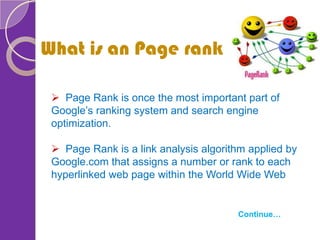
 Page Rank is once the most important part of
Google’s ranking system and search engine
optimization.
 Page Rank is a link analysis algorithm applied by
Google.com that assigns a number or rank to each
hyperlinked web page within the World Wide Web
What is an Page rank
Continue…
 Google assigns a numeric weighting from 0-10
for each webpage in the internet. This page rank
denotes a sites importance in the eyes of Google.
 A hyperlink to a page counts as a vote of support
 A web crawler may use page rank as one of a
Number of important metrics it uses to determine
Which URL to visit next during crawl of the web
What is an Indexing
 Search engine index is the place where all the data the
search engine has collected is stored.
 Search engine indexing is the process of a search
engine collecting, parses and stores data for use by the
search engine.
 Indexing is the process of creating
indexes for record collections
 The purpose of storing an index is to optimize
speed and performance in finding relevant
documents for a search query
 Without an index the search engine would scan
Every document in the corpus, Which would require
considerable Time and computing power.
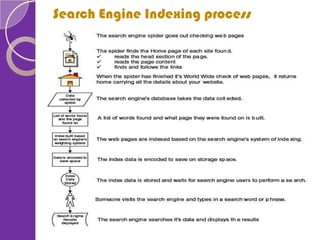
Search Engine Indexing process
Index design factors
 Merge Factors
 Storage techniques
 Index size
 Lookup speed
 Maintenance
Web search Engine
 These pages are retrieved by a web crawler
An automated web browser which follows
every link it sees.
 Another program, called an indexer, then reads
these documents and creates an Index based on
the words contained in each document.
 A web search engine is a software system that is
designed to search for information on the World Wide
 The contents of each page are then analyzed
to determine how it should be indexed
 Each search engine uses a proprietary algorithm to
create its indices such that, ideally, only meaningful
results are returned for each Query.
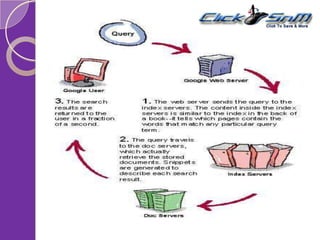
A User enters a query in to a
search engine, the
Engine examines its index and
provides a listing
of best matching web pages
according to criteria,
Usually with a short summary
containing the
Document’s title.
Search syntax
 Google’s advanced search web form gives several
additional fields which may used to qualify searches by
search criteria as date of first retrieval.
 All advanced queries transform to regular queries, usually
with additional qualified term.
 Google's search engine normally accepts queries as a
simple text, and breaks up the user's text into a sequence of
search terms, which will usually be words that are to occur in
the results, but one can also use Boolean operators, such as:
quotations marks (") for a phrase, a prefix such as "+" , "-" for
qualified terms or one of several advanced operators, such as
"site:"
Search engine optimization
 It is the process of improving the volume and quality
of traffic to a website from search engines via results.
 Higher a site’s “page rank”, the more visitors it will receive
from the search engine.
 Search engine optimization (SEO) is the process of
affecting the visibility of a website or a web page in a search
engine's "natural" or un-paid ("organic") search results
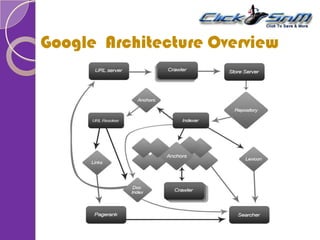
Google Architecture Overview
Conclusion
 Google is designed to be a scalable search engine
 The Primary goal is to provide high quality search result
Over a rapidly growing world wide web.
 Google employs a number of techniques to improve
Search quality including page rank, anchor text, and
Proximity information.
Presented by:
http://www.clicksnm.com

How search engine works

  • 2.
  • 3.
     Page Rankis once the most important part of Google’s ranking system and search engine optimization.  Page Rank is a link analysis algorithm applied by Google.com that assigns a number or rank to each hyperlinked web page within the World Wide Web What is an Page rank Continue…
  • 4.
     Google assignsa numeric weighting from 0-10 for each webpage in the internet. This page rank denotes a sites importance in the eyes of Google.  A hyperlink to a page counts as a vote of support  A web crawler may use page rank as one of a Number of important metrics it uses to determine Which URL to visit next during crawl of the web
  • 5.
    What is anIndexing  Search engine index is the place where all the data the search engine has collected is stored.  Search engine indexing is the process of a search engine collecting, parses and stores data for use by the search engine.  Indexing is the process of creating indexes for record collections
  • 6.
     The purposeof storing an index is to optimize speed and performance in finding relevant documents for a search query  Without an index the search engine would scan Every document in the corpus, Which would require considerable Time and computing power.
  • 7.
  • 8.
    Index design factors Merge Factors  Storage techniques  Index size  Lookup speed  Maintenance
  • 9.
    Web search Engine These pages are retrieved by a web crawler An automated web browser which follows every link it sees.  Another program, called an indexer, then reads these documents and creates an Index based on the words contained in each document.  A web search engine is a software system that is designed to search for information on the World Wide
  • 10.
     The contentsof each page are then analyzed to determine how it should be indexed  Each search engine uses a proprietary algorithm to create its indices such that, ideally, only meaningful results are returned for each Query.
  • 11.
    A User entersa query in to a search engine, the Engine examines its index and provides a listing of best matching web pages according to criteria, Usually with a short summary containing the Document’s title.
  • 13.
    Search syntax  Google’sadvanced search web form gives several additional fields which may used to qualify searches by search criteria as date of first retrieval.  All advanced queries transform to regular queries, usually with additional qualified term.  Google's search engine normally accepts queries as a simple text, and breaks up the user's text into a sequence of search terms, which will usually be words that are to occur in the results, but one can also use Boolean operators, such as: quotations marks (") for a phrase, a prefix such as "+" , "-" for qualified terms or one of several advanced operators, such as "site:"
  • 14.
    Search engine optimization It is the process of improving the volume and quality of traffic to a website from search engines via results.  Higher a site’s “page rank”, the more visitors it will receive from the search engine.  Search engine optimization (SEO) is the process of affecting the visibility of a website or a web page in a search engine's "natural" or un-paid ("organic") search results
  • 15.
  • 16.
    Conclusion  Google isdesigned to be a scalable search engine  The Primary goal is to provide high quality search result Over a rapidly growing world wide web.  Google employs a number of techniques to improve Search quality including page rank, anchor text, and Proximity information.
  • 17.