Jeff Kosciejew
Agile Catalyst & Magician, Manulife
kosciejew@gmail.com
@kosciejew
How do you lead?
How do you lead?
Built upon Leaders’ Actions Speak but Their Talk
Matters articles & workshop by David Verble
http://www.verbleworthverble.com/our-team/david-verble-m-s/
http://www.lean-transform.com/our-partners/david-verble/
Possible Outcomes Today
• Something you can apply with your own
teams and colleagues to enhance current
team dynamics & communication
• Opportunity to identify where you are now
• Better understanding of your own style
• Awareness of how others see you
Today’s Workshop Format
• Pair listening activity
• Triad activity
• Coding of statements
• Debrief of triad activity
• Discussion
Activity 1 – Round 1
• Organize yourselves into pairs
• Think of a work situation that’s frustrating
• Try not to focus on the nature of the
situation & not the specific people in it (as
much as possible)
Activity 1 – Round 1
• Determine who will tell their story first
• The Listener can ask questions and talk
about the story that is being told, but
shouldn’t speak so often that it keeps the
Story Teller from sharing and completing
their story
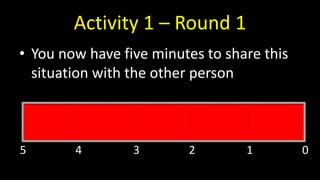
Activity 1 – Round 1
• You now have five minutes to share this
situation with the other person
5 4 3 2 1 0
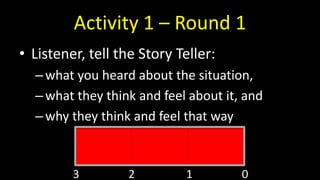
Activity 1 – Round 1
• Listener, tell the Story Teller:
–what you heard about the situation,
–what they think and feel about it, and
–why they think and feel that way
3 2 1 0
Activity 1 – Round 1
• Story Teller:
–Complete the checklist “Was I heard” to
provide feedback to your Listener
–Check marks are fine
(but additional comments are welcome)
Activity 1 – Round 1
• Story Teller:
–Complete the checklist “Was I heard” to
provide feedback to your Listener
–Check marks are fine
(but additional comments are welcome)
• DO NOT DEBRIEF!
Activity 1 – Round 2
• Now, switch roles
• Story teller  Listener
• Listener  Story teller
Activity 1 – Round 2
• New Story Teller:
–Think of a work situation that’s frustrating
–Try not to focus on the nature of the situation
& not the specific people in it (as much as
possible)
Activity 1 – Round 2
• The new Listener can ask questions and
talk about the story that is being told, but
shouldn’t speak so often that it keeps the
Story Teller from sharing and completing
their story
Activity 1 – Round 2
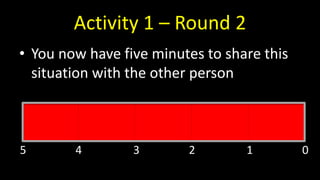
• You now have five minutes to share this
situation with the other person
5 4 3 2 1 0
Activity 1 – Round 2
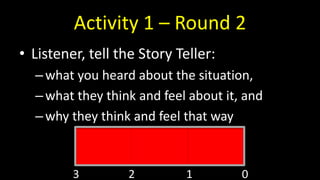
• Listener, tell the Story Teller:
–what you heard about the situation,
–what they think and feel about it, and
–why they think and feel that way
3 2 1 0
Activity 1 – Round 2
• Story Teller:
–Complete the checklist “Was I heard” to
provide feedback to your Listener
–Check marks are fine
(but additional comments are welcome)
Activity 1 – Round 2
• Story Teller:
–Complete the checklist “Was I heard” to
provide feedback to your Listener
–Check marks are fine
(but additional comments are welcome)
• DO NOT DEBRIEF!
Activity 1 – Round 3
• Exchange surveys without discussion
• Read and reflect on your survey
• Do not ask your listener to explain or
defend
• Simply accept it as their experience
Activity 1 - Considerations
• When dealing with others who you want to
help develop a problem solving mindset, you
may want to restrain the impulse to show what
you know
• Consider asking questions that you don’t think
you already have the answers to
• Allow your natural curiosity to lead you to try to
learn what the other thinks
Activity 1
Activity 2
• Organize yourself into groups of three
• Determine who will start in each of the
following roles:
– Observer
– Manager / Coach
– Problem Owner
Don’t worry, we’ll do this three times…
You’ll have a chance to experience each role
Activity 2
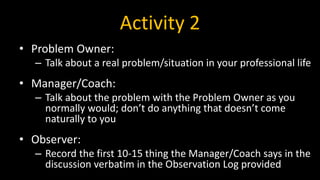
• Problem Owner:
– Talk about a real problem/situation in your professional life
• Manager/Coach:
– Talk about the problem with the Problem Owner as you
normally would; don’t do anything that doesn’t come
naturally to you
• Observer:
– Record the first 10-15 thing the Manager/Coach says in the
discussion verbatim in the Observation Log provided
Activity 2
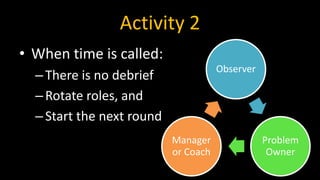
• When time is called:
–There is no debrief
–Rotate roles, and
–Start the next round
Observer
Problem
Owner
Manager
or Coach
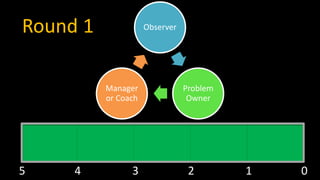
5 4 3 2 1 0
Observer
Problem
Owner
Manager
or Coach
Round 1
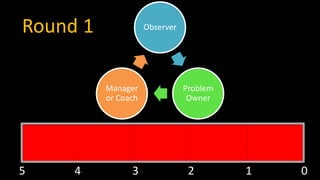
Observer
Problem
Owner
Manager
or Coach
Round 1
5 4 3 2 1 0
Observer
Problem
Owner
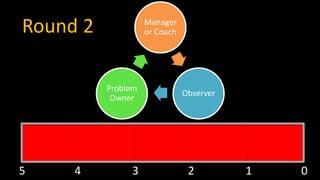
Manager
or Coach
5 4 3 2 1 0
Round 2
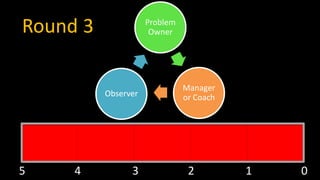
Observer
Problem
Owner
Manager
or Coach
5 4 3 2 1 0
Round 3
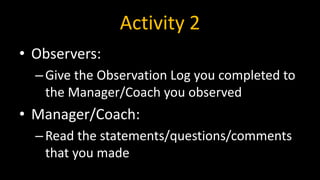
Activity 2
• Observers:
–Give the Observation Log you completed to
the Manager/Coach you observed
• Manager/Coach:
–Read the statements/questions/comments
that you made
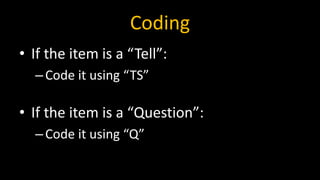
Coding
• If the item is a “Tell”:
–Code it using “TS”
• If the item is a “Question”:
–Code it using “Q”
Coding Questions
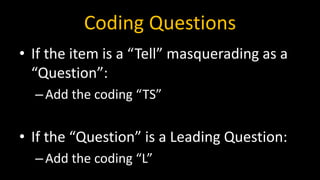
• If the item is a “Tell” masquerading as a
“Question”:
–Add the coding “TS”
• If the “Question” is a Leading Question:
–Add the coding “L”
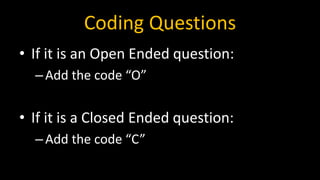
Coding Questions
• If it is an Open Ended question:
–Add the code “O”
• If it is a Closed Ended question:
–Add the code “C”
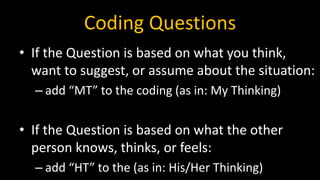
Coding Questions
• If the Question is based on what you think,
want to suggest, or assume about the situation:
– add “MT” to the coding (as in: My Thinking)
• If the Question is based on what the other
person knows, thinks, or feels:
– add “HT” to the (as in: His/Her Thinking)
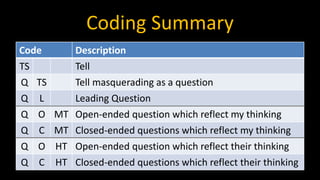
Coding Summary
Code Description
TS Tell
Q TS Tell masquerading as a question
Q L Leading Question
Q O MT Open-ended question which reflect my thinking
Q C MT Closed-ended questions which reflect my thinking
Q O HT Open-ended question which reflect their thinking
Q C HT Closed-ended questions which reflect their thinking
To consider…
• Were your items mostly Asking or Telling?
• Were your questions mostly Open, Closed, or
Leading?
• Were your questions based mostly on what you
were thinking, or what you wanted to learn about
what the other person knows & was thinking?
• Did you mostly confirm things you already knew or
thought, or did you learn things you did not know?
Activity 1
Jeff Kosciejew
Agile Catalyst & Magician, Manulife
kosciejew@gmail.com
@kosciejew
How do you lead?
Jeff Kosciejew
Agile Catalyst & Magician, Manulife
kosciejew@gmail.com
@kosciejew
How do you lead?

How do you lead?

  • 1.
    Jeff Kosciejew Agile Catalyst& Magician, Manulife kosciejew@gmail.com @kosciejew How do you lead?
  • 2.
    How do youlead? Built upon Leaders’ Actions Speak but Their Talk Matters articles & workshop by David Verble http://www.verbleworthverble.com/our-team/david-verble-m-s/ http://www.lean-transform.com/our-partners/david-verble/
  • 3.
    Possible Outcomes Today •Something you can apply with your own teams and colleagues to enhance current team dynamics & communication • Opportunity to identify where you are now • Better understanding of your own style • Awareness of how others see you
  • 4.
    Today’s Workshop Format •Pair listening activity • Triad activity • Coding of statements • Debrief of triad activity • Discussion
  • 5.
    Activity 1 –Round 1 • Organize yourselves into pairs • Think of a work situation that’s frustrating • Try not to focus on the nature of the situation & not the specific people in it (as much as possible)
  • 6.
    Activity 1 –Round 1 • Determine who will tell their story first • The Listener can ask questions and talk about the story that is being told, but shouldn’t speak so often that it keeps the Story Teller from sharing and completing their story
  • 7.
    Activity 1 –Round 1 • You now have five minutes to share this situation with the other person 5 4 3 2 1 0
  • 8.
    Activity 1 –Round 1 • Listener, tell the Story Teller: –what you heard about the situation, –what they think and feel about it, and –why they think and feel that way 3 2 1 0
  • 9.
    Activity 1 –Round 1 • Story Teller: –Complete the checklist “Was I heard” to provide feedback to your Listener –Check marks are fine (but additional comments are welcome)
  • 10.
    Activity 1 –Round 1 • Story Teller: –Complete the checklist “Was I heard” to provide feedback to your Listener –Check marks are fine (but additional comments are welcome) • DO NOT DEBRIEF!
  • 11.
    Activity 1 –Round 2 • Now, switch roles • Story teller  Listener • Listener  Story teller
  • 12.
    Activity 1 –Round 2 • New Story Teller: –Think of a work situation that’s frustrating –Try not to focus on the nature of the situation & not the specific people in it (as much as possible)
  • 13.
    Activity 1 –Round 2 • The new Listener can ask questions and talk about the story that is being told, but shouldn’t speak so often that it keeps the Story Teller from sharing and completing their story
  • 14.
    Activity 1 –Round 2 • You now have five minutes to share this situation with the other person 5 4 3 2 1 0
  • 15.
    Activity 1 –Round 2 • Listener, tell the Story Teller: –what you heard about the situation, –what they think and feel about it, and –why they think and feel that way 3 2 1 0
  • 16.
    Activity 1 –Round 2 • Story Teller: –Complete the checklist “Was I heard” to provide feedback to your Listener –Check marks are fine (but additional comments are welcome)
  • 17.
    Activity 1 –Round 2 • Story Teller: –Complete the checklist “Was I heard” to provide feedback to your Listener –Check marks are fine (but additional comments are welcome) • DO NOT DEBRIEF!
  • 18.
    Activity 1 –Round 3 • Exchange surveys without discussion • Read and reflect on your survey • Do not ask your listener to explain or defend • Simply accept it as their experience
  • 19.
    Activity 1 -Considerations • When dealing with others who you want to help develop a problem solving mindset, you may want to restrain the impulse to show what you know • Consider asking questions that you don’t think you already have the answers to • Allow your natural curiosity to lead you to try to learn what the other thinks
  • 20.
  • 21.
    Activity 2 • Organizeyourself into groups of three • Determine who will start in each of the following roles: – Observer – Manager / Coach – Problem Owner Don’t worry, we’ll do this three times… You’ll have a chance to experience each role
  • 22.
    Activity 2 • ProblemOwner: – Talk about a real problem/situation in your professional life • Manager/Coach: – Talk about the problem with the Problem Owner as you normally would; don’t do anything that doesn’t come naturally to you • Observer: – Record the first 10-15 thing the Manager/Coach says in the discussion verbatim in the Observation Log provided
  • 23.
    Activity 2 • Whentime is called: –There is no debrief –Rotate roles, and –Start the next round Observer Problem Owner Manager or Coach
  • 24.
    5 4 32 1 0 Observer Problem Owner Manager or Coach Round 1
  • 25.
  • 26.
  • 27.
  • 28.
    Activity 2 • Observers: –Givethe Observation Log you completed to the Manager/Coach you observed • Manager/Coach: –Read the statements/questions/comments that you made
  • 29.
    Coding • If theitem is a “Tell”: –Code it using “TS” • If the item is a “Question”: –Code it using “Q”
  • 30.
    Coding Questions • Ifthe item is a “Tell” masquerading as a “Question”: –Add the coding “TS” • If the “Question” is a Leading Question: –Add the coding “L”
  • 31.
    Coding Questions • Ifit is an Open Ended question: –Add the code “O” • If it is a Closed Ended question: –Add the code “C”
  • 32.
    Coding Questions • Ifthe Question is based on what you think, want to suggest, or assume about the situation: – add “MT” to the coding (as in: My Thinking) • If the Question is based on what the other person knows, thinks, or feels: – add “HT” to the (as in: His/Her Thinking)
  • 33.
    Coding Summary Code Description TSTell Q TS Tell masquerading as a question Q L Leading Question Q O MT Open-ended question which reflect my thinking Q C MT Closed-ended questions which reflect my thinking Q O HT Open-ended question which reflect their thinking Q C HT Closed-ended questions which reflect their thinking
  • 34.
    To consider… • Wereyour items mostly Asking or Telling? • Were your questions mostly Open, Closed, or Leading? • Were your questions based mostly on what you were thinking, or what you wanted to learn about what the other person knows & was thinking? • Did you mostly confirm things you already knew or thought, or did you learn things you did not know?
  • 35.
  • 36.
    Jeff Kosciejew Agile Catalyst& Magician, Manulife kosciejew@gmail.com @kosciejew How do you lead?
  • 37.
    Jeff Kosciejew Agile Catalyst& Magician, Manulife kosciejew@gmail.com @kosciejew How do you lead?

Editor's Notes

  • #9 Tell story Listener replays Story teller listens & provides feedback
  • #11 Tell story Listener replays Story teller listens & provides feedback
  • #19 Tell story Listener replays Story teller listens & provides feedback
  • #44 Tell story Listener replays Story teller listens & provides feedback
  • #45 Tell story Listener replays Story teller listens & provides feedback