Cohesion, austerity and growth:
A helicopter’s view
Paolo Zagaglia
Universit`a di Bologna
September 4, 2019
“Words matter very much, Miss Barnes. You should care more
about them, given your profession.”
Frank Underwood, House of Cards
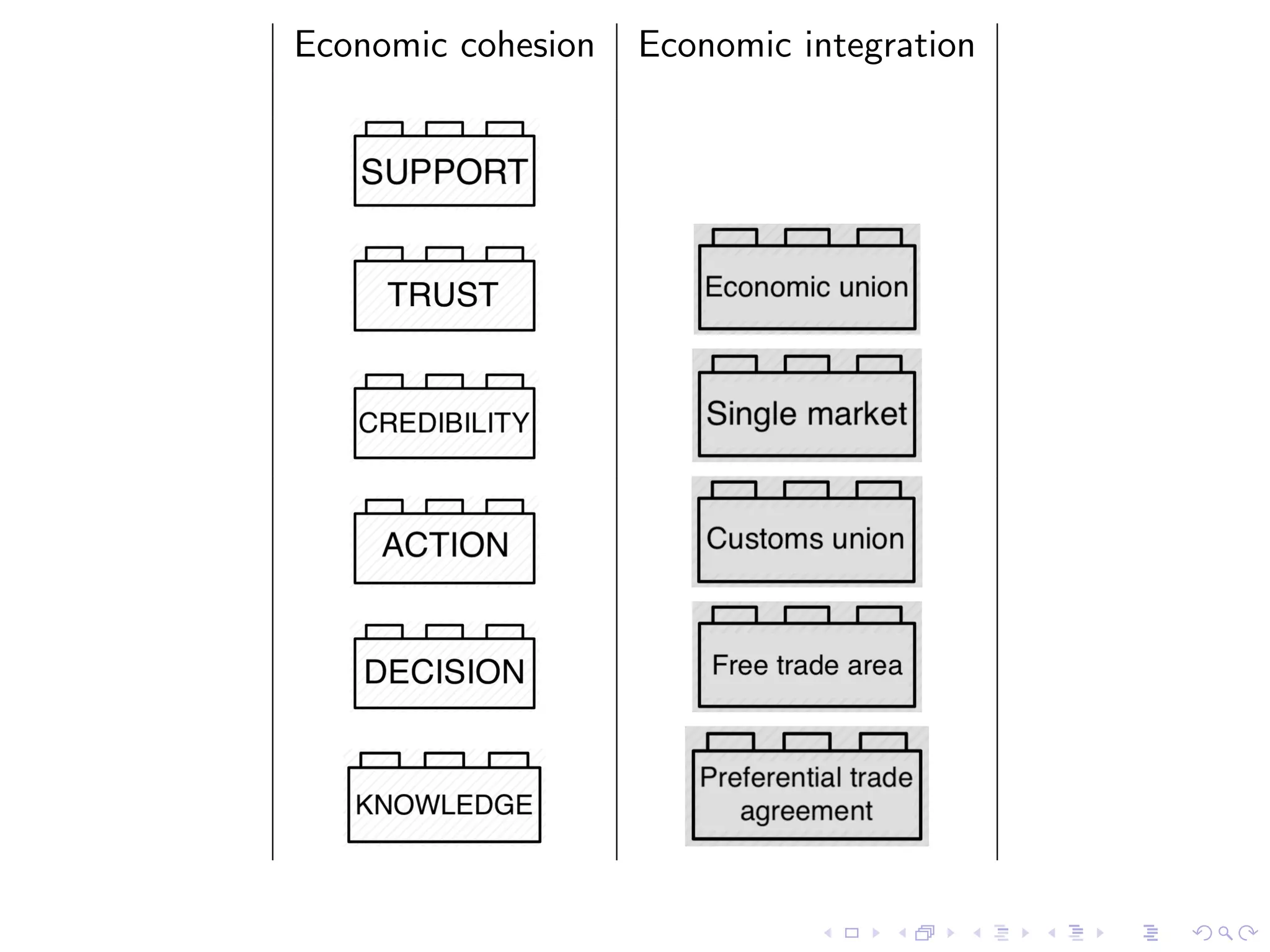
Economic cohesion
Economic cohesion Economic integration
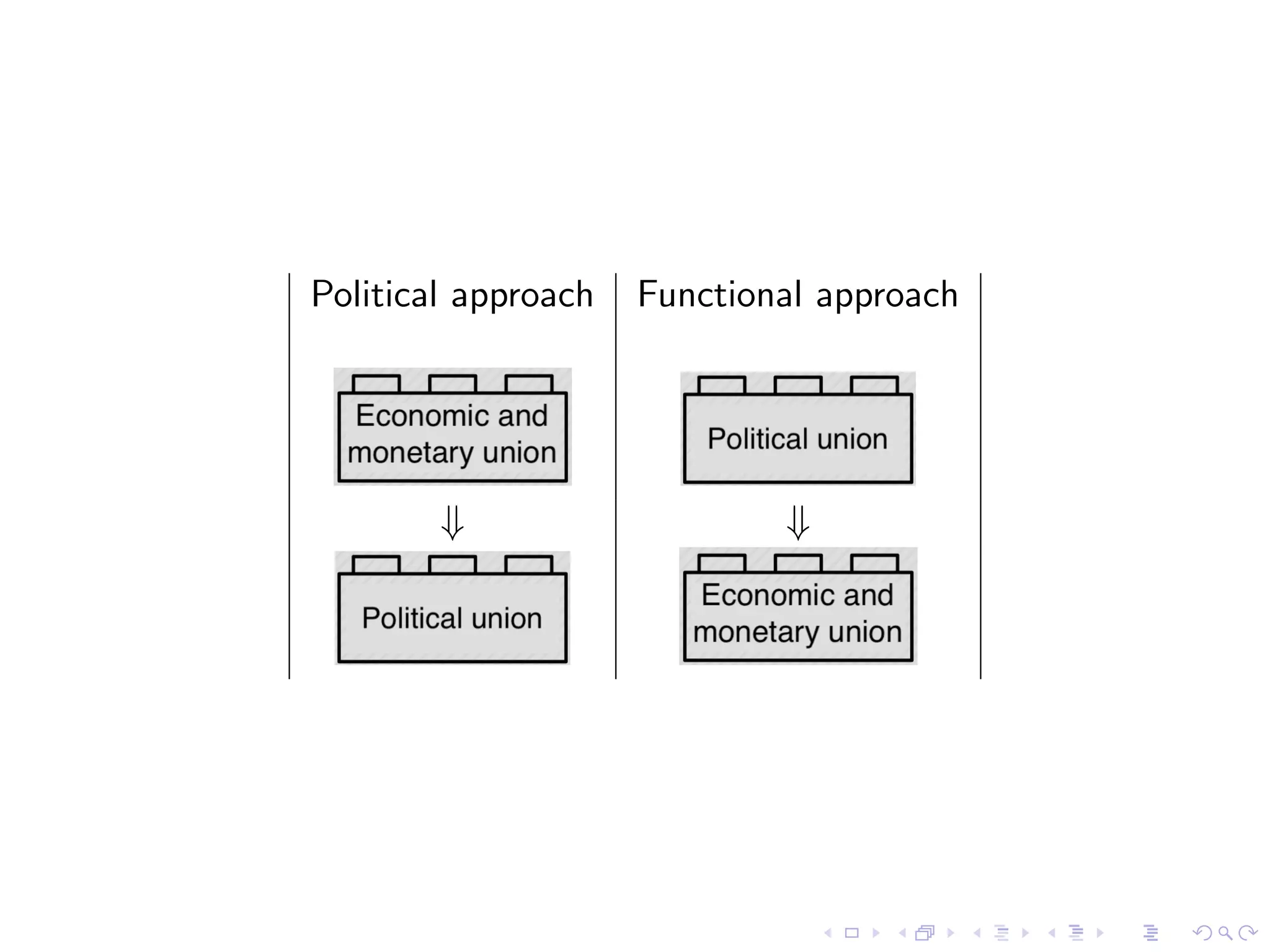
Political approach Functional approach
⇓ ⇓
The general idea of economic cohesion:
a) A helps B and asks for nothing in return, either directly or
indirectly
b) A helps B and asks for something in return, either directly or
indirectly
c) all other options in between a) and b)
A practical example:
• Road security project in country A, which enjoys no financing,
no hardware or software capabilities
• Country B lends the resources to Country A for the realization
of the project
• Country B produces both the hardware and software, and sells
it country A
=⇒ Economic cohesion between A and B?
Economic cohesion?
• self-interest as the main motive for preferences
=⇒ ‘rational’ decision making at the individual level
=⇒ ‘market drive’. . .
• other motives for individual preferences, e.g.:
=⇒ role of social/group preferences
=⇒ role of psychological factors
Fiscal austerity:
• multi-year public deficit reduction
• fiscal consolidation over the business cycle
• reduction of ‘structural’ or ‘cyclically-adjusted’ deficit
=⇒ rule-based fiscal austerity in the EU
The EU fiscal policy framework:
• Articles 121 and 126 of the Treaty on the Functioning of the
European Union (Maastricth Treaty) provided for fiscal
monitoring in 1992.
• Procedures were further clarified in the Stability and Growth
Pact (SGP) of 1997.
• Subsequent modifications took place in 2005, 2011 and 2013.
The key overall point of the EU fiscal framework:
• In April, national governments present 3-year ‘stability’ /
‘convergence’ programmes.
• If the planned or actual budget deficit exceeds 3% of GDP,
the European Commission prepares a report in which it
examines whether the transgression deviation from target
declines, and whether it is small, exceptional and temporary.
• If the EC considers that an excessive deficit exists or may
occur, it addresses an opinion to the ECOFIN Council
• All relevant factors are considered, including the medium-term
economic and budgetary position of the member state.
• The ECOFIN Council votes on whether a deficit is indeed
‘excessive’.
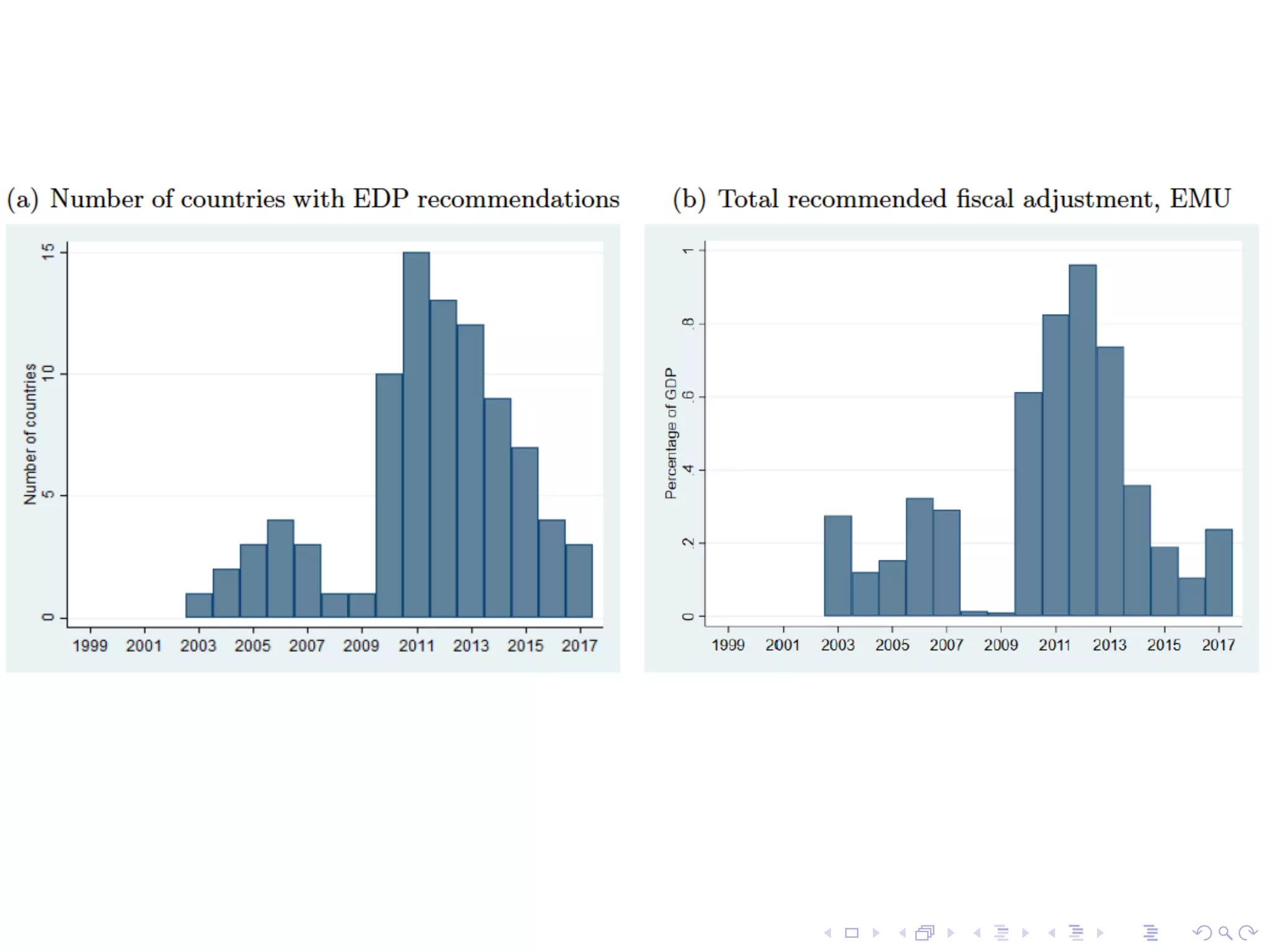
The Excessive Deficit Procedure:
• Corrective actions to excessive deficits are spelled out in EDP
recommendations.
• These are usually quantified as changes in the structural
budget balance within clear deadlines.
• In case countries do not follow the recommendations, they can
be sanctioned.
• EMU member states can be required to make a non-interest
bearing deposit consisting of a fixed component of 0.2% of
GDP and a variable component equal to a tenth of the
difference between the deficit and the 3% threshold (with a
combined maximum of 0.5% of GDP).
• In case of persistent non-compliance, the deposit will be
converted into a fine.
• For non-EMU member states, a temporary suspension of
assistance from the Cohesion Fund can be contemplated.
Revisions to the EU fiscal policy framework:
• In 2005 the Pact was changed to enhance the economic
rationale underlying the fiscal rules:
• Introduction of a ‘Debt Sustainability Monitor’ report (twice a
year) with a detailed government debt sustainability exercise.
• In 2011, the debt criterion was operationalized and voting
rules on sanctions were changed:
• Countries with debts exceeding 60% of GDP should reduce
their debts by 1/20th of the excess over 60% of GDP each
year.
• In 2013 the ‘Two-Pack’ and the Treaty on Stability,
Coordination and Governance entered into force:
• Countries should establish independent fiscal councils at the
national level.
• Countries should use macroeconomic forecasts produced or
endorsed by an independent body.
Summing up:
• The importance of the EDP procedure
• The centrality of the 3%- threshold for government deficits
• Role of the cyclically-adjusted balance at the center of the
analysis.
• Role of macroeconomic forecasts in assessing a country’s
fiscal position.
=⇒ In the technical exercises, long-term forecasts are
independent from short-term forecasts.
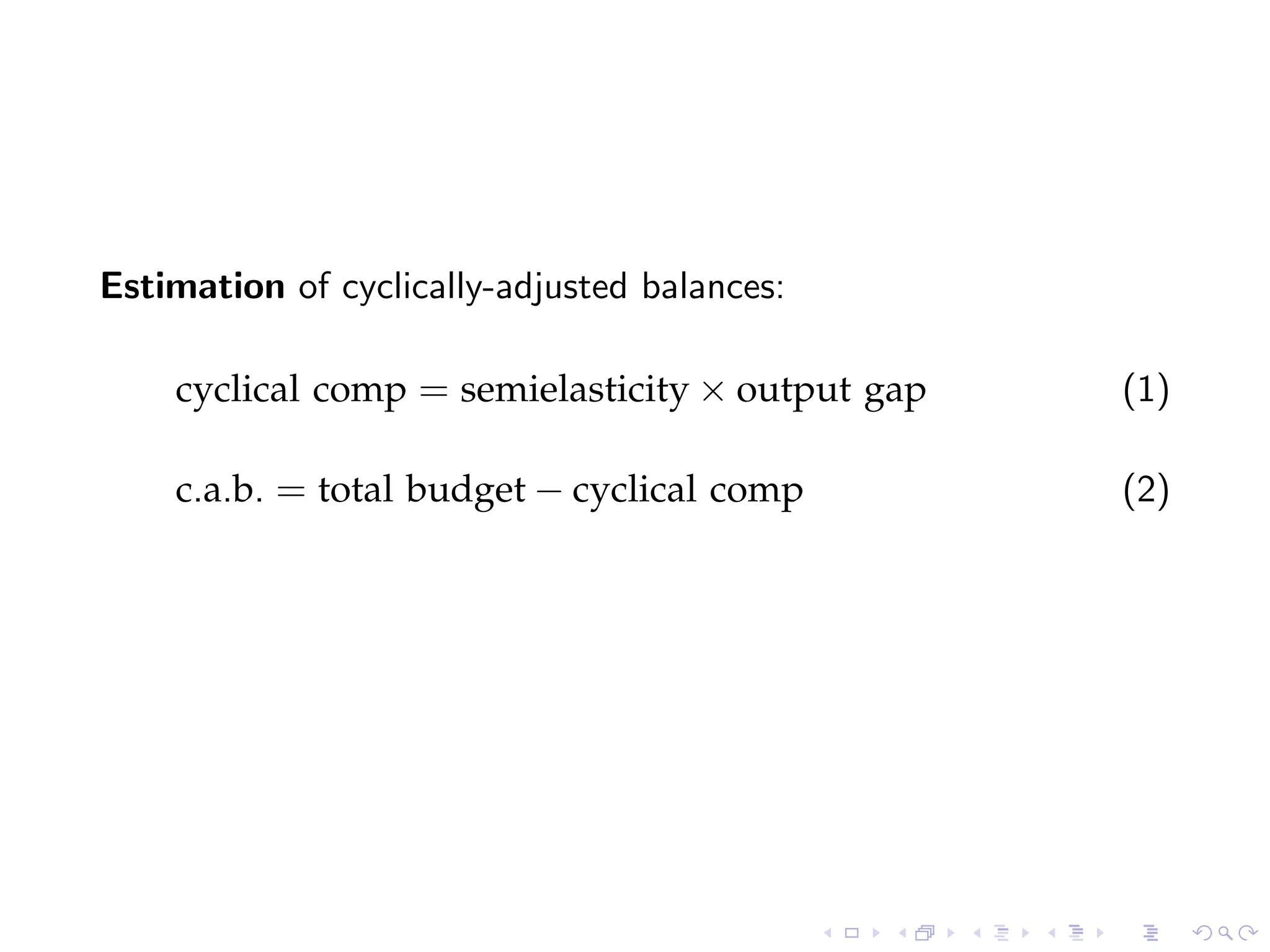
Estimation of cyclically-adjusted balances:
cyclical comp = semielasticity × output gap (1)
c.a.b. = total budget − cyclical comp (2)
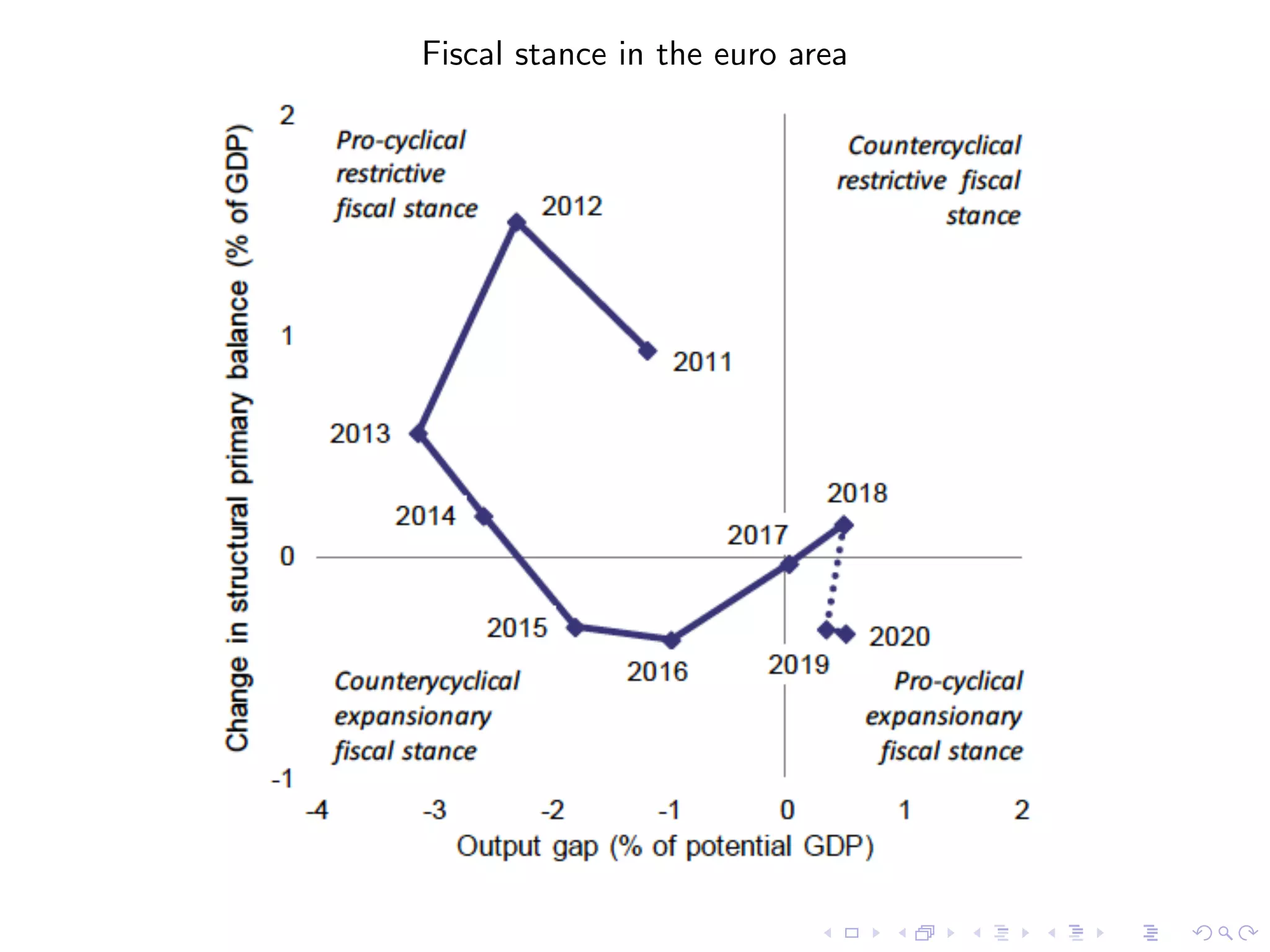
Fiscal stance in the euro area
Drivers of changes to government balances in the Euro area
Contribution to fiscal stance in the Euro area
“If, even with the threat of non-participation, a member state is
neither willing nor able to observe the limits for budget deficits
and indebtedness, it is hardly likely that it will make increased
efforts when such a strict sanction is no longer available.”
What economic case for the ‘Excessive Deficit Procedure’?
• counterbalancing macroeconomic incentives towards
over-borrowing
* Masson and Melitz (1991), Artis and Winkler (1997),
Pisani-Ferry (1996)
• limiting the ‘political bias’ towards public deficit
* Roubini and Sachs (1989), Corsetti and Roubini (1993)
• achieving coordination between fiscal and monetary policy
* Von Hagen et al. (1993), Artis and Winkler (1997), Mongelli
(1996)
• preventing banking system crises with union-wide effects
* Giovannini and Spaventa (1991), Lemmen (1998)
Financial-market discipline hypothesis (Lane, 1993):
• capital markets must be free and open
• information about the borrower’s position must be readily
available
• no bailout is allowed
• the borrower must respond to market signals
• the financial system must be strong enough to sustain the
costs of a default
“It’s just money; it’s made up. Pieces of paper with pictures on
it so we don’t have to kill each other just to get something to
eat. It’s not wrong. And it’s certainly no different today than
its ever been. 1637, 1797, 1819, 37, 57, 84, 1901, 07, 29, 1937,
1974, 1987 - Jesus, didn’t that f***** f*** me up good - 92,
97, 2000 and whatever we want to call this. It’s all just the
same thing over and over; we can’t help ourselves.”
John Tuld, Margin Call
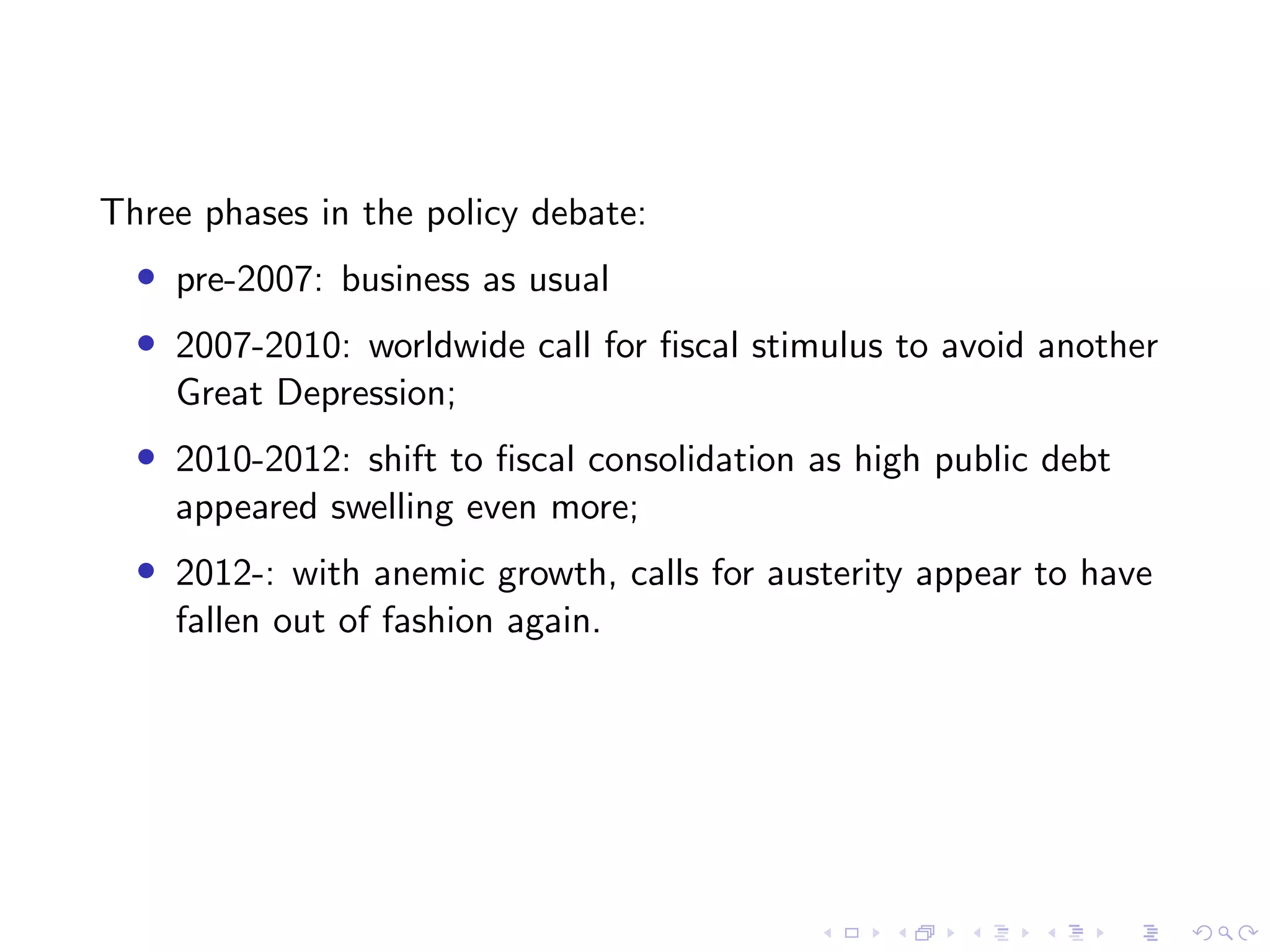
Three phases in the policy debate:
• pre-2007: business as usual
• 2007-2010: worldwide call for fiscal stimulus to avoid another
Great Depression;
• 2010-2012: shift to fiscal consolidation as high public debt
appeared swelling even more;
• 2012-: with anemic growth, calls for austerity appear to have
fallen out of fashion again.
• Non-Keynesian effects of deficit reductions / ‘Expansionary’
fiscal contraction hypothesis
=⇒ Expectations about fiscal policy
=⇒ German view of fiscal consolidation
=⇒ Role of the composition and timing
• Fiscal multipliers:
• are larger during recessions than during expansions
• are contingent on various factors
• exchange rate regime
• monetary policy
• trade linkages
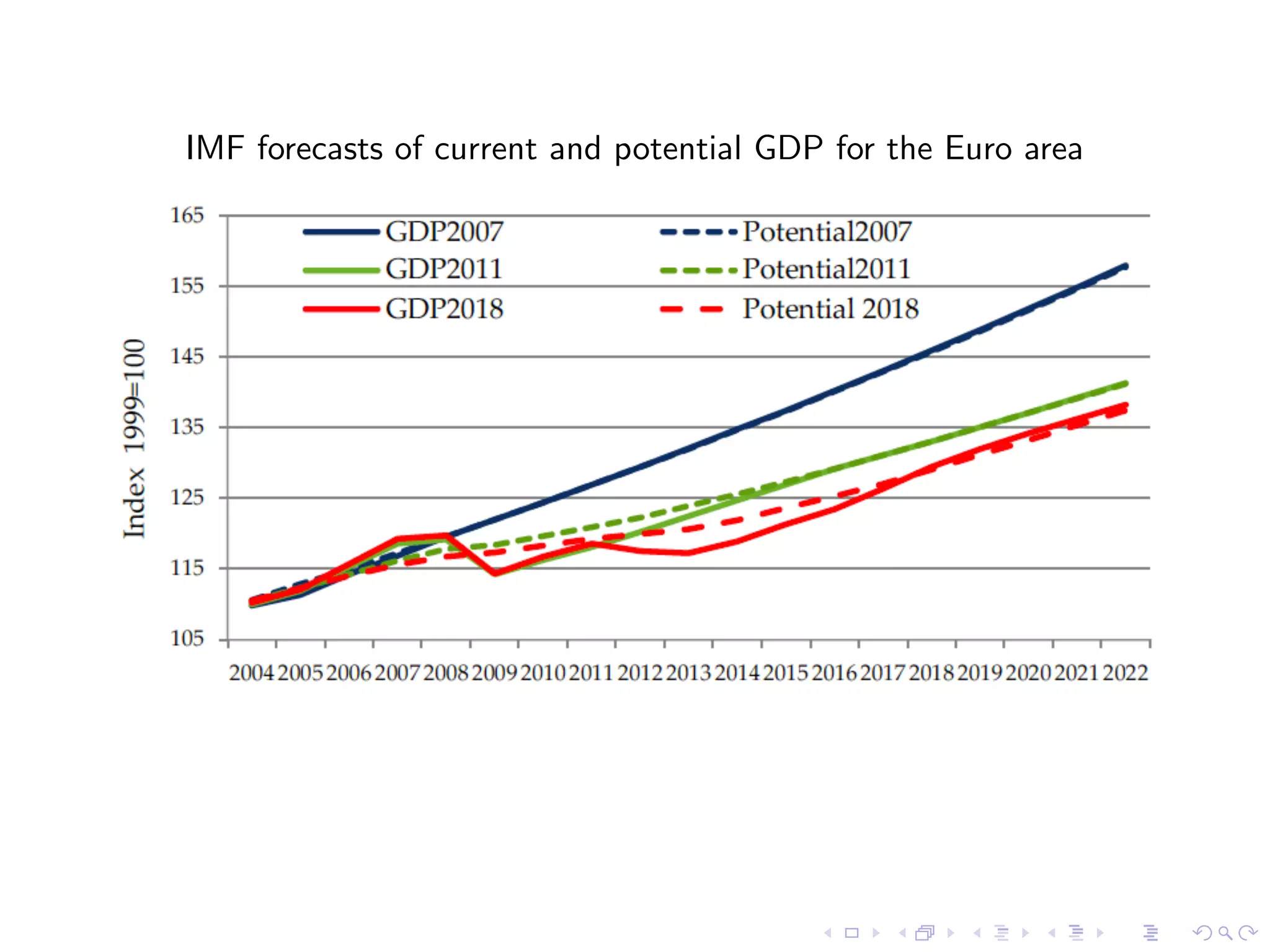
IMF forecasts of current and potential GDP for the Euro area
bt
yt
=
bt−1
yt−1 + ∆yt
stock
+
pdt + rtbt−1
yt−1 + ∆yt
flow
(3)
∆yt = yt − yt−1 (4)
yt = ¯yt
permanent
+ ˜yt
cyclical
(5)
• When designing fiscal policy from an intertemporal
perspective, governments take into consideration forecasts of
both potential output and the output gap.
• If either cyclical or one-off events lead to reductions of
long-term projections of GDP, more contractionary fiscal
policy may be warranted to achieve a public deficit target
today.
=⇒ If multipliers are large, additional fiscal tightening is needed to
reduce a government deficit during a downturn
=⇒ The initial cyclical drop of GDP becomes sustained
=⇒ Drop in cyclical GDP can become drop in permanent GDP
=⇒ Pro-cyclical fiscal policy becomes persistent
=⇒ Policy-induced hysteresis
Propagation channel: pessimism in macroeconomic projections in
setting fiscal policy:
• Fiscal policy can have a negative impact on output over a
long horizon.
• Both the cyclical and permanent part of output can be
affected by fiscal policy today over a long horizon.
‘Fiscal policy doom’ hypothesis (Fatas, 2018):
• What if potential output changes after a cyclical downswing?
• Should macroeconomic hysteresis be taken into account?
• Should second-round effects induced by fiscal policy
expectations be taken into account?
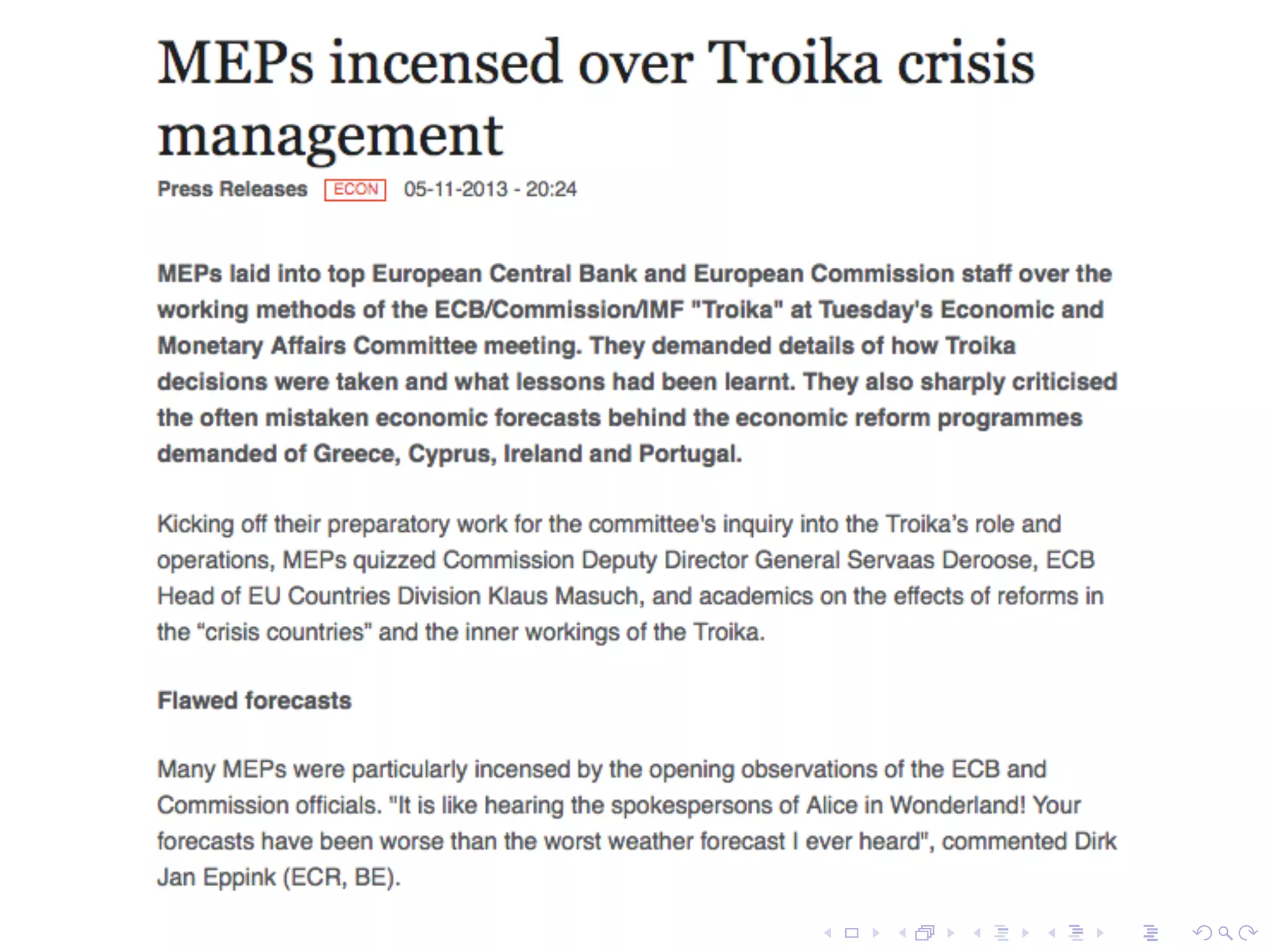
Forecast Errors for Real GDP
Key take-away points:
a) economic policy mistakes can be very costly
a.1) self-inflicted economic pain can last in time
b) think about what ‘economic cohesion’ truly means. . .
c) ‘cycles’ of economic ideas can be fairly disconnected from
‘cycles’ of policy decisions
d) economic policy requires clarity on the final objectives
THANK YOU!
Any questions?
Email me at: paolo.zagaglia@unibo.it
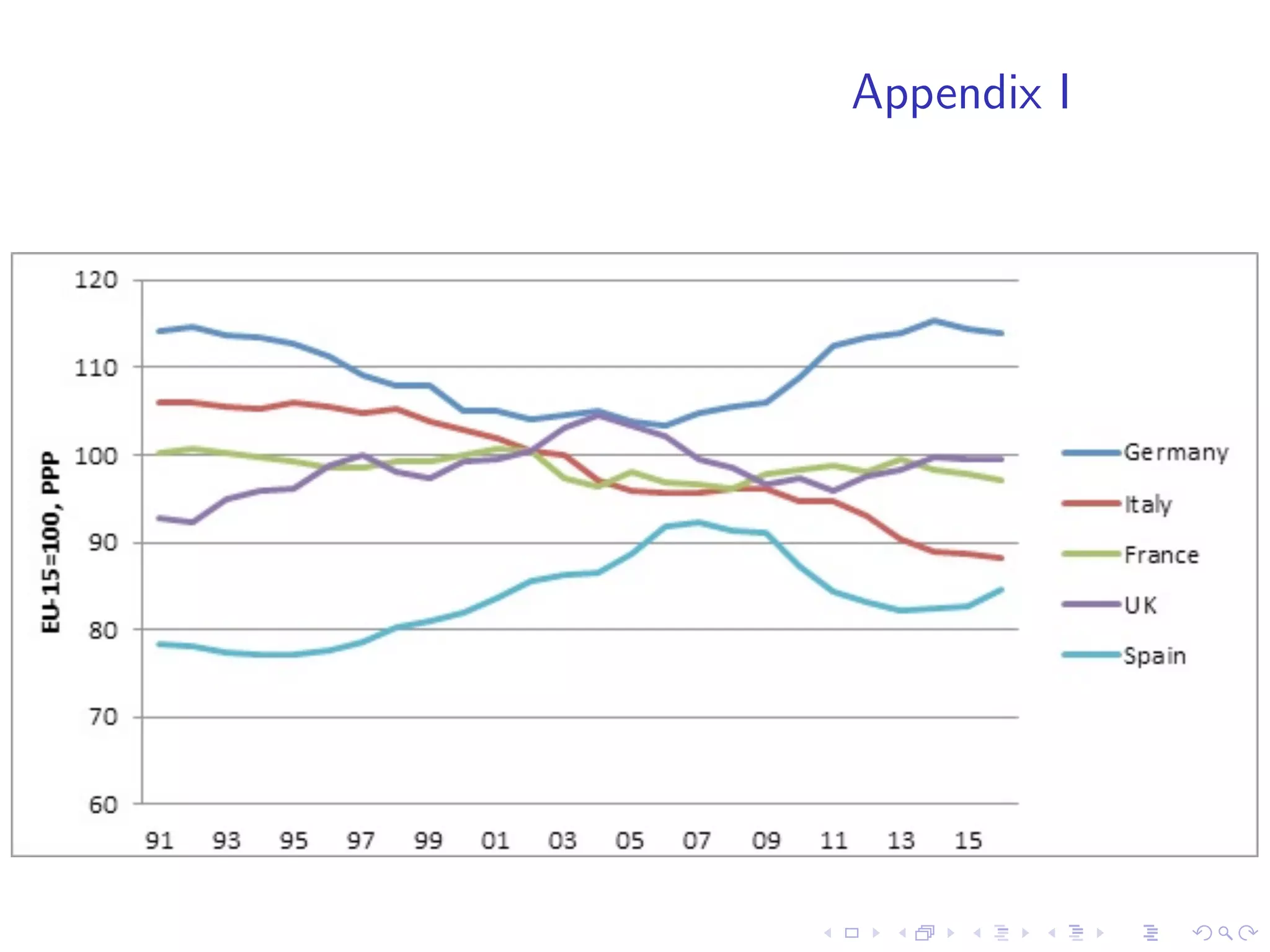
Appendix I
Appendix II
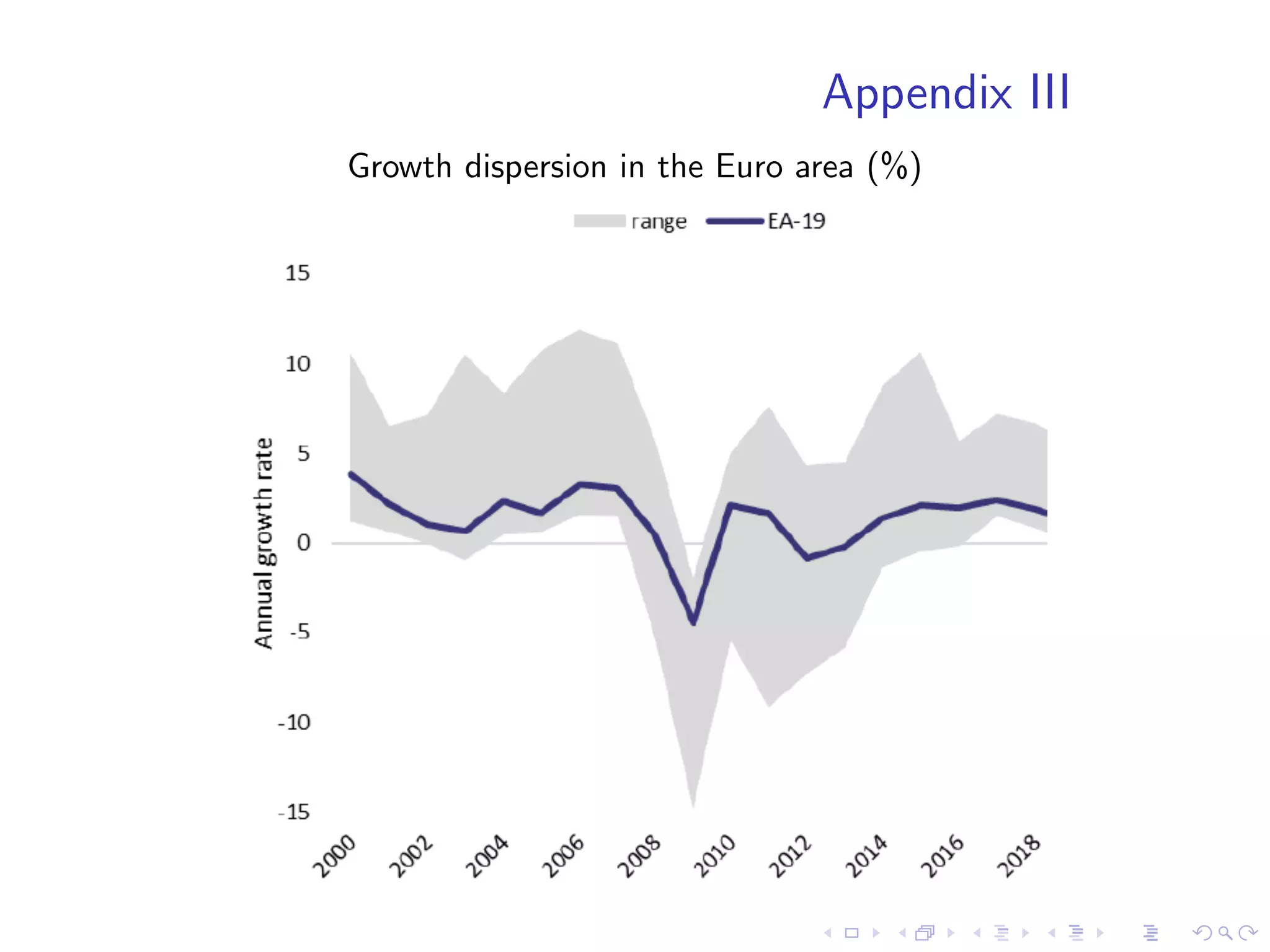
Appendix III
Growth dispersion in the Euro area (%)
Appendix IV
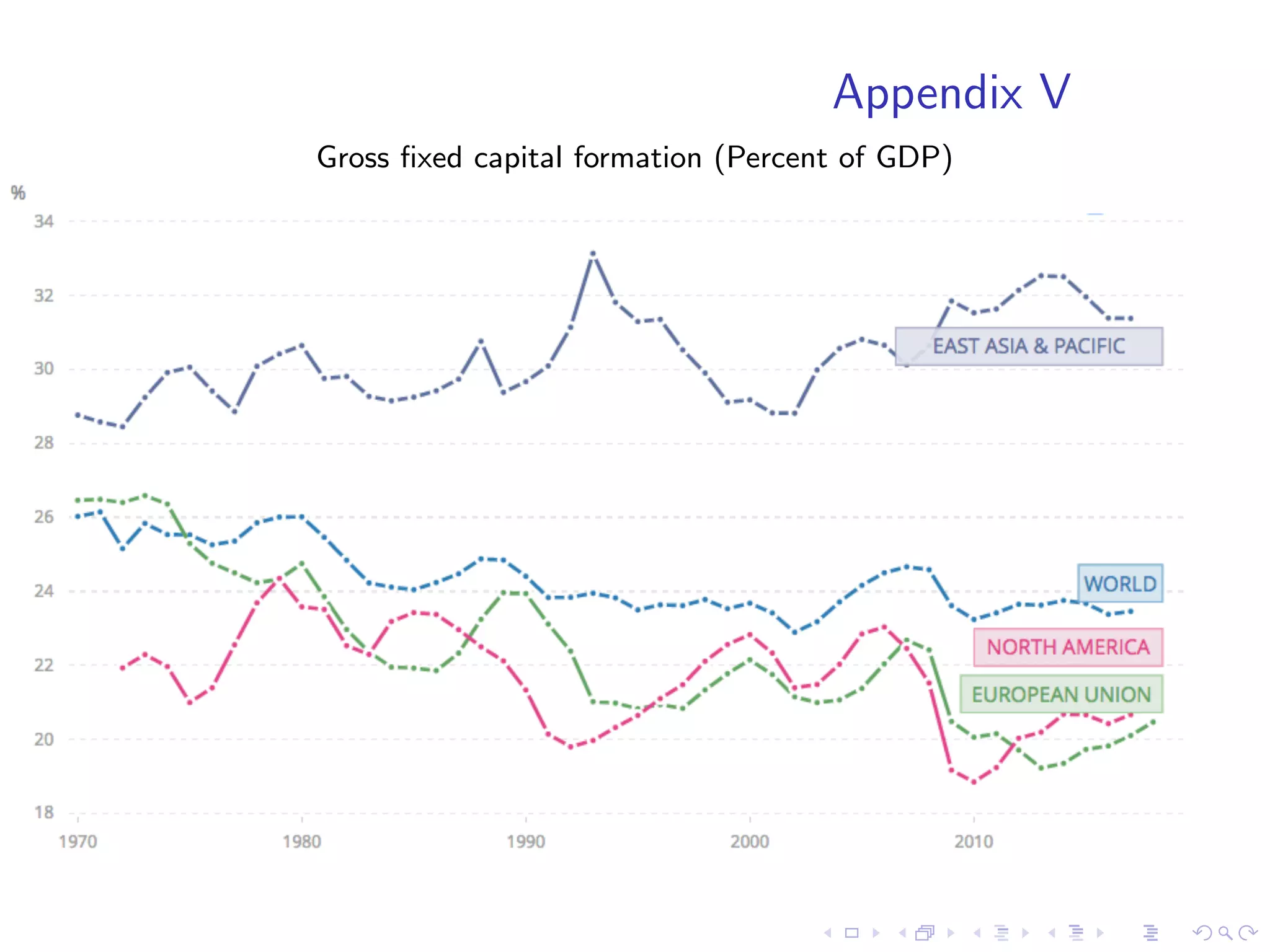
Appendix V
Gross fixed capital formation (Percent of GDP)
Appendix VI
Net Gini coefficient (after taxes and transfers), 1960-2015
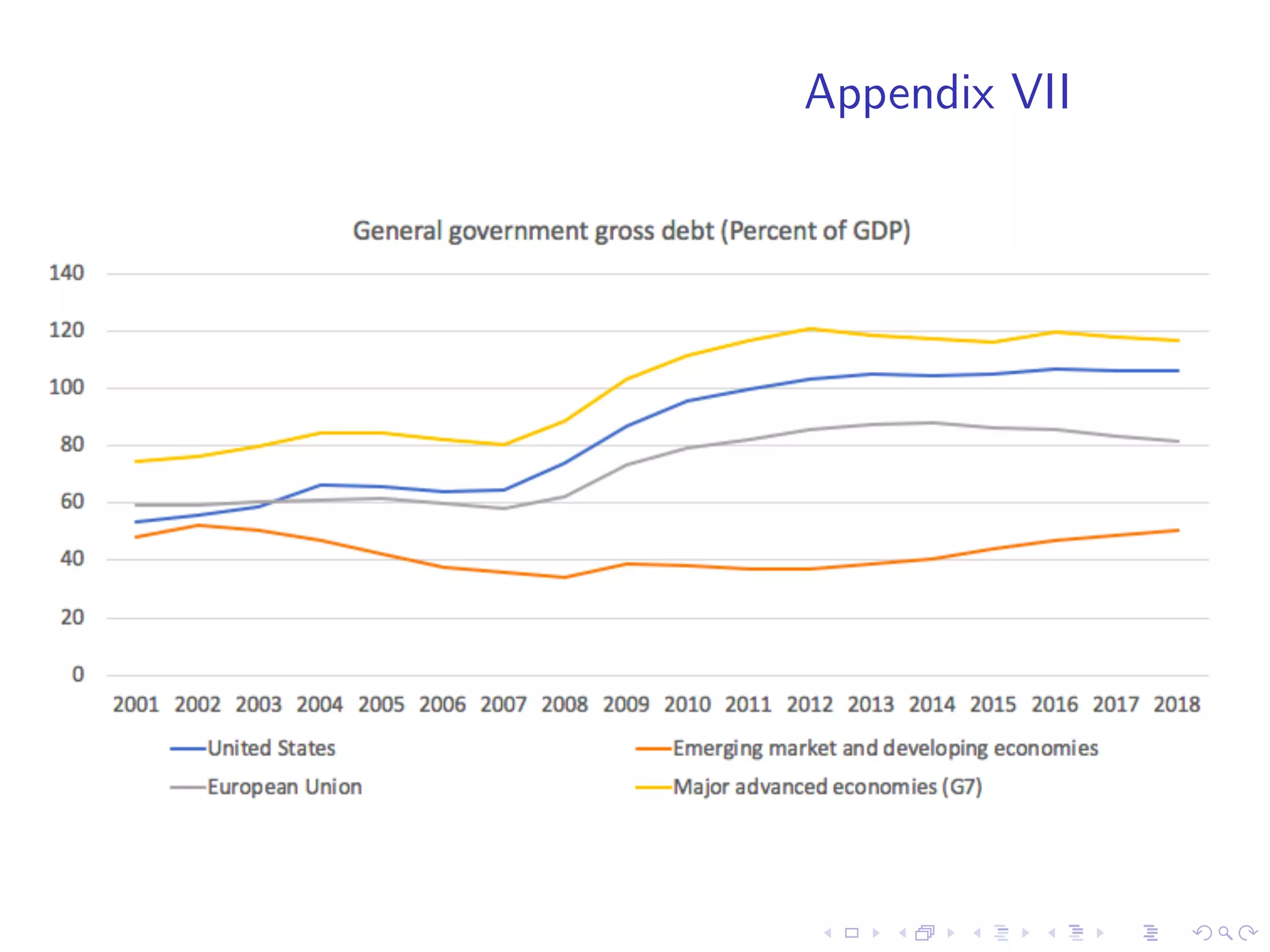
Appendix VII
Appendix VIII
GDP per capita growth (% yearly growth, 2018)
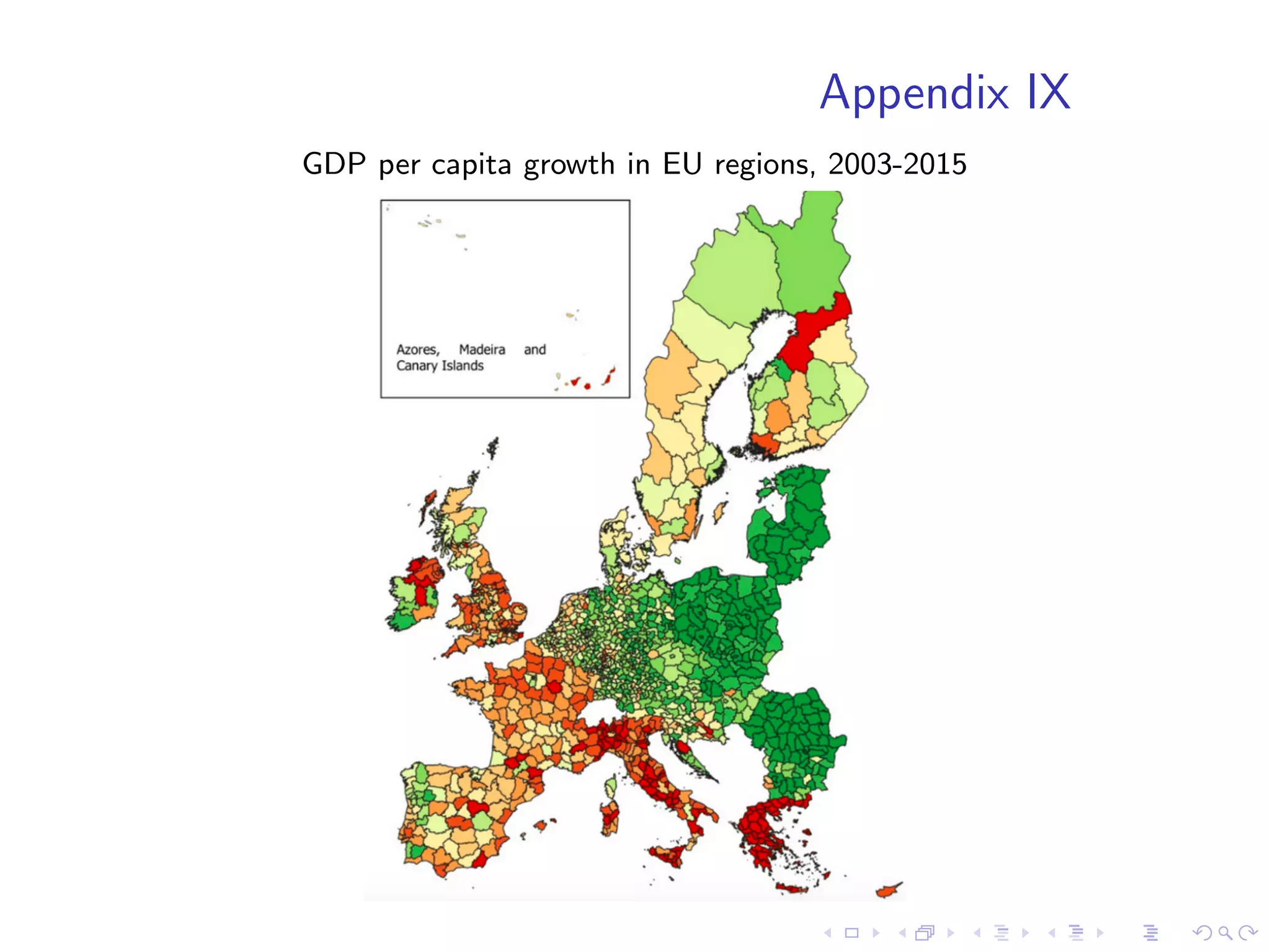
Appendix IX
GDP per capita growth in EU regions, 2003-2015

Cohesion, austerity and growth: A helicopter's view

  • 1.
    Cohesion, austerity andgrowth: A helicopter’s view Paolo Zagaglia Universit`a di Bologna September 4, 2019
  • 2.
    “Words matter verymuch, Miss Barnes. You should care more about them, given your profession.” Frank Underwood, House of Cards
  • 7.
  • 8.
  • 9.
  • 11.
    The general ideaof economic cohesion: a) A helps B and asks for nothing in return, either directly or indirectly b) A helps B and asks for something in return, either directly or indirectly c) all other options in between a) and b)
  • 12.
    A practical example: •Road security project in country A, which enjoys no financing, no hardware or software capabilities • Country B lends the resources to Country A for the realization of the project • Country B produces both the hardware and software, and sells it country A =⇒ Economic cohesion between A and B?
  • 13.
    Economic cohesion? • self-interestas the main motive for preferences =⇒ ‘rational’ decision making at the individual level =⇒ ‘market drive’. . . • other motives for individual preferences, e.g.: =⇒ role of social/group preferences =⇒ role of psychological factors
  • 15.
    Fiscal austerity: • multi-yearpublic deficit reduction • fiscal consolidation over the business cycle • reduction of ‘structural’ or ‘cyclically-adjusted’ deficit =⇒ rule-based fiscal austerity in the EU
  • 16.
    The EU fiscalpolicy framework: • Articles 121 and 126 of the Treaty on the Functioning of the European Union (Maastricth Treaty) provided for fiscal monitoring in 1992. • Procedures were further clarified in the Stability and Growth Pact (SGP) of 1997. • Subsequent modifications took place in 2005, 2011 and 2013.
  • 17.
    The key overallpoint of the EU fiscal framework: • In April, national governments present 3-year ‘stability’ / ‘convergence’ programmes. • If the planned or actual budget deficit exceeds 3% of GDP, the European Commission prepares a report in which it examines whether the transgression deviation from target declines, and whether it is small, exceptional and temporary. • If the EC considers that an excessive deficit exists or may occur, it addresses an opinion to the ECOFIN Council • All relevant factors are considered, including the medium-term economic and budgetary position of the member state. • The ECOFIN Council votes on whether a deficit is indeed ‘excessive’.
  • 19.
    The Excessive DeficitProcedure: • Corrective actions to excessive deficits are spelled out in EDP recommendations. • These are usually quantified as changes in the structural budget balance within clear deadlines. • In case countries do not follow the recommendations, they can be sanctioned. • EMU member states can be required to make a non-interest bearing deposit consisting of a fixed component of 0.2% of GDP and a variable component equal to a tenth of the difference between the deficit and the 3% threshold (with a combined maximum of 0.5% of GDP). • In case of persistent non-compliance, the deposit will be converted into a fine. • For non-EMU member states, a temporary suspension of assistance from the Cohesion Fund can be contemplated.
  • 20.
    Revisions to theEU fiscal policy framework: • In 2005 the Pact was changed to enhance the economic rationale underlying the fiscal rules: • Introduction of a ‘Debt Sustainability Monitor’ report (twice a year) with a detailed government debt sustainability exercise. • In 2011, the debt criterion was operationalized and voting rules on sanctions were changed: • Countries with debts exceeding 60% of GDP should reduce their debts by 1/20th of the excess over 60% of GDP each year. • In 2013 the ‘Two-Pack’ and the Treaty on Stability, Coordination and Governance entered into force: • Countries should establish independent fiscal councils at the national level. • Countries should use macroeconomic forecasts produced or endorsed by an independent body.
  • 21.
    Summing up: • Theimportance of the EDP procedure • The centrality of the 3%- threshold for government deficits • Role of the cyclically-adjusted balance at the center of the analysis. • Role of macroeconomic forecasts in assessing a country’s fiscal position. =⇒ In the technical exercises, long-term forecasts are independent from short-term forecasts.
  • 22.
    Estimation of cyclically-adjustedbalances: cyclical comp = semielasticity × output gap (1) c.a.b. = total budget − cyclical comp (2)
  • 24.
    Fiscal stance inthe euro area
  • 25.
    Drivers of changesto government balances in the Euro area
  • 26.
    Contribution to fiscalstance in the Euro area
  • 27.
    “If, even withthe threat of non-participation, a member state is neither willing nor able to observe the limits for budget deficits and indebtedness, it is hardly likely that it will make increased efforts when such a strict sanction is no longer available.”
  • 28.
    What economic casefor the ‘Excessive Deficit Procedure’? • counterbalancing macroeconomic incentives towards over-borrowing * Masson and Melitz (1991), Artis and Winkler (1997), Pisani-Ferry (1996) • limiting the ‘political bias’ towards public deficit * Roubini and Sachs (1989), Corsetti and Roubini (1993) • achieving coordination between fiscal and monetary policy * Von Hagen et al. (1993), Artis and Winkler (1997), Mongelli (1996) • preventing banking system crises with union-wide effects * Giovannini and Spaventa (1991), Lemmen (1998)
  • 29.
    Financial-market discipline hypothesis(Lane, 1993): • capital markets must be free and open • information about the borrower’s position must be readily available • no bailout is allowed • the borrower must respond to market signals • the financial system must be strong enough to sustain the costs of a default
  • 31.
    “It’s just money;it’s made up. Pieces of paper with pictures on it so we don’t have to kill each other just to get something to eat. It’s not wrong. And it’s certainly no different today than its ever been. 1637, 1797, 1819, 37, 57, 84, 1901, 07, 29, 1937, 1974, 1987 - Jesus, didn’t that f***** f*** me up good - 92, 97, 2000 and whatever we want to call this. It’s all just the same thing over and over; we can’t help ourselves.” John Tuld, Margin Call
  • 33.
    Three phases inthe policy debate: • pre-2007: business as usual • 2007-2010: worldwide call for fiscal stimulus to avoid another Great Depression; • 2010-2012: shift to fiscal consolidation as high public debt appeared swelling even more; • 2012-: with anemic growth, calls for austerity appear to have fallen out of fashion again.
  • 36.
    • Non-Keynesian effectsof deficit reductions / ‘Expansionary’ fiscal contraction hypothesis =⇒ Expectations about fiscal policy =⇒ German view of fiscal consolidation =⇒ Role of the composition and timing • Fiscal multipliers: • are larger during recessions than during expansions • are contingent on various factors • exchange rate regime • monetary policy • trade linkages
  • 39.
    IMF forecasts ofcurrent and potential GDP for the Euro area
  • 40.
    bt yt = bt−1 yt−1 + ∆yt stock + pdt+ rtbt−1 yt−1 + ∆yt flow (3) ∆yt = yt − yt−1 (4) yt = ¯yt permanent + ˜yt cyclical (5)
  • 41.
    • When designingfiscal policy from an intertemporal perspective, governments take into consideration forecasts of both potential output and the output gap. • If either cyclical or one-off events lead to reductions of long-term projections of GDP, more contractionary fiscal policy may be warranted to achieve a public deficit target today. =⇒ If multipliers are large, additional fiscal tightening is needed to reduce a government deficit during a downturn =⇒ The initial cyclical drop of GDP becomes sustained =⇒ Drop in cyclical GDP can become drop in permanent GDP =⇒ Pro-cyclical fiscal policy becomes persistent =⇒ Policy-induced hysteresis
  • 42.
    Propagation channel: pessimismin macroeconomic projections in setting fiscal policy: • Fiscal policy can have a negative impact on output over a long horizon. • Both the cyclical and permanent part of output can be affected by fiscal policy today over a long horizon. ‘Fiscal policy doom’ hypothesis (Fatas, 2018): • What if potential output changes after a cyclical downswing? • Should macroeconomic hysteresis be taken into account? • Should second-round effects induced by fiscal policy expectations be taken into account?
  • 43.
  • 44.
    Key take-away points: a)economic policy mistakes can be very costly a.1) self-inflicted economic pain can last in time b) think about what ‘economic cohesion’ truly means. . . c) ‘cycles’ of economic ideas can be fairly disconnected from ‘cycles’ of policy decisions d) economic policy requires clarity on the final objectives
  • 45.
    THANK YOU! Any questions? Emailme at: paolo.zagaglia@unibo.it
  • 46.
  • 47.
  • 48.
    Appendix III Growth dispersionin the Euro area (%)
  • 49.
  • 50.
    Appendix V Gross fixedcapital formation (Percent of GDP)
  • 51.
    Appendix VI Net Ginicoefficient (after taxes and transfers), 1960-2015
  • 52.
  • 53.
    Appendix VIII GDP percapita growth (% yearly growth, 2018)
  • 54.
    Appendix IX GDP percapita growth in EU regions, 2003-2015